


logo elektroda
logo elektroda
X
logo elektroda

[BK7231N/CB2S] Ceiling Fan Controller with Dimmer and RF Remote

totallylost  2 1938 Cool? (+1)
📢 Listen (AI):

TL;DR

  • A ParrotUncle RE-028W ceiling fan remote and dimmer switch uses a BK7231N on a CB2S module and controls fan speed, timer, lighting, and direction.
  • OpenBeken runs it without manual pin configuration, using autoexec.bat to map TuyaMCU data points to channels and MQTT/Home Assistant entities.
  • The Tuya datapoints include 20 for lamp on/off, 22 for brightness, 60 for fan on/off, 62 for speed, 63 for direction, and 101 for countdown.
  • The flashed unit worked with OBK and produced an MQTT setup for Home Assistant, including separate light, fan, direction, and timer entities.
  • The board connects to load and neutral without ground, the first CB2S was fried during probing, and fan reverse plus temp_value 23 remained untested.
Generated by the language model.
Universal Smart Ceiling Fan Remote Control and Dimmer Light Switch
Functions: 3-Speed Ceiling Fan Remote, Off-timer, Dimming
buy: amazon.com

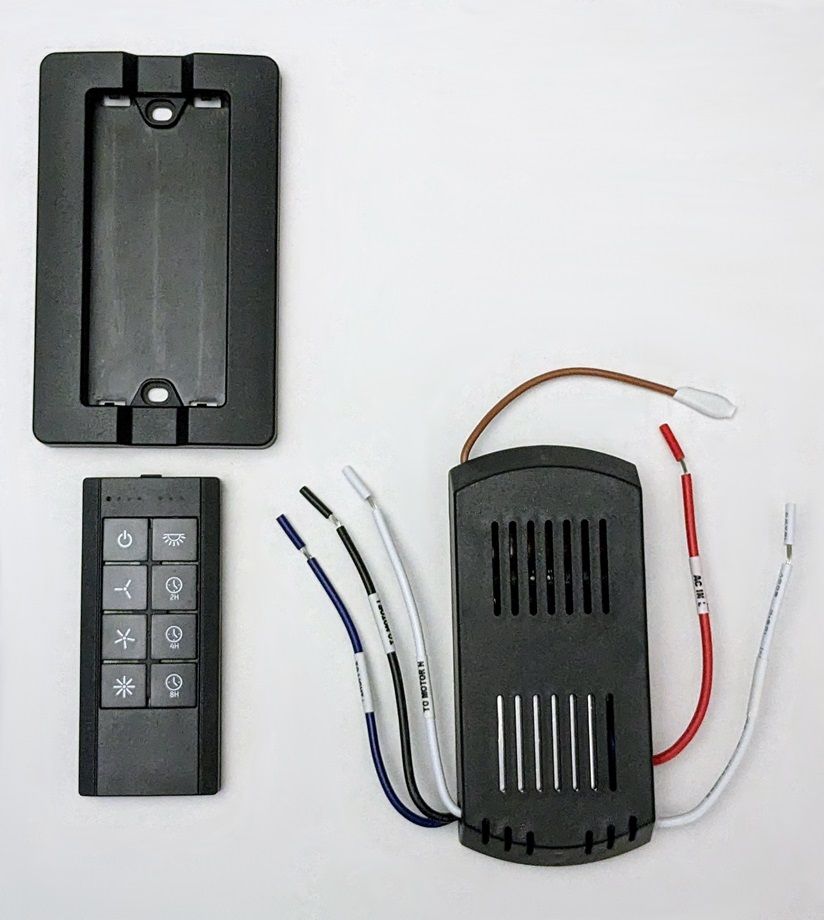
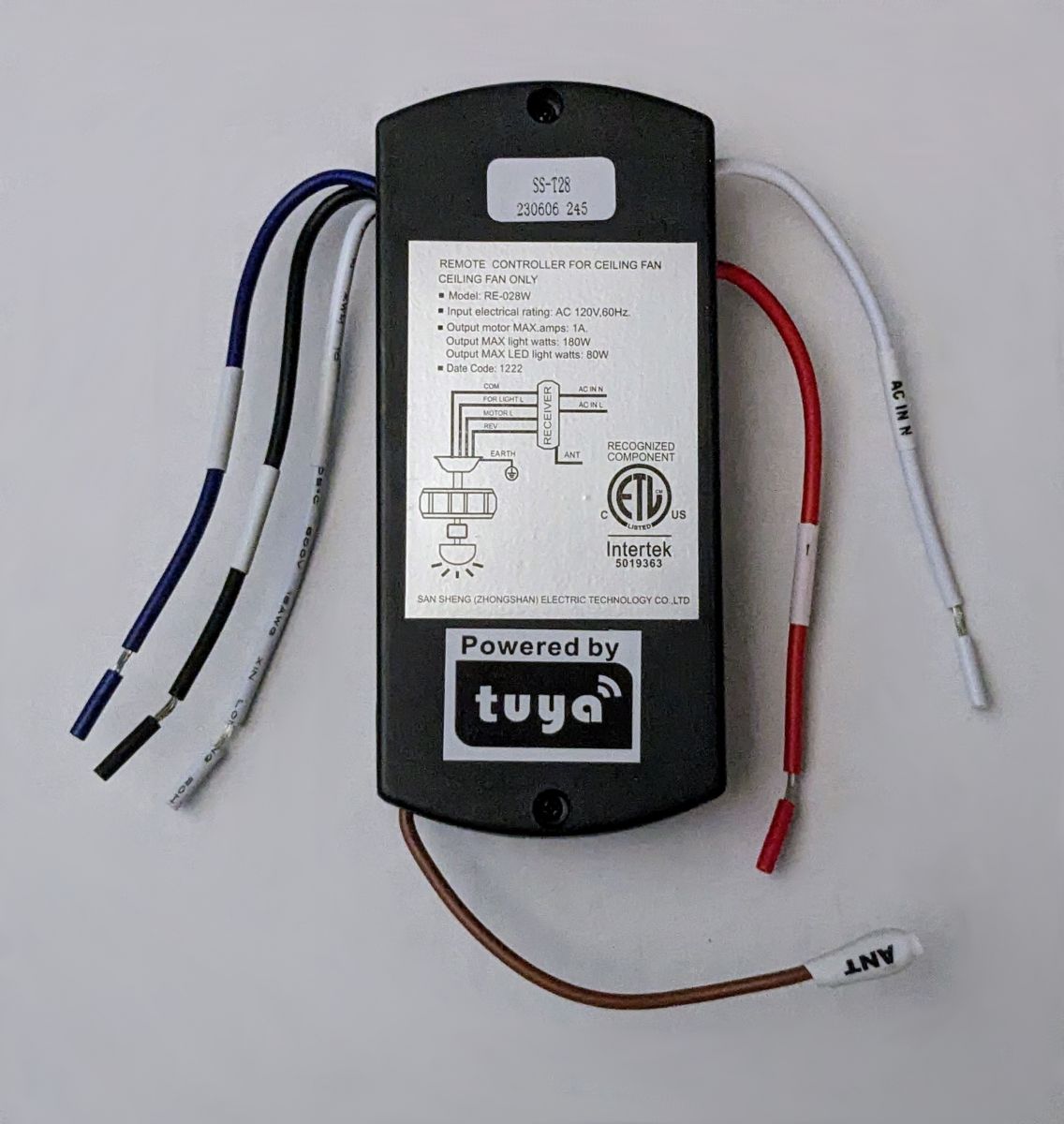
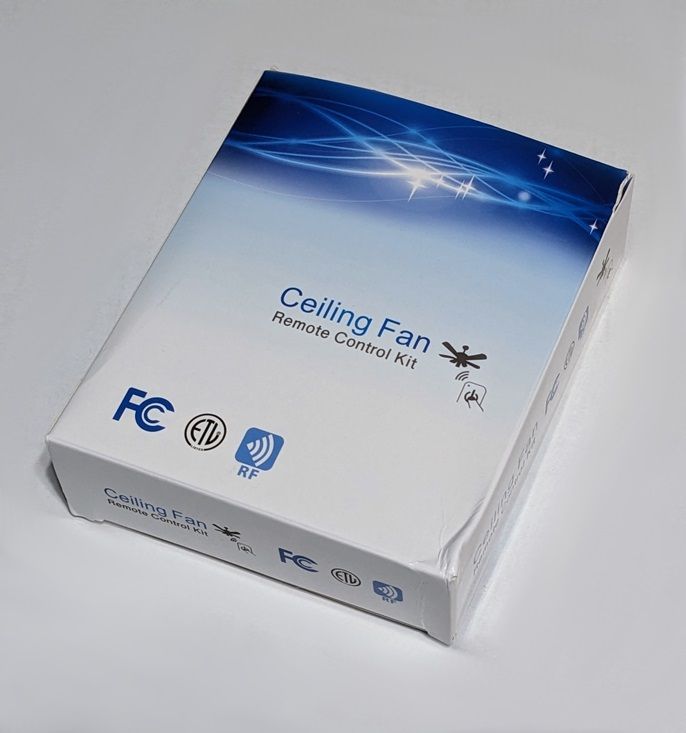
Universal smart ceiling fan remote control and light dimmer with wiring.Universal Smart Ceiling Fan Remote Control and Dimmer, model RE-028W. Ceiling fan remote control kit box with certification logos.


Quick Start:
-desolder, flash, reinstall
-No pins need configured, OpenBeken takes care of the TuyaTX/RX automagically.
-Place the 'autoexec.bat' on the device file-system and reboot.
-Grab the 'HA MQTT yaml' near the bottom of this post.


Manufacturer: San Sheng (Zhongshan), but it is branded [or unbranded] under various names.
Model: RE-028W
Chipset: CB2S
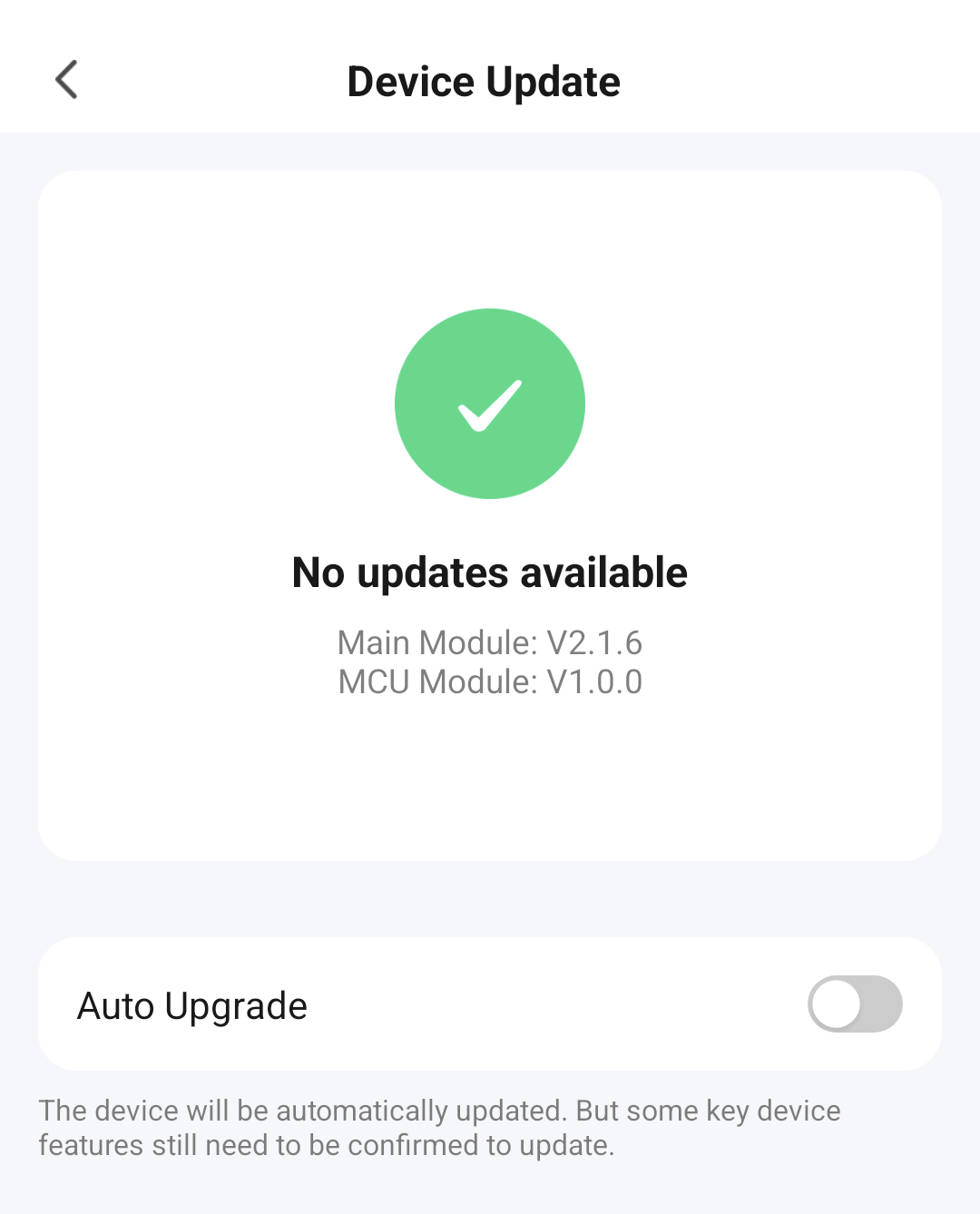
Module Firmware: V2.1.6
MCU Firmware: V1.0.0
Replacement: ESP8685-WROOM-03-H4
Notes: The unit connects electrically to load and neutral without a ground.


Primary distributors:
ParrotUncle (Subsidiary of Eileen Grays Network Technology)
Model: GA030
FEKOTS
Model: SS-T28

Potential FCC-ID: 2AX7R-RE021


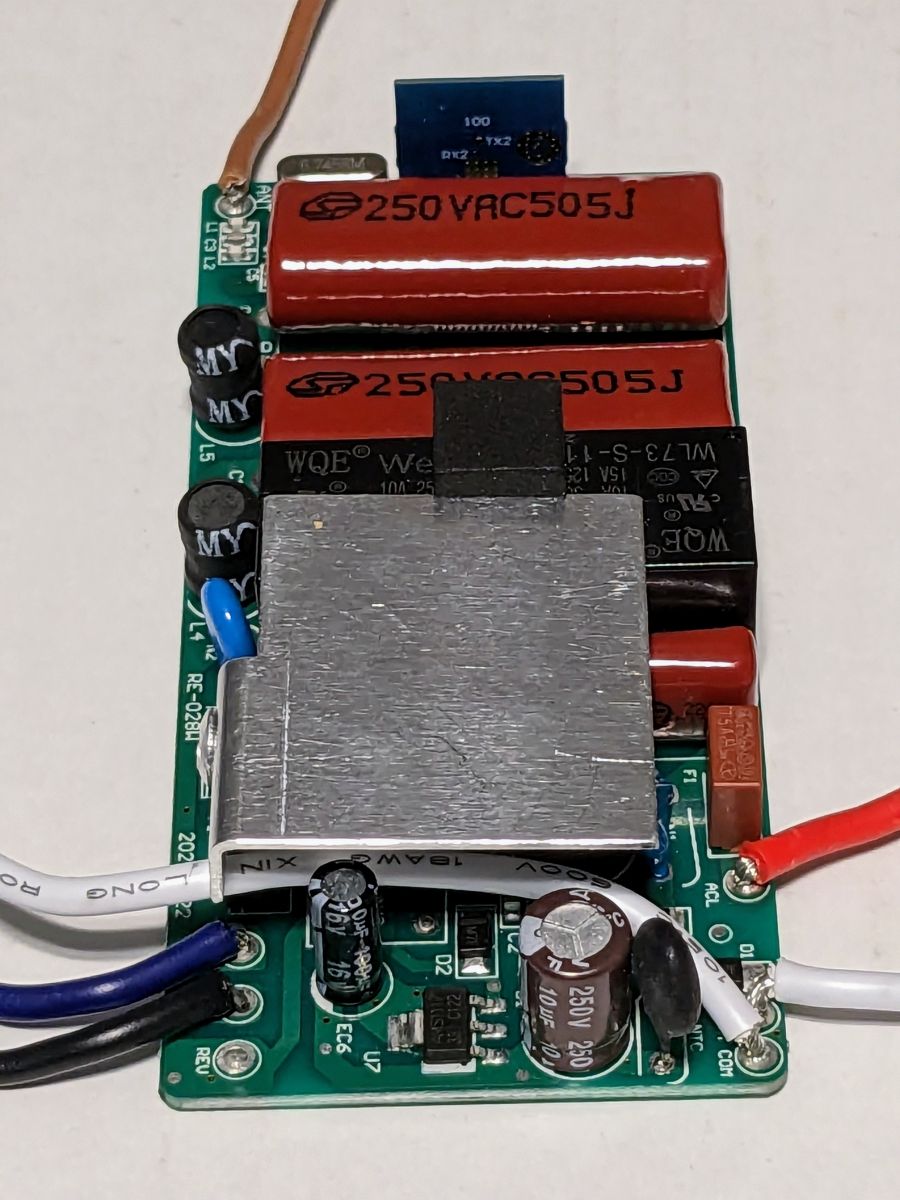
About the board
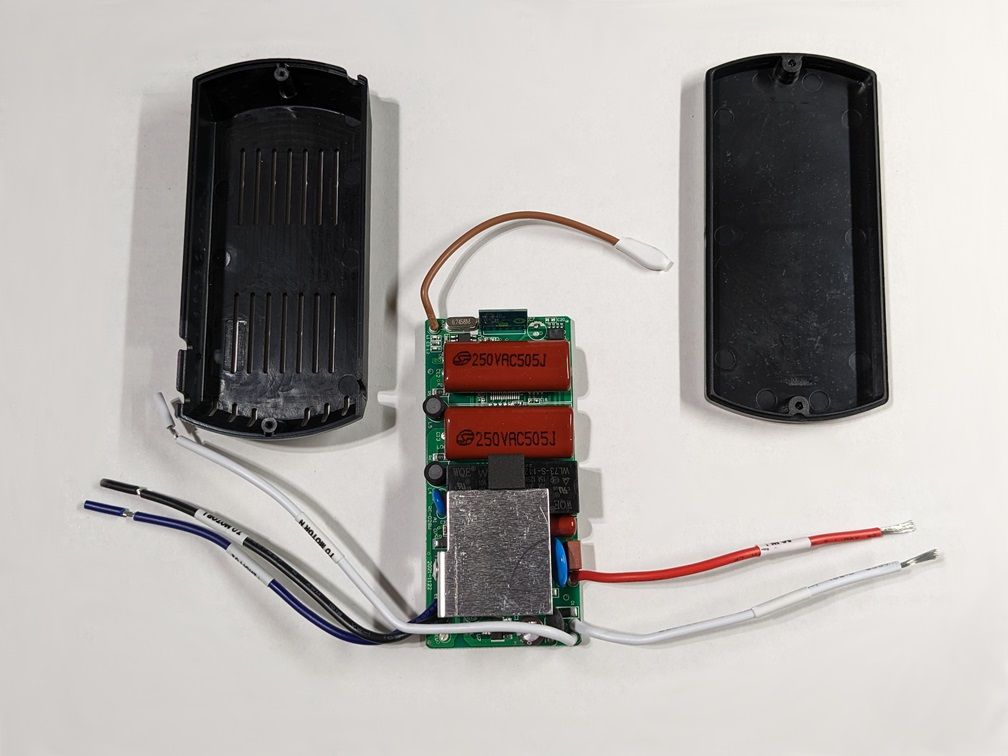
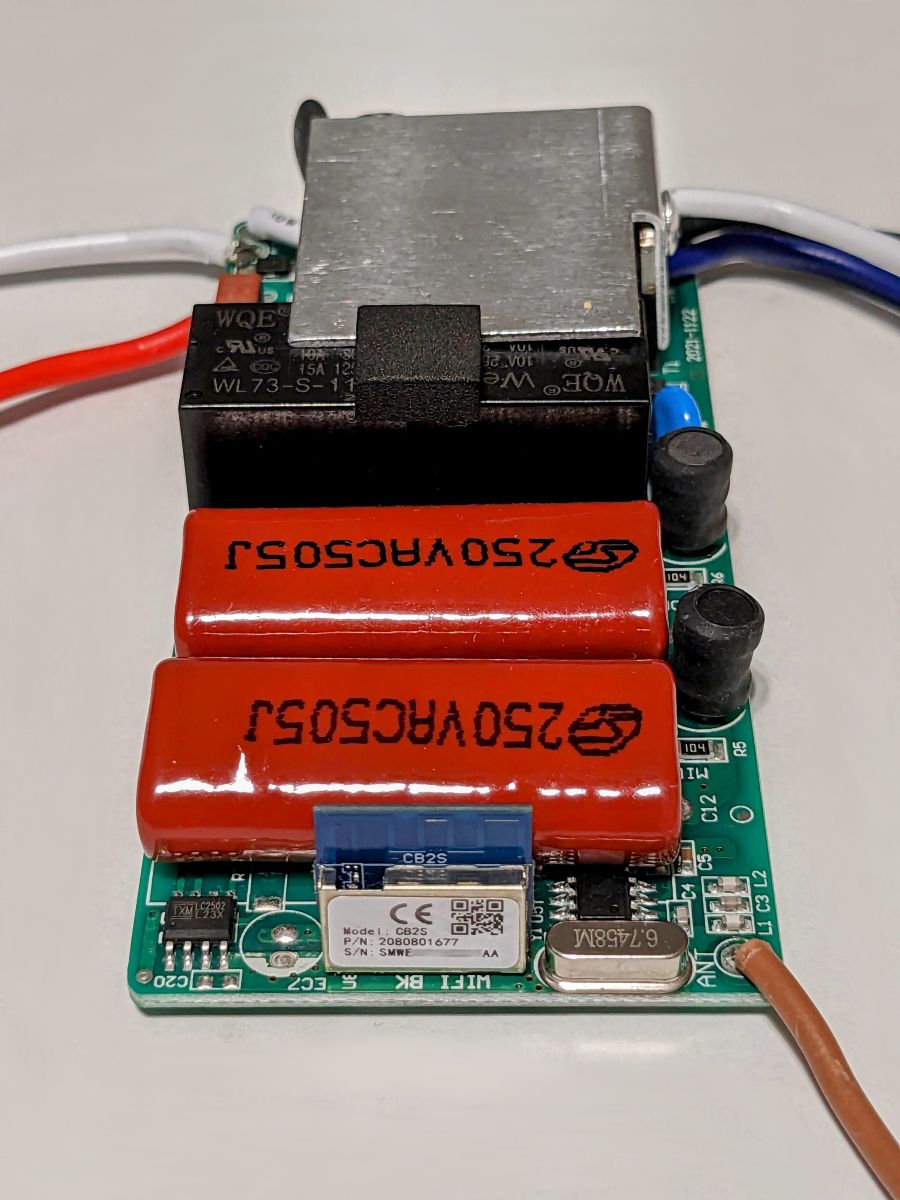
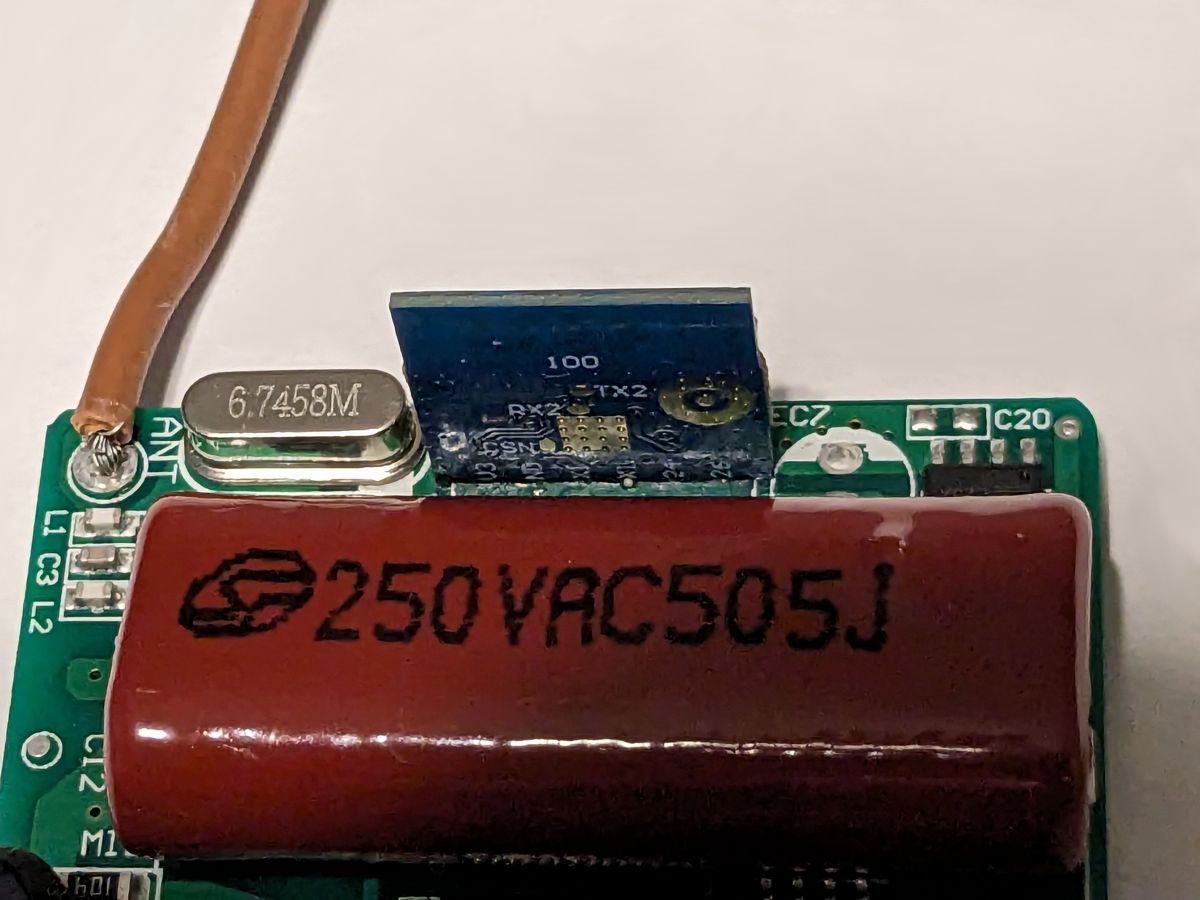
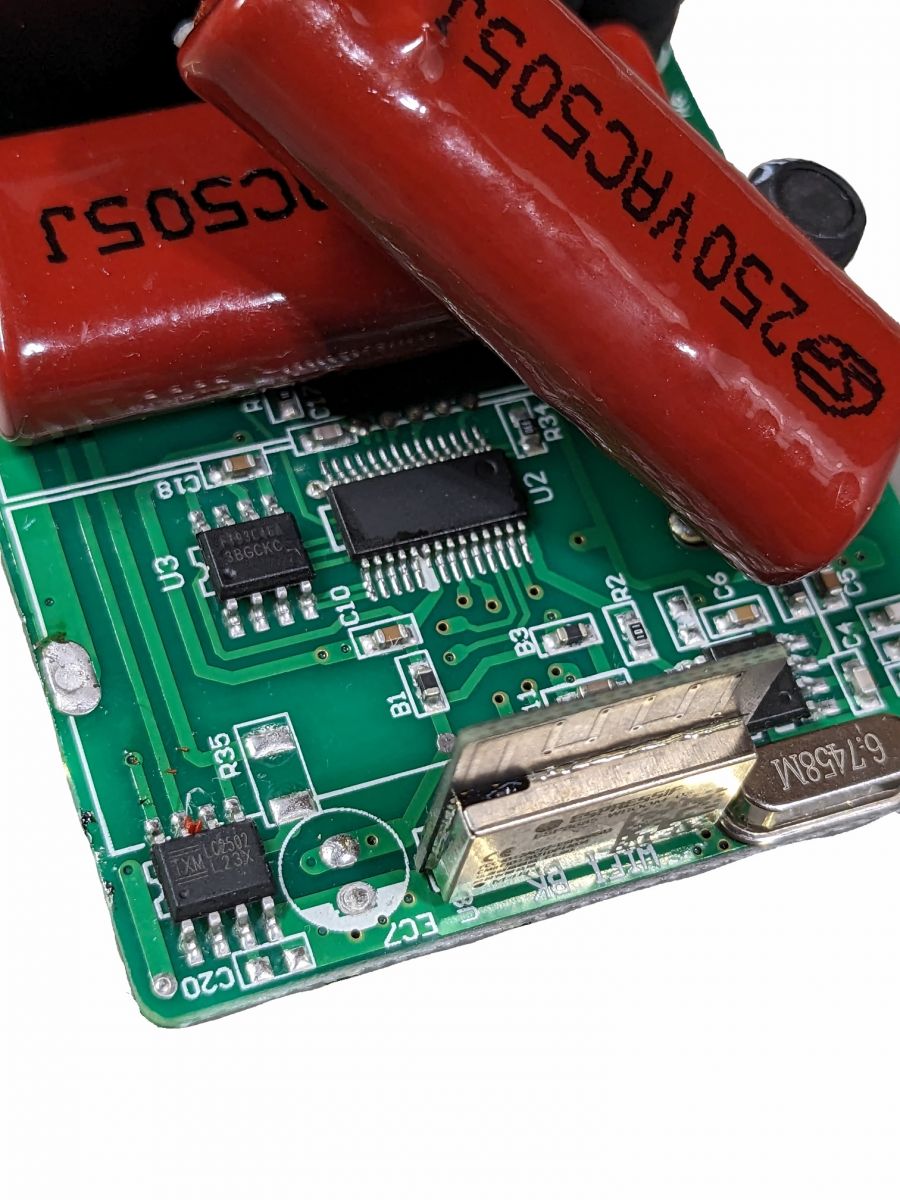
The unit ships with a Beken BK7231N on a CB2S:
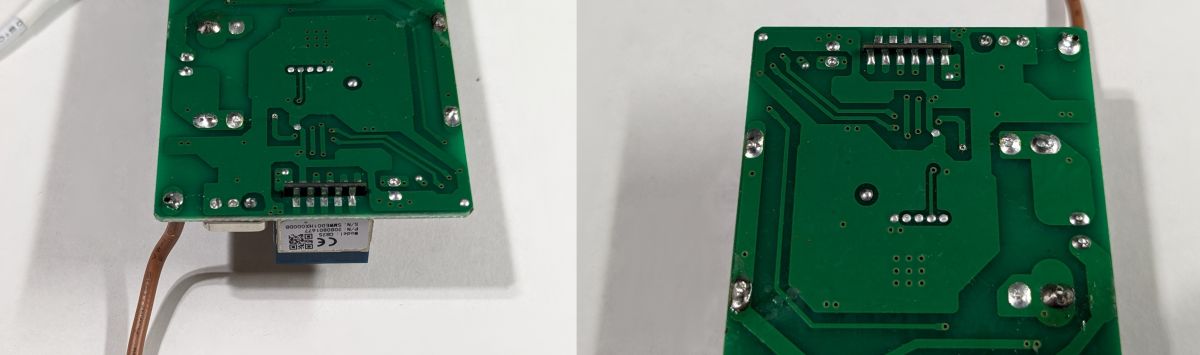
On the front of the chip, only CEN pin was soldered to the board.
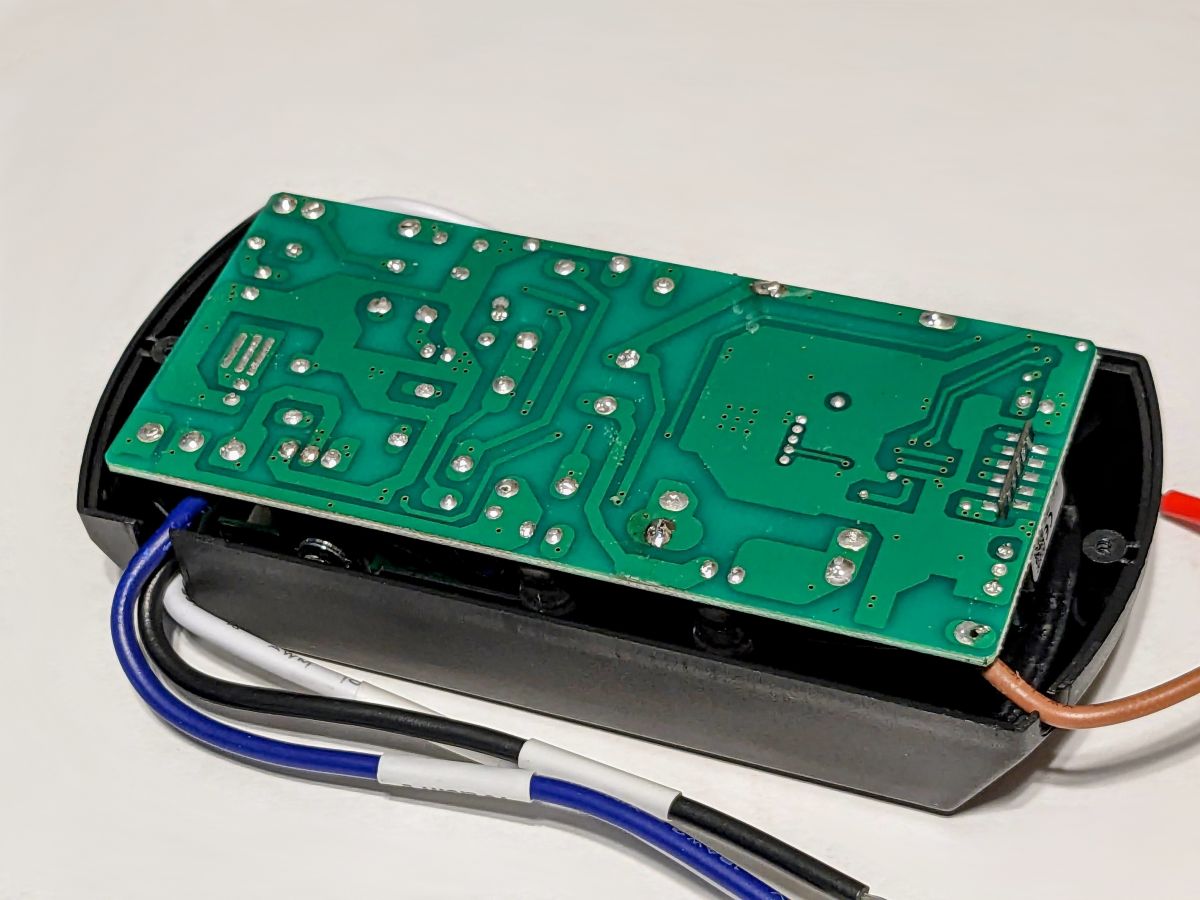
On the back of the chip, all pins were soldered to the board.
However, the only important pins seem to be Tuya_Rx and Tuya_Tx.

ESP8685-WROOM-03 is a direct drop-in replacement just with different pin names.
CB2S : CEN || 3v3 | GND | RX1 | TX1 | P24 | P26
ESP-x : _EN || 3V3 | GND | RX_ | TX_ | IO5 | IO4


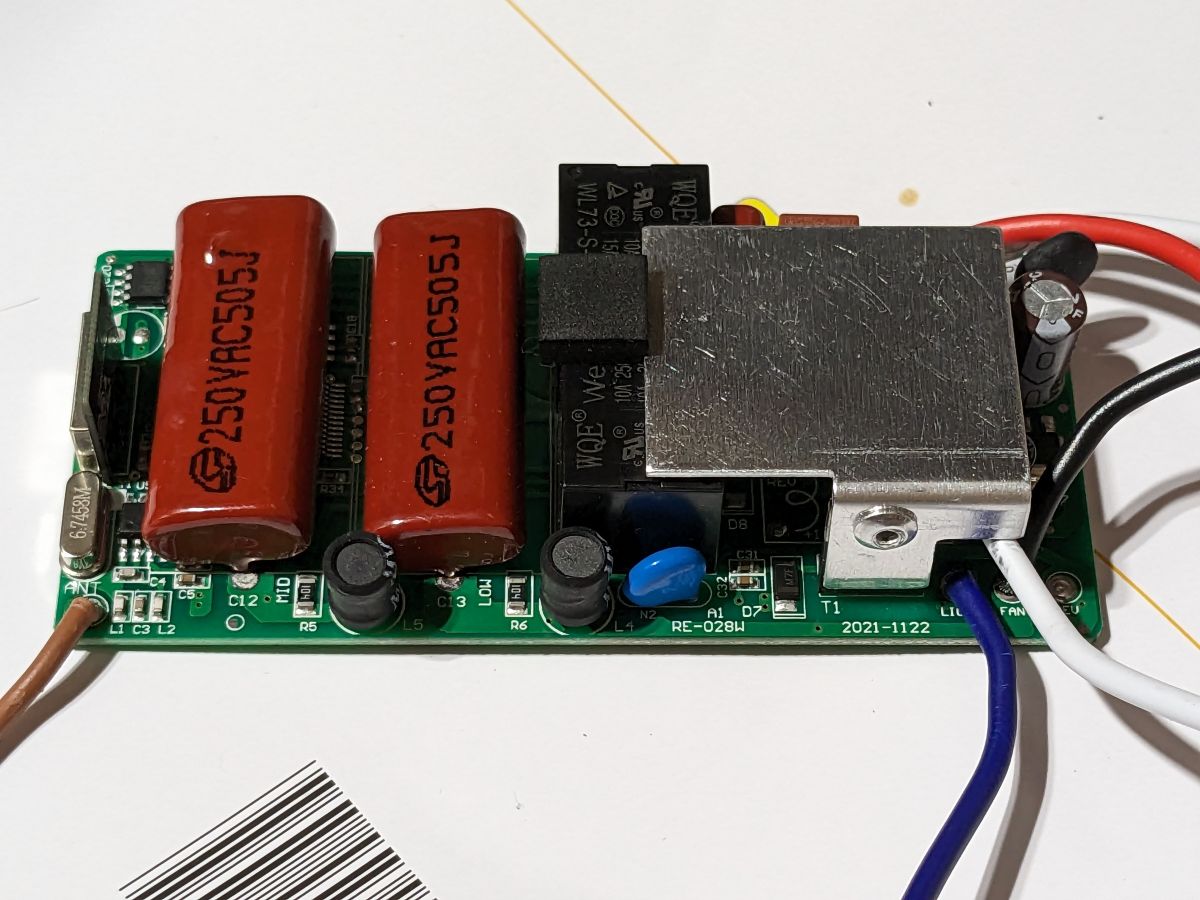
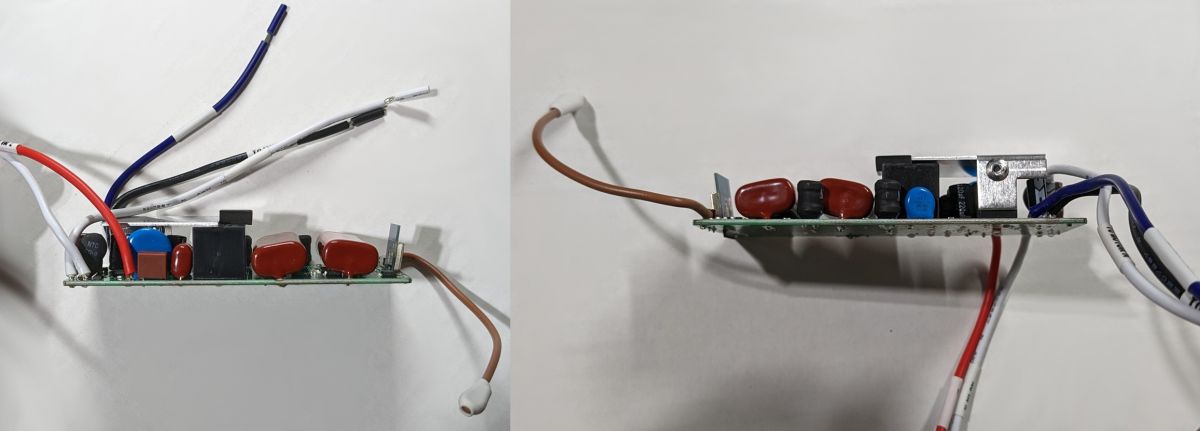
Open smart ceiling fan remote control with internal components exposed. PCB with electronic components, including a CB2S module and two large capacitors. Close-up of a circuit board with electronic components. Close-up of a circuit board with electronic components and capacitors. Circuit board of a ceiling fan remote control showing capacitors and components. Electronic module for ceiling fan control.

Printed circuit board inside a device casing with protruding wires.
Printed circuit board with various electronic components and wires.
View of the circuit board of a ceiling fan remote module.


Tuya Cloud Controls and Device Info:
Prior to flashing the device, I tried to gather as much information I could regarding the stock functionality.

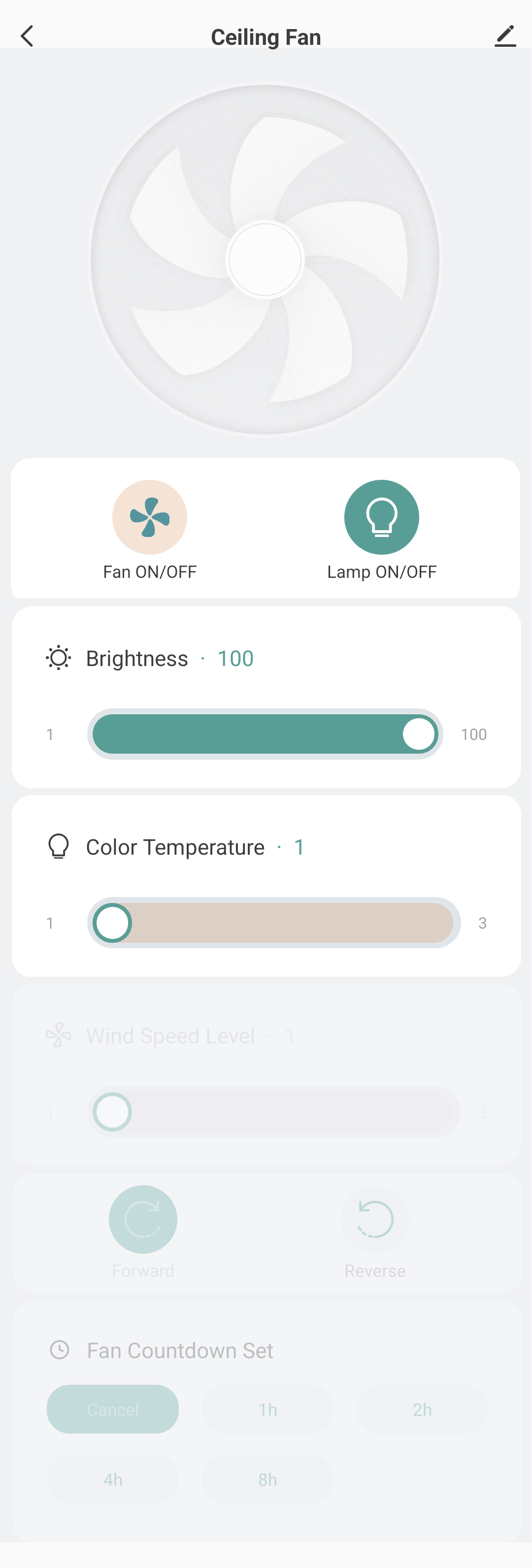
Below are the features available in the Tuya Cloud app and Version Info provided.
App screen for controlling a ceiling fan and light dimmer remotely. Device update screen with no updates available

In the Tuya Dev Project, below are the Tuya JSON and Standard Instruction Set:
JSON EDITOR
[
  {
    "code": "switch_led",
    "value": true
  },
  {
    "code": "bright_value",
    "value": 100
  },
  {
    "code": "temp_value",
    "value": 1
  },
  {
    "code": "fan_switch",
    "value": false
  },
  {
    "code": "fan_speed",
    "value": 1
  },
  {
    "code": "fan_direction",
    "value": "forward"
  },
  {
    "code": "fan_countdown_set",
    "value": "cancel"
  }
]


STANDARD INSTRUCTION SET
Code	Type	Values
switch_led	Boolean	
"{true,false}"
bright_value	Integer	
{
  "unit": "",
  "min": 1,
  "max": 100,
  "scale": 0,
  "step": 1
}
temp_value	Integer	
{
  "unit": "",
  "min": 1,
  "max": 3,
  "scale": 0,
  "step": 1
}
fan_switch	Boolean	
"{true,false}"
fan_speed	Integer	
{
  "unit": "",
  "min": 1,
  "max": 3,
  "scale": 0,
  "step": 1
}
fan_direction	Enum	
{
  "range": [
    "forward",
    "reverse"
  ]
}
fan_countdown_set	Enum	
{
  "range": [
    "cancel",
    "1h",
    "2h",
    "4h",
    "8h"
  ]
}


Home Assistant Debug Info for Tuya Cloud Integration
{
  "home_assistant": {
[...]
  },
  "integration_manifest": {
    "domain": "tuya",
    "name": "Tuya",
    "codeowners": [
      "@Tuya",
      "@zlinoliver",
      "@frenck"
    ],
    "config_flow": true,
    "dependencies": [
      "ffmpeg"
    ],
    "dhcp": [
      {
        "macaddress": "REDACTED*"
      }
      }
    ],
    "documentation": "https://www.home-assistant.io/integrations/tuya",
    "integration_type": "hub",
    "iot_class": "cloud_push",
    "loggers": [
      "tuya_iot"
    ],
    "requirements": [
      "tuya-iot-py-sdk==0.6.6"
    ],
    "is_built_in": true
  },
  "data": {
    "endpoint": "https://openapi.tuyaus.com",
    "auth_type": 0,
    "country_code": "1",
    "app_type": "smartlife",
    "mqtt_connected": null,
    "disabled_by": null,
    "disabled_polling": false,
    "name": "Ceiling Fan",
    "model": "AC 02",
    "category": "fsd",
    "product_id": "puj7wgpctcgpn70b",
    "product_name": "Ceiling Fan",
    "online": true,
    "sub": false,
    "time_zone": "-05:00",
    "active_time": "2023-11-16T00:51:32+00:00",
    "create_time": "2023-11-15T04:02:47+00:00",
    "update_time": "2023-11-16T00:51:32+00:00",
    "function": {
      "switch_led": {
        "type": "Boolean",
        "value": {}
      },
      "bright_value": {
        "type": "Integer",
        "value": {
          "unit": "",
          "min": 1,
          "max": 100,
          "scale": 0,
          "step": 1
        }
      },
      "temp_value": {
        "type": "Integer",
        "value": {
          "unit": "",
          "min": 1,
          "max": 3,
          "scale": 0,
          "step": 1
        }
      },
      "fan_switch": {
        "type": "Boolean",
        "value": {}
      },
      "fan_speed": {
        "type": "Integer",
        "value": {
          "unit": "",
          "min": 1,
          "max": 3,
          "scale": 0,
          "step": 1
        }
      },
      "fan_direction": {
        "type": "Enum",
        "value": {
          "range": [
            "forward",
            "reverse"
          ]
        }
      },
      "fan_countdown_set": {
        "type": "Enum",
        "value": {
          "range": [
            "cancel",
            "1h",
            "2h",
            "4h",
            "8h"
          ]
        }
      }
    },
    "status_range": {
      "switch_led": {
        "type": "Boolean",
        "value": {}
      },
      "bright_value": {
        "type": "Integer",
        "value": {
          "unit": "",
          "min": 1,
          "max": 100,
          "scale": 0,
          "step": 1
        }
      },
      "temp_value": {
        "type": "Integer",
        "value": {
          "unit": "",
          "min": 1,
          "max": 3,
          "scale": 0,
          "step": 1
        }
      },
      "fan_switch": {
        "type": "Boolean",
        "value": {}
      },
      "fan_speed": {
        "type": "Integer",
        "value": {
          "unit": "",
          "min": 1,
          "max": 3,
          "scale": 0,
          "step": 1
        }
      },
      "fan_direction": {
        "type": "Enum",
        "value": {
          "range": [
            "forward",
            "reverse"
          ]
        }
      },
      "fan_countdown_set": {
        "type": "Enum",
        "value": {
          "range": [
            "cancel",
            "1h",
            "2h",
            "4h",
            "8h"
          ]
        }
      }
    },
    "status": {
      "switch_led": true,
      "bright_value": 100,
      "temp_value": 1,
      "fan_switch": false,
      "fan_speed": 1,
      "fan_direction": "forward",
      "fan_countdown_set": "cancel"
    },
    "home_assistant": {
      "name": "Ceiling Fan",
      "name_by_user": null,
      "disabled": false,
      "disabled_by": null,
      "entities": [
        {
          "disabled": false,
          "disabled_by": null,
          "entity_category": null,
          "device_class": null,
          "original_device_class": null,
          "icon": null,
          "original_icon": null,
          "unit_of_measurement": null,
          "state": {
            "entity_id": "fan.ceiling_fan",
            "state": "off",
            "attributes": {
              "preset_modes": [],
              "direction": "forward",
              "percentage": 1,
              "percentage_step": 1.0,
              "preset_mode": null,
              "friendly_name": "Ceiling Fan",
              "supported_features": 5
            },
            "last_changed": "2023-11-16T01:54:03.463633+00:00",
            "last_updated": "2023-11-16T01:54:03.463633+00:00"
          }
        },
        {
          "disabled": false,
          "disabled_by": null,
          "entity_category": null,
          "device_class": null,
          "original_device_class": null,
          "icon": null,
          "original_icon": null,
          "unit_of_measurement": null,
          "state": {
            "entity_id": "light.ceiling_fan",
            "state": "on",
            "attributes": {
              "min_color_temp_kelvin": 2000,
              "max_color_temp_kelvin": 6535,
              "min_mireds": 153,
              "max_mireds": 500,
              "supported_color_modes": [
                "brightness",
                "color_temp"
              ],
              "color_mode": "color_temp",
              "brightness": 255,
              "color_temp_kelvin": 2000,
              "color_temp": 500,
              "hs_color": [
                30.601,
                94.547
              ],
              "rgb_color": [
                255,
                136,
                13
              ],
              "xy_color": [
                0.599,
                0.382
              ],
              "friendly_name": "Ceiling Fan",
              "supported_features": 0
            },
            "last_changed": "2023-11-16T01:54:03.464796+00:00",
            "last_updated": "2023-11-16T01:54:03.464796+00:00"
          }
        }
      ]
    }
  }
}


Tuya Data Points for DpId assignment
{"20":"Lamp ON/OFF","22":"Brightness","23":"Color Temperature","60":"Fan ON/OFF","62":"Wind Speed Level","63":"Direction Fan","101":"Fan Countdown Set"}


Flashing and Configuring
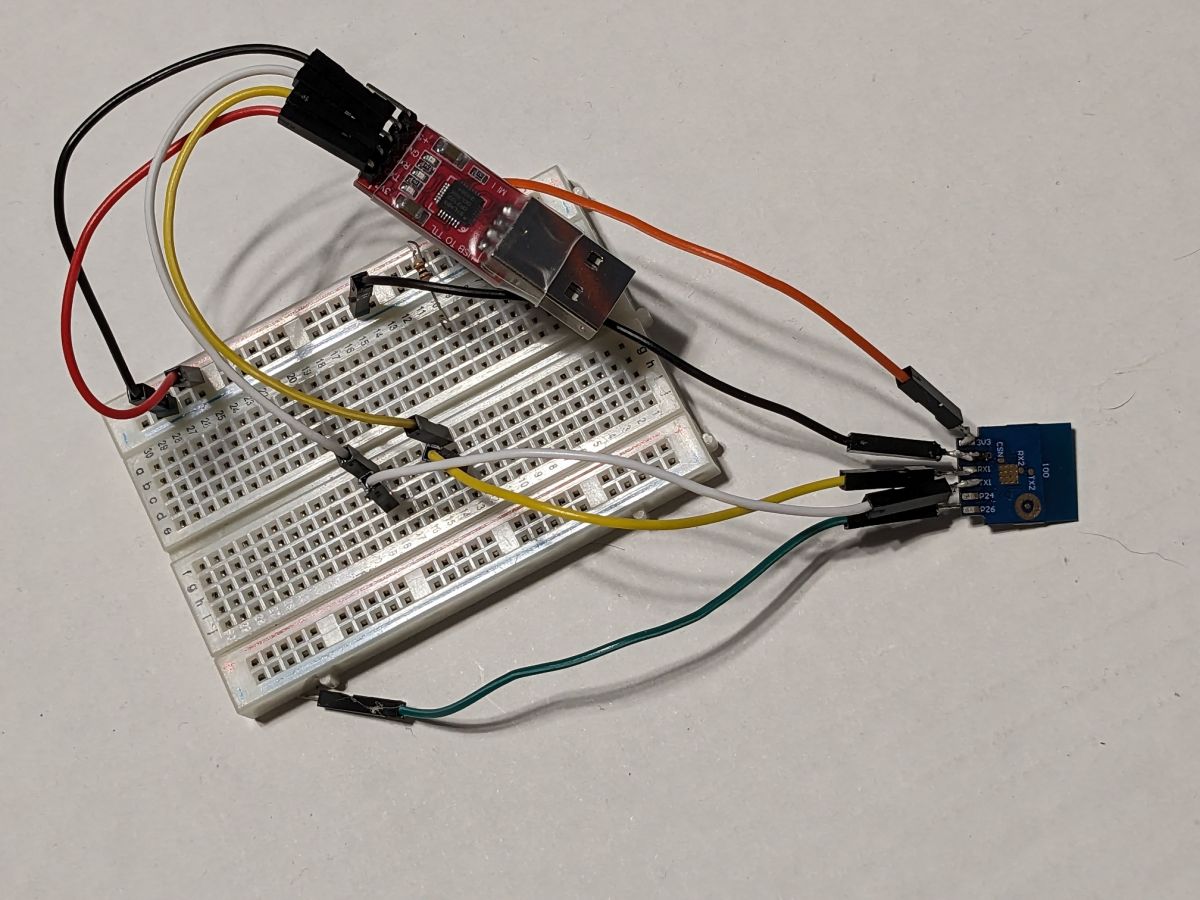
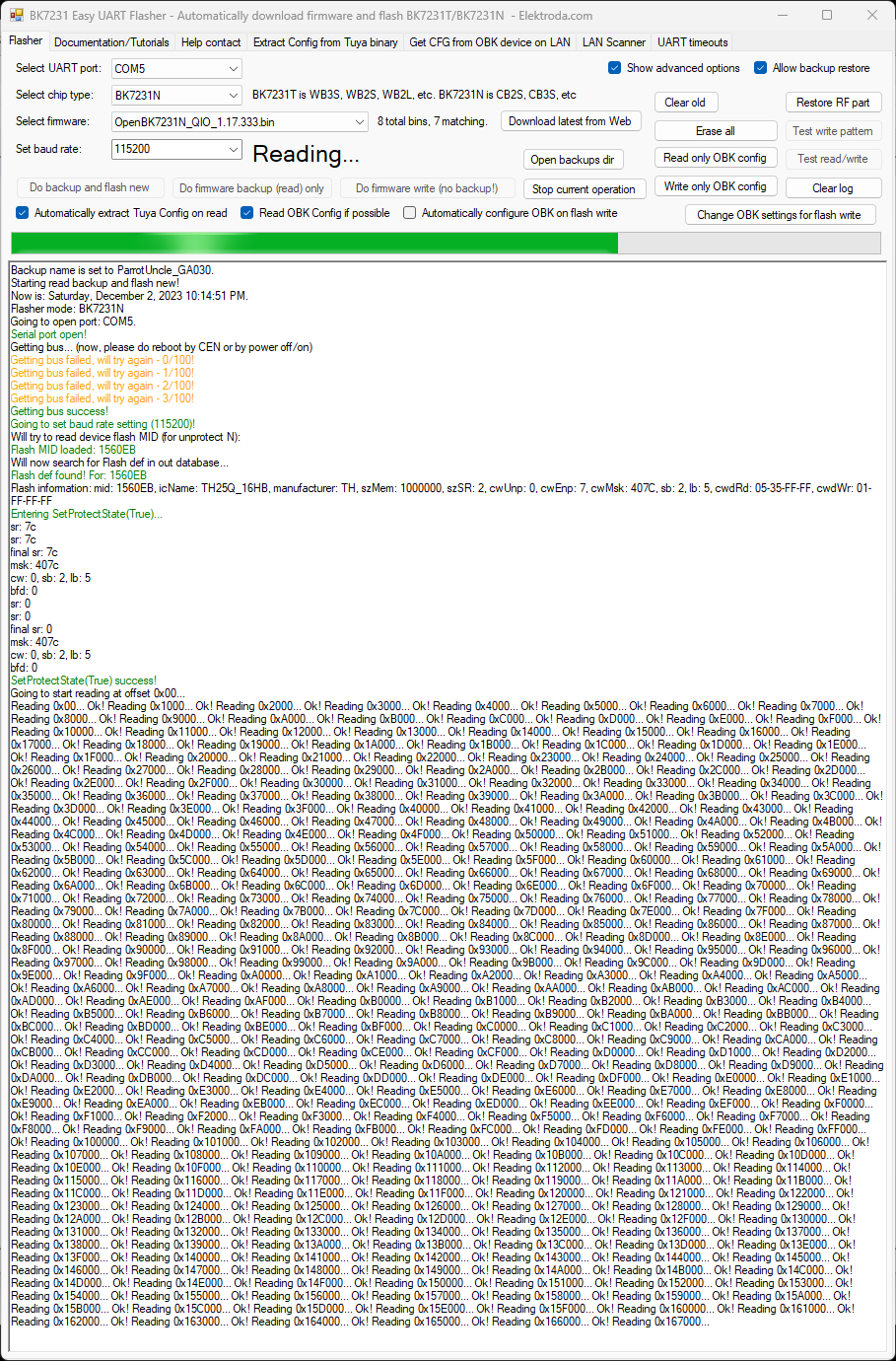
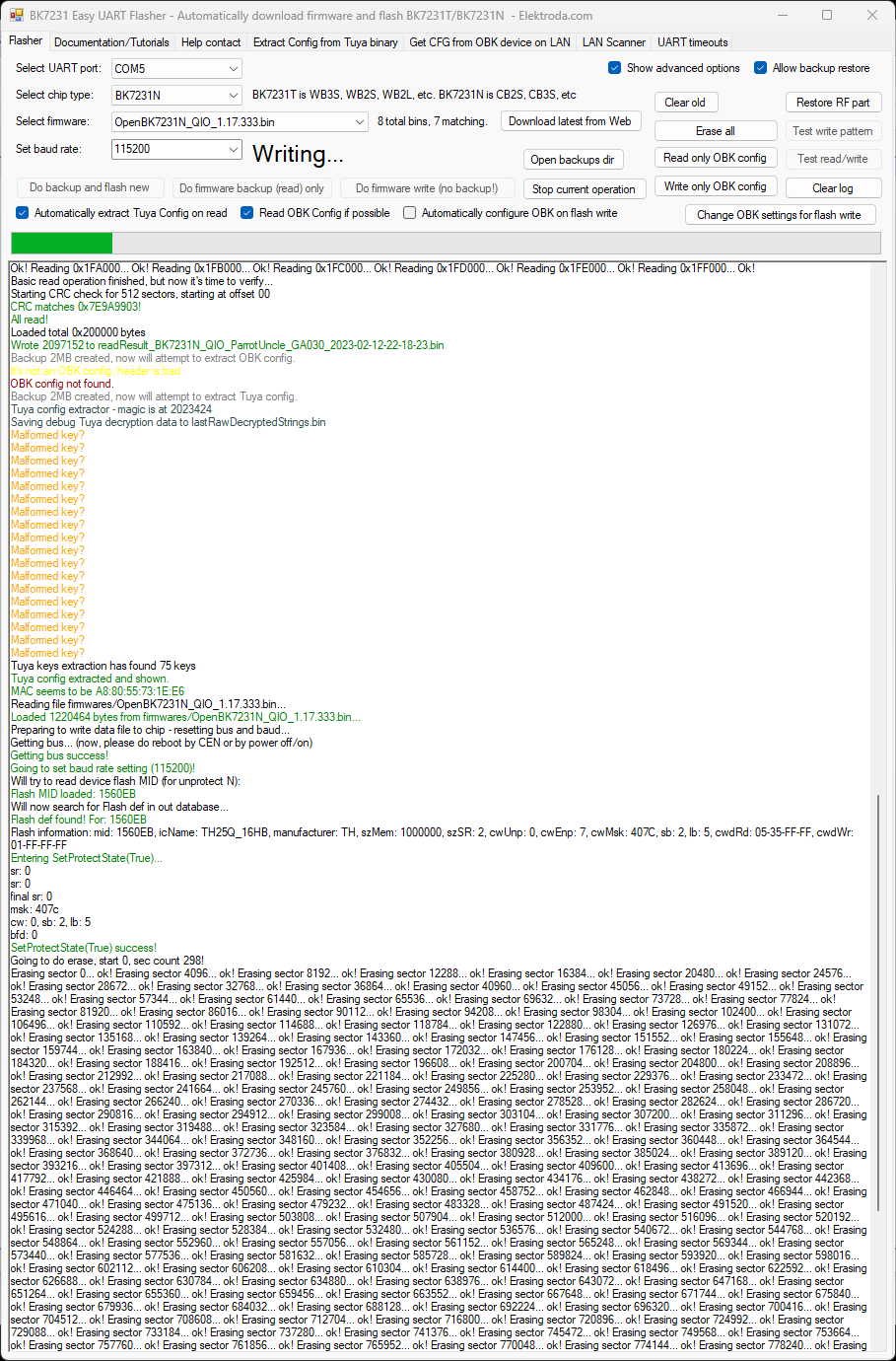
Once I acquired all of the data I believed to be available, I desoldered the CB2S from the unit and flashed it using bk7231flasher_1.1.2.
Controller module mounted on a breadboard with wires and a USB programmer.
Getting the module into flash mode was easy; simply tap the CEN pin to ground while bk-flasher is first attempting to read the bus.


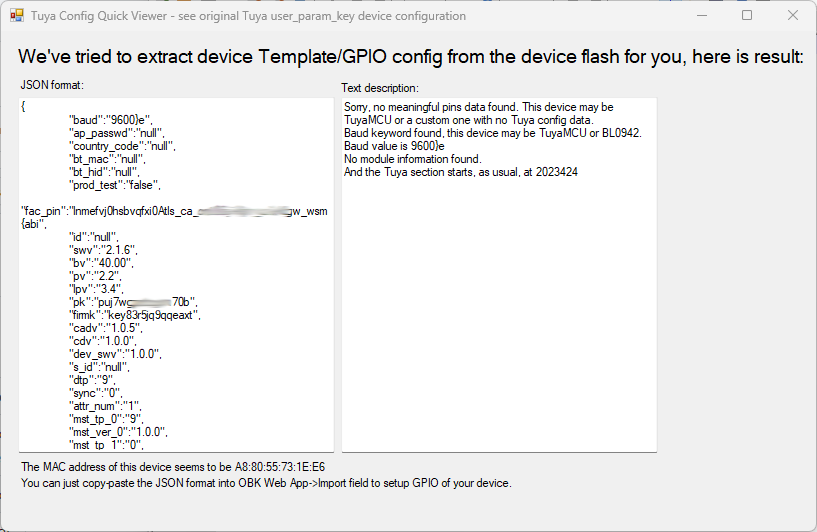
Reading the output for the Template/GPIO config had me concerned.
Device configuration with Tuya Config Quick Viewer

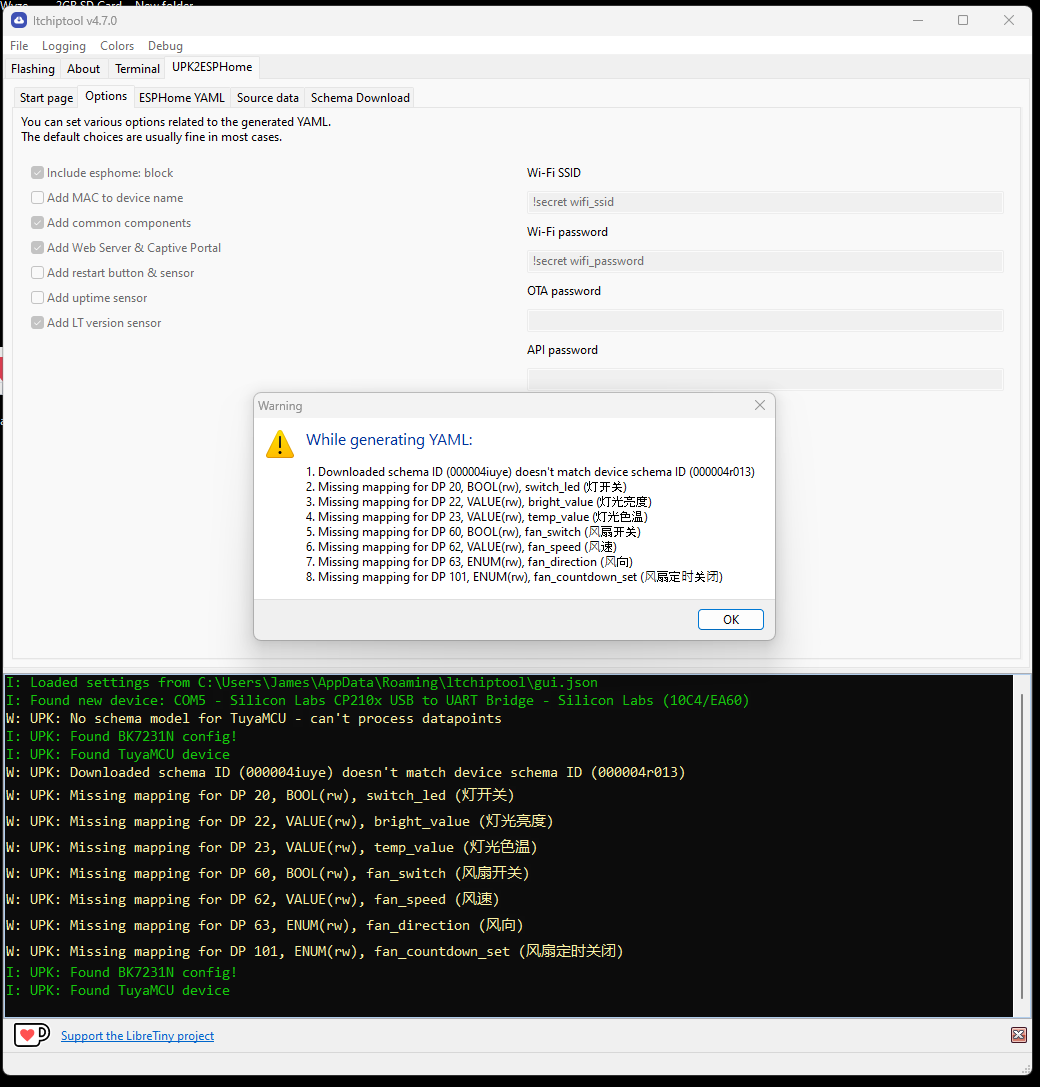
Dumping the config from ltchiptool yielded similar concerns.
Screenshot of ltchiptool showing a list of warnings during YAML generation.


I proceeded with the flash.
Screenshot of the BK7231N Easy UART Flasher tool with operational log of a flashing process on a processor. Screenshot of BK7231 Easy UART Flasher tool during device flashing.

Once complete, I soldered the chip back into the unit and reassembled everything. For testing, I hooked it up to mains power and used alligator clips to attach a lamp for testing.
I connected to the OpenBeken WebApp at 192.168.4.1 on its default broadcasting SSID and reconfigured it to connect to my IoT network.

I thought GPIO5 / GPIO4 were going to be my magic pins with GPIO20 / GPIO21 (RX / TX) for TuyaMCU comms.
This is when the fun started.
Spoiler:
I was unable to determine the proper pin configuration and tried to hook it up to my Oscilloscope. POP! The unit doesn't have a ground and fried the CB2S. I had a backup, but wanted to keep it mint until I figured things out and knew I could get it working.
I swapped the cooked CB2S for the ESP8685 I had available and loaded up the full Tasmota firmware.
Fun fact, the ESP8685-WROOM-03-H4 is not nearly as simple to flash. GPIO8 [EN?] needs pulled to 3V3 while GPIO9 needs pulled to GND and it's only available as a pad on the back of the board.
I continued to play with Tasmota settings, but had no success. Discussion on the forum lead me to take a leap and try once more to OBK my untouched unit and hope I could get it working.

It turns out that OpenBeken communicated with the TuyaMCU out of the box without needing to configure any pins. The rest of the pins do nothing and all of the configuration is Channel based using the autoexec.bat.

After much debugging and button-presses on the RF remote, I was able to develop the below autoexec.bat

autoexec.bat should contain the below content and be uploaded to the file-system of the OpenBeken flashed device.
startDriver TuyaMCU

//setChannelType [ChannelIndex][TypeString]
//linkTuyaMCUOutputToChannel [dpId][varType][channelID][bDPCache-Optional]

//{"TuyaReceived":{"Data":"55AA03070005140100010125","Cmnd":7,"CmndData":"1401000101","DpType1Id20":1,"20":{"DpId":20,"DpIdType":1,"DpIdData":"01"}}}
//Map DpID20 to channel1, type1 (Boolean) - Lamp On/Off
setChannelType 1 Toggle
linkTuyaMCUOutputToChannel 20 1 1

//{"TuyaReceived":{"Data":"55AA03070008160200040000006491","Cmnd":7,"CmndData":"1602000400000064","DpType2Id22":100,"22":{"DpId":22,"DpIdType":2,"DpIdData":"00000064"}}}
//Map DpID22 to channel2, type2 (Integer) - bright_value - {1-100,step1}
setChannelType 2 Dimmer
linkTuyaMCUOutputToChannel 22 2 2

//{"TuyaReceived":{"Data":"55AA0307000817020004000000012F","Cmnd":7,"CmndData":"1702000400000001","DpType2Id23":1,"23":{"DpId":23,"DpIdType":2,"DpIdData":"00000001"}}}
//Map DpID23 to channel3, type2 (Integer) - [color] temp_value - {1-3,step1}
//Note: This feature is not on the remote, but shows up in Tuya Cloud and I cannot find appropriate bulbs to test. If used, field should be: LowMidHigh
setChannelType 3 ReadOnly
linkTuyaMCUOutputToChannel 23 2 3

//{"TuyaReceived":{"Data":"55AA030700053C010001004C","Cmnd":7,"CmndData":"3C01000100","DpType1Id60":0,"60":{"DpId":60,"DpIdType":1,"DpIdData":"00"}}}
//Map DpID20 to channel4, type1 (Boolean) - Fan On/Off (On=1)
setChannelType 4 Toggle
linkTuyaMCUOutputToChannel 60 1 4

//{"TuyaReceived":{"Data":"55AA030700083E0200040000000358","Cmnd":7,"CmndData":"3E02000400000003","DpType2Id62":3,"62":{"DpId":62,"DpIdType":2,"DpIdData":"00000003"}}}
//Map DpID20 to channel5, type2 (Integer) - Fan Speed - {Off,Low,Med,High} (0,1,2,3)
setChannelType 5 OffLowMidHigh
linkTuyaMCUOutputToChannel 62 2 5


//{"TuyaReceived":{"Data":"55AA030700053F0400010052","Cmnd":7,"CmndData":"3F04000100","DpType4Id63":0,"63":{"DpId":63,"DpIdType":4,"DpIdData":"00"}}}
//Map DpID63 to channel6, type4 (Enum) - fan_direction - {"range": ["forward","reverse"]}
//Note: This model does not include wiring for the fan-reverse function. However, the solder-pad is labeled on the board and the toggle displays in Tuya Cloud. Feature Untested.
setChannelType 6 ReadOnly
linkTuyaMCUOutputToChannel 63 4 6

//{"TuyaReceived":{"Data":"55AA03070005650400010078","Cmnd":7,"CmndData":"6504000100","DpType4Id101":0,"101":{"DpId":101,"DpIdType":4,"DpIdData":"00"}}}
//Map DpID101 to channel7, type4 (Enum) - fan_countdown_set - {"range": ["cancel","1h","2h","4h","8h"]} (0,1,2,3,4)
setChannelType 7 LowestLowMidHighHighest
linkTuyaMCUOutputToChannel 101 4 7


//enable powersave mode
//seems to be default enabled
startDriver SSDP
PowerSave 1


This should provide all the necessary functionality with a few things to note:
-temp_value DpId23 is marked ReadOnly. Either I don't have any bulbs that use this feature or the feature doesn't work. LowMidHigh should enable the feature.
-fan_direction DpId63 is also marked ReadOnly. The unit has a solder point and the feature shows up in Tuya Cloud, however it was not mentioned in the product description nor manual and the wiring is not included with the device It's probably also risky to potentially flip and reverse it while the fan is running. I assume bad things would happen.
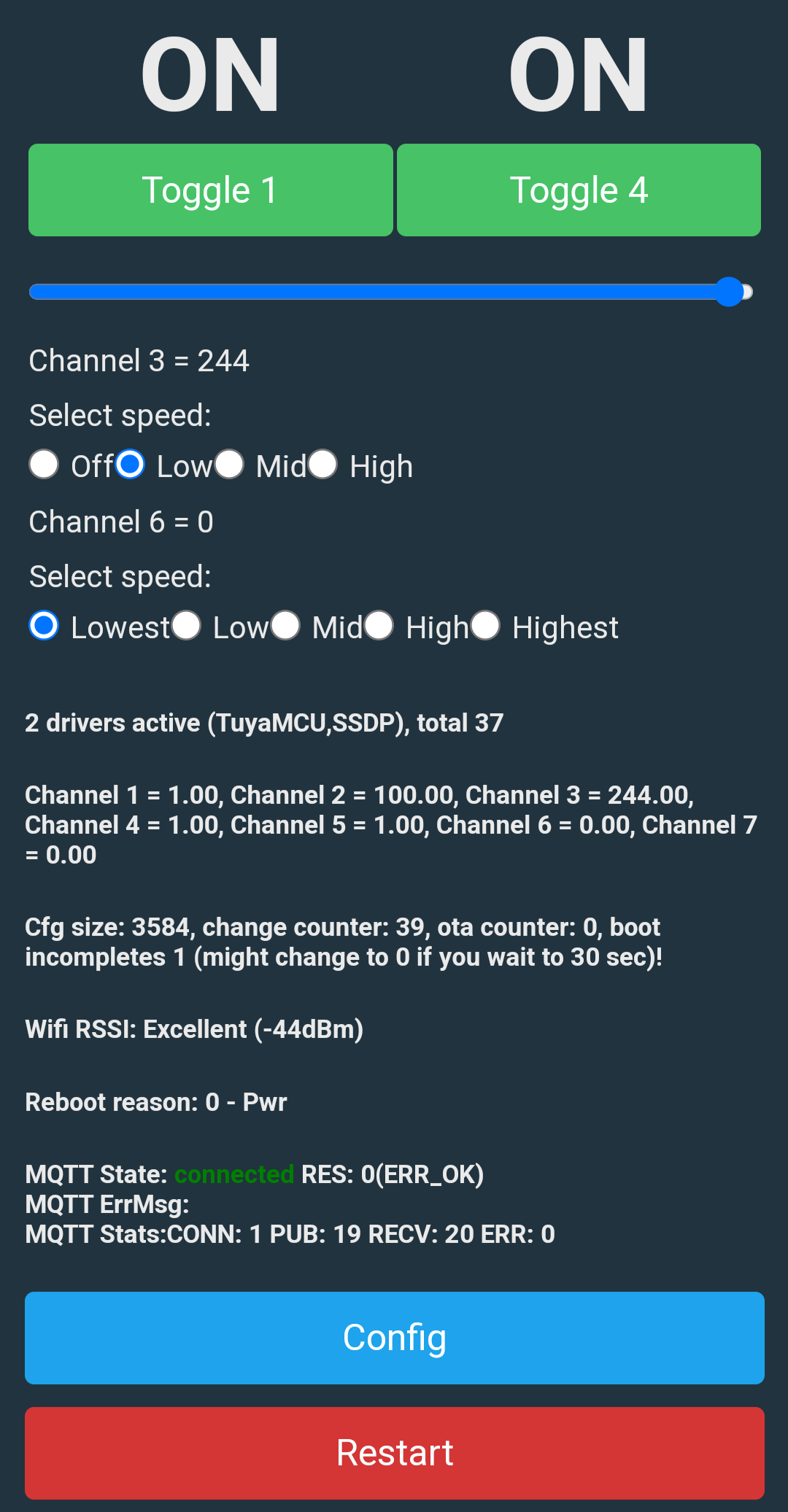
-I was unable to figure out how to rename the function labels on the OpenBeken WebApp for better usability (such as the timer selection is listed as fan speed). If someone knows how, I'll update the script.
Control panel screen for a smart ceiling fan remote control.


Home Assistant
So far, I only have a minimally viable HA integration and was only able to read the Timer setting. If anyone more experienced can create a better UI and get the timer configurable, that would be great!
I also need to figure out how to get MQTT to push more often. I found an edge-case where sometimes when power-cycled and HA's MQTT cache is cleared the fan speed will be set to 0 and Toggling Fan On/Off in UI won't cause any spinning action.

In the OpenBeken WebApp, navigate to Config > Configure MQTT and enter your Home Assistant MQTT information.

HA MQTT yaml

light:    
    name: "Bedroom Fan Light"
    unique_id: "re028w.bedroom_fan_light"
    state_topic: "re028w/cfan_br/1/get"
    command_topic: "re028w/cfan_br/1/set"
    payload_on: "1"
    payload_off: "0"
    brightness_state_topic: "re028w/cfan_br/2/get"
    brightness_command_topic: "re028w/cfan_br/2/set"
    brightness_scale: 100
    color_temp_state_topic: "re028w/cfan_br/3/get"
    color_temp_command_topic: "re028w/cfan_br/3/set"
    color_temp_value_template: >-
      {% if value == '1' %}
      Warm
      {% elif value == '2' %}
      Neutral
      {% elif value == '3' %}
      Cool
      {% else %}
      Invalid
      {% endif %}
    availability_topic: "re028w/cfan_br/connected"
    payload_available: "online"
    payload_not_available: "offline"
    qos: 1
    retain: true
    device:
        configuration_url: http://192.168.4.1/cfg
        manufacturer: Parrot Uncle
        model: RE-028W
        name: Bedroom Fan Light
        identifiers: [ 're028w.bedroom_fan_light' ]

fan:
    name: "Bedroom Fan"
    unique_id: "re028w.bedroom_fan"
    state_topic: "re028w/cfan_br/4/get"
    command_topic: "re028w/cfan_br/4/set"
    payload_on: '1'
    payload_off: '0'
    preset_modes:
      - 'Low'
      - 'Med'
      - 'Hi'
    preset_mode_state_topic: "re028w/cfan_br/5/get"
    preset_mode_value_template: >
      {% if value_json.FanSpeed == '1' %}
        Low
      {% elif value_json.FanSpeed == '2' %}
        Med
      {% elif value_json.FanSpeed == '3' %}
        Hi
      {% else %}
        Off
      {% endif %}
    preset_mode_command_topic: "re028w/cfan_br/5/set"
    preset_mode_command_template: >
      {% if value == 'Low' %}
        1
      {% elif value == 'Med' %}
        2
      {% elif value == 'Hi' %}
        3
      {% else %}
        Invalid
      {% endif %}
    direction_state_topic: "re028w/cfan_br/6/get"
    direction_value_template: >
      {% if value == '1' %}
      Reverse
      {% else %}
      Forward
      {% endif %}
    direction_command_topic: "re028w/cfan_br/6/set"
    direction_command_template: >
      {% if value_json.FanSpeed == '1' %}
        Reverse
      {% else %}
        Forward
      {% endif %}
    availability_topic: "re028w/cfan_br/connected"
    payload_available: "online"
    payload_not_available: "offline"
    qos: 1
    retain: true
    device:
        configuration_url: http://192.168.4.1/cfg
        manufacturer: Parrot Uncle
        model: RE-028W
        name: Bedroom Fan
        identifiers: [ 're028w.bedroom_fan' ]

sensor:
    name: "Bedroom Fan Timer"
    unique_id: "re028w.bedroom_fan_timer"
    icon: mdi:fan-clock
    state_topic: "re028w/cfan_br/7/get"
    value_template: >
      {% if value == '1' %}
      1Hr
      {% elif value == '2' %}
      2Hr
      {% elif value == '3' %}
      4Hr
      {% elif value == '4' %}
      8Hr
      {% else %}
      Disabled
      {% endif %}
    availability_topic: "re028w/cfan_br/connected"
    payload_available: "online"
    payload_not_available: "offline"
    qos: 1
    device:
        configuration_url: http://192.168.4.1/cfg
        manufacturer: Parrot Uncle
        model: RE-028W
        name: Bedroom Fan Timer
        identifiers: [ 're028w.bedroom_fan_timer' ]


Firmware Dump and JSON attached

{
  "vendor": "Parrot Uncle",
  "bDetailed": "1",
  "name": "Universal Smart Ceiling Fan Remote Control and Dimmer Light Switch",
  "model": "RE-028W",
  "chip": "BK7231N",
  "board": "CB2S",
  "flags": "1024",
  "keywords": [
    "Eileen Grays",
    "Parrot Uncle",
	"ParrotUncle",
	"RE-028W",
	"GA030",
	"San Sheng",
	"2AX7R-RE021"
	"FEKOTS",
    "SS-T28",
	"Fan",
	"Dimmer"
  ],
  "pins": {},
  "command": "",
  "image": "https://obrazki.elektroda.pl/4797170800_1702090627_thumb.jpg",
  "wiki": "https://www.elektroda.com/rtvforum/viewtopic.php?p=20853026"
}


I hope my efforts help others who encounter this device. If anyone comes up with improvements, I'll gladly accept them. I would also like to Tasmota-fy the config for use on my ESP module.
Attachments:
  • BK7231N_QIO_CeilingFanRemote_RE-028W.zip (1.04 MB) You must be logged in to download this attachment.

About Author
totallylost wrote 6 posts with rating 1 . Been with us since 2023 year.

Comments

p.kaczmarek2 09 Dec 2023 09:03

That's a very informative guide, let's start with this point: According to our docks, here: https://github.com/openshwprojects/OpenBK7231T_App/blob/main/docs/commands.md You can use mqtt_broadcastInterval... [Read more]

totallylost 09 Dec 2023 19:13

Thanks. I added it to my working config and will need to decide if I should keep it. It turns out this 'edge-case' was an issue of my own creation. I was thinking that deleting items in MQTT Explorer... [Read more]

FAQ

TL;DR: This FAQ helps OpenBeken users recover a BK7231N ceiling-fan controller with 7 mapped functions. The key result is that the RE-028W works "out of the box" with TuyaMCU after flashing, then returns online through the default 192.168.4.1 AP and an autoexec.bat file. [#20853026]

Why it matters: It turns a hard-to-map Tuya fan/light controller into a repeatable OpenBeken setup with working dimming, 3 fan speeds, RF remote coexistence, and MQTT basics.

Option Module Result in thread Flashing difficulty Practical takeaway
Original hardware CB2S with BK7231N Fully working in OpenBeken Easy once CEN is grounded at start Best path for this controller
Replacement hardware ESP8685-WROOM-03-H4 Hardware-compatible, but no working Tasmota result shown Harder; GPIO8 to 3V3 and GPIO9 to GND Useful backup, not the proven path

Key insight: You do not need to discover usable GPIOs for this board. OpenBeken talks to the TuyaMCU automatically, so the real work is DpId-to-channel mapping inside autoexec.bat, not pin assignment. [#20853026]

Quick Facts

  • The controller is sold as model RE-028W, uses a CB2S module with BK7231N, and the thread reports module firmware V2.1.6 plus MCU firmware V1.0.0. [#20853026]
  • Tuya functions exposed in the stock setup include lamp on/off, brightness 1–100, color temperature 1–3, fan speed 1–3, direction forward/reverse, and a timer with cancel, 1h, 2h, 4h, and 8h. [#20853026]
  • The proven recovery path is: desolder the module, flash it, reinstall it, join the default OpenBeken AP at 192.168.4.1, then upload autoexec.bat and reboot. [#20853026]
  • The board has no protective ground in normal load/neutral wiring, and probing it incorrectly destroyed one CB2S during debugging. That makes isolation and measurement method a real safety issue, not a theory. [#20853026]
  • OpenBeken can publish MQTT more often with mqtt_broadcastInterval, but the thread notes you must enable the needed flags first and avoid destructive topic edits during troubleshooting. [#20853081]

How do I flash a BK7231N CB2S ceiling fan controller like the RE-028W with OpenBeken and get it back online afterward?

Flash it by removing the CB2S, programming it, then reinstalling it and joining OpenBeken’s default AP. 1. Desolder the CB2S and flash it with bk7231flasher_1.1.2. 2. Solder it back, power the unit, and connect to the OpenBeken WebApp at 192.168.4.1. 3. Configure Wi-Fi, upload autoexec.bat to the file system, and reboot. The thread says no manual pin setup was required after reinstalling the module. [#20853026]

What is TuyaMCU, and how does OpenBeken communicate with it automatically on this ceiling fan controller without manual GPIO setup?

"TuyaMCU" is a serial control subsystem that manages appliance features through numbered data points, while the Wi-Fi module only exchanges commands and status over TX/RX. On this RE-028W, OpenBeken started talking to the TuyaMCU immediately after flashing, without manual GPIO assignment. The author expected to configure RX/TX pins, but found that OpenBeken handled Tuya serial communication automatically and only channel mapping remained. [#20853026]

Why does the RE-028W work in OpenBeken without configuring GPIO pins, even though the Tuya RX/TX lines seem important?

It works because OpenBeken already handles the Tuya serial path on this design. The thread shows the board’s other pins “do nothing” for user setup, while TuyaMCU communication came up automatically after flashing. That means the important task is mapping DpIds like 20, 22, 60, 62, 63, and 101 to channels, not assigning GPIO roles in the template. [#20853026]

How can I map Tuya Data Points like DpId 20, 22, 60, 62, 63, and 101 to OpenBeken channels in autoexec.bat for a fan light controller?

Map each DpId with setChannelType and linkTuyaMCUOutputToChannel. In the working RE-028W file, 20→channel 1 Toggle for lamp power, 22→channel 2 Dimmer for brightness, 60→channel 4 Toggle for fan power, 62→channel 5 OffLowMidHigh for speed, 63→channel 6 ReadOnly for direction, and 101→channel 7 LowestLowMidHighHighest for the timer enum. The thread also maps 23→channel 3 ReadOnly for color temperature. [#20853026]

What is autoexec.bat in OpenBeken, and what settings belong in it for a BK7231N ceiling fan dimmer with RF remote?

"autoexec.bat" is an OpenBeken startup script that runs saved commands on boot, so device logic, drivers, and channel links restore automatically after every reboot. For this fan controller, it should start TuyaMCU, define channel types, link each Tuya DpId to the correct channel, start SSDP, and enable PowerSave 1. The RF remote still worked because the TuyaMCU handled those functions after the script loaded. [#20853026]

Which Tuya DpIds control the lamp, brightness, color temperature, fan power, fan speed, direction, and countdown timer on the Parrot Uncle RE-028W?

The thread identifies seven main DpIds for this controller. They are 20 for lamp on/off, 22 for brightness, 23 for color temperature, 60 for fan on/off, 62 for fan speed, 63 for fan direction, and 101 for the countdown timer. The timer enum supports cancel, 1h, 2h, 4h, and 8h, and fan speed exposes 1 to 3 in Tuya’s standard instruction set. [#20853026]

What's the difference between using the original CB2S BK7231N module and swapping in an ESP8685-WROOM-03-H4 for this fan controller?

The original CB2S with BK7231N is the proven working option in this thread. The ESP8685-WROOM-03-H4 is described as a direct drop-in replacement by pin position, but it was harder to flash and the author did not achieve a working Tasmota setup. On the ESP8685, GPIO8 had to be pulled to 3V3 and GPIO9 to GND, with GPIO9 available only as a rear pad. [#20853026]

How do I put a CB2S or BK7231N module into flash mode with bk7231flasher, and what does grounding CEN actually do?

Put it into flash mode by grounding CEN briefly while bk7231flasher first tries to read the bus. 1. Connect the module for flashing. 2. Start the read or flash operation in the flasher. 3. Tap CEN to GND at that initial access moment. In practice, grounding CEN forces the module into a reset condition that lets the flashing tool catch the boot state correctly. [#20853026]

Why did probing this ceiling fan controller with an oscilloscope fry the CB2S, and what safety precautions matter on a no-ground mains device?

It failed because the controller is a mains device wired to load and neutral without a ground, and the probing method created a destructive condition. The author connected an oscilloscope while chasing pin behavior and immediately lost one CB2S. Treat this board as live mains hardware: isolate it, avoid grounded test equipment unless the setup is safe, and never assume signal ground equals earth ground on this controller. [#20853026]

How can I increase MQTT update frequency in OpenBeken using mqtt_broadcastInterval, and which flags need to be enabled first?

Increase it by adding mqtt_broadcastInterval to autoexec.bat after enabling the relevant MQTT broadcast flags. A forum reply points to the OpenBeken command documentation and states that the interval command works only when those flags are enabled first. The thread does not name the exact flag values, so the safe conclusion is to enable MQTT broadcasting before changing the interval. [#20853081]

Why did deleting topics in MQTT Explorer cause the fan speed state to become 0, and how should I troubleshoot Home Assistant MQTT cache issues safely?

It happened because deleting those entries published a payload of 0 back to the device instead of only clearing Home Assistant state. That pushed the fan-speed state to zero and created the false “edge case.” Troubleshoot safely by leaving live device topics intact, especially when using MQTT Explorer, and avoid deleting retained topics unless you want the device to receive the new payload. [#20853884]

What’s the best way to integrate this OpenBeken-flashed RE-028W with Home Assistant over MQTT for light brightness, fan presets, and timer status?

Use three MQTT entities: a light, a fan, and a timer sensor. The shared working example uses channel 1/2/3 for light power, brightness, and color temperature, channel 4/5/6 for fan power, presets, and direction, and channel 7 for timer status. The fan presets map to Low, Med, Hi, while the timer sensor reports 1Hr, 2Hr, 4Hr, 8Hr, or Disabled. The thread calls this setup minimally viable, not feature-complete. [#20853026]

How should I handle unsupported or untested features like temp_value DpId23 and fan_direction DpId63 when building an OpenBeken config?

Treat them as read-only until you verify the hardware path. The working file sets DpId23 and DpId63 to ReadOnly because the author could not test compatible bulbs for color temperature, and this unit lacked installed wiring for reverse control. That avoids sending unsafe or meaningless commands while still exposing status. The direction feature also appears in Tuya Cloud, but the physical device did not ship with confirmed reverse wiring. [#20853026]

Where can I rename function labels in the OpenBeken WebApp so timer and fan-speed channels display more clearly for this device?

The thread does not provide a way to rename those labels in the OpenBeken WebApp. The author explicitly says they could not find how to change function names, so timer-related fields still displayed with confusing fan-speed wording. For this device, the practical workaround is to rely on channel mapping notes and clearer names in Home Assistant instead of expecting renamed WebApp labels. [#20853026]

How would I convert this working OpenBeken TuyaMCU setup into an equivalent Tasmota configuration for an ESP8685 replacement module?

The thread does not include an equivalent working Tasmota configuration. The author moved one damaged unit to an ESP8685-WROOM-03-H4, loaded full Tasmota, and continued experimenting, but reported no success. The only proven configuration here is the OpenBeken TuyaMCU setup on the original design, so use that script as your verified baseline and treat any Tasmota port as unfinished work. [#20853026]
Generated by the language model.
%}