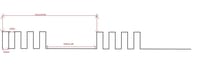
You just put "one period" for your overall cycle time, with the timings you give this totals 1500 ms, is that what you wanted? You say you want "2 different pulse in one period " but your diagram shows 4 pulses. As Aubrey says, more definition please!Bit more complex, but you could get a 1-16 line decoder like a 74HC154. Feed it from a binary 4-bit counter with a 100 ms clock and you will get 16 outputs going low in succession.This will give you a 1600 ms cycle, you only want 1500 ms. So you take output 16 (actually called /Y15 as they start from 0) and use that to reset your counter back to 0.You then arrange selected outputs to drive your LED, in this case you'd use outputs /Y0. /Y2, /Y4 and /Y8. Use diodes to connect them to your LED and it will flash as you wish.I'm a bit pushed for time but if you like this idea let me know and I'll post a bit more detail and maybe a diagram.The other way of doing it is to use a small microcontroller chip (Microchip make many ATtiny and PIC12xxx chips like this) and program it to flash your LED. Very cheap and easy, if you can program. You'd literally need the chip, a resistor and a LED.You could also get 2 555s, one with a 1500 ms period with variable duty cycle, gating the other (which drives the LED) with a 200 ms period, but you'd have to try and synchronise them to get exactly the timings you need. That is also do-able I think. Again I'll post more detail if you like this.






 forums-timer.jpg
(9.46 KB)
You must be logged in to download this attachment.
forums-timer.jpg
(9.46 KB)
You must be logged in to download this attachment.


