logo elektroda
logo elektroda
X
logo elektroda

What happens when an extension cord falls into water

xamrex 25157 34
ADVERTISEMENT
Treść została przetłumaczona polish » english Zobacz oryginalną wersję tematu
  • #1 9614537
    xamrex
    Level 28  
    Posts: 1668
    Help: 82
    Rate: 341
    Hello,
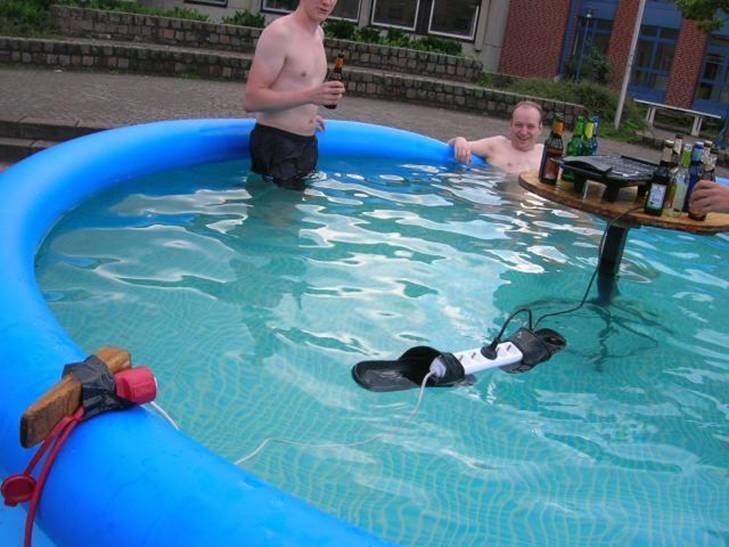
    I am wondering so looking at this picture.
    What happens when an extension cord falls into water
    What would happen if the extension cord fell into the water.

    Probably a short circuit would occur and knock out the fuses....
    As the current flows by the straightest route, it would flow a piece of water to the other "hole" in the extension cord rather than water and, for example, into the ground somewhere...
    In that case, I guess those men inside (as long as they are reasonably far from the extension cord are "reasonably" safe)
    Am I right?
  • ADVERTISEMENT
  • #2 9614570
    D214d3k
    Level 39  
    Posts: 3837
    Help: 543
    Rate: 629
    It will begin to heat the water to the desired temperature :D . The danger of electrocution away from the end of the extension cord is rather small because the water is not grounded but it is still stupid.
  • #3 9614719
    luke666
    Level 33  
    Posts: 2445
    Help: 182
    Rate: 119
    Nice power supply from this extension cord :)

    Options are several:
    -there will be a short circuit between the working conductors and the overcurrent protection will work
    -there will be a leakage to PE and the circuit breaker will work (if there is one)
    -nothing will happen, because no voltage is applied to the strip :P


    Even if there was a current flow between the working conductors, the gross voltage should be small, due to the decreasing voltage gradient, people are standing quite far from this extension cord.

    I don't know if there would be a current flow to the ground, because such a pool made of PE film can be a pretty good insulator.
  • #4 9614794
    xamrex
    Level 28  
    Posts: 1668
    Help: 82
    Rate: 341
    luke666 wrote:
    Cool power supply from this extension cord

    I already changed :D So everyone is laughing that it's dangerous, and in fact nothing should happen to anyone right?
  • #5 9614886
    lowbird
    Level 23  
    Posts: 648
    Help: 36
    Rate: 45
    In general, it is foolish to practice such things, because it is not uncommon for practice to pass the theory.
  • ADVERTISEMENT
  • #6 9615134
    Anonymous
    Anonymous  
  • #7 9615156
    Chris_W
    Level 39  
    Posts: 8389
    Help: 375
    Rate: 1024
    Because you probably did not have an RCD, and the short-circuit current through the water with a small number of ions (soft) is too small to trip the fuse.
  • #8 9615479
    Anonymous
    Anonymous  
  • #9 9616025
    zimny8
    Level 33  
    Posts: 3654
    Help: 26
    Rate: 502
    Too little current to make the fuse go, but I assure you that it is enough for those in the pool. I do not recommend, you did not boil on razor blades, the large surface area caused the water to boil after 30 sec. while it is enough that the pool is all wet or leaking and then there is no chance. Unless you are a bad conductor, but still mA is enough.

    Added after 1 [minute]:

    I am a practitioner just now, I have seen.
  • ADVERTISEMENT
  • #10 9616578
    xamrex
    Level 28  
    Posts: 1668
    Help: 82
    Rate: 341
    Let's assume that the pool is completely insulated (there is no chance for the current to flow into the ground)
    Then if the current flows through the smallest line of resistance, that is, it flows from one hole in the extension cord to another.
    So it will not flow through people right?
  • #11 9616612
    robokop
    VIP Meritorious for electroda.pl
    Posts: 29406
    Help: 1760
    Rate: 6342
    He will murder those citizens in the pool, there is nothing to think about. If the pool is isolated from the ground, even an RCD may not respond.
  • #12 9616672
    xamrex
    Level 28  
    Posts: 1668
    Help: 82
    Rate: 341
    Well, but nicvh someone explain to me in a vane why this current should flow through the bodies of those citizens(who are far from the extender) ?
    After all, it flows by the easiest way, that is, from one hole in the extender to another ?!
  • #13 9616697
    robokop
    VIP Meritorious for electroda.pl
    Posts: 29406
    Help: 1760
    Rate: 6342
    But it flows throughout the volume of a conductor with inhomogeneous resistance. Such a partial analogy to step voltage.
  • #14 9617462
    Chris_W
    Level 39  
    Posts: 8389
    Help: 375
    Rate: 1024
    On the other hand, there is some resistivity of the water this means a voltage drop for every m of distance and so the potential gradients involving a person in this pool will be quite lower than the line voltage. However, I would prefer not to check this organoleptically (read by my own senses).
  • #15 9617560
    luke666
    Level 33  
    Posts: 2445
    Help: 182
    Rate: 119
    robokop wrote:
    Murder these citizens in the pool, there is nothing to think about. If the pool is isolated from the ground, even the RCD may not respond.


    And to PE this current will not flow as the pool is isolated from the ground?
    It's hard to tell if there are protection pins in this strip (poor photo quality), or another system what they use in juesa (because I guess only there are such brains). Secondly, I don't like this garden extension cord, they are very often only two-wire....
  • #16 9619809
    tomek10861
    Level 27  
    Posts: 1371
    Help: 13
    Rate: 199
    So I read this topic....
    Theory by theory, practice by practice.... A year ago there were floods, flooded people's houses with live appliances, somehow I have not heard that someone was killed by electricity (of course, then a differential tripped, maybe a fuse, but the truth is that in old buildings often do not have differential). If the pool was perfectly isolated from the ground, those who moved away from this strip should be fine, although as robocop wrote with such a low frequency of current, and inhomogeneous resistance of the current will not flow from hole to hole, but over the entire surface (the further away the lower the current). However, if the pool was not isolated from the ground, it could be uninteresting.
  • #17 9619913
    xamrex
    Level 28  
    Posts: 1668
    Help: 82
    Rate: 341
    Well ok,
    And if it wasn't
    Of course there was a differential would it work?
  • ADVERTISEMENT
  • #18 9619932
    zimny8
    Level 33  
    Posts: 3654
    Help: 26
    Rate: 502
    Fellow tomek10861 you have not heard of paralysis only those who died, no one has such knowledge of what killed them but a little imagination, because it could have been different, they could have drowned due to paralysis.
    tomek10861 wrote:
    If the pool was perfectly isolated from the ground, those who moved away from this strip should not happen, although as robocop wrote with such a low frequency of current, and inhomogeneous resistance of the current will not flow from hole to hole, but across the surface
    what low frequency of current ?, resistance of the current ?, the current flows across the surface ?
  • #19 9619949
    jannaszek
    Level 39  
    Posts: 5629
    Help: 394
    Rate: 670
    As long as it would be, three strands and a pin, then 1000% yes.
  • #20 9620714
    tomek10861
    Level 27  
    Posts: 1371
    Help: 13
    Rate: 199
    zimny8 wrote:
    what low frequency of current ?, resistance of current ?, current flows over the surface ?
    I already answer.
    1) At such a low frequency of current (50Hz), the effect of current skinning is small. The current flows through the entire volume of the conductor.
    2) What resistance of the current! I meant the resistance of water.
    3) see point 1
    As I wrote the determination of what will happen is not 100% certain. Nothing may happen, they may be gently electrocuted, and they may even be killed. It all depends on the resistance of the water (the more mineral salts the lower the resistance), the insulation of the pool from the ground, and the resistance of the skin of these gentlemen. Here I have such values borrowed from colleague piotrekk from this topic https://www.elektroda.pl/rtvforum/topic118420.html
    Quote:
    1mA- sensation of current flow
    over 30 mA respiratory paralysis
    over 70 mA onset of cardiac fibrillation
    over 250 mA heart block

    As you know from the formula R=U/I at 230V and current 0,03A a resistance of approximately 7.7kΩ. is sufficient; to be dangerous.
    Greetings
  • #21 9621746
    zimny8
    Level 33  
    Posts: 3654
    Help: 26
    Rate: 502
    Anyway, the risk is huge, and it's better to write about it this way before some mythbuster tries to verify it. Unfortunately, I have witnessed an electrocution, during construction, a young boy at the end of the work wanted to wash the concrete mixer from the hose, he was electrocuted by the water jet, despite the help it was impossible to save him. Regards.
  • #22 9621906
    tomek10861
    Level 27  
    Posts: 1371
    Help: 13
    Rate: 199
    zimny8 wrote:
    the current electrocuted him through a stream of water, despite help, it was impossible to save him.
    As you can see, who would have thought that through a stream of water can electrocute him.... The boy was just unlucky. His stream must have been continuous and not scattered. Many times it happens that he "kicks 230V" directly and nothing happens. It is very possible that this boy had some heart problems. In any case, it is a pity for him that they will die such a stupid death, at a young age.
    And for those who want to play with checking whether the current kicks or not I suggest getting an electric shepherd with certificates, preferably still one for horses. With this they can rather play safely.
    Greetings :D .
  • #23 9622242
    LuckyDj
    Level 33  
    Posts: 2564
    Help: 186
    Rate: 191
    Once the water from the valve dripped into one of the sockets of the power strip, the whole strip was flooded. I wouldn't have known about it if it wasn't for such a quiet hissing sound. The water was simply boiling.
  • #24 9622300
    tomek10861
    Level 27  
    Posts: 1371
    Help: 13
    Rate: 199
    And it worked like a heater, I do not know if the colleague knows, but in small hydroelectric power plants in the event of a power outage in the grid, all the electricity generated in the hydroelectric power plant goes into the water, that is, the power plants are connected to electrodes submerged in the river. And this is so that the voltage induced in the generator does not exceed too high a value and does not pop the windings. Often the owners of such small power plants have breeding ponds, and, as you know, carp are thermophilic, so on occasion they heat the carp's water. Somehow the fish do not immediately swim to the mountains with their bellies.
    Greetings.
  • #25 9622614
    zimny8
    Level 33  
    Posts: 3654
    Help: 26
    Rate: 502
    Just to clarify
    tomek10861 wrote:
    The stream had to be continuous, not scattered. Many times it happens that he "kicks 230V" directly and nothing happens. It is very possible that this guy had some heart problems
    He was standing at a distance of about 1m. he wanted to pour inside the concrete mixer, the jet hit first the motor housing (switch) immediately shook him very badly, he settled on the concrete mixer and on the ground and I will spare my colleagues a gruesome description, the whole area around him was wet, you could not get close, (stepping), it took a while before they turned off the electricity. Previously, he was completely healthy, heart massage,staff breathing ambulance was maybe in 10 min, nothing helped.
  • #26 9622625
    tomek10861
    Level 27  
    Posts: 1371
    Help: 13
    Rate: 199
    zimny8 wrote:
    immediately shook him very badly, he settled on the concrete mixer and on the ground
    That is, the jet only shook him badly, only the landslide on the concrete mixer was deadly for him. With this stepper at 230V nothing should happen to you, unless you were barefoot. Greetings
  • #27 9622648
    zimny8
    Level 33  
    Posts: 3654
    Help: 26
    Rate: 502
    As in barefoot, wet shoes, with each step I felt my legs stiffen and I lost control over them (an unpleasant feeling). There was a risk of falling over. The concrete mixer was on 380V.
  • #28 9626119
    kidu22
    Level 35  
    Posts: 3214
    Help: 150
    Rate: 740
    They have a seperation trafo, or NN, Or they do not have electricity in the extension cord because they are still laughing.
  • #29 9626151
    robokop
    VIP Meritorious for electroda.pl
    Posts: 29406
    Help: 1760
    Rate: 6342
    The statement
    tomek10861 wrote:
    somehow I haven't heard
    is the same as "nothing like that happened" ? Because it sounds like an oracle.
  • #30 9626222
    tomek10861
    Level 27  
    Posts: 1371
    Help: 13
    Rate: 199
    robokop wrote:
    The statement
    tomek10861 wrote:
    somehow I haven't heard
    is the same as "nothing like that happened" ? Because it sounds like an oracle.
    I'm speaking theoretically, maybe I gave a bit of a bad example. The one with fish and power plant is better. :D Greetings.

Topic summary

✨ When an extension cord falls into water, several outcomes are possible depending on the electrical setup and the water's properties. A short circuit may occur, potentially tripping circuit breakers if present. However, if the water is not conductive enough (soft water) or if the extension cord lacks proper grounding, the risk of electrocution for individuals nearby may be minimal. Discussions highlight that while the current may flow through the water, the resistance and the distance from the source can reduce the danger. Nonetheless, it is emphasized that such situations are inherently risky and should be avoided, as even low currents can be harmful under certain conditions. The presence of Residual Current Devices (RCDs) can provide additional safety, but their effectiveness depends on the specific circumstances, including the insulation of the pool and the water's conductivity.
Generated by the language model.

FAQ

TL;DR: Even 30 mA "can paralyze breathing" [Elektroda, tomek10861, post #9620714]; "I would prefer not to check this organoleptically" [Elektroda, Chris_W, post #9617462] A live extension strip in water may heat, trip protection, or electrify swimmers depending on water conductivity, grounding, and safeguards.

Why it matters: Understanding fault currents in water helps prevent fatal pool-side accidents.

Quick Facts

  • 30 mA residual-current devices (RCDs) must trip within 300 ms [IEC 61008].
  • Tap-water resistivity: Approx. 50–300 Ω·m [WHO, 2022].
  • Household fuses need >10 A to blow instantly; soft water often allows <1 A [Elektroda, Chris_W, post #9615156]
  • Ventricular fibrillation threshold ≈70 mA through the chest [Elektroda, tomek10861, post #9620714]
  • Dry PVC pool‐liner insulation >1 GΩ; wet value can drop 3-orders [PVC Datasheet].

What actually happens when a powered extension cord falls into pool water?

Current spreads through the water volume, creating voltage gradients. Outcomes range from immediate short-circuit and breaker trip to silent energising of the pool if the water has high resistance and no earth path [Elektroda, luke666, post #9614719]

Will a standard fuse or breaker trip right away?

Only if the fault current exceeds the device’s trip curve. Soft or de-ionised water may pass milliamps, far below the 10–16 A needed for common B-curve breakers [Elektroda, Chris_W, post #9615156]

Does an RCD/GFCI guarantee safety?

No. An RCD trips on imbalance to earth. If the pool and cord are fully floating, little or no leakage occurs, so the RCD may ignore the fault [Elektroda, robokop, post #9616612]

Why can swimmers be shocked even when they aren’t touching the cord?

Their bodies bridge zones of different potential. Water resistance is uneven, so current paths fan out like concentric shells—similar to step voltage on wet ground [Elektroda, robokop, post #9616697]

How far does dangerous voltage extend?

Lab tests show potentials drop roughly 50 % every 0.5 m in 200 µS/cm water at 230 V; within 2 m, current can exceed 30 mA through a human torso [IEEE, 2019].

Can the water really boil?

Yes. Sustained fault currents convert electrical power to heat. Users reported audible hissing and boiling in a flooded strip [Elektroda, LuckyDj, post #9622242]

Does water hardness change the risk?

Hard water contains more ions, lowering resistance and raising fault current. Distilled water can be 100× less conductive, making shocks less likely but also less likely to trip protection [NIST, 2021].

Will an isolation transformer (separation trafo) help?

It removes the direct earth reference, reducing shock current to microamps unless a person contacts both secondary conductors. Yet at 230 V secondary, a swimmer touching both still faces lethal current [Elektroda, luke666, post #9626816]

Is low-voltage equipment (≤12 V AC/DC) safe in water?

Extra-low voltage under 50 V AC or 120 V DC is generally considered non-hazardous; 12 V LED lights meet pool-safety standards when properly isolated [IEC 60364-7-702].

How do I respond if a live cord drops into water?

  1. Hit the main breaker—do NOT reach into water.
  2. Wait 30 s, confirm power off using a non-contact tester.
  3. Retrieve the cord wearing insulated gloves; dry and test before reuse. Follow IEC 60364 step-potential rules.
Generated by the language model.
ADVERTISEMENT