FAQ
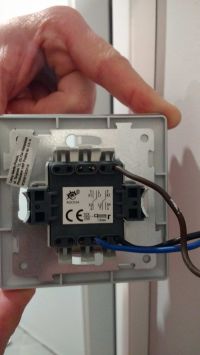
TL;DR: The Lexman two-button is a 2-circuit switch; "This is a double stair switch." Bridge the two commons and put live on the bridge for independent control. 2-gang = 2 outputs. [Elektroda, xury, post #16825876]
Why it matters: It fixes the “one button kills the other light” issue and prevents miswiring damage in minutes.
Quick Facts
- Switch type: double-stair (two-way) used as a dual light switch by adding a jumper between L1 and L2. [Elektroda, xury, post #16825876]
- Independent control requires phase on the common (bridged) and lamp leads on paired outputs (X1/X4 or X2/X3). [Elektroda, xury, post #16825876]
- Do not assume brown is live; verify first because color alone is unreliable. [Elektroda, mawerix123, post #16825955]
- Symptom: one button turns off the other light = phase placed on a wrong terminal. Move it to the common. [Elektroda, mawerix123, post #18330095]
- Typical scenario here used 3 conductors for two lamp circuits plus a shared live. [Elektroda, Canadian82, post #16825839]
How do I wire the Lexman two-button switch for two independent lights?
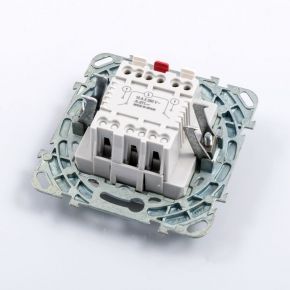
Bridge L1 to L2 with a short wire. Land the incoming phase on that bridged common. Connect the two lamp return wires to a matched pair of outputs, either X1 and X4 or X2 and X3. This gives true independent control. "This is a double stair switch." [Elektroda, xury, post #16825876]
Only one button works—what did I do wrong?
You likely didn’t bridge the two commons (L1 and L2) or you placed the phase on an output. Add a jumper between L1 and L2, then move the phase to that bridged common. Put lamp leads on a matched output pair (X1/X4 or X2/X3). [Elektroda, xury, post #16825876]
One button turns off the other light—why does that happen?
That symptom indicates the phase wire sits on the wrong terminal. Move the phase to the common terminal (the one you bridge) so each rocker feeds its own output. After correcting, each light stays on independently. "Plug the power cord into place, you have misplaced the phase wire." [Elektroda, mawerix123, post #18330095]
Where exactly should the live (phase) conductor go on this switch?
Place the phase on the middle common terminal, then add a short bridge to the second common. This mimics a two-circuit feed and lets both rockers share one live. The lamp returns stay on their respective outputs. [Elektroda, krzysiek7, post #16825896]
Can I trust wire colors like brown, black, and blue to identify live and switched?
No. Do not assume brown is live. Identify the live with proper testing before wiring. Misidentifying conductors leads to cross-switching or nonfunctional circuits. Color hints can mislead; verification prevents faults and nuisance tripping. [Elektroda, mawerix123, post #16825955]
My old three-terminal switch worked, but the new two-button doesn’t—what changed?
Your old unit likely tied the commons internally. The new double-stair switch expects two separate commons. Add a small jumper between L1 and L2, put the phase on that bridge, and move the lamp leads to the correct outputs. [Elektroda, xury, post #16825876]
Which output terminals should feed the two lamps?
Use a matched pair: X1 and X4 or X2 and X3. Keep both lamp returns on the same side’s designated outputs to avoid cross-coupling. This layout matches the internal rocker routing for predictable switching. [Elektroda, xury, post #16825876]
Quick 3-step: how do I fix the wiring so both buttons work independently?
- Move the incoming phase to the middle common and add a jumper to the second common.
- Put lamp A’s return on X1 (or X2).
- Put lamp B’s return on the paired output X4 (or X3) to match step 2.
[Elektroda, krzysiek7, post #16825896]
I have three wires in the box; can this still control two lamp groups?
Yes. One conductor supplies phase to both rockers via a bridge, and the other two are switched returns to each lamp group. This thread’s case used three conductors exactly in that way. [Elektroda, Canadian82, post #16825839]
What common mistake should I avoid when swapping to this Lexman switch?
Avoid placing the phase on an output terminal. That causes interdependence between rockers and odd behavior. Always land phase on the bridged common, then connect lamp returns to the paired outputs. Fixing this resolves the failure case instantly. [Elektroda, mawerix123, post #18330095]
Is this Lexman two-button suitable to replace a candlestick (dual-circuit) switch?
Yes. It’s a double-stair model, but it can act as a dual-circuit switch when you bridge the commons and place the phase there. Then route each lamp return to its paired output. [Elektroda, krzysiek7, post #16825896]
Why did only one lamp type light after my first attempt?
The second lamp’s return likely sat on the wrong terminal, or the commons were not bridged. Add the L1–L2 jumper, confirm phase on the bridge, and relocate the second lamp lead to the correct paired output. [Elektroda, xury, post #16825876]