logo elektroda
logo elektroda
X
logo elektroda

[Solved] Simple Linux Distro for Windows User: Install on Pendrive, Driver Compatibility & Size Tips

rostov84 14583 19
Best answers

Which simple Linux distribution can a Windows user install on a USB flash drive and run portably on different PCs, with good hardware compatibility and enough space to save persistent data?

Linux Mint Xfce is the most practical beginner-friendly choice mentioned for a USB install, with Puppy/TahrPup as the lighter portable alternative [#17005547][#17024473] The thread’s author eventually chose Linux Mint 18.3 (x64) with Xfce and installed it onto a pendrive successfully [#17133091] If you want a very small system, TahrPup ISOs were suggested at about 224 MB or 285 MB [#17024810] For a fuller persistent install with saved updates and data, one user reported using a 32 GB USB drive for Fedora, while another used a 14.3 GB pendrive for Mint [#17025010][#17015922] The replies also warn that Linux driver compatibility is not guaranteed on every machine, especially some laptops with NVIDIA/Intel dual graphics [#17023721]
Generated by the language model.
ADVERTISEMENT
Treść została przetłumaczona polish » english Zobacz oryginalną wersję tematu
  • #1 17005507
    rostov84
    Level 12  
    Posts: 924
    Rate: 213
    I am looking for a Linux distribution that:

    - it will be simple enough to be easily used by a person who has only had contact with Windows until now,
    - which you will be able to install on a pendrive and use it on any computer,
    - which will not have any problems with drivers, i.e. when you run it from a pendrive on any computer, you can use the full capabilities of all its components without the need for additional drivers.

    By the way, what capacity of the pendrive will be the best for it? I would like all data, e.g. a web browser cache, to be saved to a pendrive.
  • ADVERTISEMENT
  • ADVERTISEMENT
  • #3 17015922
    rostov84
    Level 12  
    Posts: 924
    Rate: 213
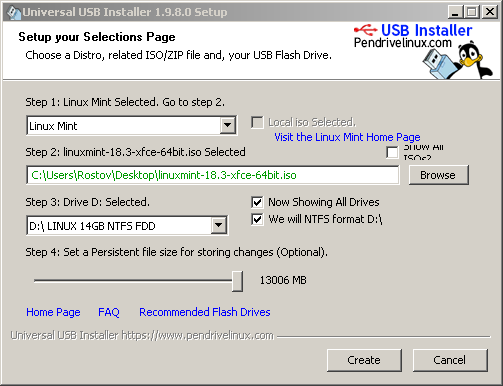
    @piterrr_ I am trying to install using Universal USB Installer 1.9.8.0 on a pendrive (14,3 GB of actual capacity) Linux Mint 18.3 (x64) from Xfce. I do this using such settings:

    Simple Linux Distro for Windows User: Install on Pendrive, Driver Compatibility & Size Tips

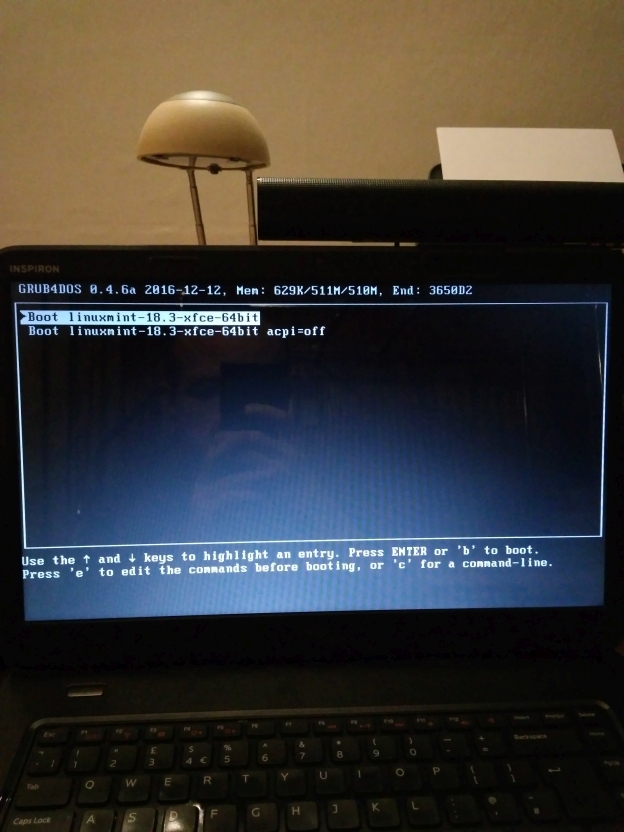
    After completing the installation and starting the computer with the pen, I can see:

    Simple Linux Distro for Windows User: Install on Pendrive, Driver Compatibility & Size Tips

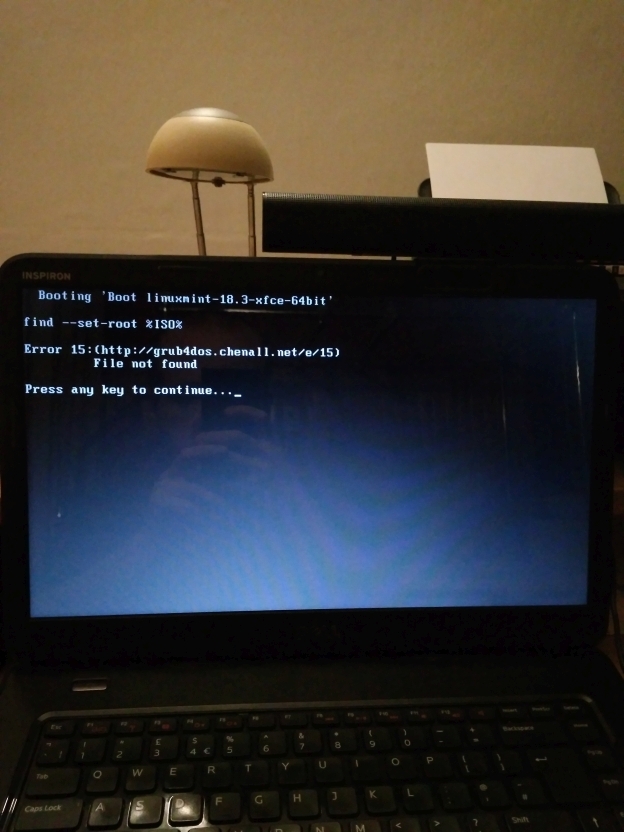
    When I choose any of the two options above, the effect is:

    Simple Linux Distro for Windows User: Install on Pendrive, Driver Compatibility & Size Tips

    Question: what am I doing wrong? NTFS format or too large file size in step 4?
  • #4 17016171
    dt1
    Admin of Computers group
    Posts: 47961
    Help: 7262
    Rate: 8187
    Show the contents of the menu.lst file, it should be in the main pendrive folder.
  • #5 17017988
    rostov84
    Level 12  
    Posts: 924
    Rate: 213
    @dt1
    Quote:

    # This Menu created with Universal USB Installer https://www.pendrivelinux.com
    default 0
    timeout 30
    color NORMAL HIGHLIGHT HELPTEXT HEADING
    foreground=FFFFFF
    background=000000

    title Boot linuxmint-18.3-xfce-64bit
    set ISO=/linuxmint-18.3-xfce-64bit.iso
    set CASPER=/casper-rw
    find --set-root %ISO%
    map %ISO% (0xff)
    parttype (hd0,3) | set check=
    set check=%check:~-5,4%
    if "%check%"=="0x00" partnew (hd0,3) 0 0 0
    if NOT "%check%"=="0x00" echo ERROR: third partion table is not empty, please delete it if you wish to use this method && pause --wait=5 && configfile /boot/grub/menu.lst
    partnew (hd0,3) 0x00 %CASPER%
    map %CASPER% (hd0,3)
    map --hook
    root (0xff)
    kernel /casper/vmlinuz file=/preseed/linuxmint.seed noprompt persistent boot=casper iso-scan/filename=%ISO% quiet --
    initrd /casper/initrd.lz

    title Boot linuxmint-18.3-xfce-64bit acpi=off
    set ISO=/linuxmint-18.3-xfce-64bit.iso
    set CASPER=/casper-rw
    find --set-root %ISO%
    map %ISO% (0xff)
    parttype (hd0,3) | set check=
    set check=%check:~-5,4%
    if "%check%"=="0x00" partnew (hd0,3) 0 0 0
    if NOT "%check%"=="0x00" echo ERROR: third partion table is not empty, please delete it if you wish to use this method && pause --wait=5 && configfile /boot/grub/menu.lst
    partnew (hd0,3) 0x00 %CASPER%
    map %CASPER% (hd0,3)
    map --hook
    root (0xff)
    kernel /casper/vmlinuz file=/preseed/linuxmint.seed noprompt persistent boot=casper iso-scan/filename=%ISO% quiet acpi=off --
    initrd /casper/initrd.lz
  • ADVERTISEMENT
  • #6 17021572
    rostov84
    Level 12  
    Posts: 924
    Rate: 213
    Will anyone advise you?
  • #8 17022517
    rostov84
    Level 12  
    Posts: 924
    Rate: 213
    @ rtj71 , unfortunately, the effect is the same: Error 15, File not found.
  • #10 17022745
    kiss39
    Level 39  
    Posts: 5334
    Help: 397
    Rate: 635
    Hello

    Today it has come to me that Linux on a laptop with two graphics cards dedicated and integrated it can be a problem with the correct operation of these cards as it has a bit, for example in Win 7. The cards do not switch as they should.
  • #11 17022765
    rostov84
    Level 12  
    Posts: 924
    Rate: 213
    @piterrr_ that's where I downloaded the 64-bit version from Xfce.

    @ kiss39 , I have a laptop with one integrated graphics card.
  • #12 17022828
    mczapski
    Level 40  
    Posts: 6227
    Help: 467
    Rate: 1652
    I have problems using Linux alone, but it seems to me that the conditions will be met by downloading to the device of almost any version of the system in the live edition (of course iso). I do not know how you intend to use this system but try to use it
  • #13 17023721
    kiss39
    Level 39  
    Posts: 5334
    Help: 397
    Rate: 635
    @ rostov84
    I am talking about installing eg Linux on a drive instead of LiveCD / USB etc.

    Laptop with cards such as nVidia and Intel HD 3000/4000. Downloading and installing drivers under nvidia means that only the nVidia card and the fan fan are enabled. People with Linux installed already do something Bumblebee - https://fedoraproject.org/wiki/Bumblebee. Now, at the present moment, it is not 100% resolved. Who knows maybe it will issue a package refined so that the laptop works (integrated graphics and dedicated) with Linux as well as with the Windwos 7 system.
  • #14 17024434
    rostov84
    Level 12  
    Posts: 924
    Rate: 213
    In my case, the installation on the disk is gone. I need a fully portable version of Linux.
  • ADVERTISEMENT
  • #16 17024754
    mczapski
    Level 40  
    Posts: 6227
    Help: 467
    Rate: 1652
    In view of the above, the most recent crypts adapted to a particular system are best traced in our forum.
    The perfect solution for someone who starts the game and generally needs the results of the computer and not exploring its functions. It is true that the creators of linux system software have got a bit lost in preventing further intrusions. I use Mageia 6 and now has problems for my ears (I also have Nvidia). Actually, it probably does not work as we would like. This is probably the result that few people work on solving problems. Subsequent versions of the kernel and environment are created without interruption. So if a fellow questioner wants to meet the needs, it's probably worth using a few avant-garde solutions on the principle that it works too.
  • #17 17024768
    rostov84
    Level 12  
    Posts: 924
    Rate: 213
    @mczapski in general, linux is needed for me to use the Internet, due to the lower vulnerability of linux to viruses and malware. To take advantage of the office package, listening to music, watching movies, etc.
  • #19 17025010
    kiss39
    Level 39  
    Posts: 5334
    Help: 397
    Rate: 635
    rostov84 wrote:
    In my case, the installation on the disk is gone. I need a fully portable version of Linux.


    I made for a USB Laptop (4GB) PEN with bootable Fedora and later installed the Full version of Fedora on Pendriawie 32GB. I signed the most up-to-date 880MB updates, installed nvidia drivers. I have everything :D what I need, for example from War Thunder games, I also recommend a nice RTS 3D called 0.AD in 3D for free, the game is available in single and multiplayer mode, the game is in Polish, info. https://www.elektroda.pl/rtvforum/topic2922457.html
  • #20 17133091
    rostov84
    Level 12  
    Posts: 924
    Rate: 213
    Ultimately, I decided on Linux Mint 18.3 (x64) with Xfce. First, I recorded the ISO image on a DVD-RW disc, and installed it on the pendrive. It's so nice. :)

Topic summary

✨ The discussion revolves around finding a simple Linux distribution suitable for Windows users, which can be installed on a pendrive and used on various computers without driver issues. Linux Mint 18.3 with Xfce is frequently recommended for its user-friendliness and compatibility. Users share experiences with installation methods, including using Universal USB Installer and YUMI, and discuss potential issues like Error 15 related to file formats. The importance of pendrive capacity is highlighted, with suggestions for using at least 16GB to accommodate system files and user data. Alternatives like Puppy Linux and Fedora are also mentioned for their lightweight and portable nature.
Generated by the language model.

FAQ

TL;DR: Want a simple, portable Linux for Windows users? Try Linux Mint Xfce or tiny Puppy; one ISO is only 224–285 MB. “TahrPup 6.0.6…285MB…Or 6.0.5…224MB. And Rufus…see if it works?” [Elektroda, Pedros050, post #17024810] Why it matters: This FAQ shows exactly how to get a driver-friendly, persistent USB Linux working and how to fix common boot errors for true plug‑and‑go use.

Quick Facts

What’s the simplest Linux I can run from a USB as a Windows user?

Linux Mint 18.3 Xfce was recommended and ultimately confirmed working when installed to a pendrive. The OP reported success after installing from a DVD‑RW to USB. This desktop feels familiar to Windows users while staying lightweight. Many readers start here and only switch if they need a smaller image. “It’s so nice.” [Elektroda, rostov84, post #17133091]

How big should my USB drive be for a portable Linux with persistence?

A 4 GB stick handled a live setup, but a 32 GB stick supported a full Fedora install and updates (~880 MB). For comfort, plan 16–32 GB if you want apps, updates, and files to live on the USB. If you only browse, a smaller live image can work. Larger drives reduce space pressure from caches and office files. [Elektroda, kiss39, post #17025010]

How do I create a bootable USB that actually boots?

Use the method that worked in‑thread: write the ISO and install to USB.
  1. Get a known‑good ISO (e.g., TahrPup listed) and Rufus.
  2. Write the ISO to USB with Rufus.
  3. Boot and test; re‑write if needed. This approach also helps confirm your hardware boots Linux cleanly. [Elektroda, Pedros050, post #17024810]

I see “Error 15: File not found.” How do I fix it?

Recreate the USB from an official ISO and avoid questionable mirrors. One helper explicitly pointed to the official Linux Mint download page when this error persisted. Rewriting from a verified image often resolves missing‑file boot errors caused by mismatched filenames or corrupted downloads. If the issue remains, rebuild with a different tool. [Elektroda, Pedros050, post #17022564]

Should I format the USB as NTFS or FAT32 for creation tools?

One responder recommended selecting “ntfs format” within YUMI’s menu during creation. Creation tools handle boot sectors and file placement, but matching the tool’s suggested format reduces headaches. If your board balks, recreate using the tool’s default. [Elektroda, rtj71, post #17021582]

Will drivers work on different PCs from the same USB?

Portable Linux works widely, but switchable dual‑graphics laptops (Intel + NVIDIA) can misbehave. A participant noted fans and power issues until using Bumblebee‑style approaches for Optimus. If you rely on such hardware, expect tuning. “Now… it is not 100% resolved.” [Elektroda, kiss39, post #17023721]

Will my browser cache and files persist on the USB?

Yes, when you enable persistence. The posted GRUB menu used a casper‑rw persistence file, which stores changes such as browser cache and settings on the USB. Ensure your ISO name and paths in the boot config match, so the persistent session starts correctly. [Elektroda, rostov84, post #17017988]

What if I only need web, office, music, and movies?

That was the OP’s exact use case. They wanted lower malware exposure for browsing plus office and media playback. A lightweight desktop like Mint Xfce fits this scenario and ran well in the thread’s final outcome. Start with a clean ISO, then add your apps. [Elektroda, rostov84, post #17024768]

Is Puppy Linux a good tiny, portable choice?

Yes. Puppy TahrPup was suggested specifically for portable use, with very small ISOs (approx. 224–285 MB). It’s fast on older USB 2.0 sticks and ideal when you need core apps without bloat. Write it with Rufus to test quickly. [Elektroda, Pedros050, post #17024810]

How did the original poster finally make Mint work from USB?

They wrote the Linux Mint 18.3 Xfce ISO to a DVD‑RW first, then installed Mint onto the USB from that disc. Afterward, the pendrive booted and ran well. “It’s so nice.” This two‑step path can bypass quirks of some USB creators. [Elektroda, rostov84, post #17133091]

Can I fully install a distro onto a USB like a real drive?

Yes. One user first made a 4 GB live USB, then installed Fedora fully onto a 32 GB USB, applied about 880 MB of updates, and added NVIDIA drivers. Performance was adequate for games like 0 A.D. and War Thunder on their setup. [Elektroda, kiss39, post #17025010]

What is Bumblebee?

Bumblebee is a community approach used by Linux users to handle laptops with both NVIDIA and Intel graphics (Optimus). It helps manage power and switching when proprietary drivers lock to the discrete GPU. Use it if your laptop runs hot or drains quickly. [Elektroda, kiss39, post #17023721]

What is YUMI?

YUMI is a Windows tool that builds multiboot USB sticks from ISOs. In the thread, it was suggested with the “ntfs format” option. If one ISO fails, add another entry to test your hardware quickly. [Elektroda, rtj71, post #17021582]

What is Rufus?

Rufus is a Windows utility for writing bootable ISOs to USB. A helper recommended pairing Rufus with lightweight Puppy ISOs to validate boot, then iterating. It’s quick for checking if your PC boots UEFI or legacy cleanly. [Elektroda, Pedros050, post #17024810]

How do I fix menu.lst or ISO filename mismatches?

Open the USB’s menu.lst and confirm the ISO filename and paths match exactly. The posted config referenced linuxmint-18.3-xfce-64bit.iso and casper files; mismatches trigger boot errors. Recreate the stick if edits fail. [Elektroda, rostov84, post #17017988]
Generated by the language model.
ADVERTISEMENT