
logo elektroda
logo elektroda
X
logo elektroda

Intelligent emergency lighting in hallway with relay BIS-414 - diagram

Jenolo 9111 10
ADVERTISEMENT
Treść została przetłumaczona polish » english Zobacz oryginalną wersję tematu
  • #1 12493292
    Jenolo
    Level 10  
    Posts: 21
    Help: 1
    Rate: 5
    Welcome.

    This is my first post,so please admins for understanding. I don't even know if I'm posting in the right section, I think I am, if so please feel free to move it to where it needs to be.

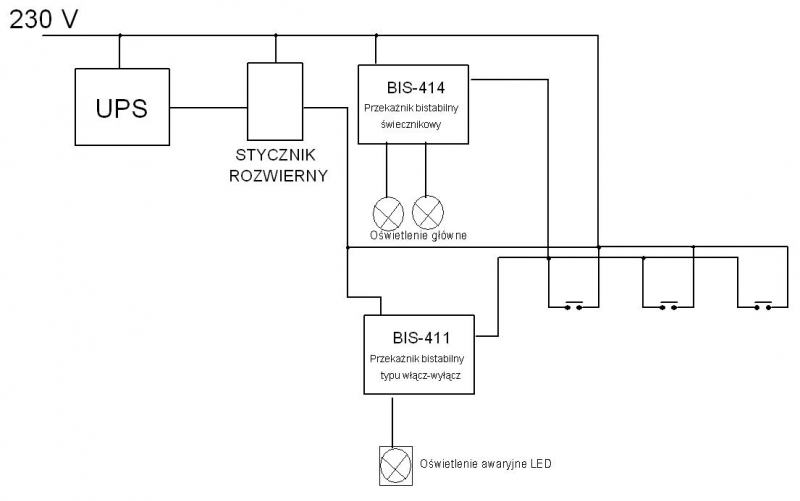
    I am in the process of designing the electrical installation in my new detached house. I am very keen to have "intelligent" emergency lighting, i.e. to have at least one LED strip (lamp) in each room, which would replace a traditional candle or torch during power failure. In most of the rooms, I will have what I would call traditional lighting, i.e. switching on and off on normal one-button switches, but with two poles (the second circuit is the emergency one). I have stopped at the hallway, however, because I want to have lighting switched from three points and two segments of bulbs. I'd like to use a commercially available BIS-414 sequential bistable relay (candlestick relay). I know how to connect it, but I'd like to ask for your advice whether the diagram I've sketched will work properly and which contactor I've called an NC (I think they exist) you could recommend.
    The diagram below is a block diagram without distinguishing between L, N, PE wires:
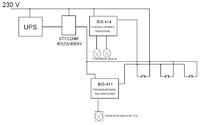
    Intelligent emergency lighting in hallway with relay BIS-414 - diagram
  • ADVERTISEMENT
  • #2 12495429
    pafciowaw
    Automation specialist
    Posts: 2439
    Help: 480
    Rate: 364
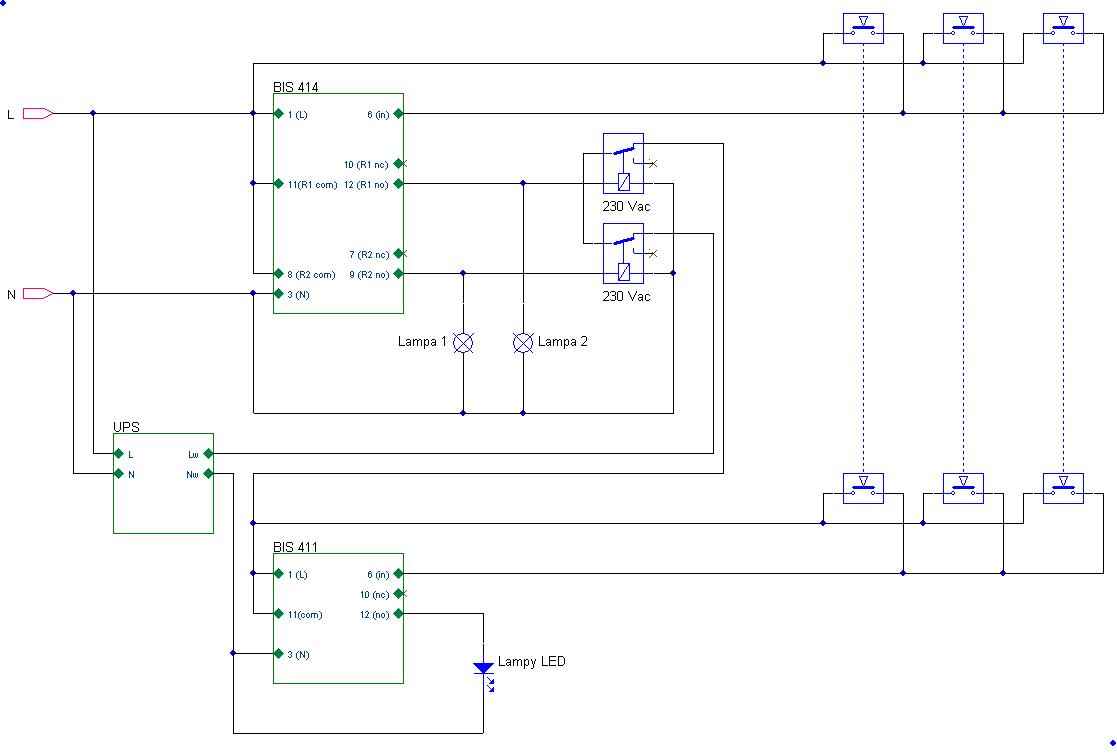
    2 relays can be added;
    driving lamp circuit 1 or 2 - will simultaneously open the power circuit of BIS 411 and the LED's.
    This solution is good - because the relays are only energised when the lights are switched on. In the "idle" state, no current is drawn. Intelligent emergency lighting in hallway with relay BIS-414 - diagram
    One drawback - there may be a brief flash of the emergency light when the main circuit lighting is switched on.
    Advantage: galvanic separation of main and UPS power supply.
  • #3 12495510
    RomanFilipecki
    Level 18  
    Posts: 217
    Help: 22
    Rate: 32
    And haven't you thought what the UPS is for. Wouldn't it be better to use the low DC voltage to power the LED lighting circuits, plus you open the way for optimal future connection of photovoltaic panels.
  • ADVERTISEMENT
  • #4 12495701
    Jenolo
    Level 10  
    Posts: 21
    Help: 1
    Rate: 5
    The UPS would also power a pump and a cooker controller and two fridges, and now you can easily buy small LED fittings for 230V....

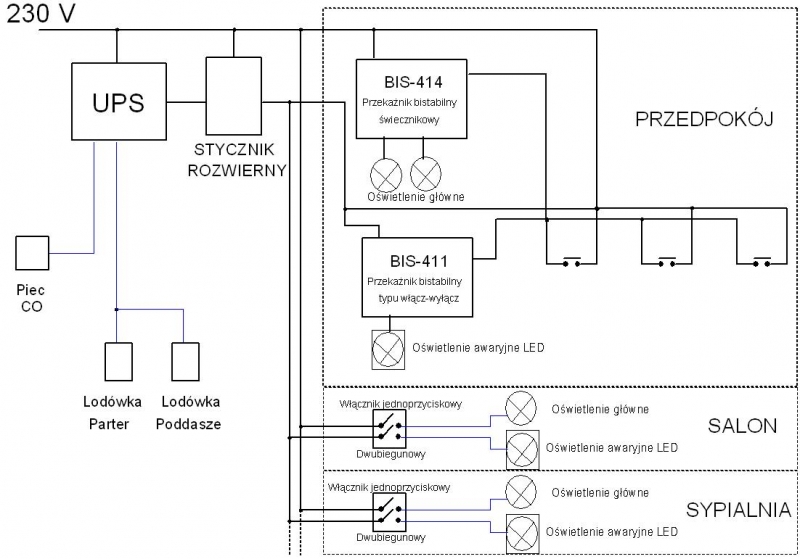
    pafciowaw this relay contactor that opens the circuit from the UPS I would like to use for all the emergency lighting in the entire house, I have preliminarily calculated with about 15 LED luminaires at 230V consuming about 3W each. If I were to use the solution proposed by you, I would probably have to put such a relay behind each switch, which would increase the cost of installation considerably

    this is a more elaborate block diagram of my idea for an emergency installation:
    Intelligent emergency lighting in hallway with relay BIS-414 - diagram
  • #5 12495947
    RomanFilipecki
    Level 18  
    Posts: 217
    Help: 22
    Rate: 32
    I at my home want to switch to 24vdc power for lighting, powering laptops, communications etc, operated by local controllers to ensure lights are switched on, off, power adjusted. 24v power from a battery charged by panels and a fan.
    My aim is to reduce energy consumption. With this solution, the main lighting can run at all times.
    Out of curiosity, a laptop turned on for 24 hours consumes about 1kWh of electricity, and at the moment I use up to 400kWh.
  • ADVERTISEMENT
  • #6 12500694
    Jenolo
    Level 10  
    Posts: 21
    Help: 1
    Rate: 5
    I have a question, for this emergency lighting installation, is it sufficient if I lead the wires to the switches with 4 x 1.5 conductors, i.e. a common N, PE and separate phases for the main lighting and emergency lighting, or do I have to give 5 conductors, a separate N also for the emergency lighting?
  • ADVERTISEMENT
  • #7 12501154
    Pawel2420
    Level 31  
    Posts: 1554
    Help: 136
    Rate: 101
    The solution you have come up with is quite complicated and the rules will be unreliable. Usually, so-called emergency lighting is implemented in the simplest possible way.
    E.g. a staircase where someone might trip in the dark and do something to themselves can be gently permanently illuminated.
    If you combine just three components: a DC power supply for LEDs, a LED bulb and a small gel battery, you get what you need. That is, no extra wires, relays, contactors, etc. If something breaks, you will probably detect it quickly and not at the moment when the emergency lighting is supposed to work
  • #8 12501480
    Jenolo
    Level 10  
    Posts: 21
    Help: 1
    Rate: 5
    You may be right; although you forgot the fourth element like a battery charger; but you don't live in my village where the electricity goes out very often...I already have in my old house (the new one I am putting next door), probably 10 different candles to finish, 2 torches in which I have already changed the batteries several times.... if there's an opportunity to do something to improve and make my evening commute easier during a power outage, I'd like to do it. My parents, who will be living on the ground floor, and my wife like the idea, my wife even more so because we have a little 10-month-old daughter.
    Is it complicated? I don't think so, it's enough to use double-pole switches instead of the usual ones, an additional relay in the two hallways and more wires. And since we decided to buy a UPS for the cooker anyway, it would be a sin not to use it for emergency lighting.
  • #9 12501598
    Pawel2420
    Level 31  
    Posts: 1554
    Help: 136
    Rate: 101
    The DC power supply is the charger.
    The solution in practice was realised if I remember correctly with a 0.5-10V 350mA power supply, a 12V LED bulb and a 6V 3Ah battery. The cost of the whole thing is a few tens of zloty.
  • #11 12827412
    opto17
    Level 13  
    Posts: 131
    Help: 8
    Rate: 22
    simply use the original luminaires or add emergency modules to existing ones
ADVERTISEMENT