Czy wolisz polską wersję strony elektroda?
Nie, dziękuję Przekieruj mnie tamstoos wrote:The traditional zipper head has this in common with its "length" increasing as it closes
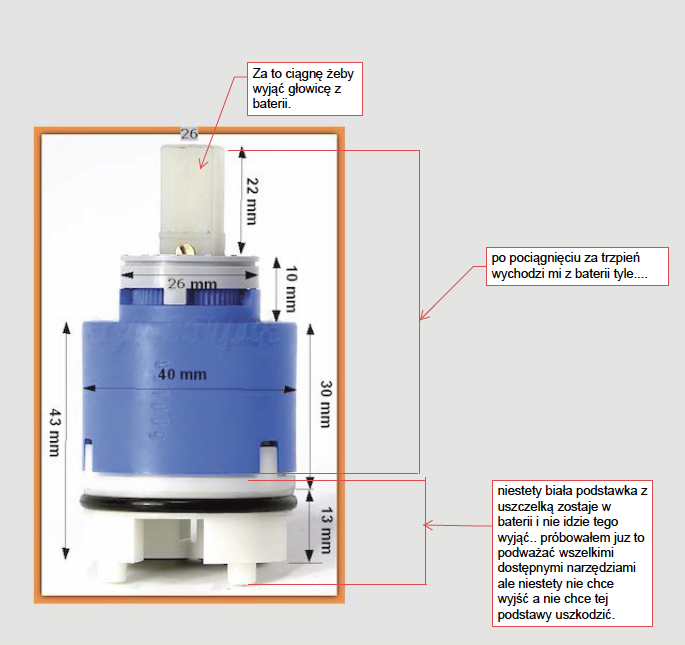
The dimension of the ceramic heads is constant, and if the place where it is screwed is longer than its dimension, the water must drip,
in such cases, you have to resort to the ways that a colleague wrote above
attyde wrote:I had the same. It turned out that the faucet has two holes (hot and cold water) of the same diameter, and the outlet is larger. The original gasket just couldn't seal it. I made a gasket from an old inner tube.I turn on the main valve and the water runs in full stream
chickenik77 wrote:Where it is? Maybe in Krakow (especially in the neighborhood of the Ugorek estate)? If so, I could see it (I don't have a car or a "license", so preferably Os. Ugorek or on the route of the 424 bus).I unscrewed the screw completely and tried it with a hammer. Nothing helps wrestling.
TL;DR: Up to 70 % of post-repair drips come from cartridge length or gasket mismatch [PlumbingIndustry, 2021]. “The position of the valve does not matter” [Elektroda, saskia, post #12533578] Match length, seat, and seals; descale before force. Why it matters: fixing one €10 part can cut 90 L of wasted water daily.
• Typical ceramic head lengths: 24 mm (basin) or 35–40 mm (kitchen) [PlumbingEurope, 2020] • Replacement cartridge price range: €6–€18 retail (EU) [DIY-Market, 2022] • Allowed leakage after repair: ≤ 0.1 L/min under 3 bar per EN 817 [CEN, 2018] • Limescale dissolves 30 % faster in 50 °C vinegar than at 20 °C [ChemLab, 2019] • Food-grade silicone grease temperature range: –40 °C to 200 °C [Manufacturer-Data, 2021]