


logo elektroda
logo elektroda
X
logo elektroda

How to automate roller shutters at home without cables? The cheapest radio solutions

czacha414 23655 16
Best answers

How can I automate several home roller shutters more cheaply without running cables, ideally with radio control or a simple switch system?

A plain socket-type radio switch will not do this by itself; you need a shutter controller or a relay circuit that translates the receiver’s ON/OFF into the separate open and close commands, because the motor must be switched through its limit-controlled shutter logic [#12782150][#12782689] One suggested low-cost approach is to use a relay with a 230 V AC coil: wire the switching contact for ON to the open button and the switching contact for OFF to the close button, and rely on the built-in limit switches to stop the motor at the end positions [#12782689][#12784777] If the original wall buttons have only one contact, use relays with one changeover contact and one rest contact; if they have more contacts, match the relay contact count accordingly [#12784777] Another practical option is a dedicated roller-shutter controller module, built into each shutter box, which can be programmed so a brief press runs a full cycle and a longer press allows partial movement [#12782736][#12783897] For a ready-made solution, there are time/roller-shutter controllers such as FIF modules that let you set the operating time for each shutter individually [#12795104][#13204302]
Generated by the language model.
ADVERTISEMENT
Treść została przetłumaczona polish » english Zobacz oryginalną wersję tematu
  • #1 12782009
    czacha414
    Level 9  
    Posts: 32
    Rate: 9
    Warm welcome,

    I have 4 roller shutters in 3 rooms at home (on the 1st floor), each with a separate up/down switch, the shutters are not connected in any way.
    It takes me a long time to open/close all of them as I have to wait a while for each one, which is why I would like to automate this process. It doesn't really matter to me whether I use a radio remote control or a flush-mounted switch. It's also irrelevant whether I have to hold down a button while lowering/lifting the roller shutters or if I just have to press it for a while - the important thing is that all the roller shutters are controlled at the same time. I guess that if it wasn't to be radio-controlled, I would have to connect all the roller shutters with some kind of cable and that's why this method is out of the question (long distances between shutters=lots of work to lay cables and hide them). My question is: the cheapest set I've found is 80zl for the receiver + 50zl for the remote control, i.e. almost 400zl in total. Does anyone have any idea how or where to do it cheaper? I must admit that the priority for me is the price...
    Someone advised me to use a radio switch from auction portals (cost of 4 pcs + remote control about 100zł) - something that is mounted between an electrical device and a socket in the wall. The remote control is used to switch the current flow from the socket on/off. If I understand it correctly, this would not work, because if the on button would raise the roller blinds (if mounted in front of the raise button), the off button on the remote would not lower them, because the `off` is in fact only used to cut the current, not to release the current to the lower button?
  • ADVERTISEMENT
  • #2 12782150
    ankowalik
    Level 24  
    Posts: 997
    Help: 4
    Rate: 142
    czacha414 wrote:
    does anyone have any idea how or where to do this cheaper? I'm not hiding the fact that price is a priority for me...
    Someone advised me to use a radio switch from auction portals (the cost of 4pcs + remote control about 100zł) - that is, something that is mounted between the electrical device and the socket in the wall. The remote control is used to switch the current flow from the socket on/off. If I understand this correctly it would not work because if the on would for example raise the roller blinds (if mounted in front of the raise button for the roller blinds) then the off on the remote would not lower them because `off` in fact only serves to cut the current and not to release the current to the lower button?
    What someone advised needs to be supplemented by a circuit ( with limit switches) alternately opening and closing the roller shutters with a single ON command.
  • #3 12782158
    czacha414
    Level 9  
    Posts: 32
    Rate: 9
    I'm not sure I understand correctly. An alternating open/close system with a single button means that, for example, when the shutters are fully opened with the `on' button, the system would automatically switch to shutter closing mode, when closed it would switch back to opening, yes? Is such a system practicable or is it just a hypothetical consideration?
  • ADVERTISEMENT
  • #4 12782196
    deksta84
    Level 24  
    Posts: 638
    Help: 50
    Rate: 84
    None of this, and how is the circuit supposed to know that it is not going to start opening again after being held down for a long time? Better two circuits separately (close, open). It's all there for the taking. What voltage do these roller shutters run on? Is there any rasping in the mechanism when you hold closing, opening, which would indicate that the desired stops are not present. The easiest way to do this is to wire the relevant switches together, but then you are giving up a separate control. For isolation you could use a circuit on relays and a small microprocessor. Which would not dispose you of the right to separate control. Do you understand the idea? You go to room 1: you press a button, you go to room 2: you press a button, you go to room 4: you press a button, to room 3 you don't go: it's still closed. You don't wait for it to open/close, you go on as you feel like opening/closing the rest.
  • #5 12782421
    czacha414
    Level 9  
    Posts: 32
    Rate: 9
    The roller shutters are powered directly from the mains, and it seems to me that they have limiters (if I understand the word correctly) because they stop working when fully open/closed, even though I keep pressing the button. And I like the idea of briefly pressing the raise/lower button on the roller shutter without having to hold it, I hadn't thought of that at all..... But how do I put this idea into practice?
  • #6 12782689
    ankowalik
    Level 24  
    Posts: 997
    Help: 4
    Rate: 142
    And when you get some sleep you have a much simpler and cheaper solution :D
    For this control someone advised you connect a relay with a 230V AC coil.
    You connect the switching contact after the command "ON" to the "open" button. The switching contact after the command "OFF" you connect to the "closing" button.
    The fact that the relay holds/does not hold for several hours is irrelevant because there are limit switches.
    salut
    andre
  • ADVERTISEMENT
  • #7 12782736
    deksta84
    Level 24  
    Posts: 638
    Help: 50
    Rate: 84
    I would build four separate controllers to be built into the roller shutter control box. The switches on the wall would be connected to the controller e.g.: press briefly, the controller forces full movement, hold longer, the controller allows incomplete movement. An even simpler solution is to replace the switches with fixed switches. There are double switches with protection so that two opposing movements are not triggered. The simplest is just a three-position switch with a lever with two switchable circuits and a small housing. Unit cost: £5.
  • #8 12783427
    czacha414
    Level 9  
    Posts: 32
    Rate: 9
    ankowalik wrote:
    Well, if you get sleepy, you have a much simpler and cheaper solution :D
    For this control someone advised you connect a relay with a 230V AC coil.
    You connect the switching contact after the command "ON" to the "open" button. The switching contact after the command "OFF" you connect to the "closing" button.
    The fact that the relay holds/does not hold for several hours is irrelevant because there are limit switches.
    salute
    andre
    So should I look for a relay with a 230V coil? If I have a quick look at, for example, auction sites, there are a lot of such relays, it is difficult for a layman to find the right one...

    Added after 13 [minutes]:

    deksta84 wrote:
    I would build four separate controllers to be built into the roller shutter controller box. The switches on the wall would be connected to the controller e.g.: press briefly, then the controller forces full movement, hold longer, then the controller allows incomplete movement. An even simpler solution is to replace the switches with fixed switches. There are double switches with protection so that two opposing movements are not triggered. The simplest is just a three-position switch with a lever with two switchable circuits and a small housing. Unit cost: 5zł.
    The first idea with 4 roller shutter controllers seems very good only where to look for such a controller , or what is its professional name I will look for myself? The second idea is to change the switches working in 3 modes (if I understand the idea correctly: switch in position 1 raises the blind, position 2 - nothing happens, position 3 - lowering, yes?). Where can I find such switches and the same with the first method - under which name can they be found in shops? With this method, I am also wondering how it works: if I push the switch to position 1 - raising the roller shutter, for example - I understand that after the roller shutter is fully raised, the `switch' will cut off any further movement of the roller shutter, yes? How does this work in practice? Would it not be a problem for the roller shutter motor or the cut-off switch if the roller shutter switch is left in this raise/lower position rather than in the neutral position for longer?
  • ADVERTISEMENT
  • #9 12783897
    deksta84
    Level 24  
    Posts: 638
    Help: 50
    Rate: 84
    Controller, this needs to be built and programmed. Look for lever switches.
  • #10 12784777
    ankowalik
    Level 24  
    Posts: 997
    Help: 4
    Rate: 142
    czacha414 wrote:
    So I have to look for a relay with a coil for 230V? If I have a quick look at, for example, auction portals, there are a lot of such relays, it is difficult for a layman to find the right one...


    I assume that the original buttons have one contact, so buy relays with one switching contact when the relay is active and one switching contact when the relay is "at rest". That is, two contacts switching alternately.
    If the buttons have more contacts, then relays, of course, with the same number of contacts.
  • #11 12787550
    czacha414
    Level 9  
    Posts: 32
    Rate: 9
    I am considering yet another solution. Please correct me if I am writing nonsense. Since I have a limit mechanism in my roller shutter motors, how about replacing the current raise/lower switch (which works on the principle: both buttons are in the down position, if you want to raise/lower it, you press the button to the up position and immediately when you release it, it goes back to the down position) with a fixed button with 3 positions (1st position - raise, 2nd position - neutral, 3rd position - lower)? For example, when I want to lower a roller shutter completely, I simply walk up to each window and push the button to position 3 and leave it there. The roller shutter lowers, the limit switch switches off the motor and the button remains in position 3 until the next use. I know this is not an ideal solution as I still have to go to each window to close all the roller shutters, but instead of standing at each window for 20 seconds, I just walk up, press the button and immediately go to the next one and in 20 seconds I have gone around all of them? Does this solution make sense from a technical point of view? Wouldn't it be too much of a strain for the limit mechanism to constantly receive a signal from the roller shutter switch that, for example, lowering is pressed?
  • #12 12787730
    Ryszard49
    Level 39  
    Posts: 6186
    Help: 312
    Rate: 1004
    Hello.
    You can buy a simple switch for roller shutters and the matter is settled. I have a radio-controlled remote control at my place, with a 1-channel switch at each roller shutter. We can control it from the remote control or each roller shutter separately from the control unit switch. There are three buttons: up, down and stop. In my case, unfortunately, the control did not work. The remote control has too short a range and I have to be in the central point of the flat to control all the roller shutters.
    Regards.
  • #13 12787746
    czacha414
    Level 9  
    Posts: 32
    Rate: 9
    Ryszard49 wrote:
    Hello.
    You can buy a simple switch for the roller shutters and the matter is settled. I have a radio-controlled remote control at my place, with each roller shutter a control unit - switch 1 channel. We can control it from the remote control or each roller shutter separately from the control unit switch. There are three buttons: up, down and stop. In my case, unfortunately, the control did not work. The remote control has too short a range and I have to be in the central point of the flat to control all the roller shutters.
    Greetings.
    I know it is possible, the question is the total cost of purchase? I have 4 roller-blinds, the cheapest solution I have found (i.e. remote control + 4x controllers - 1 for each roller-blind) comes to approx. 400PLN, and my question is whether it can be done more cheaply?
  • #14 12795104
    deksta84
    Level 24  
    Posts: 638
    Help: 50
    Rate: 84
    If you care about the time it takes to close the roller shutters, e.g. to get out of work quickly, then perhaps a simple timer for those 25 seconds of operation. If you want to save a lot of money, then only a fixed switch. Maybe the built-in ones have an extendable return spring?
  • #15 12795824
    czacha414
    Level 9  
    Posts: 32
    Rate: 9
    deksta84 wrote:
    If you care about the time it takes to close the shutters, e.g.: fast exit to work, then maybe a simple timer, for those 25 seconds of operation. If you want to cut costs very much, then only a fixed switch. Maybe the built-in ones have an extendable spring return?
    I don't know if it's a good description that I care about the shutter closing time - I would put it this way, that I care about not having to stand next to each shutter and hold the button down while lowering/lifting - I have several windows and I do this a minimum of 4x a day so it adds up to a lot of time. I haven't dismantled the current switches but I suspect they work on the principle of some kind of spring that pulls the switch back when released. Regarding the idea of fitting a 3-position permanent switch (lowering/neutral/lifting) - if I fit such a switch and sometimes leave it in a non-neutral position, will my roller shutter control equipment not be adversely affected? What do you mean by `ordinary timer'?
  • #16 12798748
    deksta84
    Level 24  
    Posts: 638
    Help: 50
    Rate: 84
    Look for simple time switches e.g. Link .

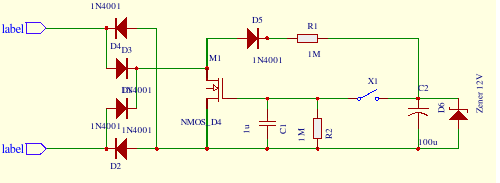
    I have sketched the diagram below "on the fly". The component values are still to be thought about. The principle of the circuit is the timing determined by the C1R2 circuit. When switch X1 is briefly shorted, the current from capacitor C2 will charge capacitor C1. The transistor will short the ends of the label, via a Graetz diode bridge, until resistor R2 discharges capacitor C1. Such a circuit, together with a lever switch, would need to be placed in parallel with the contacts of the existing switches.

    Pull out one pair of switches and take a picture of the wires (do not move the wires from the switches).


    How to automate roller shutters at home without cables? The cheapest radio solutions


    Edit
ADVERTISEMENT