logo elektroda
logo elektroda
X
logo elektroda

How to control the BIS-411 230V relay using an Arduino?

voe 4986 12
ADVERTISEMENT
Treść została przetłumaczona polish » english Zobacz oryginalną wersję tematu
  • #1 13578707
    voe
    Level 10  
    Posts: 9
    Welcome,

    I have an electrical installation at home made with BIS-411 230V relays and I am interested in whether it is possible to control such a relay using a computer, e.g. Arduino?

    If so, I would be grateful for directing me where and how to look for information on this subject.

    Please understand - I am a programmer and my knowledge of electronics is rather low :)
  • ADVERTISEMENT
  • #2 13578903
    Marek Nawrocki
    Level 27  
    Posts: 685
    Help: 98
    Rate: 136
    Hello !!!
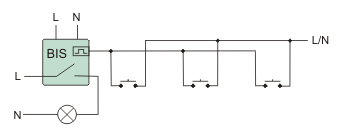
    You can only make an arduino circuit that would control the relays and connect the contacts of these relays in parallel to the control buttons.
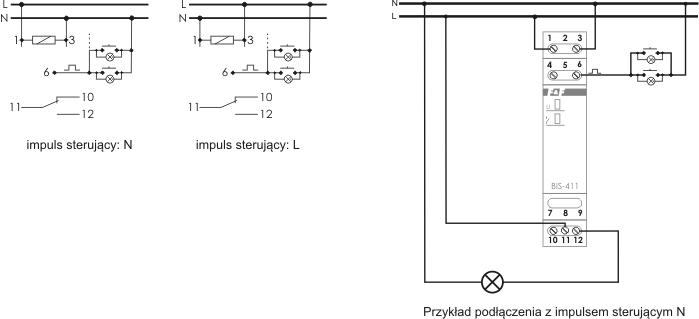
    Generally to control Bis - 411 there must be a terminal no.4 or 6 momentarily shorted to the neutral wire "N" of the installation , but you can also control through the phase pulse "L" . How to control the BIS-411 230V relay using an Arduino?
  • #3 13579710
    stkop
    Level 15  
    Posts: 121
    Help: 14
    Rate: 7
    A little OT: What was the genesis of using these BIS relays in your installation? Do you have all your lighting circuits implemented like this?
  • ADVERTISEMENT
  • #4 13581236
    voe
    Level 10  
    Posts: 9
    Marek:
    Thanks for the answer. That you have to make a short circuit is what I understand. Normally I make a short circuit with a bell switch. The question is how to make this short circuit with the Arduino. From what I understand, with BIS-411 230V relays, a current of 230V flows at the time of the short circuit. Would it be easier to make this short circuit using BIS-411 24V relays?

    stkop:
    I have a large part of my lighting done this way. Thanks to this, I can e.g. switch the bedroom light on/off at the entrance and on each side of the bed.
  • #5 13581259
    stkop
    Level 15  
    Posts: 121
    Help: 14
    Rate: 7
    In this case, 24V or 230V doesn't really matter. The relay is both a switch and an isolator [separation] to the Arduino.

    A much more serious issue to solve is how the Arduino is supposed to 'know' what state a circuit is in at any given time [on or off].
  • ADVERTISEMENT
  • #6 13581301
    voe
    Level 10  
    Posts: 9
    I will admit that how the Arduino is supposed to "know" what state the circuit is in has not been thought of so far.

    To start with, I wanted to do something very simple - see how to simulate the "click" of a bell switch with the Arduino.

    If I have, for example, such a module: http://arduinosolutions.com/pl/p/Modul-z-4-przekaznikami-z-transoptorami/669, can I directly connect it to my Bis-411 relay or am I still missing something?
  • Helpful post
    #7 13581318
    stkop
    Level 15  
    Posts: 121
    Help: 14
    Rate: 7
    Just for the record... actually with a board like this you don't need BIS's anymore.... you would have to connect the NO buttons to the Arduino inputs.... And that would only be, as a matter of fact, in accordance with the art.
  • #8 13581334
    Marek Nawrocki
    Level 27  
    Posts: 685
    Help: 98
    Rate: 136
    Hello !!!
    I agree with colleague "stkop". It is also possible to make executive systems on optocouplers and triaks , I just don't know if the triac will be controlled at the load "Bis -411".
    A higher-power optotriac can be used, e.g. S202S02 .
    such as on the drawing How to control the BIS-411 230V relay using an Arduino?
    Then from the Arduino you only control the diode on legs 3,4 and you have galvanic isolation.
    You would have to see if such a triac would drive the "Bis - 411".
    Such a module as you provided in the link is best suited for this.
    But if you have such a module then, as colleague "stkop" suggests, you do not need "BIS-411"
    and for this it replaces 4 pcs. "Bis - 411" and you can add other things you can think of in Arduino, e.g. certain lamps switched on for a certain time, or switching off at a given hour. You will write all logic in Arduino.
    Greetings !!!
  • #9 13581494
    voe
    Level 10  
    Posts: 9
    Gentlemen,

    I do not want to give up the BIS-411 relays in favour of the Arduino for the reason that if the Arduino dies, all the circuits controlled by it will die. Currently when BIS-411 fails, only one circuit fails. I would like the control from Arduino to be just a "feature", which will eventually enable me e.g. to switch on the light from my mobile phone. I would preferably use ready-made modules for this.

    Please correct me if I am wrong. Let's assume that I have a working installation on BIS-411 and I do not want to change it. By connecting one of the relays on the module I have given above to terminals 3 and 6 of the BIS-411 relay and programming it accordingly, am I able to achieve the desired effect?

    Greetings

    How to control the BIS-411 230V relay using an Arduino?
  • Helpful post
    #10 13581512
    Marek Nawrocki
    Level 27  
    Posts: 685
    Help: 98
    Rate: 136
    Hello !!!
    Exactly as you write , everything will work.
    Just check if your BIS-411 is connected to terminal 6 or 4, it depends on the type of Bis-411.
    And at the module you connect to the relays on the contact "NO" normal open , but you probably know that.
    Greetings !!!
  • #11 13581521
    voe
    Level 10  
    Posts: 9
    Super! This is exactly the kind of confirmation I was looking for. Thank you very much for your help :)

    Greetings
  • ADVERTISEMENT
  • #12 13581539
    stkop
    Level 15  
    Posts: 121
    Help: 14
    Rate: 7
    As for the idea of synchronising the state of the output with the arduino, you could, for example, power some small relay with the output of the BIS, but with a control coil for 230V. Feed the output of this relay to the input of the arduino. Only that the whole thing will make a rather crude impression... 3 relays to control one point [sic!]
  • #13 13600520
    voe
    Level 10  
    Posts: 9
    Thanks again for your help! I am closing the topic.
ADVERTISEMENT