Hello,
The first Frenchman and already problems. 1.5 dci engine.
The car is from 2014 on the machine.
I bought it recently and so far traveled with me 350km. Before yesterday I went to the city, I bet for 1 hour and did not smoke after returning. Service, candle light, check, stop, esp lit and displayed "Risk of engine failure" message.
I left the car and returned after a few hours. Strangely, he fired without a problem.
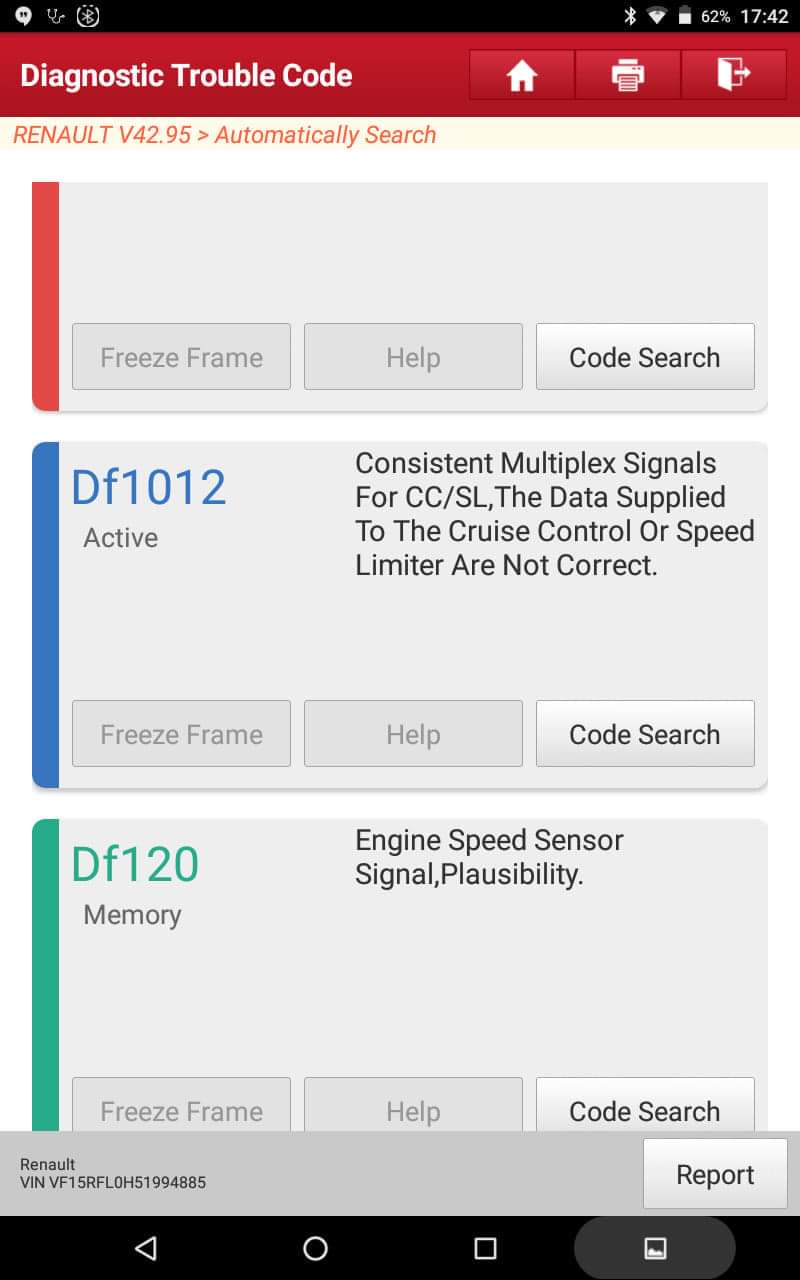
I connected and showed errors:
DF1012- Compatibility of multiplexed stable speed speed signals / speed limiter (CC / SL) - Send incorrect data to CC / SL.
DF771- Adaptive flow regulation values- Below the lower limit.
I was looking for information on the Internet with what to bite and I did not find the answer.
I got home and did not smoke yesterday morning.
The same indicator lights on the display again show "risk of engine failure" and additionally "Check the hill start aid". There was still "check UP .. something? I just haven't registered and didn't show up again.
Errors same.
I checked the battery with a meter, around 12.3V, after a while it showed 11.9. So I charged and only 12.4. Try-fired all evil spirits left him. I measured the battery again, 12.3.
Can these jokes be caused by a weak battery?
What else ... I had 3/4 fuel tank, the indicator jumped up and shows full. The tip only drops after removing the card.
I still have a message that the rear three straps fastened. After connecting the computer, it shows all the time that the sensor's open circuit. I raised the couch, it turned out that the sensors were connected, but the cable from them hangs free. At the end of the cable 4 pins but no plug. And the cable to which it could be connected is also missing. Where would such a cable come from? Or can these sensors be turned off?
The first Frenchman and already problems. 1.5 dci engine.
The car is from 2014 on the machine.
I bought it recently and so far traveled with me 350km. Before yesterday I went to the city, I bet for 1 hour and did not smoke after returning. Service, candle light, check, stop, esp lit and displayed "Risk of engine failure" message.
I left the car and returned after a few hours. Strangely, he fired without a problem.
I connected and showed errors:
DF1012- Compatibility of multiplexed stable speed speed signals / speed limiter (CC / SL) - Send incorrect data to CC / SL.
DF771- Adaptive flow regulation values- Below the lower limit.
I was looking for information on the Internet with what to bite and I did not find the answer.
I got home and did not smoke yesterday morning.
The same indicator lights on the display again show "risk of engine failure" and additionally "Check the hill start aid". There was still "check UP .. something? I just haven't registered and didn't show up again.
Errors same.
I checked the battery with a meter, around 12.3V, after a while it showed 11.9. So I charged and only 12.4. Try-fired all evil spirits left him. I measured the battery again, 12.3.
Can these jokes be caused by a weak battery?
What else ... I had 3/4 fuel tank, the indicator jumped up and shows full. The tip only drops after removing the card.
I still have a message that the rear three straps fastened. After connecting the computer, it shows all the time that the sensor's open circuit. I raised the couch, it turned out that the sensors were connected, but the cable from them hangs free. At the end of the cable 4 pins but no plug. And the cable to which it could be connected is also missing. Where would such a cable come from? Or can these sensors be turned off?