logo elektroda
logo elektroda
X
logo elektroda

battery in the trunk - connection to the battery and cut-off switch plus

HUBPOZ 10284 18
Best answers

How should I wire a trunk-mounted battery and master cut-off switch, and can I use a thinner factory cable together with a thicker one?

Use one properly sized cable instead of mixing a thick and a thinner one in parallel, and if the cut-off switch is mounted near the battery, disconnecting the negative side to the body is commonly recommended as the safer approach [#16672116][#16672954] The alternator should stay connected directly to the battery, bypassing the switch, because cutting the battery off while the engine is running can create a voltage surge that can damage the rectifier diodes [#16673415][#16675226] When you move the battery to the trunk, increase the cable cross-section compared with the factory battery-starter lead; one reply suggests at least one size above stock, and for a 90 A alternator at least 10 mm², preferably 16 mm² [#16672116][#16672954] If you run separate starter and vehicle-supply cables, they should only join at the battery or distribution point, not along the route, because current will not share evenly between different wire sizes and a fault in one wire can overload the rest [#16672954]
Generated by the language model.
ADVERTISEMENT
Treść została przetłumaczona polish » english Zobacz oryginalną wersję tematu
  • #1 16671502
    HUBPOZ
    Level 11  
    Posts: 26
    Rate: 3
    battery in the trunk - connection to the battery and cut-off switch plus


    Hello,
    I am moving the battery to the trunk, and want to install a battery cutout.
    I wonder which is the safest option.

    I am not an electrician, therefore I am worried about the load capacity of a thinner cable line.

    I read conflicting opinions about the solutions for connecting several cables, e.g.
    two with the same cross section thinner instead of one thick in between
    one receiver and source.

    In my case, one is thicker and the other is thinner.

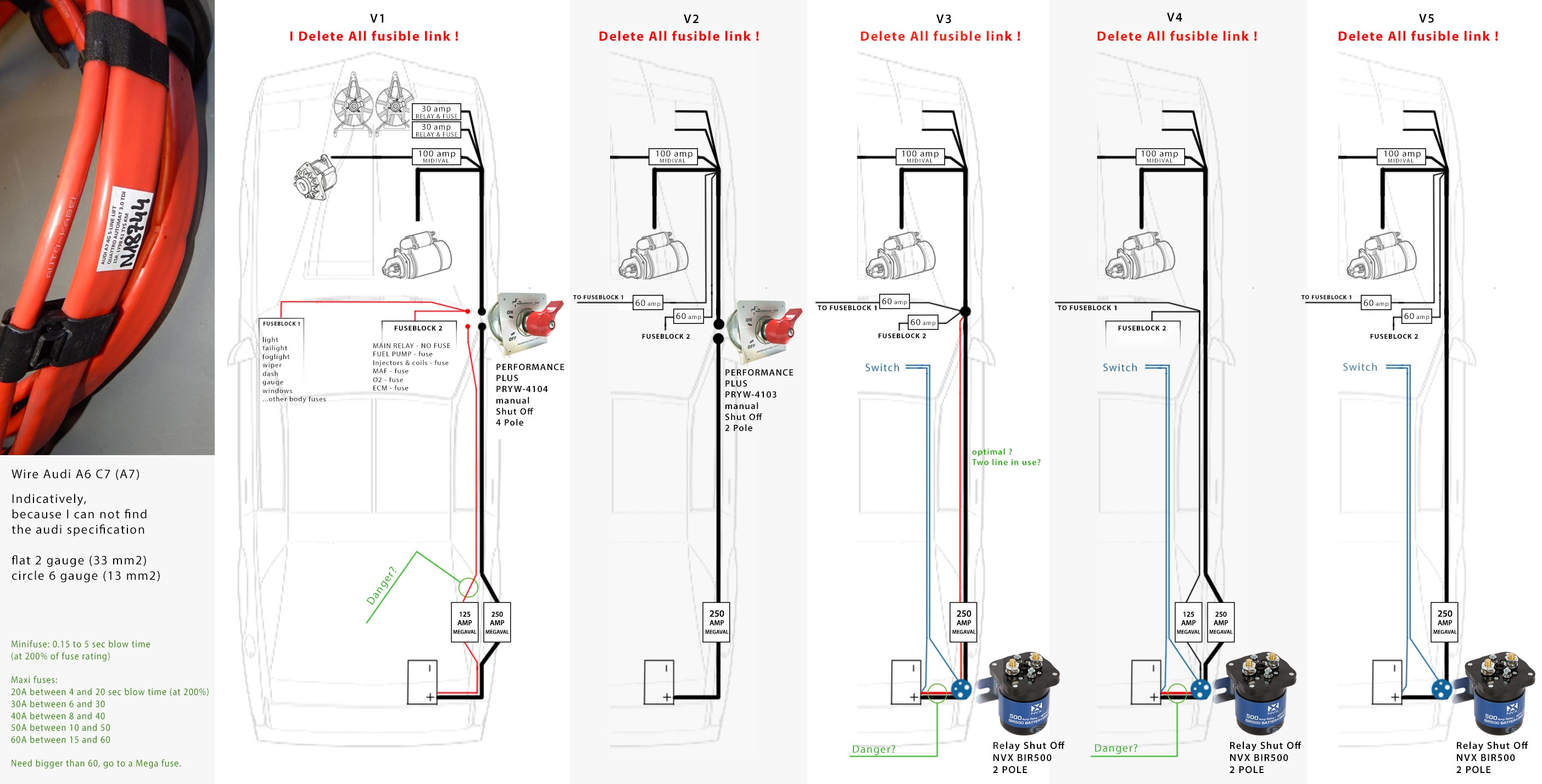
    Unfortunately, I do not know what parameters and diameters the audi cable has,
    hence I wrote roughly.
    and I do not know what the thinner cable was used for at the factory,
    whether to the fuse box or directly to the alternator.
  • ADVERTISEMENT
  • #2 16672116
    teskot
    Rest in Peace
    Posts: 2969
    Help: 420
    Rate: 951
    If you absolutely need to move the battery backwards, see how the factory solutions are implemented (BMW, Mercedes). In my opinion, firstly, it makes no sense to separate the power cables of the starter and other receivers (the chapter should be under the hood). Second, the battery disconnect switch should disconnect the "-" battery from the body. This solution is commonly used and safer. In addition, note that the cross-section of the cable you will need is at least one step higher than the factory battery-starter cable.
  • #3 16672204
    Dziarski Hank
    Level 34  
    Posts: 2051
    Help: 245
    Rate: 927
    teskot wrote:
    Second, the battery disconnect switch should disconnect the "-" battery from the body. This solution is commonly used and safer.


    Why, then, are cars using pyrotechnic clamps on the plus side, and in motorsport, are current disconnectors on the plus cable with a pump / ECU disconnector and a discharge resistor?
  • #4 16672695
    teskot
    Rest in Peace
    Posts: 2969
    Help: 420
    Rate: 951
    Switch disconnector directly on the terminal + here you are, the pump / ECU switch on the power cable is also the most, especially because it is preceded by a fuse of a relatively small value. But the departure from the + battery with a 35 or 50mm2 cable to the disconnector, and then to the installation, does not convince me very much. In the event of an "event", we are left with a section of the wire that is always live and the disconnector terminal itself. In my opinion, the use of such a disconnector on the ground wire is safer, because it will not be possible to disconnect the voltage if necessary, but we do not introduce any additional risk.
    Anyway, I'm not going to argue about whether to disconnect + or -. I wrote how I would do it, and the author will do it as he wants.
  • ADVERTISEMENT
  • #5 16672699
    Dziarski Hank
    Level 34  
    Posts: 2051
    Help: 245
    Rate: 927
    It wasn't a malicious question. For me, disconnecting the ground seems like a better idea, but as you can see, the facts are against the logic.
  • #6 16672916
    HUBPOZ
    Level 11  
    Posts: 26
    Rate: 3
    battery in the trunk - connection to the battery and cut-off switch plus

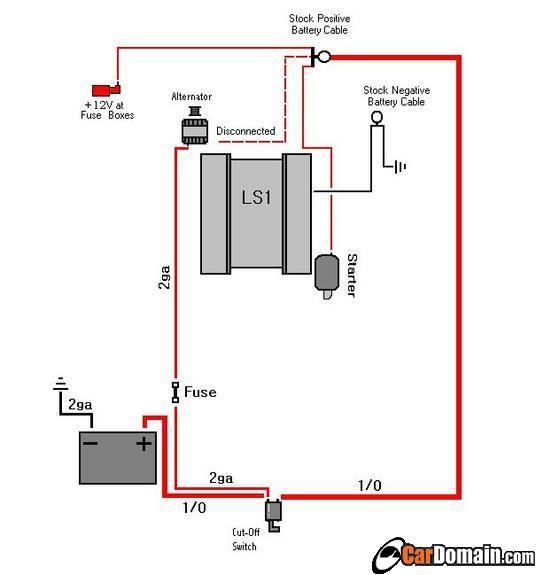
    In the attachment there is a diagram of how they do it in the US to the drug, as is the case with approvals for other rallies. They disconnect a plus.

    Although who I do not talk to, he advises to disconnect the minus ...

    I also noticed that quite often
    the alternator is connected to the battery directly in cars of different manufacturers.
    Unfortunately, I do not know and do not understand for what purpose.

    Unfortunately, I can not find any schematic for audi or bmw how they solve it.
    Because maybe the additional line is just for the alternator.

    As for the cable cross-section, unfortunately I do not know what the cross-section of this cable is,
    but it is used in many Audi models, it has its length so I think the manufacturer
    took into account its size to length.

    As for disconnecting the mass instead of a plus, I would have to lead a second, quite long cable if it was to be disconnected with a manual switch. (shorter if the magnetic relay is located in the trunk)

    What is safety in motorsport is usually detached outside the car,
    and in commercial vehicles, the pyrotechnic clamp disconnects immediately at the battery for safety.
    I, on the other hand, want to disconnect in the cabin due to the fact that I modified quite a lot
    the entire installation and I want to be in control in case something is fried.

    Therefore, the switch should be in the cabin.
    In fact, disconnecting ground seems to be the better solution.

    There is no live wire left, I will add a wire going under the carpet directly on
    car body. But the problem is that the positive wire would be almost 5 meters and the negative wire would be almost 3 meters instead of one.


    //

    To understand the matter, the most I would like to know is whether the starter current with two wires, one thick, the other 2/3 thinner, will not overheat the thinner one, or the percentage
    it will be distributed according to the resistance of the cables and the thinner wire is safe ??
  • #7 16672954
    teskot
    Rest in Peace
    Posts: 2969
    Help: 420
    Rate: 951
    If you intend to use a contactor close to the battery, it really doesn't matter which pole you disconnect it. I don't understand, why would the mass cable be 3m? After all, you attach it to the car body in the closest place to the battery. If you are going to "release" 2 power lines separate for the starter and separate for the rest of the receivers, they can only be connected on the battery - they still have no right to connect with each other anywhere. And it is not recommended to use a few thinner wires instead of one thicker one, because the current flow will never be the same, and in the event of damage (interruption) of one of the wires, the current will flow through the remaining, functional ones and it may exceed the allowable value for a given cross-section. You can easily connect the B + terminal of the alternator with the terminal of the starter. Or to the point of power distribution to other receivers. In this case, it doesn't really matter. Just pay attention to the appropriate sections. If the alternator is, say, 90A, the cross-section of the battery-alternator cable is minimum 10mm2 (although better 16mm2 ;) . Below are 3 variants of how I would do it:
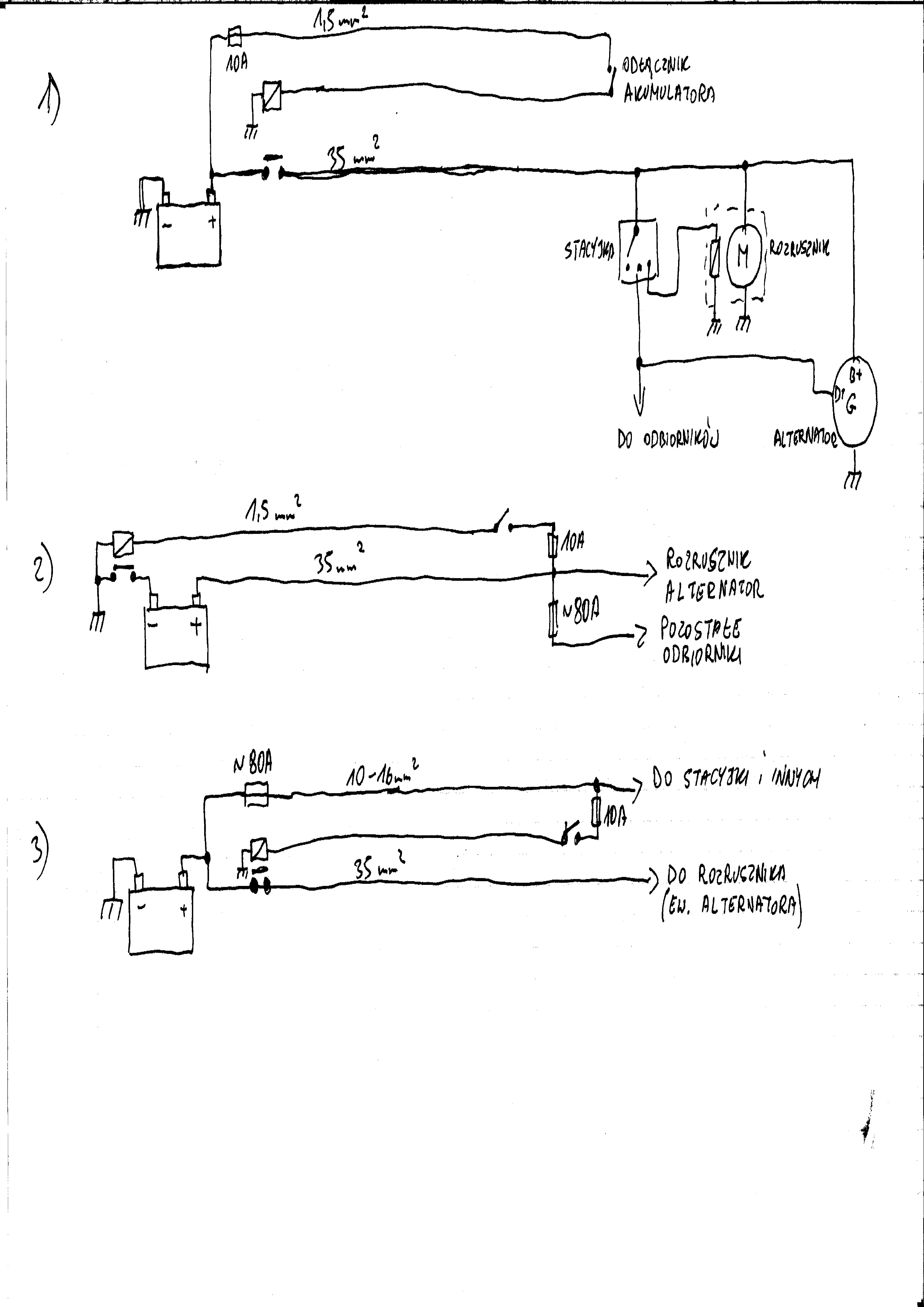
    battery in the trunk - connection to the battery and cut-off switch plus
  • ADVERTISEMENT
  • #8 16673415
    carrot
    Moderator of Cars
    Posts: 8382
    Help: 1306
    Rate: 3544
    The alternator is to be connected to the battery bypassing the switch in order to avoid its damage when the plane is accidentally turned off with the engine running, the second issue is the current switch in the rally car to turn off the engine, so that it would not happen if the battery itself was disconnected (the ECU would work to still powered from the alternator), therefore the switch must not be between the - battery and ground
  • #9 16673528
    HUBPOZ
    Level 11  
    Posts: 26
    Rate: 3
    Why can the alternator be damaged if the battery is cut with the engine running? No receiver? Diesels run as far as I know without a battery and an alternator
    rather it is not disconnected from the terminal (battery not connected = no receiver)

    Added after 1 [hours] 42 [minutes]:

    battery in the trunk - connection to the battery and cut-off switch plus
  • #10 16673807
    Staszek49
    Level 35  
    Posts: 2421
    Help: 228
    Rate: 1138
    Buddy, the "old" diesels could work without a battery and a generator, because they did not have fuel shut-off valve. Current diesels cannot be started without electricity, due to the advanced electronics.
  • ADVERTISEMENT
  • #11 16673988
    Wawrzyniec
    Level 38  
    Posts: 3974
    Help: 390
    Rate: 1065
    In trucks, battery disconnectors are used differently. Some positive, others negative. However, in cisterns and other vehicles for the transport of flammable materials, there is always a minus.
  • #12 16674955
    HUBPOZ
    Level 11  
    Posts: 26
    Rate: 3
    Staszek49 wrote:
    Buddy, the "old" diesels could work without a battery and a generator, because they did not have fuel shut-off valve. Current diesels cannot be started without electricity, due to the advanced electronics.


    it is not about walking without a generator but with an alternator without a battery,
    the question is why the alternator should fail if the current is suddenly cut off while the engine is running.
  • Helpful post
    #13 16675226
    carrot
    Moderator of Cars
    Posts: 8382
    Help: 1306
    Rate: 3544
    The voltage regulator in the alternator works on the principle of switching the voltage on the rotor on / off, it is not a smooth regulation. if you remove it from the load in the form of a battery, there will be a sudden voltage surge and breakdown of the diodes in the rectifier bridge
  • #15 16676878
    Wawrzyniec
    Level 38  
    Posts: 3974
    Help: 390
    Rate: 1065
    He says "operationele power: 15 W".
  • #16 16677327
    teskot
    Rest in Peace
    Posts: 2969
    Help: 420
    Rate: 951
    But I don't think this relay / contactor is suitable for continuous operation.
  • #17 16677360
    kkknc
    Level 43  
    Posts: 23446
    Help: 1901
    Rate: 6611
    It doesn't matter which pole you place the switch on. Although today disconnecting electronics is not the best solution. When moving the battery to the trunk, you need to increase the cable cross-section. And you have to convert it.
  • #18 16679702
    teskot
    Rest in Peace
    Posts: 2969
    Help: 420
    Rate: 951
    Everything has already been said, and the issue of possible damage to the alternator / electronics could be omitted in my opinion. The situation in which we use the disconnector is critical / emergency and at this point the safety of people and their lives is important, not the possibility of damaging the equipment. How we are to act "concretely" there is no sanctity. Use all available means to protect human life. For example, if I were to save a person who had been hit, I would have deep respect whether the protection on the pole would work or whether the transformer station would be hot. Sorry, off top.

Topic summary

✨ The discussion revolves around the safe relocation of a car battery to the trunk and the installation of a battery cut-off switch. Participants debate the best practices for connecting battery cables, emphasizing the importance of using appropriately sized cables to handle the load. There are differing opinions on whether to disconnect the positive or negative terminal, with some advocating for disconnecting the negative for safety reasons. Concerns are raised about potential damage to the alternator if the battery is disconnected while the engine is running, highlighting the need for proper wiring to avoid voltage surges. The conversation also touches on the use of relays and contactors for battery management, with recommendations for ensuring adequate current capacity and safety measures in emergency situations.
Generated by the language model.

FAQ

TL;DR: 90 A alternator needs min 10 mm² (better 16 mm²); "You can easily connect the B+ terminal of the alternator with the terminal of the starter." [Elektroda, teskot, post #16672954]

Why it matters: This FAQ helps DIY car owners moving a battery to the trunk choose safe cable sizes and a proper cut-off strategy for daily and motorsport use.

Quick Facts

Is it safer to put the battery cut-off on plus or minus?

For street setups, many installers prefer cutting the ground. It removes long always-live positive sections and exposed live studs. If the switch is near the battery, either pole works. Prioritize short runs, secure routing, and proper lugs. [Elektroda, teskot, post #16672695]

Why do rally cars cut the + line and add a discharge resistor?

Race switches must stop the engine instantly. If you only cut battery negative, the alternator can keep the ECU and pump alive. Wiring the kill to interrupt the alternator/ECU feed with a discharge resistor safely collapses voltage and shuts the engine down. [Elektroda, carrot, post #16673415]

Can I run one thick cable and one thinner in parallel to the starter?

Avoid parallel battery cables. Current will not share equally because resistances differ. If one conductor opens, the remaining cable can exceed its rating and overheat. Use a single, adequately sized cable sized for cranking current and length. [Elektroda, teskot, post #16672954]

What cable size should I use when relocating the battery to the trunk?

Increase cross-section versus the stock under-hood lead. As a guide, a 90 A alternator merits at least 10 mm², better 16 mm², especially with 4–5 m runs. Keep grounds short and solid. "Pay attention to the appropriate sections." [Elektroda, teskot, post #16672954]

How should I wire the alternator so the kill switch doesn’t fry it?

Route the kill so the alternator output is not left unloaded when the engine runs. Motorsport layouts interrupt the + feed to ECU/pump and provide a discharge path, preventing destructive voltage spikes across the rectifier. [Elektroda, carrot, post #16673415]

Can disconnecting the battery with the engine running damage the alternator?

Yes. The regulator chops rotor current on and off. Removing the battery load can cause a surge, breaking rectifier diodes. That’s why race kills include a discharge path for alternator energy. [Elektroda, carrot, post #16675226]

Where should I connect the ground when the battery sits in the trunk?

Bond the negative terminal to a clean, bare-metal part of the body near the battery. Keep the ground as short as possible to reduce resistance and fault energy path length. [Elektroda, teskot, post #16672954]

Does it matter which pole I disconnect if I use a contactor by the battery?

If the contactor sits close to the battery, either pole is acceptable. Keep the always-live section minimal and all terminations insulated and strain-relieved. [Elektroda, teskot, post #16672954]

Are winch solenoids good as main battery disconnects?

Most winch contactors are for intermittent duty. They often aren’t rated for continuous carry with low coil heating over long periods. Choose a continuous-duty battery isolator or motorsport master switch. [Elektroda, teskot, post #16677327]

What coil power does a magnetic relay need to stay closed?

Expect around 15 W hold power for typical winch-style 12 V contactors. Ensure your control circuit and switch can supply that continuously without overheating. [Elektroda, Wawrzyniec, post #16676878]

How do I relocate a battery and add a cabin kill switch (3 steps)?

  1. Run a single, upsized positive cable to a protected cabin switch or to a trunk contactor; keep routes fused and grommeted.
  2. Ground the battery to nearby chassis; add engine and body ground upgrades.
  3. Tie alternator B+ to starter or the main distribution point per the chosen variant. [Elektroda, teskot, post #16672954]

Will a modern diesel keep running with the battery disconnected?

No. Older diesels could run without electrical systems. Modern diesels need powered electronics and fuel shut-off control, so they will not operate without electrical supply. [Elektroda, Staszek49, post #16673807]

Why do some OEMs wire alternators directly to the battery?

Direct alternator-to-battery connections keep the alternator loaded and stable. If a switch isolates the battery alone, alternator spikes can occur. Bypassing the switch avoids regulator and rectifier stress. [Elektroda, carrot, post #16673415]

What do regulations favor for hazardous cargo vehicles?

Operators use negative cut-offs on vehicles carrying flammable loads. This reduces exposed positive runs and live terminals outside the battery. Follow local codes and body-builder guidelines. [Elektroda, Wawrzyniec, post #16673988]

In an emergency, should I worry about damaging electronics when I hit the kill?

No. Safety comes first. As one expert put it, "Use all available means to protect human life." Equipment can be replaced; people cannot. [Elektroda, teskot, post #16679702]
Generated by the language model.
ADVERTISEMENT