logo elektroda
logo elektroda
X
logo elektroda

BMW E60 / E63 Active Steering Repair: Driver Failure, Voltage Issues & Diagnostic Tips

MIKUr1 23874 13
ADVERTISEMENT
Treść została przetłumaczona polish » english Zobacz oryginalną wersję tematu
  • #1 16838946
    MIKUr1
    Level 10  
    Hello

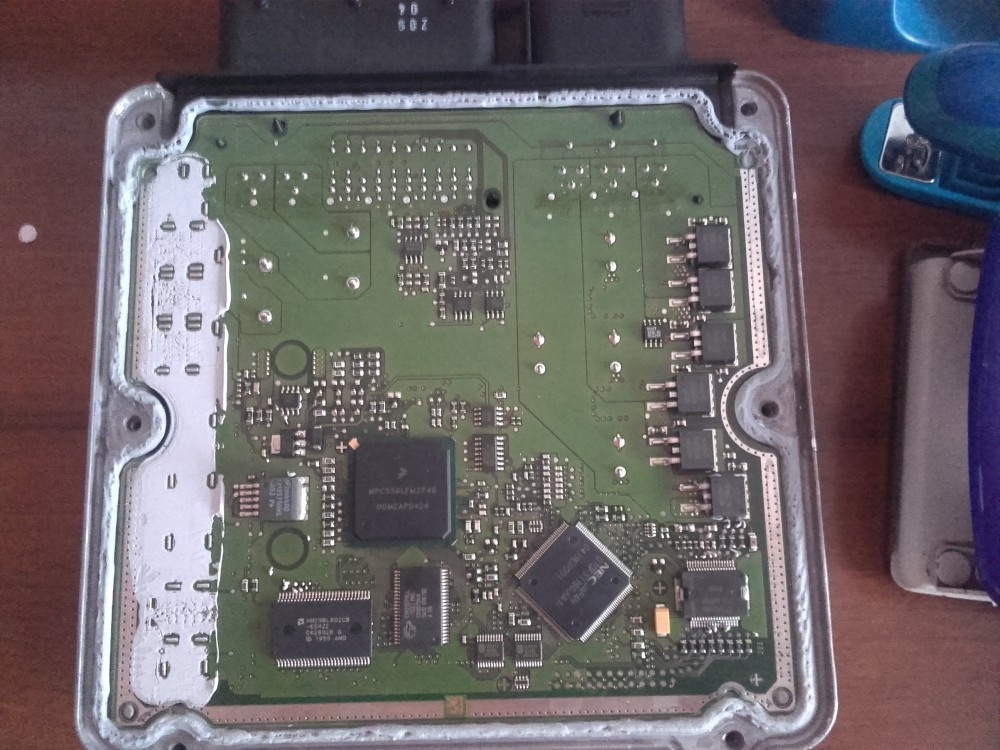
    I have a problem with the Active Steering system in BMW. In fact, I am almost sure (ALL others excluded) that the driver has failed and here is a question for one of the best professionals in this country. Can he be saved? I checked it thoroughly with the diagnostic program and it seems that the processor does not get up. Is it dead or no power? How to check? The power supply suggestion is due to the fact that the error that appears after connecting the interface is an error with too low supply voltage - below 7.5 V. The voltage at the connector has been checked and is OK, so it's a problem with the current inside the controller. I am attaching a photo and thank you very much in advance for any tips and suggestions.
    BMW E60 / E63 Active Steering Repair: Driver Failure, Voltage Issues & Diagnostic Tips
  • ADVERTISEMENT
  • Helpful post
    #2 16840640
    seat21
    Level 29  
    Do a BGA reballing first.
  • #3 16841174
    MIKUr1
    Level 10  
    I forgot to write that the driver refused to cooperate when the alternator failed. After repairing the Active Steering alternator, it no longer worked. Earlier there were no problems with him, so it certainly is not a coincidence. Do you think it could be a matter of a problem with the connection of the processor to the board, but in the current situation, does it look like the death of a component?
  • ADVERTISEMENT
  • Helpful post
    #4 16841371
    seat21
    Level 29  
    Try replacing this item. Was the alternator overcharging or not charging?
    Attachments:
    • BMW E60 / E63 Active Steering Repair: Driver Failure, Voltage Issues & Diagnostic Tips 2422563000_1511259690.jpg (247.81 KB) You must be logged in to download this attachment.
  • ADVERTISEMENT
  • #5 16841663
    MIKUr1
    Level 10  
    First of all, I would like to thank you very much for your interest in the topic. If I manage to save this driver, I publicly commit myself to put something good to quench my thirst ;) Sometimes the alternator overcharged, other times it didn't. I did not notice it right away, because the car never refused to obey due to the fact that the moments when it did not load and loaded smoothly and quickly intertwined. I noticed it only on the last route before the alternator was repaired, when all possible controls went out and I started the charging voltage check function on the meter. I was far from home, and the car, after restarting, drove as it should and everything went out, so I concluded that there is no need to "tow". I will add that AFS was working properly until the very end. In the backyard it was fired from the cables 2-3 times and a few meters to the garage it was already "remaining electricity" and again the disco on the clocks. From that moment it was not fired until the alternator was repaired. After assembling and firing, I noticed the symptoms and errors listed in the first post. Coming back to the topic, isn't the selected system sometimes responsible for powering the electric motor? Can the processor also power it? As I mentioned before, after playing with Inpa it looks more like a CPU problem. I absolutely do not question knowledge, especially since mine is definitely much lower, I'm just trying to do something like brainstorming and bring this dead man back to life together :)
  • #6 16841852
    seat21
    Level 29  
    But it is with the communication module and what errors exactly? If there is communication, try flashing the disem or ista driver first.
  • #7 16842036
    MIKUr1
    Level 10  
    bledy:

    0x612C hardware error control device
    0x613A Supply voltage Kl. 30 (
  • #8 16847163
    MIKUr1
    Level 10  
    Due to the fact that I did not want to have a grounded car, I bought a "new" controller. After rewriting the VIN everything started working as it should. Nevertheless, I will try to fix this one and if I find anything I will write here. If anyone has any suggestions, ideas and advice leading to saving the driver, thank you very much in advance and I will try to repay you somehow :)
  • ADVERTISEMENT
  • #9 16883262
    MIKUr1
    Level 10  
    The controller was taken by my uncle, who repaired various controllers in the mines. He immediately ruled out damage to the element marked a few posts above and rather does not suspect damage to the processor. As soon as I know anything, I will of course let you know :)
  • Helpful post
    #10 16886241
    marcin_70
    Level 21  
    Hi
    I recently went through a similar topic. https://www.elektroda.pl/rtvforum/topic3400030.html#16851625
    The cause of my problems was a spilled batch in mpc (all FFFF). You can try to read the contents of the memory with BDM (due to the fact that it is built like edc16) and check how "effected" you can copy the batch from the new to the old.
  • #11 18477068
    Tomkoff
    Level 9  
    Hello
    I have the same problem with the title driver, does anyone have info on how to connect bdm with this driver to read the memory? Unless there's another way to fix on a 612C driver internal error?
  • #12 18477316
    MIKUr1
    Level 10  
    BDM as in EDC16, points from the right having the controller connector facing each other. The problem will probably be with the charge.
  • #13 18550496
    adamek2828
    Level 10  
    Hello,
    my AS controller was probably flooded (water on the passenger floor) but after opening it inside it was dry as a bone and no signs of corrosion. Do you have any schematics for this controller to at least check the voltages?
    P.S. apart from the water on the sidewalk (leakage of the door, specifically polystyrene between the bacon and the door), I struggled with the problem of a weak battery, I fired on the cables 2-3 times. I do not know if, as you write, maybe the batch was damaged from voltage surges. What do you think?

Topic summary

✨ The discussion revolves around issues with the Active Steering system in BMW E60/E63 models, specifically focusing on a suspected driver failure and voltage problems. The user reports a low supply voltage error (below 7.5 V) and questions whether the driver can be repaired. Responses suggest various diagnostic approaches, including BGA reballing, checking connections, and replacing components. The user also mentions a history of alternator issues, which may have contributed to the current problem. A new controller was acquired, which resolved the issue temporarily, but the user is still interested in repairing the original driver. Additional suggestions include reading memory contents via BDM and checking for voltage surges that could have damaged the controller.
Generated by the language model.

FAQ

TL;DR: BMW E60/E63 Active Steering faults often log 0x613A when supply dips below 7.5 V; many owners report “the processor does not get up.” Alternator events, firmware corruption, and BGA/power-stage faults are common roots. [Elektroda, MIKUr1, post #16838946]

Why it matters: This FAQ helps DIYers and techs diagnose and repair Active Steering driver failures, voltage errors, and comms issues fast.

Quick Facts

What do BMW Active Steering codes 0x612C and 0x613A actually mean?

0x612C flags an internal hardware error in the AS controller. 0x613A indicates the module sees low supply at Kl.30. If 0x613A logs, verify battery, charging system, fuses, and grounds before opening the ECU. Clear codes, road-test, and re-scan to confirm persistence. [Elektroda, MIKUr1, post #16842036]

Should I try BGA reballing on the Active Steering ECU?

Yes, if power and firmware checks pass but the module still won’t boot, reballing the BGA can restore processor-to-board connections. A pro advised, “Do a BGA reballing first.” Perform only after stable supply verification and code reads. Use proper rework profiles to avoid pad lift. [Elektroda, seat21, post #16840640]

My alternator failed and AFS died afterward—are they related?

Yes. Reports show AFS failure right after alternator over/under‑charge episodes and 2–3 jump-starts. Voltage swings can trip 0x613A and stress the controller. Inspect charging output, battery condition, and grounds. If supply is stable yet AFS stays offline, proceed to firmware and hardware checks. [Elektroda, MIKUr1, post #16841663]

Can flashing with DIS/ISTA recover a nonresponsive Active Steering unit?

If there is communication, attempt a software flash with DIS/ISTA before hardware work. This can restore corrupted calibration or firmware. Ensure a fully charged battery and a stable charger during programming. If flashing fails or comms drop, continue with bench reading via BDM. [Elektroda, seat21, post #16841852]

How do I connect BDM to read the AS controller’s MPC?

It’s built like EDC16. Use an EDC16 BDM adapter to contact the MPC pads, read the dump, compare, and repair if needed. 1) Identify BDM pads and align the EDC16 probe. 2) Read and save full MPC contents. 3) Compare with a good dump and write back corrected data if corrupt. “You can copy the batch from the new to the old.” [Elektroda, marcin_70, post #16886241]

What does an “all FFFF” MPC dump indicate, and how do I fix it?

An “all FFFF” dump indicates erased or unread firmware/calibration data in the MPC flash. Read the working replacement unit, then write its corresponding batch to the original, matching part and software levels. Recode if needed, then clear faults and test drive. [Elektroda, marcin_70, post #16886241]

Do I need to code the VIN after swapping the AFS controller?

Yes. A used controller typically works only after VIN rewrite and coding to the vehicle. One case restored full AFS operation immediately after writing the car’s VIN into the donor module. Always verify steering angle calibration afterward. [Elektroda, MIKUr1, post #16847163]

Where can I find the official power-supply and pin references for AFS?

Use BMW’s technical information: the Active Steering power-supply page shows feeds, grounds, fusing, and signal routing. Follow it to verify Kl.30, ignition feeds, and earth points before suspecting ECU hardware. Print the diagram for step-by-step probing. [Power supply for Active Steering]

Could water on the passenger floor kill the AFS module even if the PCB looks dry?

Yes, cabin water ingress correlates with AFS issues, but the ECU may still appear dry. Moisture can affect connectors or wiring under carpet. After drying, inspect harness splices and measure supply at the module. If faults persist, proceed to firmware checks. [Elektroda, adamek2828, post #18550496]

Can jump-starting or a weak battery corrupt the AFS firmware?

Owners observed AFS faults after repeated jump-starts and weak batteries. Voltage transients can coincide with software issues. Stabilize the electrical system, then diagnose. If corruption is suspected, confirm via BDM read and compare with a known-good dump. [Elektroda, adamek2828, post #18550496]

What is Kl.30 in this context, and what should I measure?

Kl.30 is the unswitched battery supply input to vehicle modules. Verify battery voltage at Kl.30 at the AFS connector and across grounds per the BMW diagram. If the module logs low Kl.30, fix supply faults before reflashing or reballing. [Power supply for Active Steering]

ISTA/DIS sees the module but flags 0x612C—what next?

0x612C suggests an internal controller fault. After confirming stable power and grounds, check firmware integrity via BDM. If the dump is corrupt, repair by cloning or rewriting matched software. If software is intact, consider BGA rework. [Elektroda, MIKUr1, post #16842036]

Orientation tip: how are the BDM points laid out on this board?

With the controller connector facing you, the BDM points are on the right, matching EDC16 conventions. Use that orientation to place your BDM probe correctly and avoid pin swaps during reads. [Elektroda, MIKUr1, post #18477316]

After alternator replacement, AFS still dead—what sequence should I follow?

Confirm power per the BMW diagram, then attempt a software flash. If unsuccessful, read the MPC via BDM and repair the dump. As a last step, try a known-good module coded with your VIN to isolate hardware from software faults. [Elektroda, MIKUr1, post #16847163]

Is the highlighted power stage the motor driver or CPU supply?

A pro review in-thread dismissed the initially highlighted part as the culprit and did not suspect the CPU itself. Prioritize verifying the supply path, firmware integrity, and BGA connectivity before replacing power stages. [Elektroda, MIKUr1, post #16883262]

Any quick on-car checks before ECU surgery?

Yes. Check battery SOC, alternator output ripple, and all fuses. Measure Kl.30 at the AFS connector. If ISTA/DIS communicates, try a controlled reflash. Only then proceed to bench BDM read or BGA work. “If there is communication, try flashing first.” [Elektroda, seat21, post #16841852]
Generated by the language model.
ADVERTISEMENT