logo elektroda
logo elektroda
X
logo elektroda

Choosing an SDR Receiver for Airline Channels, Electronics, and Mobile Use

240sx 9411 13
ADVERTISEMENT
Treść została przetłumaczona polish » english Zobacz oryginalną wersję tematu
  • #1 17893272
    240sx
    Level 10  
    Posts: 361
    Rate: 65
    I want to buy a USB SDR receiver.
    I see that there are several most popular models:
    1. The cheapest, usually black, the size of a pen drive with the inscription DVB+DAB+FM. The set includes a small antenna and remote control. From $10.
    2. Blue in a square (from the top) housing with the inscription "Android", antenna and remote control.
    3. In a cubic greenish box marked "Newgen RTL2832 SDR".
    4. Similar, in white, with the words "RTL-SDR.COM".
    5. Black "Foxway", with two antenna connectors: 100kHz-30MHz and 25MHz-1.7GHz. From $35.

    ...and probably others (but too expensive).

    Could I ask for advice on which one to buy?

    I`d like:
    1. Listen to airline channels (approx. 122 MHz AM).
    2. Use when building and testing electronic circuits (amateur).
    2. Ability to work with a smartphone (and not just a PC or laptop).
    3. Worked on Linux and Windows.
    4. Wide bandwidth - also long waves.
    5. Good sensitivity.
    6. Good additional equipment (e.g. antennas).

    Greetings Marcin
  • ADVERTISEMENT
  • Helpful post
    #3 17894799
    Sumar
    Level 16  
    Posts: 252
    Help: 11
    Rate: 18
    Of the cheapest ones, blue is recommended, but numbers 1, 2 and 3 do not meet your requirements:

    Quote:
    4. Wide bandwidth - also long waves.

    Nos. 4 and 5 probably also receive frequencies below ~24 MHz using the direct sampling method. The simplest and the worst.

    Taking into account:

    Quote:
    2. Use when building and testing electronic circuits (amateur).

    You`re no stranger to using a soldering iron, are you? In such a case, I recommend the cheapest blue tuner, plus the AD831 mixer module for $10 from AliExpress and a quartz generator, e.g. 80 MHz - PLN 5 on Allegro. Add an attenuator consisting of 3 resistors and you have a ready upconverter. A much better option for HF bands than direct sampling.

    The cheapest blue tuner differs from slightly more expensive ones mainly in accessories. It may have a stable TCXO, aluminum housing (screen + cooling), SMA socket. However, they are still based on the same RTL2832U/R820T2 systems. They have the same sensitivity and will work equally well on a smartphone, Windows and Linux. What about additional equipment? You will choose this individually. After all, an antenna for the HF band will not be different for blue than for black.
  • ADVERTISEMENT
  • #4 18434447
    240sx
    Level 10  
    Posts: 361
    Rate: 65
    I will return to the topic: is the "RTL2832U+R820T2 100KHz-1.7GHz UHF VHF HF RTL.SDR USB Tuner Receiver AM FM Radio" receiver
    (e.g. https://www.aliexpress.com/item/32965619493.html) is it really the same device as the cheapest "RTL2832U+R820T2 pendrive" only with the "defective" sampling at lower frequencies described above?
  • Helpful post
    #5 18434734
    Sumar
    Level 16  
    Posts: 252
    Help: 11
    Rate: 18
    240sx wrote:
    I will return to the topic: is the "RTL2832U+R820T2 100KHz-1.7GHz UHF VHF HF RTL.SDR USB Tuner Receiver AM FM Radio" receiver
    (e.g. https://www.aliexpress.com/item/32965619493.html is actually the same device as the cheapest "RTL2832U+R820T2 pendrive" only with the "deficient" sampling at lower frequencies described above?


    Exactly. If you scroll down, in the customer reviews section you will find photos of what it looks like inside. An ordinary tuner glued into a larger board with direct sampling.

    PS Remove the closing bracket immediately after the link, because you can`t enter by simply clicking.
  • ADVERTISEMENT
  • #6 18434844
    240sx
    Level 10  
    Posts: 361
    Rate: 65
    Thank you for the information.

    Does this mean that the available "assembly kits" are exactly what you just mentioned? Pendrive, mixer, silencer:
    https://www.aliexpress.com/item/4000171946465.html

    From devices that, according to descriptions allow reception from 100kHz there is also: https://www.aliexpress.com/item/32621388951.html
    Does anyone have it or can you tell from the description whether it is better/worse than those described earlier?
  • Helpful post
    #7 18434853
    Sumar
    Level 16  
    Posts: 252
    Help: 11
    Rate: 18
    Both devices are still only direct sampling. Using a mixer with a generator, you can build a real converter plugged in between the antenna and the RTL-SDR antenna connector.
  • #8 18435005
    240sx
    Level 10  
    Posts: 361
    Rate: 65
    It`s decided: I`m buying the "cheapest" SDR receiver in the form of a pendrive.
    Could you please tell me where to find the exact implementation of the device you described?
  • #9 18436504
    Sumar
    Level 16  
    Posts: 252
    Help: 11
    Rate: 18
    240sx wrote:
    It`s decided: I`m buying the "cheapest" SDR receiver in the form of a pendrive.

    I recommend the most popular "blue".

    240sx wrote:
    Could you please tell me where to find the exact implementation of the device you described?

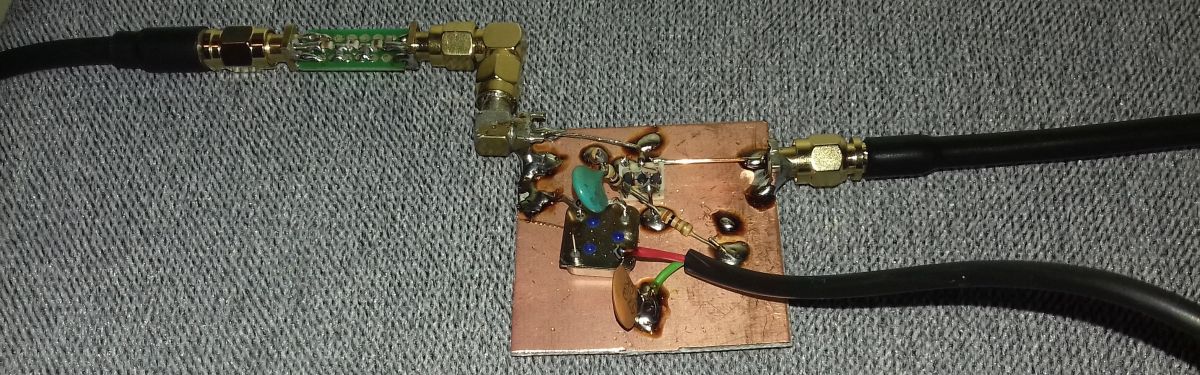
    When I understood that the converter is a simple combination of a mixer and a generator, and not any complicated device, I built something like this myself:

    Choosing an SDR Receiver for Airline Channels, Electronics, and Mobile Use20181005_2..732.jpg (418.73 kB)You must be logged in to download this attachment.

    Several elements connected together, a great description is probably not necessary. If you need any details, just ask.

    You can omit the low-pass filter at first and build it later if needed. In quiet rural areas it may be unnecessary, but in the city, near strong transmitters.
  • #10 18480963
    raff216
    Level 10  
    Posts: 41
    Rate: 2
    Hello, I am also planning to start my adventure with SDR. I`m currently using a Baofeng dual band. but I want to expand the possibilities of listening on the air. My question to Sumar is "I live in the city, in blocks of flats around. So I have a lot of interference. Does the above description of the topic only work on kf? I would like to build something with my own efforts, some filters for this pendrive.
  • #11 18481522
    Sumar
    Level 16  
    Posts: 252
    Help: 11
    Rate: 18
    The photo above shows the filter already closed in the housing. Here is an earlier photo where you can see what`s inside. It`s an ordinary low-pass filter with SMD elements, made according to a pattern. At the moment I don`t remember what the values of the elements are, but it was made at about 30 MHz. Currently, I have changed the location, I have no way to hang the HF antenna here and the topic has been forgotten for a while. However, I can say that the filter worked properly - it did not worsen the desired signal, but it definitely cut out regular FM radio stations. The construction of such a receive-only filter is simple, because there is no need to wind the coils with thick wire, you can only use ready-made SMD elements, because it will not transmit any power.

    Choosing an SDR Receiver for Airline Channels, Electronics, and Mobile Use
  • #12 18481945
    raff216
    Level 10  
    Posts: 41
    Rate: 2
    Well, it`s a pity you don`t remember. Some kind of projection would be useful. Because it`s not very visible in the photos. And ready-made filters exceed the price of the device. I already have the monitor. Connect the HP terminal to this. And listen. To start with, which SDR modem would you recommend, working from 100khz to 2GHz? If I like it, I`m willing to play with the antennas.
  • ADVERTISEMENT
  • #13 18483468
    Sumar
    Level 16  
    Posts: 252
    Help: 11
    Rate: 18
    You can look at the diagrams in google images under sdr upcoverter. Most of them have a low-pass filter on the input. To start with, I recommend the blue tuner + upconverter. If you are not afraid of a soldering iron, I recommend the passive one with the ADE-1 mixer. As for the terminal, it may be weak. I tried to run RTL-SDR on something like this and it was very sluggish, both on Windows and Linux. However, SDR is resource-intensive (especially spectrum analyzer and waterfall).
  • #14 18483799
    raff216
    Level 10  
    Posts: 41
    Rate: 2
    I`m not afraid of soldering irons. Overall, he is a DIY enthusiast in his free time :) I have access to welding machines, soldering irons and lathes. As for the technical specifications of the device, I couldn`t find an answer anywhere as to whether it would be that much of a burden. Maybe the terminal`s parameters weren`t impressive. Which you used. But I will keep looking for answers. And the plan was to buy a 4x1.7 processor with 4GB of RAM.

Topic summary

✨ The discussion revolves around selecting a USB SDR receiver suitable for listening to airline channels and for electronics experimentation. Various models are considered, including a cheap black pen-drive style receiver, a blue square model, a green cubic box labeled "Newgen RTL2832 SDR," a white model from "RTL-SDR.COM," and a black "Foxway" receiver. Recommendations favor the blue model, which is noted for its compatibility with smartphones, Linux, and Windows, as well as its good sensitivity. Users suggest enhancing performance with additional components like an AD831 mixer and a quartz generator for better HF band reception. The conversation also touches on the construction of upconverters and filters to improve signal quality, particularly in urban environments with interference.
Generated by the language model.

FAQ

TL;DR: For HF below ~24 MHz, avoid direct sampling; "blue is recommended" for a starter RTL-SDR, then add an upconverter. This FAQ helps you choose a low-cost receiver for airband, electronics testing, and smartphone/PC use. [Elektroda, Sumar, post #17894799]

Why it matters: The right dongle and a simple upconverter dramatically improve HF reception while keeping your setup cheap and portable.

Quick Facts

What’s the best low-cost SDR for airband, electronics testing, and general listening?

Pick the popular "blue" RTL2832U/R820T2. It matches pricier sticks in sensitivity and compatibility. Pay extra for TCXO, SMA, and a metal case for stability and shielding. It works on Android, Windows, and Linux. Add band-appropriate antennas for best results. [Elektroda, Sumar, post #17894799]

Do "100 kHz–1.7 GHz" USB sticks truly receive HF well?

They are a regular RTL2832U stick mounted on a larger board. HF is accessed by direct sampling on that board. That method lacks a proper front-end and performs worse than a real upconverter. Expect better HF with a mixer-based converter. [Elektroda, Sumar, post #18434734]

How do I get longwave/shortwave on RTL-SDR without poor direct sampling?

Use an upconverter instead of direct sampling. Combine a mixer module with a fixed-frequency quartz oscillator and an attenuator. Then feed the shifted signal into the RTL-SDR.
  1. Mix HF from the antenna with an 80 MHz quartz generator using an AD831 module.
  2. Add a simple 3-resistor attenuator between the mixer and the tuner.
  3. Connect the mixer output to the RTL-SDR input and tune at the offset. [Elektroda, Sumar, post #17894799]

Will an RTL-SDR work with my Android phone?

Yes. The RTL2832U/R820T2 works equally well on smartphones. Use appropriate apps and required connection accessories. It also works on Windows and Linux PCs. [Elektroda, Sumar, post #17894799]

What do pricier "blue" kits add over the cheapest stick?

Mostly accessories and stability, not sensitivity. Extras include a stable TCXO, aluminum housing for shielding and cooling, and an SMA input. All use the same RTL2832U/R820T2 chips and perform similarly in sensitivity. Choose based on build, connectors, and convenience. [Elektroda, Sumar, post #17894799]

Can a low-power terminal or mini-PC handle SDR?

Simple receivers may run, but UI and decoding can feel sluggish. "SDR is resource-intensive (especially spectrum analyzer and waterfall)." Try a faster PC if the terminal struggles. Reduce visualization rates if needed. Linux or Windows both work. [Elektroda, Sumar, post #18483468]

Which antennas should I use for airband and HF?

Match the antenna to the band you want. Airband benefits from a tuned VHF antenna. HF needs an appropriate HF antenna and, for RTL-SDR, an upconverter. Antenna choice does not depend on color or brand of stick. Plan for separate antennas per band. [Elektroda, Sumar, post #17894799]

Do Foxway or RTL-SDR.com versions cover HF without extra hardware?

Below ~24 MHz they still rely on direct sampling. That approach is the simplest and worst for HF. Expect better HF by adding a mixer-based upconverter between the antenna and the tuner. Use the stick’s normal VHF/UHF input for VHF and above. [Elektroda, Sumar, post #17894799]

I live in a city with strong FM stations. How can I cut interference?

Insert a simple receive-only low-pass filter around 30 MHz on the HF side. It did not worsen desired signals and it definitely removed broadcast FM. Build it with SMD parts using a standard low-pass topology. This helps near strong transmitters. [Elektroda, Sumar, post #18481522]

Are those AliExpress "assembly kits" real upconverters?

Many kits marketed for 100 kHz reception still use direct sampling. They are not true frequency-shifting converters. For better HF, build or buy a mixer plus oscillator converter. Plug it between the antenna and the RTL-SDR’s antenna input. [Elektroda, Sumar, post #18434853]

Can I listen to airline channels, and what settings should I use?

Yes. Set AM demodulation and tune the aeronautical band, approx. 118–136 MHz. Use a band-tuned VHF antenna for clearer reception. Keep nearby strong signals out with appropriate filtering if needed. [“Airband”]

How do I physically connect a DIY upconverter to the dongle?

Place the converter between the antenna and the RTL-SDR’s input. The antenna feeds the converter’s RF input; the converter’s output feeds the stick. Power the converter’s local oscillator as designed. Then tune to the shifted frequency. [Elektroda, Sumar, post #18434853]

Do you have an exact low-pass filter schematic and part values?

A basic SMD low-pass filter around 30 MHz worked well in tests. It used an ordinary pattern and cut broadcast FM while preserving the desired band. Exact values were not recorded, but any standard LPF calculator and SMD parts suffice. Build receive-only, so no heavy coils. [Elektroda, Sumar, post #18481522]

What local oscillator frequency should I pick for an upconverter?

An 80 MHz quartz generator is a simple, low-cost choice for a fixed-LO upconverter. Combine it with a low-cost mixer and an attenuator. This shifts HF into the tuner’s comfortable VHF range. It’s an inexpensive, effective approach for RTL-SDR HF. [Elektroda, Sumar, post #17894799]
Generated by the language model.
ADVERTISEMENT