
Why F&Home?
F&Home is a solution that stands out not only for the functionality of the system, but also for the backing behind the brand. It is a Polish product, developed locally by a company with many years of experience in automation, which is of great importance to many investors, installers and developers. This means easier contact with the manufacturer, a better understanding of the realities of the domestic market and a greater sense of security when choosing a system for a home or development.
A great advantage of F&Home is also the free training courses, thanks to which installers and partners can get to know the system's capabilities faster, learn how to configure it correctly and implement solutions more efficiently at customers' sites. This is important not only from a technical point of view, but also from a business point of view - a well-trained contractor can act more confidently, more efficiently and build a more professional offer.
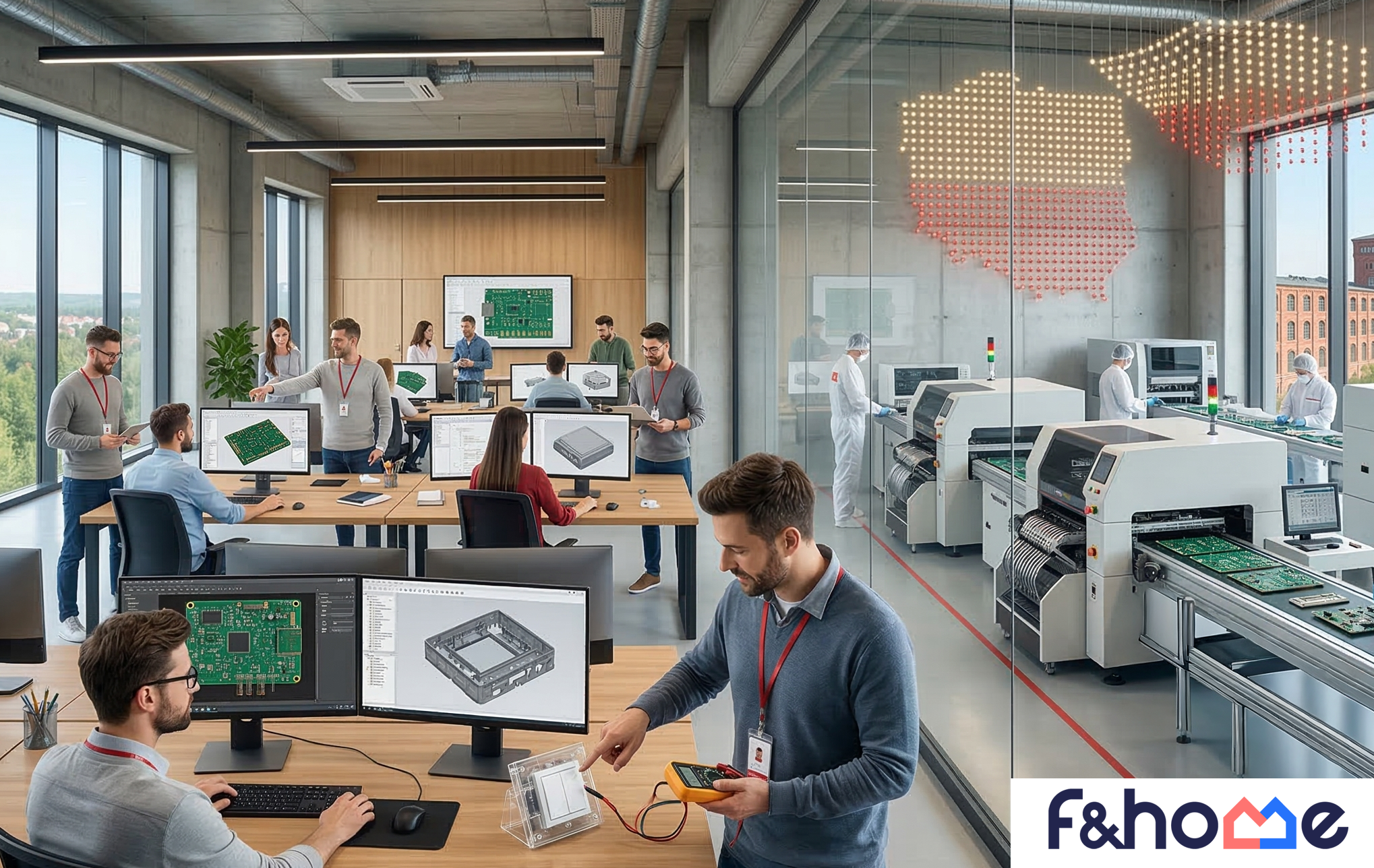
Also worthy of special mention is the very good pre- and post-sales support. Prior to implementation, partners can count on assistance in selecting a solution, technical consultation and adapting the system to the specific project. Once the investment is up and running, service and technical support remains equally important, which increases the comfort of the installer's work and gives the end customer the feeling that there is a real manufacturer behind the system and not just a catalogue of equipment. It is this combination: a Polish background, available training and strong technical and commercial support that makes F&Home an attractive solution not only technologically, but also practically.
F&Home is not a gadget, but a well thought-out system architecture
The most important difference between an automation system and consumer smart devices is the architecture. In the case of F&Home, the foundation is not a single product operating 'for itself', but a centrally managed installation based on a management unit and sensors, actuators and measurement modules. In the F&Home system, the role of the central unit can be played by, among others, the mH-DEVELOPER module, which is at the same time the system's central unit and the executive module for basic functions such as heating, lighting and sockets. In practice, this means that the system can be built in layers: from a simple range of functions based solely on the server to more advanced automation with additional modules in the switchboard or wireless extensions.
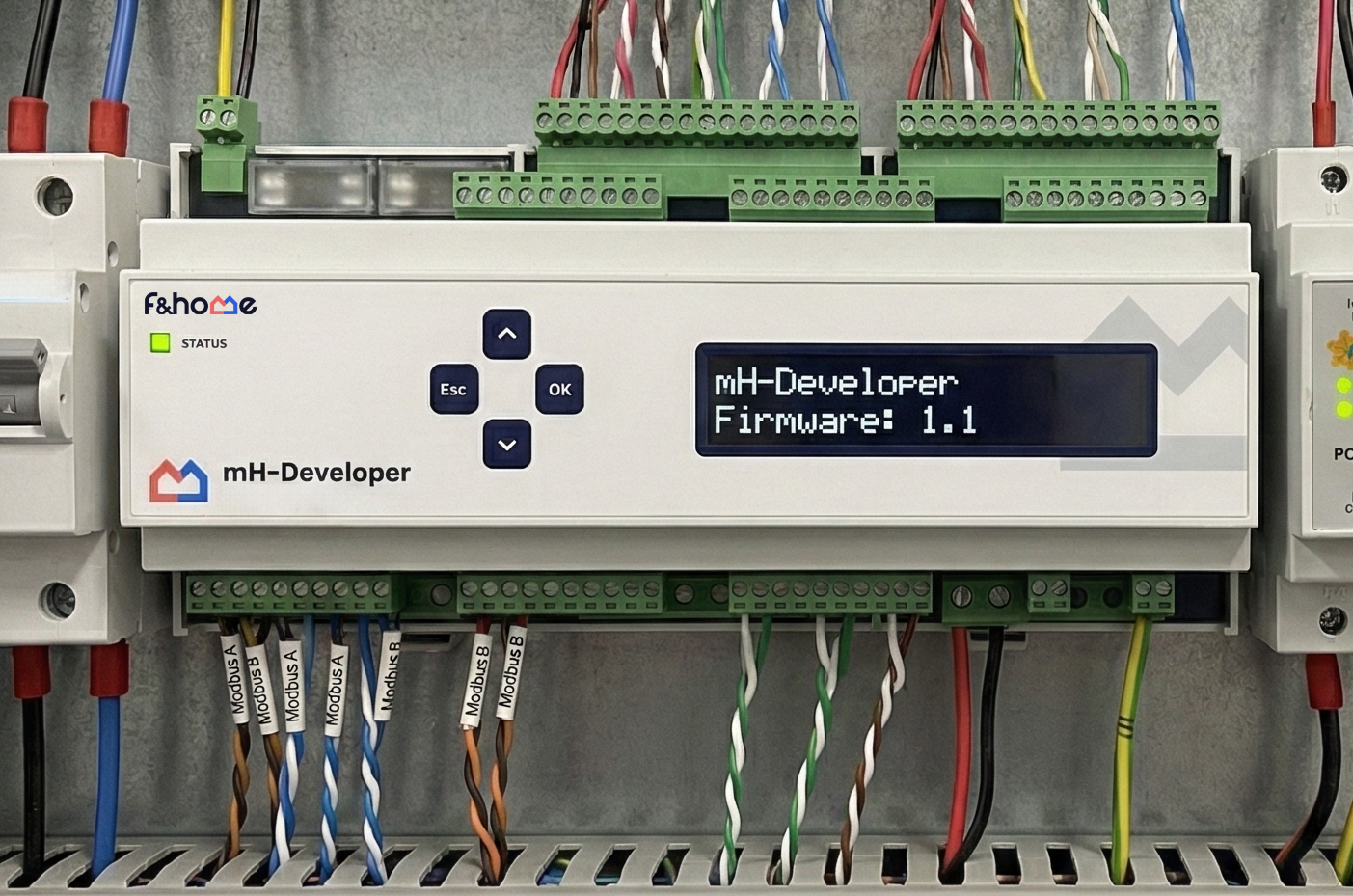
This is important from a commercial point of view. The end customer is not buying an 'app to turn on the lights', but a complete solution that can control multiple installations from a single environment. For the installer and integrator, this in turn means greater project predictability, easier structuring of operating logic and the ability to offer the customer not a single device but a complete system. It is this approach that makes F&Home closer to classic building automation than the fashion for single-function smart accessories. This conclusion stems from the system architecture: central server, wired and wireless actuators, logic tools, scenes, remote access and integrations.
Functional scope: from light and blinds to HVAC and energy
F&Home offers a very wide range of functions that can be covered by common control. The system offers solutions for managing lighting, heating, electrical sockets, roller shutters, windows, ventilation, garden watering, gates, air conditioning, alarms and energy consumption monitoring. From the developer's perspective, this means being able to organise the various technical installations in a single control environment. From the contractor's perspective, the chance to enter into projects of greater value than electrical or heating automation alone.
Technically, this scope is supported by a diverse family of modules. Among others, the system includes input and output modules for lighting and sockets, mixed modules for lighting and roller shutters, motor modules for controlling motorised receivers, 230 V dimmers, LED RGB and LED 12/24 V controllers, 0-10 V controllers, temperature sensor modules and heating valve control modules. This selection of devices shows that the system does not end with a binary 'on/off', but offers the possibility of building installations of varying levels of complexity - from simple circuit control to temperature regulation or control of actuators such as air conditioning or recuperation.
Logic, scenes and automation - or the true value of the system
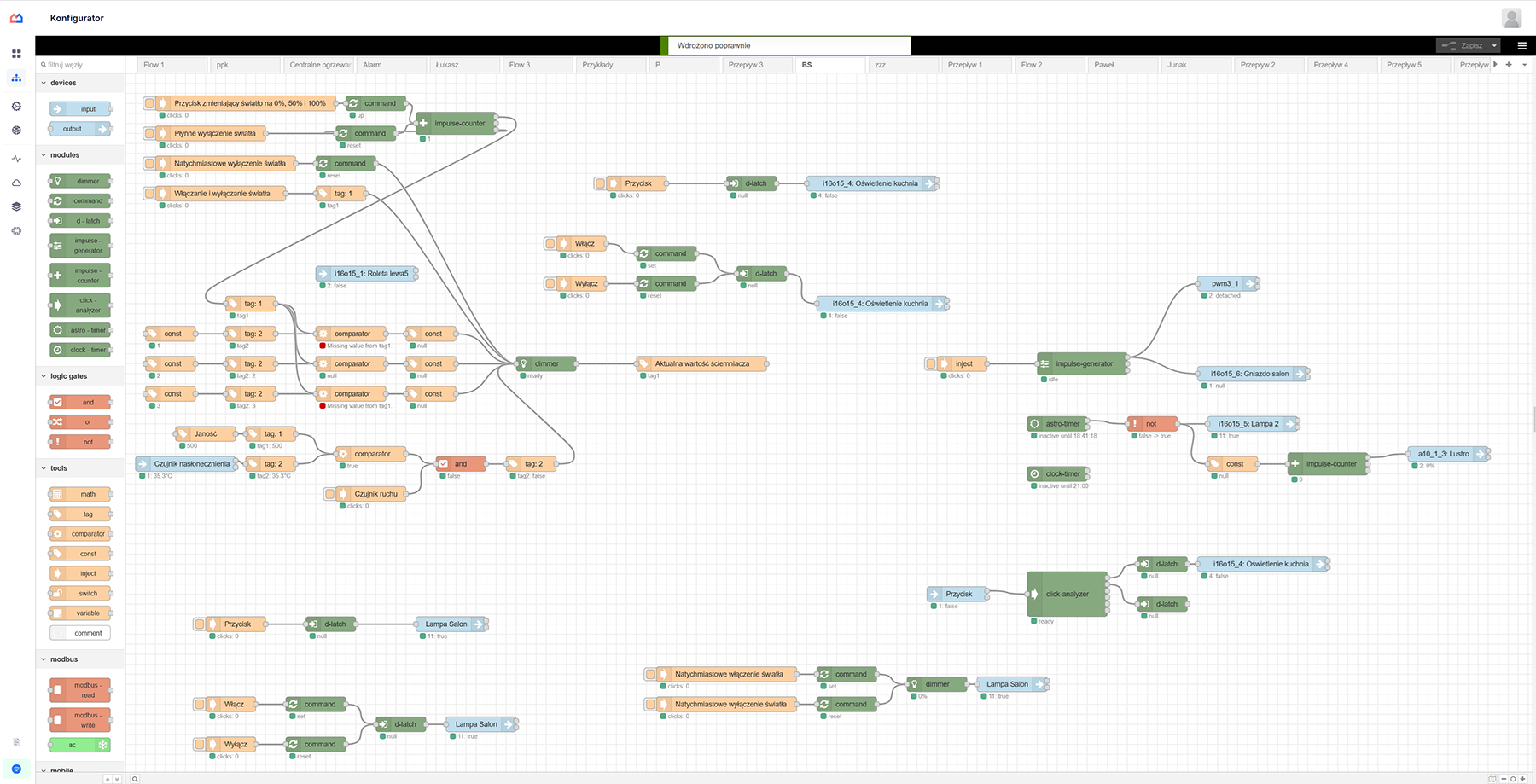
The value of a smart home system is not determined by the number of icons in the app, but by whether the building can react according to a planned logic. F&Home is not only about input and output devices, but also logic modules and configuration tools, including dimmers, pulse functions, pulse counters, signal duration analysers, astronomical clocks, programmable clocks, AND/OR/NOT logic gates, mathematical functions, comparisons, constants and switches. This is a very important piece of information for the designer and installer, as it shows that F&Home can implement scenarios and dependencies specific to building automation, rather than just manual control from a phone.
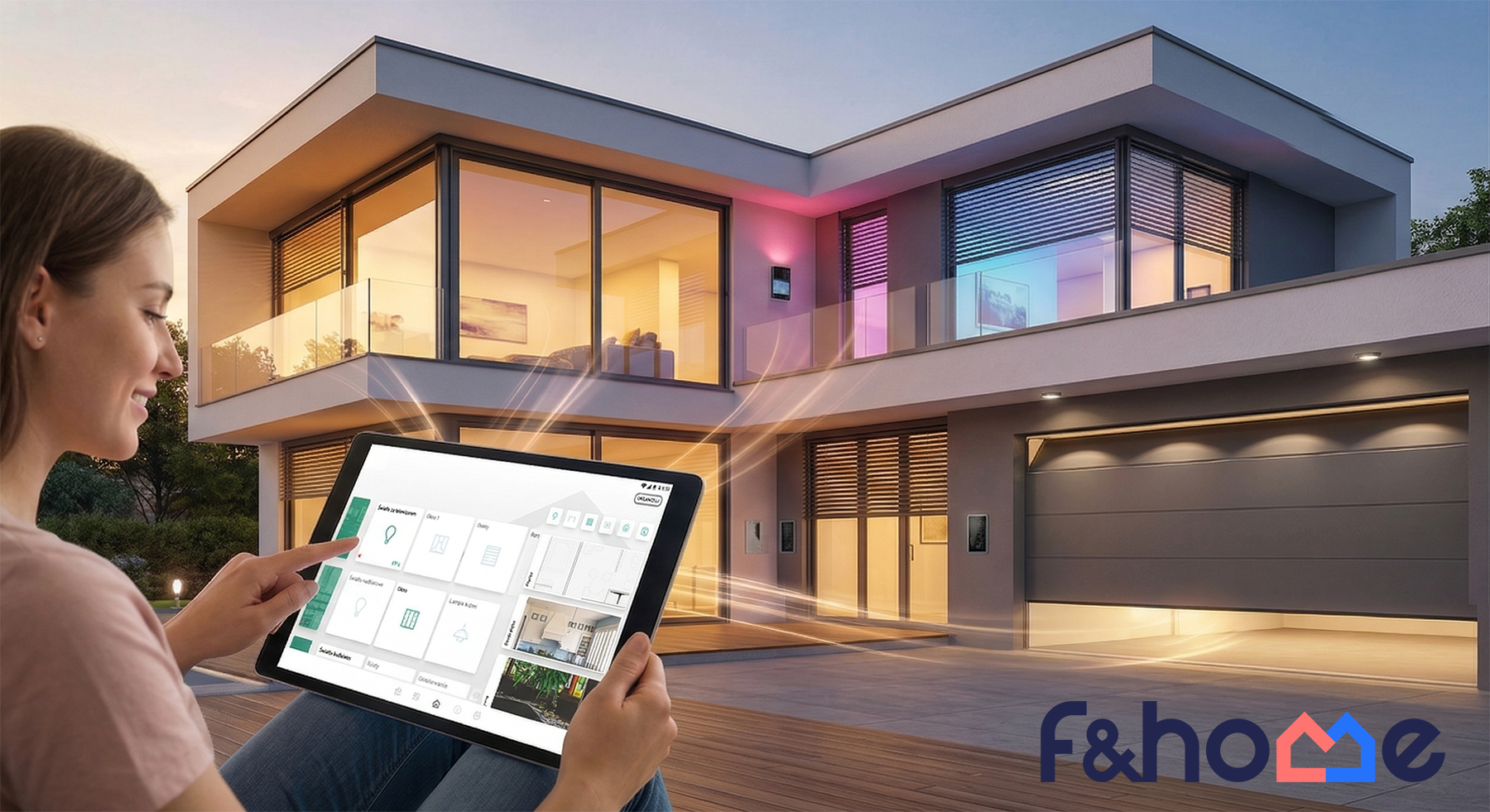
Commercially, this translates into a much stronger sales argument. The customer can be offered an 'Exit Home' scene that a single command extinguishes lighting, lowers blinds and cuts off selected circuits, or the 'Evening' scene, which combines lighting, temperature and multimedia. The FOX app for phones and tablets allows scenes to be created and multiple commands to be grouped under a single icon. Combined with system logic, this gives real automation, not just a remote control on a smartphone.
The FOX app and F&F cloud: local and remote control
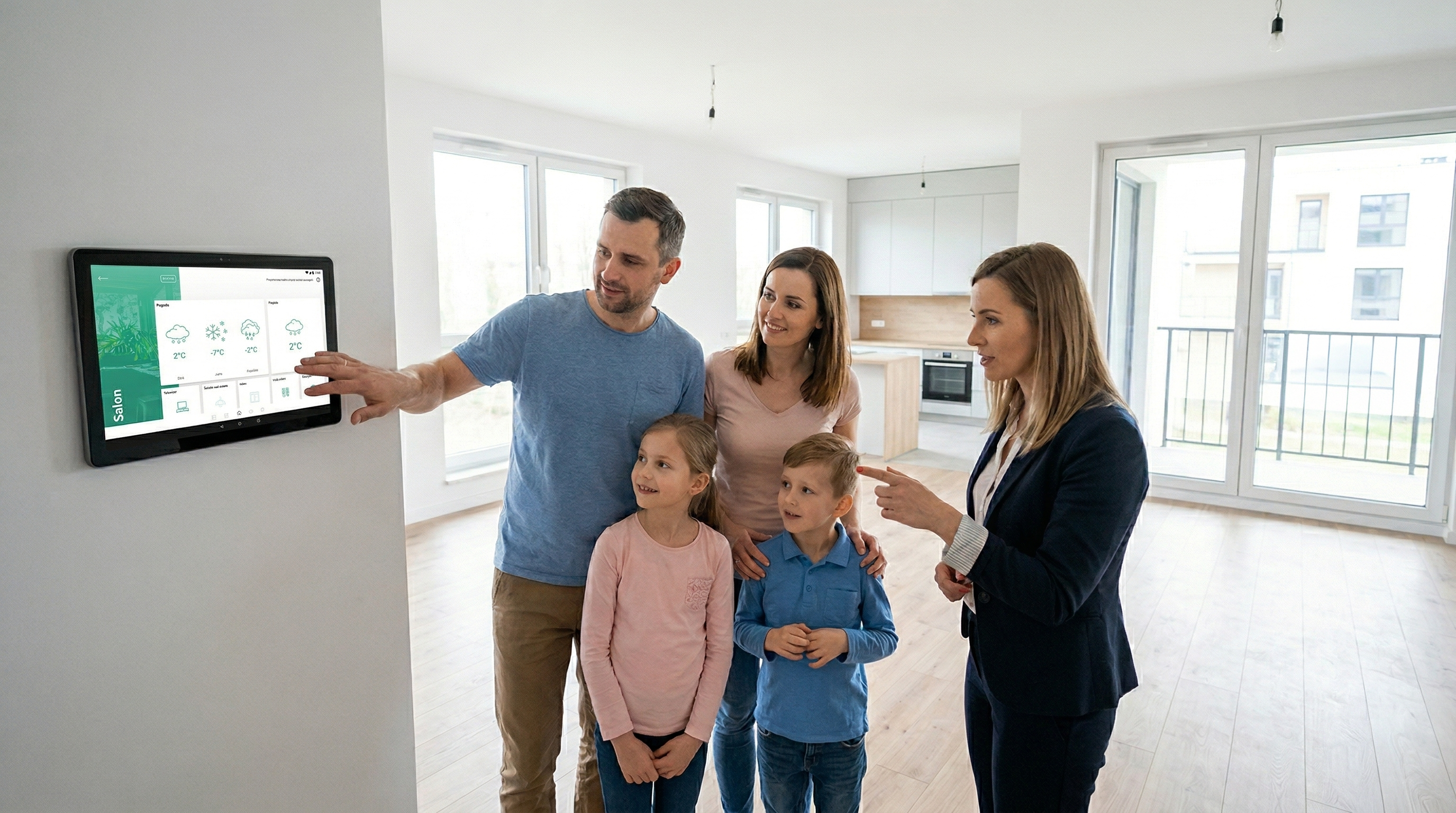
The usability layer in F&Home is based on the FOX mobile app, which is a proprietary software developed by F&F Filipowski engineers, available for Android and iOS, for local and remote control of F&Home and FOX systems. Importantly, the communication model is not limited to the internet. The system operates locally on Wi-Fi, while outside the home it uses F&F's proprietary cloud. The app automatically switches between local and cloud control, and each user can be given roles and permissions.
From a security point of view, F&F's cloud architecture is particularly interesting. The system communicates with the cloud via encrypted communication. The cloud infrastructure is located in Europe and the servers do not store any sensitive data about device states or users. Connection to the cloud is optional, and the system is able to operate locally without an internet connection. This is an important argument especially for customers who are concerned that a smart home means full dependence on the public cloud and constant off-site data transfer.
Integrations: Modbus, SATEL Integration
Modern building automation must be able to talk to third-party devices. F&Home exposes this area very clearly. The DIN2 and DEVELOPER servers support communication in the Modbus RTU standard, which makes it possible to connect devices operating in this protocol, including air conditioners, recuperators, temperature, humidity, brightness and pressure sensors, input/output extensions, lighting controllers or energy meters, among others. From a technical point of view, this is a very strong point for the system, as Modbus remains one of the most practical and widespread integration standards in automation.
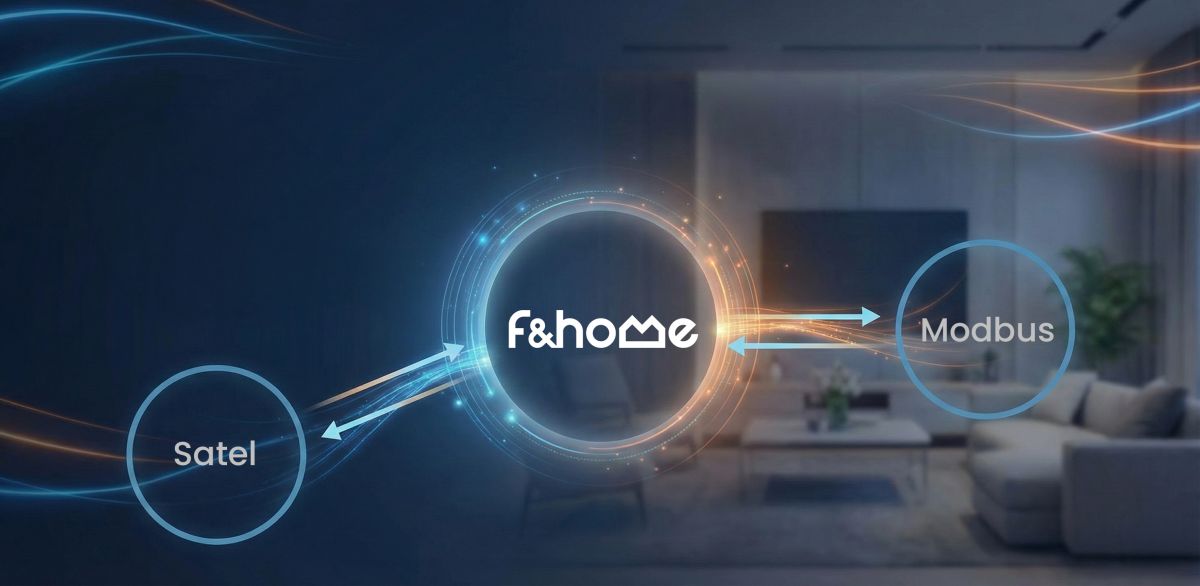
At the functional level of integration, F&Home can be connected to SATEL INTEGRA alarm control panels via LAN using the ETHM-1 module. The result is full exchange of information on panel inputs and outputs, the possibility to use signals from motion sensors and reed switches in the system logic and viewing of arming and disarming status. This is a very practical scenario: the alarm ceases to be an island and becomes part of the logic of the entire building.
Scalability and hybrid model
F&Home is a hybrid solution, combining a wired base with the ability to upgrade to wireless technology without forging walls. Commercially, this is a very apt model: a developer can deploy a basic functions already during the construction phase and, once occupied, add further elements when the need actually arises.
This is also a strong argument for developers. The mH-DEVELOPER and mH-DEVELOPER MINI servers were designed with the developer market in mind, and F&Home is a scalable, reliable system ready to be implemented in single buildings as well as larger housing estates. The system is growing and being developed all the time: more than 6,000 certified installers, more than 10,000 deployed installations and a brand presence in more than 50 countries. Of course, these are marketing numbers, but from a sales perspective they help to build confidence in the solution and the belief that this is not a niche experiment, but an evolving platform with a back office.
Benefits to investor, installer and developer
For the private developer, F&Home means first and foremost that the building is organised into a single system: common controls, scenes, remote access, alarm integration, comfort control and the possibility of further expansion. This translates into everyday convenience, but also into more conscious management of energy and home functions. F&Home stands for comfort, security and energy efficiency.
For the installer, the value is in moving from the role of a single circuit contractor to that of a technology integrator. Increasingly, the market expects the contractor not only to install correctly, but also to be able to bundle lighting, roller shutters, heating, alarm and network elements into a single functioning organism. F&Home provides a sensible base here: its own modules, app, cloud and open integration channels via Modbus. This means not only a higher level of competence, but also the possibility of building a higher-margin offer and a longer service and development relationship with the customer. The business case here is a logical consequence of the scope of the system and its integratability.
For the developer, F&Home is a tool to raise the standard of the development. Smart flats represent a market advantage, greater interest in the offer and added value for the property. In the residential segment, where it is becoming increasingly difficult to differentiate a project by its location or standard of finish alone, building automation is becoming an element that really increases the attractiveness of the product, especially when the system can be implemented in stages and leave the customer with a path for further expansion.
Summary
F&Home is a system that is worth considering not in terms of a 'smart add-on', but as a building automation platform for home, flat and selected investment applications. Its strongest points are its modular architecture, central management, FOX application, proprietary F&F cloud, wide range of functions and external integrations via Modbus RTU and SATEL. In addition, the system offers the possibility of building hybrid solutions, combining a wired base with later wireless expansion.
From a technical point of view, F&Home gives you the tools to create real automation, not just remote control. Commercially - it allows you to build an offering based on comfort, security, scalability and integration. That's why it can be an interesting proposition for both the investor looking for a complete system and the installer or developer who wants to take smart building design and sales to the next level.
More information about the F&Home system and the building automation solutions used can be found on the manufacturer's website of F&F Filipowski:
https://www.fif.com.pl
[Advertising cooperation with F&F Filipowski sp.k.]