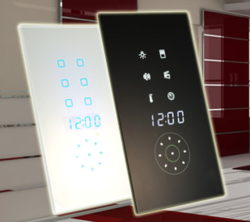
Krzyś33, you know that the Integra has modules which assign an address to each device, so in theory a single bus (one wire) is enough for most devices such as sensors and the like. Integra offers a wide range of programming options (options that are more than enough for the average person in a standard building, and in 99 per cent of cases, most of these features simply go unused due to the client’s lack of awareness of what other cool things can be done)
In view of the above, I see no reason to invest significant sums in other, more expensive systems, because what percentage of their capabilities will we actually utilise?

As for Bronka22, he wanted to make it clear that cabling isn’t, as they say, just a matter of ‘running a wire’
. You need to have a clear concept of how the building will function, a plan for the installation (even if it’s just in your head, but a well-thought-out one), and an awareness of what else will be installed in the building during the finishing stages – what other systems are involved – to avoid conflicts, faults or damage. It may well be that you’re doing the cabling today, plastering tomorrow, and in two days’ time someone’s drilling through your cables because they want to fix a suspended ceiling with wall plugs, or your installation turns out to run through areas where, for example, a forced-ventilation system is planned. So what then? You can be sure they’ll rip out your cables because you could have adapted to their design, whereas they’re unlikely to bend or alter metal pipes and other structures just because a few of your cables are in the way. That’s life. Anyone who’s ever spent even a single day laying cables in an unheated building in winter, freezing their socks off, and then seen what needs repairing or changing, has learnt once and for all what to avoid and what to ask about and agree with the client, because the client will always say‘I don’t know anything about this; you’re the expert, you should have foreseen this’ – and, actually, they’re right:)
As for Mr Konopka:
an alarm is always a matter of the client’s taste and psychological approach; some say the sound will deter a burglar – I’ve seen alarm systems that were completely silenced and did absolutely no good; others claim that the sight of a siren and the fact that the system is visible deters burglars by suggesting there are lots of valuable items in the house, though that seems a rather silly approach in an age when every new house has an alarm system fitted as standard.
As for the monitoring, I really don’t understand what the issue is. How can they require you to have the entire alarm system installed? You install the control panel, you’ve got a working system, you register with the agency and they fit you with a radio transmitter, a DL unit or some other means of alerting the alarm monitoring centre; you pay the subscription fee and expect the police to arrive on time. The idea of a rapid police response, or that you’ll actually be able to do anything if you just receive a text message yourself, is a bit of a pipe dream – not to mention the situation where you yourself might be in danger if someone tries to force their way into your home whilst you’re inside. into your home whilst you’re inside. Only an alarm system will guarantee a rapid response from the intervention team.
It all comes down to money again – do you think it’s worth spending about 50 zł a month on CCTV (that’s the price in Łódź; I don’t know what it’s like where you are)
With an intercom, you’ll enter a code – I can even draw you a diagram of how to connect it to the Integra system so that when someone stands at the gate, it’ll beep, light up, go off, and do whatever else you want. For my own convenience, I’ve assigned one button on the remote to activate the electric strike; I use it when I’m entering the property from outside. You can also control the gate or garage door from the remote.. Once again, it’s worth thinking in advance about how many devices you’d like to control remotely (remotely within the property, not via text messages, as that wouldn’t be practical here); depending on how many there are, you’ll need to install a multi-channel radio link.
As for those sensors for LPG, natural gas, carbon monoxide, chloroform and fire detection, it depends on what sort of systems you have in your home and what we need to be wary of. As for the question about the sensor in the cooker, what does it do? Does it shut off the gas locally? Do you mean an anti-leak safety device, or whatever it’s called? And what if a leak occurs in the gas supply – somewhere in a pipe or a rubber hose connected to the cylinder – whilst you’re on your way home, unaware of the danger? The control panel could, for example, cut off the entire gas supply to the house, the siren could alert you with a fire alarm signal, or that favourite text message of yours could notify you of the danger whilst you’re still out and about; alternatively, the security agency could receive the signal and notify you.
There are certain limitations with this SMS control system, as it tends to work by triggering a specific output on the GPRS transmitter using a command, and there’s usually a limited number of these outputs, so it’s probably not possible to adjust the temperature smoothly from 10 to 30 degrees. You’ll need to think about how to do it, but I’m sure something can be worked out.
As for tampering with the alarm system, it’s a simple matter. It needs to be so well and properly designed that, before any idiot interferes with it or tries to gain access to the protected areas, it should have time to send out intrusion, sabotage or other such signals. Mind you, this is only effective if a response team arrives within 5–15 minutes – then there’s still a chance of catching someone on the premises; you won’t be able to do much on your own.
Equipment such as control panels, transmitters, keypads, recorders, routers, etc. must be installed in the protected areas immediately!!! This ensures that, as I wrote above, you’ll already know what’s going on before anyone has a chance to do anything.
People often overlook this and dream of, for example, fitting a transmitter in the entrance hall simply because there happens to be a bit of space next to the cupboard or something. It’s all well and good until someone snaps off the antenna as they walk in
As for recording the footage from the cameras, it seems to me you haven’t had a look at the price lists. Isn’t it the case that your IP cameras, plus an extra computer (because I don’t know if you’re planning to fit a massive hard drive into a normal PC), and a router will end up being a huge expense? Wouldn’t it work out cheaper to get a recorder with its own internal hard drive, capable of connecting to the network, and use standard cameras rather than IP ones? It really just comes down to how much money you’ve got to spend, but who’d want to pay more for the same result?
To wrap up, it seems to me that you’ve got quite a few vague ideas that aren’t tied together into a coherent whole, and perhaps that’s why your mates are getting annoyed. Perhaps you should focus less on the specific technical issues and more on the overall concept – I want this, that and the other; I want to secure X rooms; I want to record footage from X outdoor and Y indoor cameras; I want to control such-and-such a device; I want to divide the house into zones or not; is it a single-storey or multi-storey house, does it have a garage or not, one, two or three entrances; do one, two or three people live there together or in separate rooms, etc. What’s more important for you at the outset is how this house is going to function. We can easily help you choose the right technical solutions, starting with a suitably large control panel, the number of keypads and sensors, the placement of cameras, and the cabling – where, why and for what purpose – and ending with on how to strip insulation from wires without cutting your fingers:)
Best regards








 I was looking for general advice, but perhaps it really was too general. My friend’s stress is a different matter – but let’s not go back to that