logo elektroda
logo elektroda
X
logo elektroda

How do I integrate the Satel Integra 64 with INT-IORS to control lights and roller blinds?

wurban 17906 39
Best answers LABEL_AI_GENERATED

How can I wire a Satel Integra 64 with INT-IORS expanders so I can control individual lights and roller shutters manually and also force them into an alarm mode?

Use separate relay-controlled circuits: one output per lighting circuit and two outputs per roller shutter (up/down), because a shared relay setup only gives you all-on/all-off behavior and won’t let you control or override each load independently [#9767078][#9772638][#9783114] For the lights, the recommended approach is to connect each fitting or lighting circuit to its own Integra/INT-IORS relay output, with a bell/pushbutton switch as the local input and the Integra relay acting as the central control [#9772638][#9810821] For the shutters, use two outputs per blind so you can raise and lower them separately, and arrange the wiring so that the manual “open” signal is disconnected when “close” is commanded, and vice versa [#9767078][#9783114] If you want the alarm to take over, use the INT-IORS relay contacts in an NC/NO changeover arrangement so normal manual control works when the system is idle, and the automation/alarm path can switch the lights on and lower the shutters when needed [#9767308][#9771469] If the loads are split across several breakers, keep them on separate outputs and use an additional relay only as a higher-current interface if needed [#9764333][#9765428]
AI summary based on the discussion. May contain errors.
ADVERTISEMENT
Treść została przetłumaczona polish » english Zobacz oryginalną wersję tematu
  • #31 10045609
    Anonymous
    Anonymous  
  • ADVERTISEMENT
  • #32 10046939
    elmłot
    Level 18  
    Posts: 361
    Help: 13
    Rate: 19
    For a burglar who’s already inside, a closed roller blind is no obstacle at all.
    If they’ve got in, they’ll get out, and if they want to, they’ll break through a closed roller shutter in 5 seconds.
    Not only will they steal the TV, but they’ll cause further damage.
    Losses resulting from a burglary are of two kinds: damaged appliances, doors, windows, roller shutters, etc., and any items that may have been stolen. Sometimes the value of the former exceeds that of the stolen goods.
    Raising the roller shutter by a few centimetres, which triggers the alarm, may deter a potential burglar; moreover, they won’t have time to damage the roller shutter, let alone the window.

    Raising the roller shutters after an intruder has been detected inside the building (if they gained entry not through a window), whilst simultaneously switching on the lights and when the windows are visible to neighbours, no longer affects the fact of the burglary as it has already taken place; but it may startle the uninvited guest and prompt them to flee.
    In the event of a power cut, the roller shutters will not raise, nor will the lights come on.

    If the roller shutters are burglar-proof, it is indeed worth considering this feature, also bearing the insurer in mind.
    Ordinary roller shutters, however, do not provide protection against burglary.

    The downside of this solution lies elsewhere, but my colleague failed to spot it.
    Let me suggest that this creates the possibility for the system to raise the roller shutters for a specific period of time, and to do so, one needs to trigger the alarm from inside without necessarily entering the premises. Sometimes this may be possible.
    But on this basis, the alarm could be triggered every few moments, until eventually no one responds to the umpteenth false alarm.

    I’ll pass on your view that this is a “daft idea” to the blind specialists, and I’ll also try to find out how the opinions are split between those for and against.
  • ADVERTISEMENT
  • #33 10047084
    Anonymous
    Anonymous  
  • #34 12166835
    ekmir
    Level 24  
    Posts: 1761
    Help: 18
    Rate: 408
    As actuators (“relays”), which would be better: INT-IORS expanders, or bistable relays (FF BIS) and roller shutter controllers (FF STR)?
  • ADVERTISEMENT
  • #35 12168724
    pafciowaw
    Automation specialist
    Posts: 2439
    Help: 480
    Rate: 365
    The choice of one solution or another depends on individual needs.
    Integra can perform pre-programmed actions and actions triggered by various factors, whilst the dedicated BIS and STR solutions from F&F (or another company) tend to operate on a ‘point-by-point’ basis, although it is also possible to switch lights on in ‘hotel mode’ or open/close blinds ‘in groups’.
  • #36 12168838
    ekmir
    Level 24  
    Posts: 1761
    Help: 18
    Rate: 408
    The use of STR or SRM series roller shutter controllers, or BIS, PMB or ASM series bistable relays, has the advantage over INT-IORS in that, in the event of a fault, the problem is likely to be confined to a single circuit.
    That is why I think it would be a good idea to use individual ‘modules’, especially as the system continues to function even if there are any issues with Integra.

    The question, however, is whether it will be possible to somehow ‘reconcile’ Integra with these controllers and relays?
  • #37 12169196
    pafciowaw
    Automation specialist
    Posts: 2439
    Help: 480
    Rate: 365
    This can be arranged...
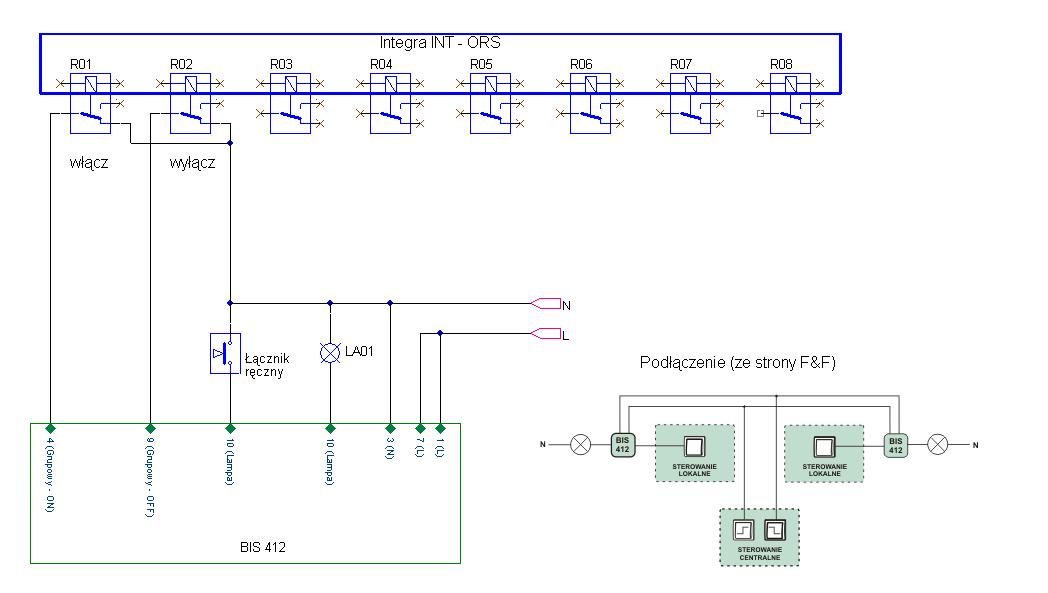
    BIS 412 – as you suggest, ‘local’ control – a bell switch – turns the lighting on and off; you connect the ‘central control’ (two signals) to switch this single BIS 412 or a group of several (lighting scene)
    STR – the same control method.
    A less ‘elegant’ control method involves using, for example, the BIS 411 – the bell switch turns the lighting on and off; now, if we want to take over control via the Integra, we must use a single (Integra) relay to momentarily cut the power supply to the BIS-411; once the power supply is restored, it will be set to the off position - at that point, you can ‘flick the light’ using a dedicated Integra relay by sending pulses via contacts in parallel with the bell switch – this is where the problem lies, as you have to count the pulses to know whether the light is on or off...
  • #38 12169263
    ekmir
    Level 24  
    Posts: 1761
    Help: 18
    Rate: 408
    pafciowaw wrote:
    It is possible to reconcile this...
    BIS 412 – as you suggest, ‘local’ control – a bell switch – turns the lighting on and off; you connect ‘central control’ (two signals) which switches this single BIS 412 or a group of several (lighting scene) on or off
    STR – the same control method.


    I understand that it’s connected directly to the Integra, as shown in the diagram:
    https://obrazki.elektroda.pl/9066519400_1312221261.jpg

    Are no additional INT-IORS expanders required here?

    pafciowaw wrote:
    A less ‘elegant’ method of control is to use, for example, the BIS 411 – the bell switch turns the lighting on and off; now, if we want to take control via the Integra, we need to use a single (Integra) relay to momentarily cut the power supply to the BIS-411; once the power returns, it will be set to the off position – at which point you can ‘flip the light’ using a dedicated Integra relay by sending pulses via contacts in parallel with the bell switch – this is where the problem lies, as you have to count the pulses to know whether the light is on or off...


    This solution is indeed rather ‘clumsy’, so I’m definitely in favour of the first one :)
  • ADVERTISEMENT
  • #39 12169857
    pafciowaw
    Automation specialist
    Posts: 2439
    Help: 480
    Rate: 365
    I was thinking of a solution like this
    How do I integrate the Satel Integra 64 with INT-IORS to control lights and roller blinds?
    the connection numbering corresponds to the contact layout in the BIS 412
    The Integra relays (contacts) act as a ‘central control’...
  • #40 12169902
    ekmir
    Level 24  
    Posts: 1761
    Help: 18
    Rate: 408
    I see that my esteemed colleague has a ready-made diagram for every solution :)
    Thank you for this solution.
    So, does this mean that an INT-ORS expander needs to be used between the Integra and the bistable relay after all?
ADVERTISEMENT