
logo elektroda
logo elektroda
X
logo elektroda

Moeller X-Comfort relay and LED strip dimming - how to switch EMC YT 210 safely?

mjasinsk 4537 12
Best answers

How can I safely switch and dim an EMC YT 210-powered LED strip with X-Comfort without overheating the supply or damaging the LEDs?

Put a bridge rectifier after the EMC YT 210 transformer, because the LEDs were being driven with reverse current on AC and that was what made everything heat up [#9798563] Use a rectifier with plenty of current margin; for a 60 W / 12 V strip, a 15 A bridge was suggested, giving about a threefold safety margin [#9799749] Wire the bridge so the AC inputs go to the transformer output and the +/− terminals go to the LED strip, and if possible set the dimming to about 80–90% because the rectified 12 V will be a bit higher than before [#9799749] If the 100 Hz ripple is visible or annoying, add large electrolytic capacitors, but then measure the voltage again with brightness reduced [#9799749] When the rectifier itself runs too hot, the only further suggestion given was to use a rectifier made from fast diodes [#9872803]
Generated by the language model.
ADVERTISEMENT
Treść została przetłumaczona polish » english Zobacz oryginalną wersję tematu
  • #1 9797763
    mjasinsk
    Level 9  
    Posts: 6
    Hello,
    This is my first post. I’m not an electrician or an electronics engineer, but I’m not a complete idiot either, so feel free to explain things to me in reasonably technical terms. I’m installing components of the Moeller X-Comfort home control system in my new flat. For now, I’m testing the components in my current flat, and everything was working fine until I got round to the LED issue.

    The idea is this: I want the sensor (X-Comfort) to pick up a signal, send it to the receiver (X-Comfort), which then sends a control signal to switch on the transformer powering the LED strip, thereby brightening or dimming it. The system works very well with standard incandescent or halogen bulbs

    Problem No. 1: I used an EMC YT 210 transformer (yes, I know LEDs should be powered by DC, but this one outputs AC); I connected the X-Comfort control unit in front of the transformer. Everything worked brilliantly, except that I broke a basic rule, which risked damaging the LEDs; on top of that, the EMC YT 210 was getting incredibly hot.

    Could you please advise on what to do to make this solution work properly – in other words, to avoid damaging the LEDs and prevent the transformer from burning out?

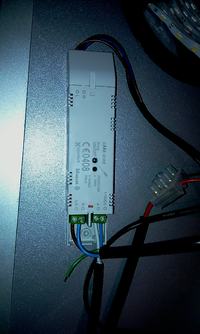
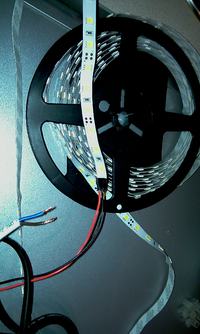
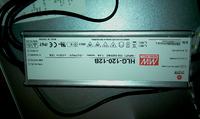
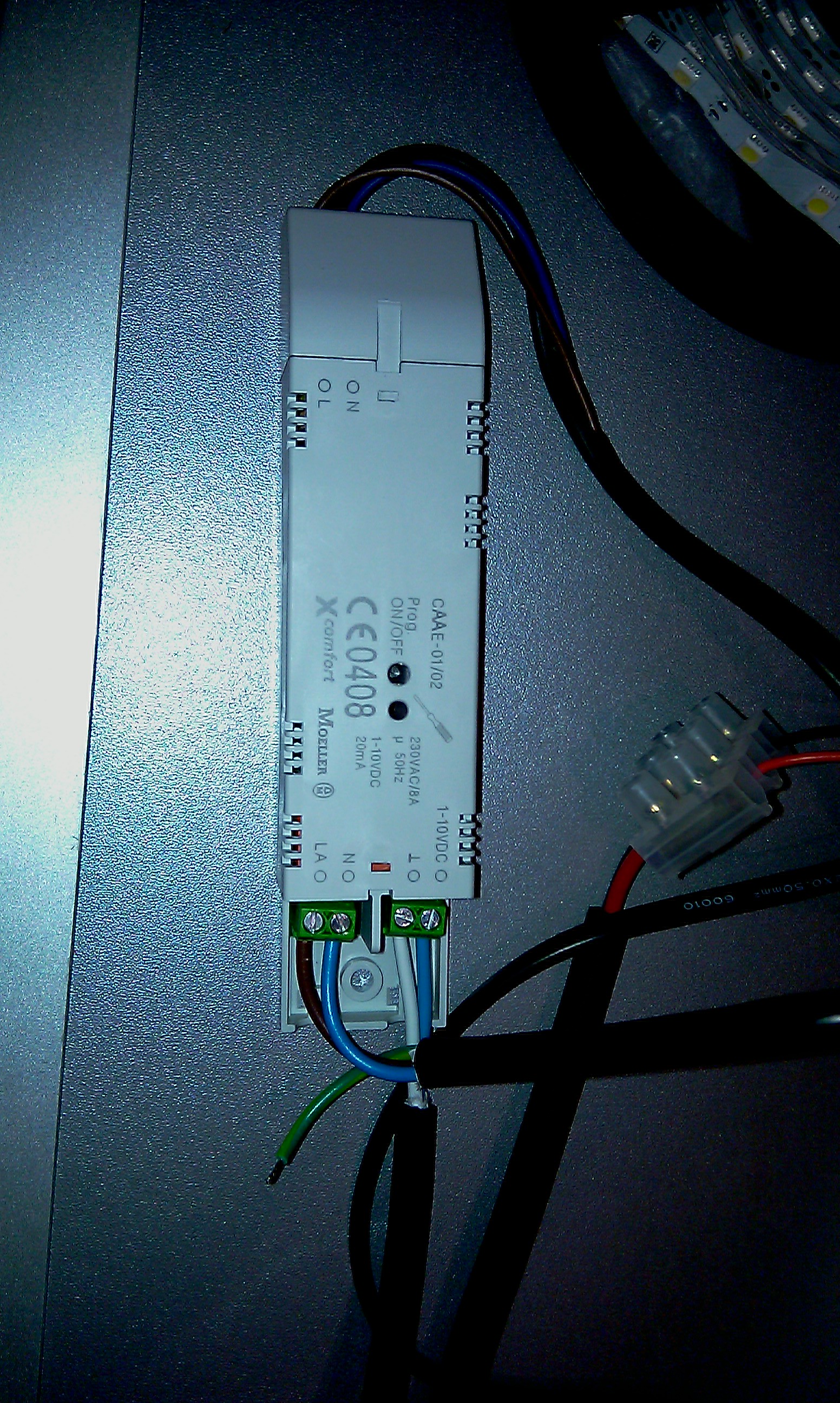
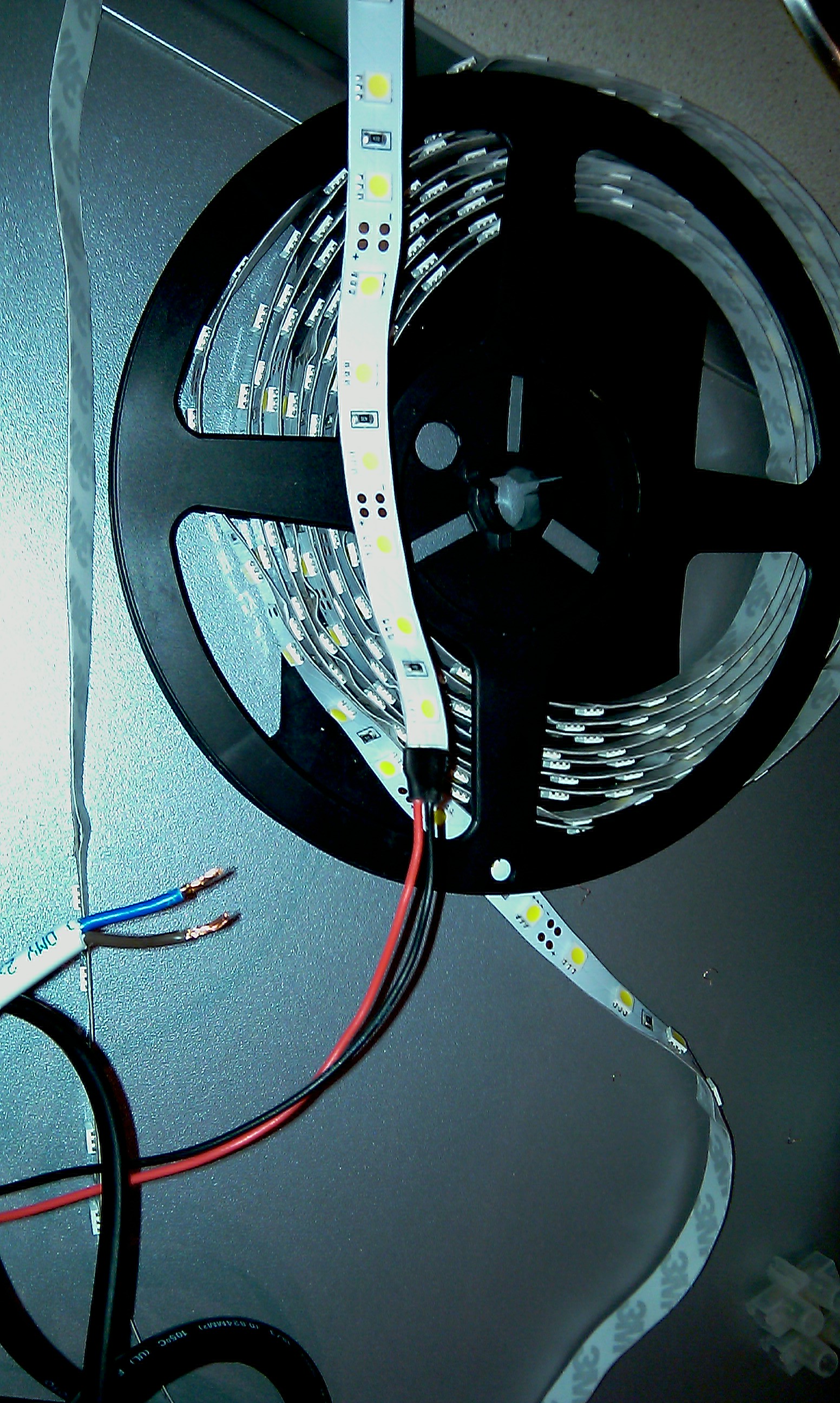
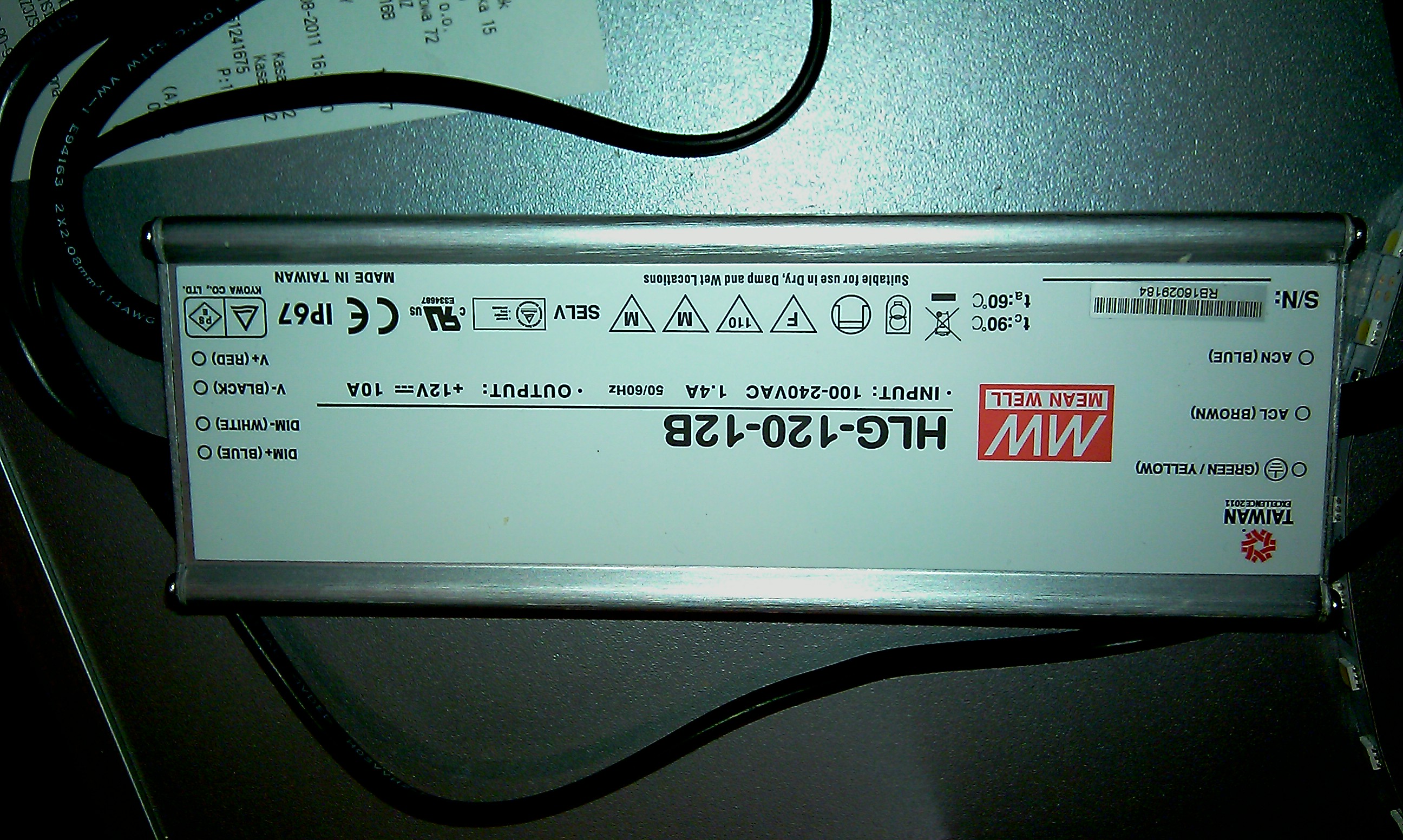
    Problem No. 2 (with illustrations). I contacted the LED supplier and x-comfort and established that the correct transformer for the LEDs must be used to avoid damaging them. The team at x-comfort informed me that I should purchase a transformer with an additional 1–10V control, and to replace the dimming receiver used above with a special receiver featuring a 220V input, the same output to the transformer, and additionally a DIM+ and DIM– 1–10V 20mA input. I went ahead and bought one, spending a fortune on the power supply (Mean Well HLG-120-12B) as shown in the photo. I hooked it all up nicely and was absolutely astonished… Admittedly, the power supply stays nice and cool, but:
    1. The LEDs seem to be brighter and are getting warm (sic!) – a 5m-long 5050 LED strip rated at 14.4 W per metre.
    2. The X-Comfort switches the system on and off, but refuses to dim it. In fact, it dims by about 20–30 per cent and then switches off, whereas it should be able to dim from 0–100 per cent and then switch off only after going from 100 per cent back to 0.

    What should I do????

    Please explain it in simple terms

    Paradoxically, solution no. 1 – which seemed unacceptable – would actually work brilliantly. And solution no. 2 has cost me money, and now I’ll have to sell Mean Well power supplies on Allegro :(

    HELP......


    Moeller X-Comfort relay and LED strip dimming - how to switch EMC YT 210 safely? Moeller X-Comfort relay and LED strip dimming - how to switch EMC YT 210 safely? Moeller X-Comfort relay and LED strip dimming - how to switch EMC YT 210 safely?
  • ADVERTISEMENT
  • #2 9798563
    D214d3k
    Level 39  
    Posts: 3837
    Help: 543
    Rate: 629
    As far as I’m concerned, all you need to do is add a rectifier bridge for the EMC YT 210. The voltage will be higher, but the RMS voltage will be normal. Everything was heating up due to the reverse current in the LEDs. The converter is rated at 210 W, whilst the diodes are rated at 60. To be on the safe side, test it on a short strip – I don’t want to have 5 metres on my conscience.
  • #3 9798765
    mjasinsk
    Level 9  
    Posts: 6
    What annoys me most is that the correct solution doesn’t work, especially as that LED power supply was five times more expensive:( Can I buy this bridge as a ready-made component somewhere, or do I need to dust off my soldering iron?
  • ADVERTISEMENT
  • #4 9798857
    D214d3k
    Level 39  
    Posts: 3837
    Help: 543
    Rate: 629
    You can fold the hairpins. Link
  • ADVERTISEMENT
  • #5 9799479
    matekogon
    Level 22  
    Posts: 850
    Help: 35
    Rate: 279
    Mate, why did you use that EMC YT 210 transformer – was it included in the kit? You could have bought a standard toroidal transformer for that bridge and that would have sorted it.
  • ADVERTISEMENT
  • #6 9799670
    mjasinsk
    Level 9  
    Posts: 6
    No, I’d already bought some for the halogen lights in the bathrooms and the kitchen. I tried the solution with LEDs and a dimmer controller connected before the power supply, knowing that the output was AC rather than DC, and everything worked brilliantly. In ‘comfort’ programming mode, I could set the LEDs to fade in and out smoothly with a time delay. Exactly what I’d expected, except that, as mentioned, the setup was incorrect with an AC transformer at the output. The only problem was that it got unbearably hot. So I bought two Mean Well power supplies specifically designed for LEDs, with 1–10 V control, and an X-Comfort receiver, also with 1–10 V control. I hooked it all up and it was a disaster. The LEDs dim by 30 per cent and, on top of that, they’re hot as hell – which, even with these large 5050 LEDs and a considerable power rating of 60W, shouldn’t be happening in my opinion. I should add that it’s not a fault with the equipment, as I have two Mean Well power supplies and two dimming receivers, and it behaves the same way in every configuration. Of course, on Monday I’ll ring the manufacturer and the shop that recommended this exact LED kit to find out what’s going on, but I’m also trying to find a solution myself :)

    P.S. Interestingly, I’ve found shops online offering LED strips with YT series EMC power supplies… and they’re even recommending this setup…That’s a bit unprofessional, isn’t it?

    Added after 5 [minutes]:

    D214d3k wrote:
    You can fold the hair clips. Link


    OK... but treat me as a complete idiot on this one and tell me: in my setup, if I were to connect this after the EMC YT210 power supply – i.e. at the 12V output...what exact specifications should this bridge have to ensure that the LED strip, with the parameters given above, works flawlessly?
  • #7 9799749
    D214d3k
    Level 39  
    Posts: 3837
    Help: 543
    Rate: 629
    I’ve provided a link to a bridge rectifier that will suit you – 15 A, whilst 60 (W)/12 (V) gives 5, so you’ve got a threefold margin. The price isn’t high, so you can afford to have a bit of a margin. Connect the bridge behind the transformer; the positive terminal is marked diagonally from it, the negative terminal is opposite, and the remaining terminals are the AC inputs. If you can programme the dimming to 80–90 per cent, do so, as the rectified 12 V is higher (maximum voltage) than before the bridge rectifier. If you find the 100 Hz ripple in the light irritating (visible, for example, when moving your eyes quickly), you can connect large electrolytic capacitors, but in that case, setting the brightness to less than 100% and measuring the voltage will be necessary.
  • #8 9799973
    mjasinsk
    Level 9  
    Posts: 6
    D214d3k wrote:
    I’ve provided a link to a bridge rectifier that will suit your needs – 15 A, whilst 60 (W)/12 (V) gives 5, so you have a threefold margin. The price isn’t high, so you can afford to have a bit of a margin. Connect the bridge behind the transformer; the ‘+’ is marked diagonally from it, the ‘–’ is opposite, and the rest is the AC input. If you can programme the dimming to 80–90 per cent, do so, as the rectified 12 V voltage is higher (maximum voltage) than before the bridge rectifier. If you find the 100 Hz ripple in the light irritating (visible, for example, when moving your eyes quickly), you can connect large electrolytic capacitors, but in that case, setting the brightness to less than 100% and measuring the voltage will be necessary.


    Thanks, I’ll give this a go, though I must admit that having spent a fair bit on these gadgets, I didn’t expect there to be such problems :)
  • #9 9800271
    D214d3k
    Level 39  
    Posts: 3837
    Help: 543
    Rate: 629
    If there’s no difference, why pay over the odds :) . Being able to control everything with a single remote and register several remotes in the system is a definite advantage. However, you have to dig through the documentation to check and configure everything. When selling a system that’s already expensive, they push expensive accessories (because if someone can afford such a system, they can surely afford the expensive extras too). Meanwhile, most things can be sorted out for 15 per cent of the original price, without any loss of quality and even with some savings. By the way, how much does this HLG cost? If it’s more than 200, I’d rather buy an LED dimmer with a remote control :) .
  • #10 9800510
    mjasinsk
    Level 9  
    Posts: 6
    Well, unfortunately, this HLG costs 240 gross :( It’s a bit of a gamble, but I bought it because I was expecting a double LED strip, i.e. 120 WATT. Maybe I’ll be able to return it to the seller, as the power supply is only two days old and one of them hasn’t even been taken out of the box. After all, I’m entitled to a refund. As for the controls, the idea is that the system can be controlled using remote controls and a central unit – and eventually via a computer as well. It’s also programmed wirelessly via a computer, so the system itself is pretty cool. For now, the only problem is with the LEDs. The system also includes roller blinds and heating control. You can even connect energy consumption meters to individual phases and monitor consumption by specific appliances or parts of the house via the central unit. You can then download this data to your computer or simply read it on the central unit’s display.

    Added after 3 [hours] 50 [minutes]:

    I’ve finally brought my multimeter back from the building site. My understanding of solution no. 2, described in the first post, has deepened considerably. I measured the current at the 1–10 V output of the X-Comfort actuator and found that, when the dimming function is activated, the current smoothly decreases from 10 V to 1 V and vice versa. I repeated the same procedure on the power supply’s output, and here the situation is completely different: for the first 3 seconds, whilst the actuator drops from 10 V to, say, 7 V, the power supply’s output remains at 12 V the whole time; then a slow drop begins, but when the actuator reaches 1V and there is a click indicating it has switched off completely, the power supply output is around 5V. Perhaps this will give you some ideas on what to do about this issue :)
  • #11 9801605
    D214d3k
    Level 39  
    Posts: 3837
    Help: 543
    Rate: 629
    Can you set the dimming level between 15 and 70 per cent? Then have a go.
  • #12 9866392
    mjasinsk
    Level 9  
    Posts: 6
    Listen, I’ve also tried a solution using an electronic transformer and a rectifier… though I think I’ll need to buy a heat sink for this rectifier as it seems to run at about 200 degrees Celsius… It actually melted my plastic connector because I’d only connected it for a test. From now on, the LEDs are working, the dimmer is dimming, and the electronic transformer isn’t getting very hot, but that rectifier is getting horribly hot... how can I sort this out?????????
  • #13 9872803
    tyshowian
    Level 13  
    Posts: 66
    Help: 3
    Rate: 12
    I suggest using a rectifier made from fast diodes
ADVERTISEMENT