logo elektroda
logo elektroda
X
logo elektroda

Sterbox in a smart home – an alternative to expensive PLC systems?

lukas_t1 12466 11
Best answers

Can Sterbox handle the automation needs of a small flat, or is a traditional PLC or another controller a better choice?

Sterbox looks usable for a small smart-home setup, but for the described flat it was judged too limited because the base unit has 12 I/O points, one expansion module brings it only to 20 total, and the project was estimated to need 24 I/O points [#10005108] It also has only 16 macrocells, so even relatively simple automation logic can consume a large part of its internal resources; a virtual test tool is available to check a design before buying [#11128467] The original poster later said Sterbox itself works well in practice, but the I/O limit and expansion cost made him lose interest, while eHouse looked more attractive because it offers more I/O and dimmer options in one unit [#10635973] [#10005108] If you want a more PLC-like alternative, PLC2011 was described as having 21 inputs, support for many 1-Wire sensors, encrypted communication, and manual operation that still works even if the controller fails [#10727816]
Generated by the language model.
ADVERTISEMENT
Treść została przetłumaczona polish » english Zobacz oryginalną wersję tematu
  • #1 9956027
    lukas_t1
    Level 10  
    Posts: 6
    Hello, forum members!
    For some time now, as I’m planning to move into a flat (has anyone tried IB in a flat yet?), I’ve been looking into various solutions.
    Off-the-shelf systems are out of the question due to the enormous costs; especially as a student of automation, I’d like to tinker with something like this purely for the fun of it, to gain some experience.
    As working strictly with PLCs isn’t really my thing (and besides, they’re not exactly cheap either), I’ve been looking for alternatives.
    After browsing through many manufacturers’ websites, forums and so on, I came across two or three solutions that caught my interest:
    1) hall2007 – rather enigmatic, in my view
    2) plc2011a/b – looks promising, but you’d actually need two units for the system to work
    3) sterbox – personally, this is the one I liked the most

    What do I need this for? To control my flat (45m² – I realise that installing an IB system in such a small flat is a bit of a strange idea, but as I’ve mentioned before, I’m doing this purely for the fun of it, and the experience will certainly come in handy when I build a house).

    My requirements are as follows:

    - lighting control (several circuits) depending on PIR sensors, photodetectors and the time of day (scenes, but preferably without dimming)
    - temperature sensors (at least two), PIRs, and possibly a gas/smoke detector
    - a shared audio system for the living room, kitchen and bathroom, fed from a ‘line-in’ on a radio or MP3 player
    - control via the web, mobile phone, traditional switches and a control panel (e.g. a tablet)
    - access control (RFID, card, tokens)
    - ‘I’m coming in, I’m going out, I’m going to bed’ programme to control all the electronics
    - wake-up function, e.g. with music and lights coming on
    - presence simulation
    - no roller blinds/shutters/pumps/furnaces/heating/garden watering/gates and wickets or other bells and whistles

    So, now for the questions:
    * Has anyone seen something like this before or played around with it? Perhaps someone has already set up a specific system using this controller?
    * Will this be enough for my needs?
    * What do you make of the models mentioned above? Their prices (particularly the Sterbox and Hall2007) seem extremely attractive, and I’m wondering if this comes at the expense of capabilities and functionality
    * Or should I just give these gadgets a miss and go for traditional PLCs?

    Many thanks for all your valuable advice:)
    lukas

    PS I was wondering where to post this topic, and I think this section is the most appropriate; however, if the moderators decide otherwise, please move it:)
  • ADVERTISEMENT
  • #2 9957879
    kj1
    Electrician specialist
    Posts: 3280
    Help: 278
    Rate: 848
    Have a look HERE
    maybe you’ll find something you like
  • ADVERTISEMENT
  • #3 9960957
    lukas_t1
    Level 10  
    Posts: 6
    Thanks for the link; I’ve read almost all of it, and I have to admit it’s an incredibly valuable treasure trove of knowledge,

    but there’s nothing specifically about my issue, which is why I’ve started a new thread.
  • #4 10002708
    Dinkss
    Level 12  
    Posts: 34
    Help: 1
    Rate: 2
    How’s the work on this STERBOX coming along?


    I’m asking because I’m also thinking of buying this device.
  • #5 10005108
    lukas_t1
    Level 10  
    Posts: 6
    Hello,
    To be honest, I’ve been reading a lot about IB all the time; I spoke to the manufacturer and distributor of Sterbox – I got a lot of information there to answer the questions I’d been wondering about, and quite a few things have become clearer.
    Unfortunately, a problem has arisen: the manufacturer’s website contains incorrect information (actually, it’s written in a rather convoluted way, but in my opinion it’s misleading) regarding the number of I/O ports.
    It turns out that there are not 16 in total (as the description suggests) but 12. Of course, there are additional modules to expand the number of I/O ports, but
    1. they’re expensive
    2. only one expansion module can be connected to a single Sterbox, so the whole system can only have 20 I/O ports


    That’s not enough… far from enough, even for a flat. I’ve just calculated that I need 24 I/O ports, and now there’s a problem. I was advised to buy a second Sterbox (possibly with an additional module as well); that way, I’d have a decentralised system and 32/40 I/O points. That’s all well and good, but the cost doubles and I’ve started to lose interest in the idea.

    I’ve also found a really good website about the eHouse system (it has some drawbacks, but one advantage of Roommanager, for example, is the large number of I/O points plus dimmers). I’m only just getting to grips with it. As for the price, it’s more expensive, but I’d only need one, so all in all it might be worth it.

    In short, I’m still learning about the subject and, at the moment, I don’t yet know which controller I’ll go for. As for the practical side of things, I’m about halfway through the design phase.

    If you have any questions, feel free to ask – two heads are better than one. Best regards,
    Łukasz
  • ADVERTISEMENT
  • #6 10635841
    Zibiland
    Level 13  
    Posts: 179
    Rate: 12
    Did you manage to get that Sterbox up and running?
  • ADVERTISEMENT
  • #7 10635973
    lukas_t1
    Level 10  
    Posts: 6
    Yes, I’ve had a bit of a play with it – it works really well.
    Unfortunately, due to a lack of time, I haven’t really been able to put it through its paces. I still have a few comments and doubts as to whether certain functions will work on it, but generally speaking, it runs smoothly.
  • #8 10637948
    Zibiland
    Level 13  
    Posts: 179
    Rate: 12
    Could you send me details of how you connected the controls for the roller blinds and the garage door?
    I’m interested in the option to open/close all the roller blinds and to open/close the balcony roller blind.
    I’m also interested in one more thing: what happens if the controller breaks down? How do I open the roller blinds and switch on the lights, etc.?
  • #9 10639466
    lukas_t1
    Level 10  
    Posts: 6
    For me, it’s still at the stage of mock-ups and drawings rather than actual construction. As the title suggests, it’s meant to be a mixed-use building rather than a house, so I don’t have a garage door (or roller shutters either).

    But I don’t really understand the question, because what difference does it make what you connect? Whether it’s an LED, a fan or a control output for a garage door motor, the connection will be exactly the same.

    Implementing a ‘switch everything on/off’ function might prove problematic. I’m not saying it can’t be done – if you put your mind to it, it’s probably possible – but I haven’t had time to work it out.

    And what happens if it breaks down? Well, exactly the same as if any PLC were to break down – it’ll stop working :) You can, for example, bridge it with relays and control it manually from the switchboard (particularly for those critical functions), because, after all, you can always open the garage door with the remote control if you have to.
  • #10 10727816
    palacz997
    Level 12  
    Posts: 35
    Help: 1
    Rate: 2
    lukas_t1 wrote:

    2) plc2011a/b – looks good, but you’d actually need two of them for the system


    I’ve got both the A0 and the B0. I’m very pleased with them.
    http://tanieogrzewanie.istore.pl/
    There’s also a 1-Wire bus to which I’ve connected 24 DS18B20 thermometers; on the same 1-Wire bus, you can connect eight remote relays based on the DS2408. There are four general-purpose temperature controllers, with alarms for temperatures exceeding or falling below set limits. And there’s a fully professional alarm system. I can see any window that’s unsealed, or unsealed and open. You can measure analogue quantities, such as the resistance of anything from 0 to 10k. There are 21 inputs and 84 recognised sensors.
    You can set up commands on your phone such as ‘LEAVING’, ‘RETURNING’ etc., and send commands to several PLC2011 units at once with a single key press.
    Thirdly, data transmission is strongly encrypted using a built-in cryptographic accelerator based on the AES-256 algorithm.

    If you’re controlling the lighting, you set up a staircase circuit wherever the final staircase button is a PLC2011A0. Even if the electronics fail and the relay gets stuck in one position, the light will still work. You can disconnect the power from the PLC and still switch the light on and off.

    As for controlling the roller shutters, I have F&F roller shutter relays. I also have manual buttons by the windows to open them all, just one side, or the terrace separately.
    This works very well with the PLC2011A0; it uses 3 of its relays.
    Under no circumstances should you run twisted-pair cable to any switches. You need to set up staircase circuits with cross-wired buttons if necessary, and no damage to the electronics will cause anything to switch off. The control system will stop working, but manual operation will continue as normal.

    There is also support for programmers. An API is provided in the form of DLL libraries for Delphi, C++ and C#. You can even transmit data via an RS232 serial port with a 280-byte buffer within the PLC itself.
  • #11 10728000
    Zibiland
    Level 13  
    Posts: 179
    Rate: 12
    I’m still wondering whether to go for a Sterbox or a PLC.
    I’ve set up the whole system at home in a star configuration, and reliability was my main priority. That’s why I’ve built the entire system using relays, and I’ll be adding a controller to it. At the moment, it’s working without a controller.
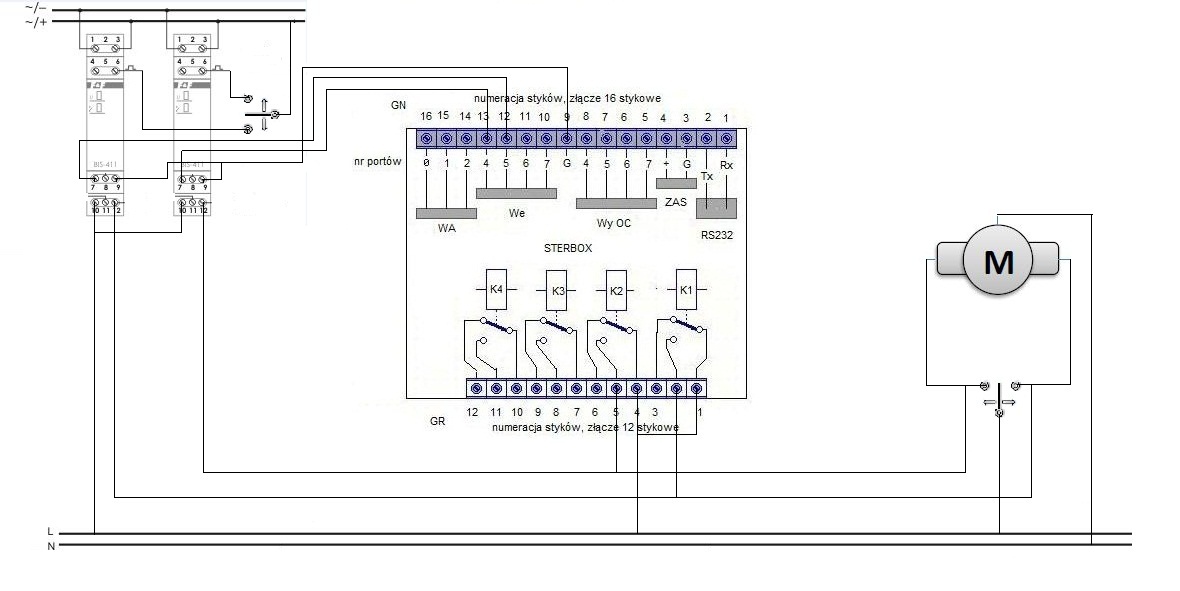
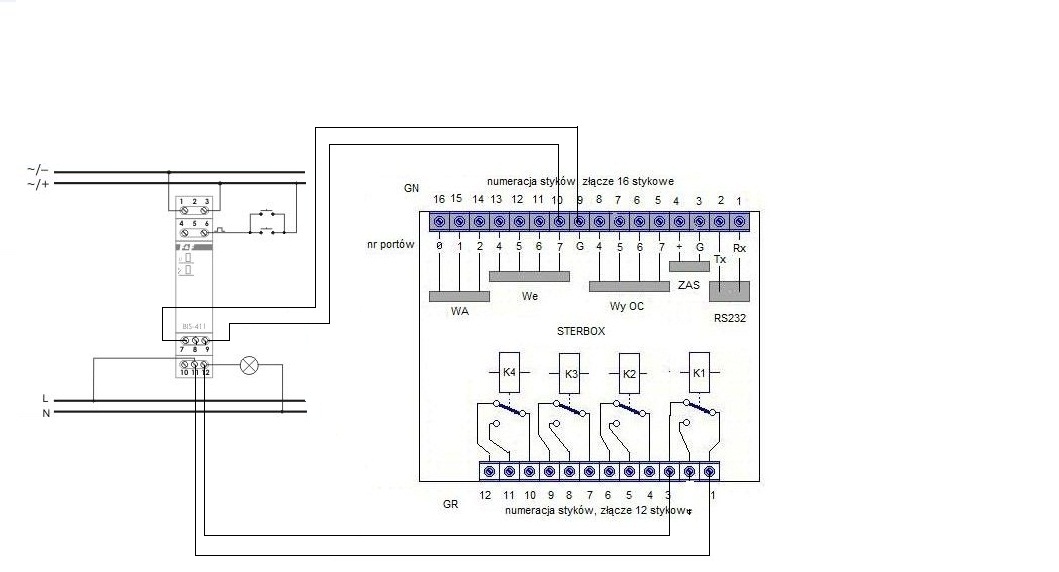
    I’ve put together something like this (diagrams for Sterbox):

    Lighting control:
    Sterbox in a smart home – an alternative to expensive PLC systems?

    Centralised roller shutter control: I use Mobilus controllers for local control
    Sterbox in a smart home – an alternative to expensive PLC systems?

    What I’m missing for the PLC is the software for iPhone, iPad and iPod; I know it’s due out soon, and I know how things are with this software :( .

    palacz997
    Could you send me details of how you’ve connected it at your place?
  • #12 11128467
    Polikon
    Level 14  
    Posts: 179
    Help: 1
    Rate: 28
    Hello.
    I’ve been playing around with the Sterbox for a while now and have been reading quite a lot about it. Most people who want to use it to control something tend to talk about the number of outputs or inputs. No one mentions the capabilities Sterbox offers for controlling these inputs and outputs. I’ve mainly set it up to control my aquarium and my stove. The project itself was intended to include options for manual on/off switching and separate automatic control of the aquarium and the stove.
    And it turned out that, despite my earlier optimism regarding the number of different types of gates, flip-flops, etc. Once the design was implemented, it turned out that I’d used up a significant portion of the Sterbox’s resources just to control two devices, utilising only four outputs and three inputs. To set five timers on the so-called ‘wire’, I had to use three macrocells; adding the ability to switch manual and automatic modes on and off meant I used six macrocells. And the Sterbox only has 16 of them.
    And just as lukas_t1 wrote about his project, I would consider whether the Sterbox’s internal resources would allow this project to be carried out.
    A major plus is that the manufacturer or distributor offers the option to test the Sterbox’s settings virtually. http://www.sterbox.eu/index.php/demox
ADVERTISEMENT