



logo elektroda
logo elektroda
X
logo elektroda

Where should the RS485-controlled cabinets be located – in a central cabinet or in individual room c

MES Mariusz 7299 18
Best answers

Should I place RS485-controlled actuator modules in one central cabinet or split them into separate room cabinets when rewiring a small house?

Put the RS485-controlled modules in one oversized central cabinet if you can; for a small house, the extra cabling is usually worth it, and long RS485 runs should be avoided, with the bus wired in shielded cable [#9972792][#10024170] Protect the actuator modules with an RCD and upstream overcurrent protection matched to the load and cable cross-sections, for example several B10 breakers, ideally on the same phase [#9972792] If you do use room-local cabinets, don’t assume a small downstream fuse will give perfect selectivity or that only that circuit will trip, because upstream protective devices and the RCD may also operate; read up on selectivity of overcurrent protection devices [#9981630]
Generated by the language model.
ADVERTISEMENT
Treść została przetłumaczona polish » english Zobacz oryginalną wersję tematu
  • #1 9971201
    MES Mariusz
    Level 36  
    Posts: 5452
    Help: 8
    Rate: 222
    Hello.

    I’m buying a small house in Wrocław that needs a complete refurbishment. As the electrical wiring will also be redone from scratch, I want to install my own smart home automation system there:

    All the wiring will converge in a single junction box:

    - 230V cables to every light bulb in the house and every 230V AC socket will run directly from the junction box
    - the wires to the light switches will be low-voltage cables (constant 12V – signal wiring). I intend to use the cheapest cables available (Ethernet twisted pair) for the switches.
    - The wires from the switches (signal wires) will be routed to the junction box.
    - For the time being, the light switches will activate relays in the junction box, which in turn will switch on the 230V circuits (light bulbs).
    - In future, DIN-rail modules will be installed there. A single module contains 10 inputs (signal wires from the switches) and 10 outputs (10 230V AC lines) for connecting light bulbs, sockets etc., as well as an RS485 interface enabling the module to be controlled via a control computer.
    - Each of the module’s outputs has a current-carrying capacity of 16A at 230V AC (this is the rating of the relays fitted there)

    I’m just wondering what the best way is to position the circuit breakers. I’m considering the following sequence:

    a).

    1. A control module with 10 AC outputs connected directly (before the fuses)
    2. A single fuse on each of the 10 outputs

    In this scenario, each device (light bulb, socket) would have its own fuse. This is a costly solution – as many fuses as there are devices.

    b).

    - A fuse upstream of the module for all devices controlled by the module – for this solution to be effective (e.g. in the event of a short circuit in a light fitting), the fuse upstream of the module would have to trip before the 16A / 230V AC relay contact is damaged. On the other hand, one would want to ensure full utilisation of the module’s power rating (10 x 16A) – the question is whether these assumptions are mutually exclusive?

    Please assess this solution (all cables routed to a single junction box).


    Another option (I’m only just about to start laying the installation) is to install a junction box in every room and run 230V AC and the RS485 bus to each one. In that case, the cables from all the devices in a given room would be routed not to the main junction box, but to the junction box in that room.

    But the cottage is rather tiny, so I’m not sure whether running cables from all the devices in the building would actually be that much of a hassle. It’s hard to call it a waste either. It’ll probably cost a bit more for the copper cables, but in the second scenario (cables running only to a single junction box per room), you’d have to spend a fair bit on the junction boxes alone (let’s assume there are 10 rooms in the building).

    Thank you in advance for any suggestions before I start laying the cabling in my home. I’d also be happy to look at proposals (quotes/prices) for junction boxes with DIN rails (for a large cabinet, or possibly room-specific cabinets).
  • ADVERTISEMENT
  • #2 9971606
    stomat
    Level 39  
    Posts: 5651
    Help: 257
    Rate: 1956
    After all, the short-circuit current will flow through the relay regardless of whether the fuse is upstream or downstream of the module.
    Why make life so difficult for yourself? What will you use to power these relays? A power failure affecting these modules means total darkness.
  • #3 9971933
    MES Mariusz
    Level 36  
    Posts: 5452
    Help: 8
    Rate: 222
    stomat wrote:
    After all, the short-circuit current will flow through the relay regardless of whether the fuse is upstream or downstream of the module.

    Obviously. If you read carefully, two options are being considered. The first is where the phase for a single module goes through a single fuse; the second is for a situation where we have 10 fuses available on a single module (on the output lines). This leaves the choice of a single fuse upstream of the module (assuming that sockets and lighting are controlled by separate modules).

    For the alternative option (individual junction boxes with a live supply and a control module), a single live supply is routed to each room (for both sockets and lighting). The live wire goes to the module and is switched on via it to the sockets and chandeliers. With this option, you could have one control module and ten fuses in each junction box for a given room. Alternatively: in addition to this, there is a main junction box in the hall from which all the phases for the individual rooms branch out, protected by fuses (as many fuses as there are rooms). In that case, you could potentially do without the fuses in the rooms. The phase entering the module would then be protected, rather than the individual circuits (for example, a short circuit in a socket would cut off power to the entire room).

    stomat wrote:
    Why make life so complicated?

    So that the entire system can be conveniently controlled from a central computer. The system hasn’t been installed yet, so now is the perfect time – it’s now or never.

    stomat wrote:
    What will you use to power these relays?
    A power failure affecting these modules would mean total darkness.

    Don’t worry about the power supply for the relays or the control system. It’s self-contained (battery-powered).
  • #4 9972792
    kasprzyk
    Electrician specialist
    Posts: 5595
    Help: 354
    Rate: 670
    Hello
    Centralise the system into a single cabinet. Avoid long RS485 buses (max. 400 m, e.g. for the Nexo system). Components ‘connected’ to the bus must be wired using shielded cable. For protection, it is best to use residual current devices (RCDs) with an overcurrent protection element upstream of the actuator modules; the protection rating should be selected to match the loads and cable cross-sections – in other words, it is best to divide this into several B10 protection devices, and ideally they should be on the same phase.

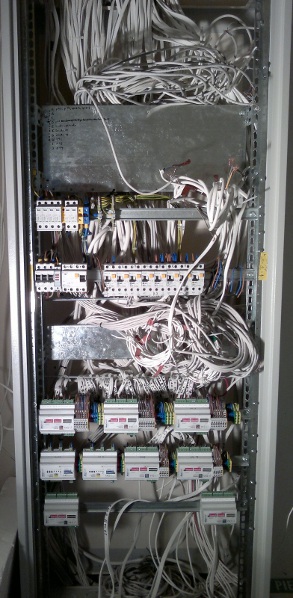
    The photo shown is of a 0.75 / 2m high cabinet for one floor of a building (3 bedrooms, 2 bathrooms, a fitness room, 3 walk-in wardrobes) with space for LAN and satellite TV. It’s worth oversizing the cabinet, as it can become a problem later on.
    Regards

    Not yet finished:
    Where should the RS485-controlled cabinets be located – in a central cabinet or in individual room c
  • ADVERTISEMENT
  • #5 9973676
    stomat
    Level 39  
    Posts: 5651
    Help: 257
    Rate: 1956
    So what does the sentence in bold mean?
    MES Mariusz wrote:

    - a fuse upstream of the module for all devices controlled by the module - for this solution to make sense (e.g. in the event of a short circuit in the bulb holder), the fuse upstream of the module would have to trip before the relay contact is damaged 16A / 230V AC.

    And if the fuse is behind the module, will the contact not be damaged then?
    Hmm, ‘convenient control’, you say? So, for example, if you want to iron some clothes, it’s not enough just to plug the iron into the socket; you also have to go to the computer and switch the socket on. I don’t see where the convenience is here, but then I’m old-fashioned.
  • #6 9973923
    Miwhoo
    Electric installations specialist
    Posts: 2137
    Help: 128
    Rate: 316
    Protection behind the module will ensure selectivity; the power supply to the entire module will not be cut off, only the specific output circuit in which the fault has occurred. To maintain this selectivity, one might consider using fuse links so that not all overcurrent protection devices trip in the event of a short circuit.

    If the controller loses power [unless you’re planning to use an emergency backup], the whole automation system will go to the dogs, in accordance with Murphy’s Law:
    “A powered system works better” :)
  • ADVERTISEMENT
  • #7 9973936
    retrofood
    VIP Meritorious for electroda.pl
    Posts: 31317
    Help: 1140
    Rate: 4789
    Miwhoo wrote:
    The protection circuits behind the module will ensure selectivity; the power supply to the entire module will not be cut off, only the specific output circuit in which the fault has occurred.


    And given that 1 bulb = 1 circuit, there’ll be quite a few of them...
  • #8 9974025
    Miwhoo
    Electric installations specialist
    Posts: 2137
    Help: 128
    Rate: 316
    If you’re going to have a go, you might as well go all out… and anyway, a switchboard with automatic controls will be the size of a three-door wardrobe… I once put together a similar project, but based on the Satel Integra 128WRL. Boy, was that good fun. Now I’ve got a switchboard waiting to be put together for a house where a wind turbine – that popular windmill :) – has been installed as an additional power source. The owner isn’t yet sure which circuits to power from the mains and which from the wind turbine, so he’s asked for a ‘selection option’ – i.e. a 1-0-2 switch – on each circuit. :)

    In my implementation, the low-voltage installations converged in a RACK cabinet, from where a +12V signal was routed via multi-pair cables to the relay modules in the electrical switchboard. The only downside to switching to Integra home automation is the inability to dim the lights...

    Col. stomat, it’s not necessarily as you say, because, for example, sockets can be made ‘available’ during a specific time slot; you can simulate the presence of household members when no one is at home; and if you add motion sensors, door-opening sensors, you can write specific scenarios, e.g. to switch on the lights or send commands to other devices… there are plenty of possibilities; it just depends on your imagination and the size of your wallet.

    It’s true that the more complex the system, the greater the risk of failure, but you have to make trade-offs.
  • #9 9974642
    stomat
    Level 39  
    Posts: 5651
    Help: 257
    Rate: 1956
    Miwhoo wrote:
    e.g. sockets can be made ‘available’ during a specific time slot

    Sure, but what’s the point? Am I supposed to restrict myself in my own home? What if one day I want to plug something in outside the ‘availability’ hours?
  • #10 9974681
    retrofood
    VIP Meritorious for electroda.pl
    Posts: 31317
    Help: 1140
    Rate: 4789
    Miwhoo wrote:

    It’s true that the more complicated something is, the greater the risk of it breaking down, but you have to make trade-offs.


    I see this sort of project as an art installation. Something to be exhibited, for example, at ‘Zachęta’
    But at home??? And in a small one at that?
    By the way, why don’t people want an LCN system? After all, with this system, most of the cables disappear.
  • #11 9975039
    MES Mariusz
    Level 36  
    Posts: 5452
    Help: 8
    Rate: 222
    Stomat , I note that you are not interested in the topic of smart buildings. You are opposed to this type of solution, and you are entitled to your opinion. However, the topic of this thread was different, and I would kindly ask you to adhere to the forum rules.

    Returning to the topic – I am still considering the use of local distribution boxes for each room. A bus cable, a live wire and thin signal cables from the light switches run to the local cabinet (and cables are routed from it to mains sockets and chandeliers/wall lights). The cabinet supports up to 10 devices (I’m assuming that the total number of sockets and chandeliers in a given room won’t exceed 10). The local cabinet contains up to 10 fuses (behind the control module). In addition, there is one central cabinet (a fuse box from which the live wires will be distributed to all the local cabinets).

    I plan to run the RS485 bus as follows:

    control computer -> main fuse box -> local cabinet for room 1 -> light switch in room 1 -> local cabinet for room 2 -> light switch in room 2 -> local cabinet for room n -> light switch in room n.

    This will give me access to the RS485 bus in every room (with the option to add any devices – e.g. voice alarms, operator panels).

    The light switch boxes will be connected to the local cabinet via an Ethernet cable (signals from the switches to the control module), but in addition, a loop with the RS485 bus will be left in the switch boxes (see bus routing plan), enabling the installation of any operator panels in place of the switches.

    The module allows the lighting to be controlled both via signals from the switches and via the RS485 bus. Even if the main computer fails, it will still be possible to switch the lights on and off. However, the RS485 bus takes precedence. The lights can be controlled regardless of the current position of the wall switch (I am considering the use of bell switches or astable switches).


    Option one (centralising everything in a single cabinet is still possible; in that case, I will install smaller junction boxes in the rooms with an RS485 bus running through them, to allow for the connection of further devices).

    I would be grateful for examples, quotations or price proposals for local cabinets which, on the one hand, are compact in size, and on the other, can accommodate 10 fuses and a control module in a Z-104 enclosure. I assume these will be cabinets containing two DIN rails. They will be recessed into the wall and should not protrude significantly from the wall.
  • ADVERTISEMENT
  • #12 9976247
    kasprzyk
    Electrician specialist
    Posts: 5595
    Help: 354
    Rate: 670
    Hello
    Since you’re investing in cabling and, later on, relatively expensive smart home equipment, you’ll certainly be spending a fair bit of money on the interior finish too – no electrical box in the rooms or kitchen will enhance the look of your flat.

    The idea behind a smart installation is to plan specific, comprehensive solutions. During the construction phase, you should think through every detail, including exactly which light fittings you’ll install before moving in, not to mention LCD panels and so on.
    Focusing now on ‘spare’ cable outlets that you may never use, or which may later turn out to require new cables to be added, rerouted or extended to another location, is completely missing the point, but you don’t have to agree with my opinion ;)
    Just remember to allow for the installation of LED strips, RGB lighting, power supplies, controllers, current balancing for actuators, battery-backed system support, etc.
    Regards
    And one more thing – avoid 230V sockets controlled by the system; only use them where you’re absolutely certain of their intended purpose, e.g. aquarium lighting – but don’t plug a heater into that socket...
  • #13 9976763
    MES Mariusz
    Level 36  
    Posts: 5452
    Help: 8
    Rate: 222
    kasprzyk wrote:
    Since you’re investing in cabling, you’ll later need relatively expensive IB accessories

    Yes and no. These are my own modules housed in Z-104 enclosures. The system is, at best, a practical application of modules I’ve built myself.

    kasprzyk wrote:
    you’ll certainly be spending a fair bit of money on the interior finish too – no electrical boxes in the rooms or kitchen will enhance the flat’s appearance.

    That’s right. It needs to be done aesthetically and not be an eyesore.

    kasprzyk wrote:
    The idea behind a smart installation is to plan specific, comprehensive solutions. During the construction phase, you should think through every detail, including which light fittings you’ll install before moving in, not to mention LCD panels and so on.

    That’s right.

    kasprzyk wrote:
    Focusing now on ‘spare’ cable outlets that you may never use, or which may later turn out to require new ones to be added, re-routed or extended to another location, MZ is completely missing the point, but you don’t have to agree with my opinion ;)

    Yes and no – above all, common sense must prevail. You have to strike a balance on certain things. You should also bear in mind that an Ethernet cable from Allegro costs less than 50 gr per metre, and having a surplus of cables at your disposal is a much better situation than having too few.

    kasprzyk wrote:
    Just remember to allow for the installation of LED strips, RGB strips, power supplies, controllers, the current balance of actuators, battery backup for the system, and so on.

    That goes without saying. With particular attention to the appropriate number of cores and cable thickness for a 12/24V low-voltage installation (supplied to local junction boxes). The fact that a buffer power supply system is provided for in such situations probably comes as no surprise to anyone.

    kasprzyk wrote:
    one more thing – avoid 230V sockets controlled by the system; only use them where you are absolutely certain of their intended purpose, e.g. aquarium lighting – but do not connect a heater to that socket...

    I’m assuming the use of relays with a capacity greater than the anticipated final load. For example, I plan to protect the controller’s relay contacts, rated at 16A, with a fast-acting fuse of no more than 10A. I hope this solution will work and will, to some extent, protect the modules from having to replace the relays too often.
  • #14 9978321
    pafciowaw
    Automation specialist
    Posts: 2439
    Help: 480
    Rate: 364
    Since you’re building your own modules (you’ve chosen the casings, etc.), I don’t understand your concerns regarding overcurrent protection (before, or downstream?) – couldn’t you have provided COM/NO/NC signals on the module’s relay outputs? – this would significantly improve the modules’ functionality – allowing circuits to be grouped under each overcurrent protection in almost any way...;)
  • #15 9978486
    MES Mariusz
    Level 36  
    Posts: 5452
    Help: 8
    Rate: 222
    pafciowaw wrote:
    Since you’re building your own modules (you’ve chosen the casings…etc.), I don’t understand your dilemma regarding overcurrent protection (before or after?)

    In this thread, the real dilemma was different: whether to protect the entire module with a single fuse, or to use separate fuses for each controlled circuit.

    pafciowaw wrote:
    Was it not possible to output COM/NO/NC signals to the module’s relay outputs? - this would significantly improve the modules’ functionality – allowing circuits to be grouped under each overcurrent protection in almost any way...

    The fewer possible combinations there are, the more channels can fit into a single module. To illustrate this – given screw terminals (let’s say 16 screws) – you could use 1 for neutral and 15 for live wires (connecting the neutrals outside the module), or insist on 8 neutrals and 8 live wires. Fuse boxes have limited internal volume – the smaller they are, the less they stand out.
  • #16 9978575
    pafciowaw
    Automation specialist
    Posts: 2439
    Help: 480
    Rate: 364
    If you use 2 com and split the rest into two, you can assign B16 to the sockets and B10/B6 to the lighting – with just two S-terminals on each module, you’ll ensure that when the lights are off, the socket circuits will be active.
    The allocation may differ depending on other loads, such as roller blinds, fans, etc.
  • #17 9978713
    MES Mariusz
    Level 36  
    Posts: 5452
    Help: 8
    Rate: 222
    pafciowaw wrote:
    If you use 2 com terminals and split the rest into two, you can assign B16 to the sockets and B10/B6 to the lighting – with just two S terminals per module, you’ll ensure that when the lights are off, the socket circuits will be active.
    The division could be different if you take other loads into account, e.g. roller blinds, fans, etc.

    This is a sensible solution of sorts. However, I’ll try to stick with the option of individual fuses for each channel. Assuming a price of 10 zł per 6A/10A fuse, the cost per cabinet is 10 x 10 zł. That’s a lot, and yet not much. It depends on your perspective. The nice thing is that each circuit is protected individually, mostly by a small 6A fuse.

    In that case, in every room behind the door (so as not to spoil the look), there’s a cabinet with 2 DIN rails (2 x 12) – on the first rail, a control module in a Z-104 enclosure; on the second rail, a set of fuses. In the event of a short circuit in the installation, a single 6A or 10A circuit in the room box (socket or wall light) trips, and in a critical situation, the 16A fuse in the main distribution board (the power supply to the module) trips. In summary, in the event of a short circuit, one local circuit trips. In the event of a more serious fault, the entire room will be cut off from the power supply, e.g. one room.

    Due to the large number of fuses (with maximum occupancy of the local distribution boards for six rooms: 6 × 10 fuses – 60 fuses, plus 6 fuses in the main distribution board), The challenge, therefore, will be to find a wholesale supplier of fuses offering them at the lowest price. It would be advisable (due to the relay contacts) for these to be fast-acting fuses.

    The cost of the local fuse boxes is around 70 zł each (prices from Allegro for flush-mounted, metal fuse boxes with white doors (6 x 70 zł)) – reasonably smart-looking, so as not to spoil the walls.
  • #18 9981630
    kasprzyk
    Electrician specialist
    Posts: 5595
    Help: 354
    Rate: 670
    MES Mariusz wrote:

    The great thing is that each circuit is protected individually, mostly by a small 6A fuse.

    In the event of a short circuit in the installation, a single 6A or 10A circuit in the room junction box (socket or wall light) trips, and in a critical situation, the 16A fuse in the main junction box (the power supply to the module) trips. To summarise, in the event of a short circuit, one local circuit trips. In the event of a more serious fault, the entire room – for example, a single room – will be cut off from the power supply.

    Unfortunately, this is not how it works in the event of a B6 short circuit – the next B16 and C25 fuses in the pre-meter protection may also blow; do also remember the residual current device (RCD).
    Read up on the selectivity of overcurrent protection devices.
    Best regards
  • #19 10024170
    filozof16
    Level 12  
    Posts: 78
    Help: 1
    Rate: 3
    Personally, I’d advise against using a bus system. I prefer to run all the cables down to the cellar. If it’s a small house, the number of cables will be no more than 100. Cables aren’t that expensive, and the advantages of a solution using a central junction box outweigh the cost of the cables. I recommend this solution; I’d only consider the alternative if it were a large house. I’ve personally had mine fitted with a central junction box – when I’m doing some work on the wiring, I sit in the cellar and don’t get in anyone’s way. And PLC is perfectly suited to this.
ADVERTISEMENT