
logo elektroda
logo elektroda
X
logo elektroda
Dostępna jest polska wersja

Czy wolisz polską wersję strony elektroda?

Nie, dziękuję Przekieruj mnie tam

How do I add a motor stop function in the event of an obstruction in the roller shutters?

pempek 4893 10
Best answers

How can I add an obstruction-stop function to a roller shutter motor controller, and is a microcontroller plus triac control scheme a good approach?

The thread does not propose a current-sensing obstruction-stop circuit; the advice is to use a roller-shutter motor with built-in end-switch adjustment or an integrated controller/radio receiver instead of adding extra wiring and a homemade triac controller [#15047690][#15050146] These motors already have their end-switch settings inside, so you do not need to pull separate limit cables to the window [#15050146] The practical recommendation is to keep the installation as simple as possible because more wiring and controllers make later troubleshooting harder [#15057200] If you still want to experiment, assemble the setup first and test it dry, before drilling holes or running all the cables [#15060429]
ADVERTISEMENT
Treść została przetłumaczona polish » english Zobacz oryginalną wersję tematu
  • #1 15047299
    pempek
    Level 10  
    Posts: 34
    Rate: 5
    Welcome,

    I am going to assemble a smart home installation for myself and one of the functions is to be electronic control of the roller shutters. I would like to install an electric motor for each roller shutter (e.g. such a http://www.napedy.net/portos-silnik-rurowy-10nm-do-rury-40mm-230v-p-574.html). As this motor needs 230V control, I am going to design a controller with a small microprocessor so that it will be possible to open/close the roller shutters remotely and from a button mounted in the room.
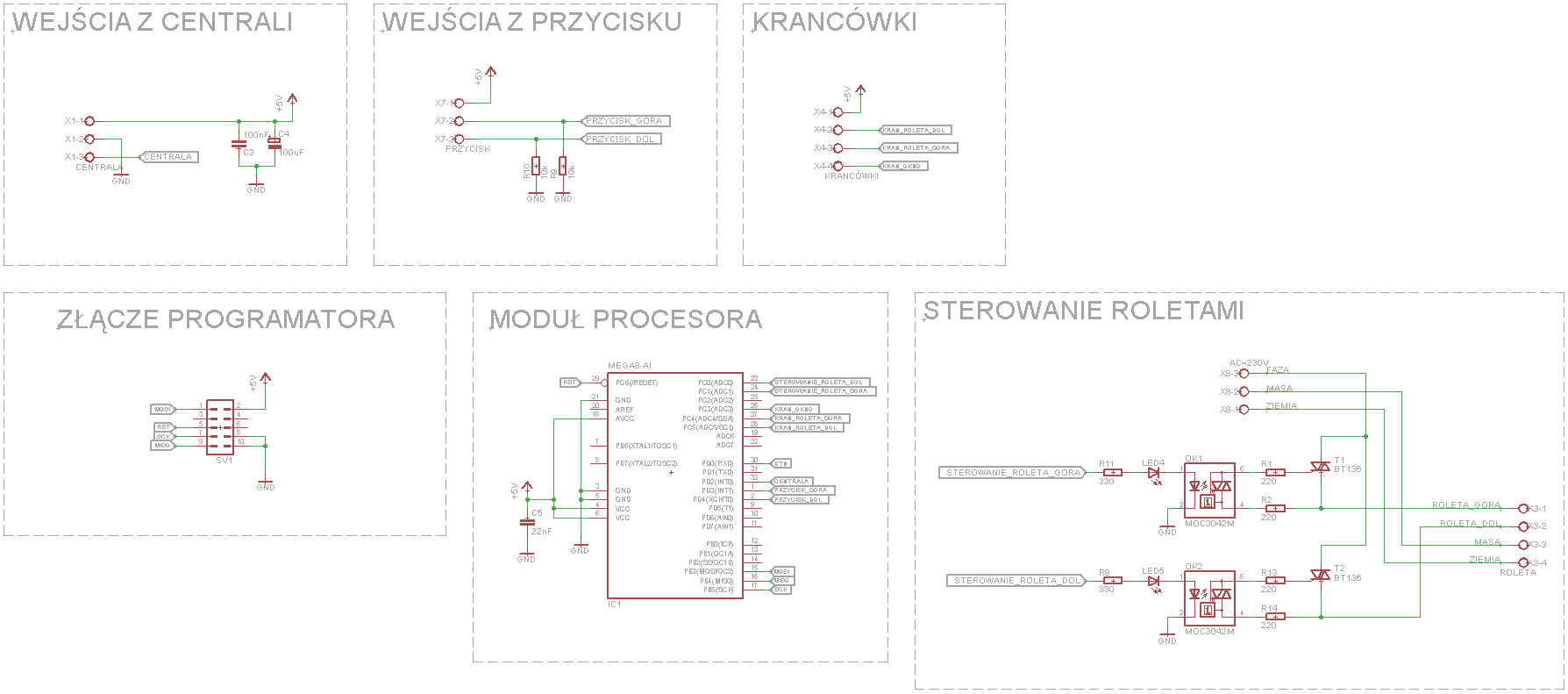
    So far I have come up with a circuit like this:
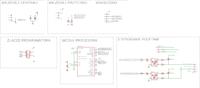
    How do I add a motor stop function in the event of an obstruction in the roller shutters?

    You can see from the schematic that the control of the roller shutters (230V) is done via an optotriac and a triac.
    If it makes sense, I would still like to add the ability to stop the motor if the roller shutter encounters an obstacle (as suggested by the increased current flow in the circuit).
    Could you advise on how to add such functionality and whether the whole roller shutter controller design is likely to work?
  • ADVERTISEMENT
  • #2 15047601
    piterek-23
    Level 33  
    Posts: 3321
    Help: 162
    Rate: 427
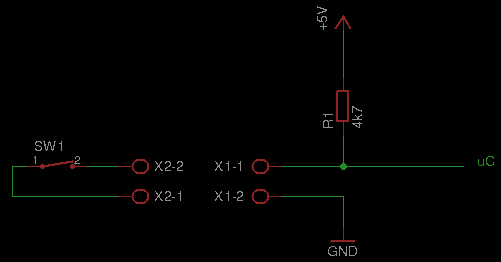
    The buttons are probably this way:
    How do I add a motor stop function in the event of an obstruction in the roller shutters?
  • ADVERTISEMENT
  • #4 15047870
    pempek
    Level 10  
    Posts: 34
    Rate: 5
    I was thinking of using a button that short-circuits the contacts, so my schematic shows a +5V voltage on one line, which will appear at the uC input when the top or bottom button is shorted, respectively. So it's just like piterk's schematic, only with the logic reversed (voltage control). Should I replace this with ground control?

    I could buy an off-the-shelf motor with a radio controller, but I'm still going to pull cables to the window to mount the limiters there. I'd like to have the whole thing monitored in one place, to which I'll also pull sensors from the garage, front door, temperature etc.
    Once I've assembled all this, I'll then make myself a single remote control for everything.
  • ADVERTISEMENT
  • #5 15050146
    Falco76
    Level 25  
    Posts: 908
    Help: 41
    Rate: 148
    On this motor, you have the end switch settings inside, so you don't have to pull cables. Everything works nicely - I fitted one recently, no problems.
  • #6 15051880
    pempek
    Level 10  
    Posts: 34
    Rate: 5
    Ok, that means the extremes in the engine are sufficient.

    So to summarise:
    Should I change the button control to ground?
    Optotriacs will work as drawn?
  • #7 15052318
    Falco76
    Level 25  
    Posts: 908
    Help: 41
    Rate: 148
    This motor is radio controlled. I don't understand why you want to make life difficult for yourself in pulling cables, controllers etc....
  • #8 15055340
    pempek
    Level 10  
    Posts: 34
    Rate: 5
    There are several reasons for this:
    -the roller shutter is to be controlled from two buttons on the wall (one at the window and a collective one for closing/opening all the roller shutters in the flat),
    -it is also to be controlled from a control unit on which I also want to display the closed status of the roller shutters and windows (so I have to pull these cables anyway). So this gives 3 control points, and anyway I won't want to use a standard remote control for just the roller shutters, but rather a more universal one for controlling other things as well (e.g. temperature),
    -the motor without radio control is cheaper, and the cable communication is more secure.
  • ADVERTISEMENT
  • #9 15057200
    Falco76
    Level 25  
    Posts: 908
    Help: 41
    Rate: 148
    Ok, your choice. I'm not writing these answers to tease you. I know from experience that the more wiring you do the bigger the problem you will have later. The control points can be solved by programming the remotes accordingly. In my opinion it would be best not to connect everything together. If it dies, nothing will work in the house. A motor without a radio controller is cheaper, but add cables, holes, installation (possible cable relocation problems later) - and you have the same thing. Think it over well, what you want to do and make it as simple as possible. No unnecessary complications, especially as you are experimenting.
  • #10 15057593
    pempek
    Level 10  
    Posts: 34
    Rate: 5
    Sure, I understand your arguments and I also think they are very valid.
    If I were installing this in an already finished flat they would probably prevail, but here I have the 'comfort' that the flat is in a development state, so everything is still to be done anyway.
    I'll install one such tile and see how it works out.
  • #11 15060429
    Falco76
    Level 25  
    Posts: 908
    Help: 41
    Rate: 148
    If I may offer some advice, assemble it and see how it works 'dry', i.e. without pulling cables or drilling holes. Good luck
ADVERTISEMENT