


logo elektroda
logo elektroda
X
logo elektroda

16A Extension Cord: 1mm2 Wire Thickness Safety & Connecting 35m Series for 15A Load

rahtava 26235 40
Best answers

Is a 1 mm² extension cord acceptable for a 16 A load over about 35 m, and can a chain of extension cords with a 15 A load at the end overheat or burn?

No— for 16 A the cable should be about 2.5 mm² per conductor, not 1 mm², and at 35 m with a 15 A load the setup is a real overheating/fire risk [#16393659][#16400784] The main problems are voltage drop, cable heating, and extra contact resistance at every plug/socket connection in the series chain [#16393659][#16393675] A long cable should be made as one proper 35 m extension with good-quality connectors, not 10 cords in series [#16393675] If the cable is on a reel or not fully unwound, the heating risk is even higher; fully unroll it unless the cord is specifically rated otherwise [#16393659][#16400844] A 16 A socket/fuse rating does not mean the cable itself is safe at 16 A— cable cross-section and cooling conditions still determine whether it will overheat [#16403820][#16400784]
Generated by the language model.
ADVERTISEMENT
Treść została przetłumaczona polish » english Zobacz oryginalną wersję tematu
  • #31 16403013
    kkas12
    Level 43  
    Posts: 17356
    Help: 1073
    Rate: 4262
    vodiczka I do not impose anything on anyone. I present my opinion.
    What you prefer does not matter because what the user chooses counts.
    And he will choose to be lazy because developing the entire extension cord is over-zealous.
    And when he reads your posts in this thread, he is convinced that he knows everything because he is infallible.

    My Zelmer has less than 5 meters of 2x1.5mm2 cable, so it unfolds practically in its entirety. And the engine power is 1500W max and will not increase as in an extension cord with more than one socket.
    It's just to show that the comparison of the extension cord on the drum with a vacuum cleaner is wrong.


    vodiczka wrote:
    As a rule, load a partially unrolled cord only as it is fully coiled in accordance with the warning on the drum, and in the absence of such a warning, unwind it completely.
    America's colleague did not discover this "principle". After all, there is no other option but to connect to the extension cord at its end.
    There is a colleague for (development) and also against :lol:


    PATAFIAN_PATAFIAN wrote:
    ... he was always cold ...
    Because it's cooled ;)
    And there are no cooling extension cords yet.
  • ADVERTISEMENT
  • #32 16403018
    retrofood
    VIP Meritorious for electroda.pl
    Posts: 31317
    Help: 1140
    Rate: 4781
    PATAFIAN_PATAFIAN wrote:
    I checked several times by touching the entire drum with the cable after 30-40 minutes of work and it was always cold, in hot weather only slightly warm (but only minimally). The vacuum cleaner has a power of 1800W.

    Don't be kidding yourself. There is no such option as the engine is air and drum cooled it will always warm up even from the air and not from the flow of electricity. This only increases the heat.
    And the fact that after 30 minutes it is cold, put it between fairy tales and do not tell them here.
  • ADVERTISEMENT
  • #33 16403067
    elpapiotr
    Electrician specialist
    Posts: 12199
    Help: 1013
    Rate: 3508
    Hello.

    Well, it's time for tangible evidence.
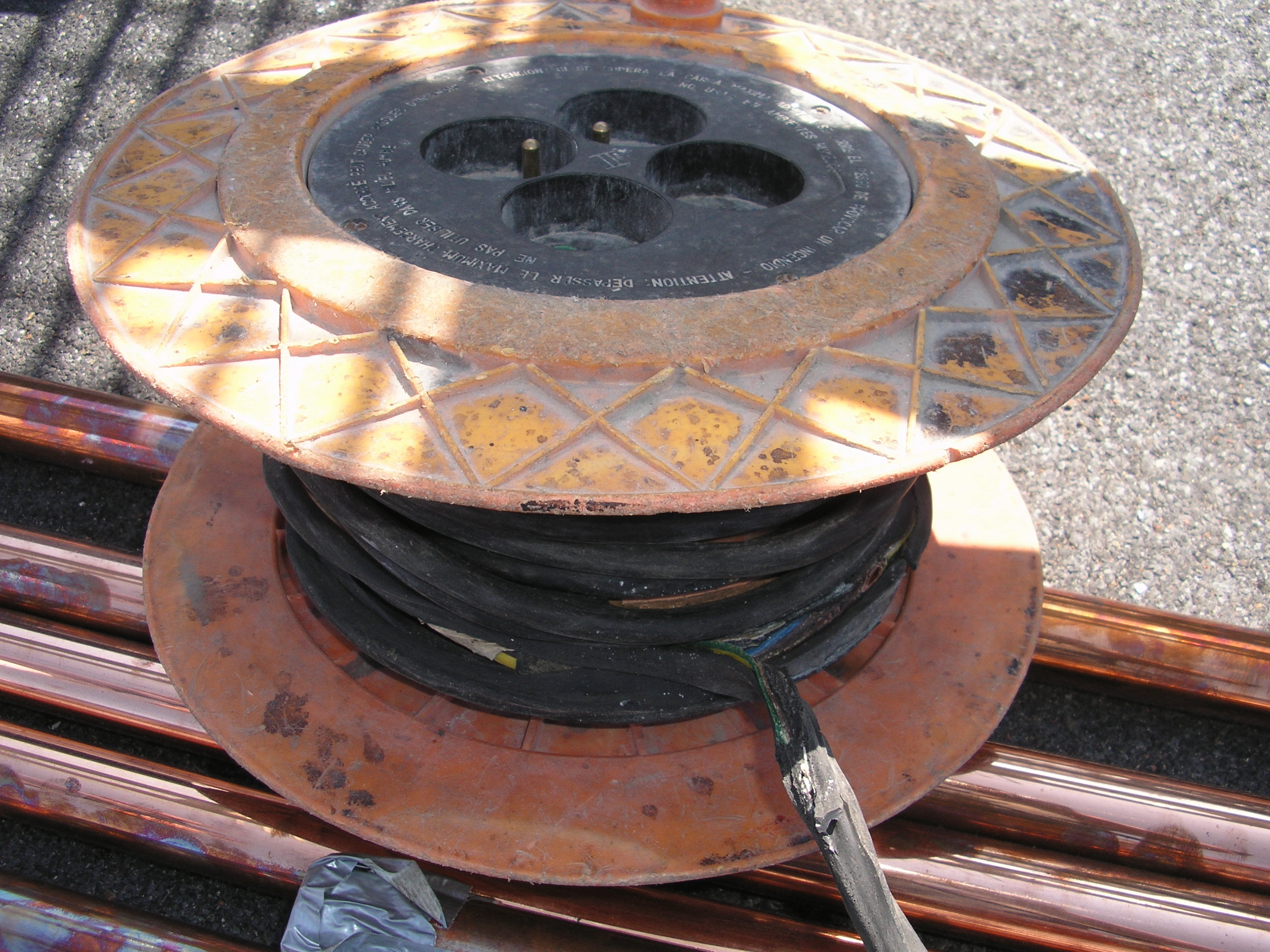
    Construction Katowice, ul. XXX:
    16A Extension Cord: 1mm2 Wire Thickness Safety & Connecting 35m Series for 15A Load

    In another case, on another construction site, the caretaker decided to get some sleep.
    He burned the extension cord completely. Unfortunately, there are no photos :cry:
  • ADVERTISEMENT
  • #34 16403142
    Strumien swiadomosci swia
    Level 43  
    Posts: 27411
    Help: 1403
    Rate: 6379
    PATAFIAN_PATAFIAN wrote:
    The vacuum cleaner has a power of 1800W.

    The engine power is 700-900W. Even industrial karchers don't get any more.

    But for the cable from the vacuum cleaner I added a 2kW heat gun because a long cable and a solid plug and I will tell you that the cable heats up completely unrolled.
  • #35 16403202
    Łukasz-O
    Admin of electroenergetics
    Posts: 21783
    Help: 654
    Rate: 4278
    A simple matter, if someone burns down the extension cord, they will learn to develop the next time. Science must cost.
  • ADVERTISEMENT
  • #36 16403429
    Anonymous
    Anonymous  
  • #37 16403820
    Anonymous
    Level 1  
  • #38 16403917
    vodiczka
    Level 43  
    Posts: 30168
    Help: 1183
    Rate: 4287
    kkas12 wrote:
    I do not impose anything on anyone. I present my opinion.
    You impose on your friend, even with this entry:
    kkas12 wrote:
    So stop deliberating on warnings because you can't do something like that.
    The extension cord must be fully unrolled !!! Always!
    It is not the same as saying: "I always develop it to the end and recommend it to others" :)
    kkas12 wrote:
    It's just to show that the comparison of the extension cord on the drum with a vacuum cleaner is wrong.
    You shoot yourself in the knee again because no one has made such a comparison. And if the rolled up extension cord in the vacuum cleaner does not heat up (which, along with others, I do not believe), it means that its cross section is matched to the engine power so that it can work when rolled up.
    15kVmaciej wrote:
    First, you need to calculate the resistance of your extension cord
    Rolled up and unfolded are identical, the amount of heat released is the same. What will tell us that we lose, for example, 28W of power on an extension cord? The decisive factor is the greater ability to give up / dissipate heat in the unfolded state.
  • #39 16403976
    kkas12
    Level 43  
    Posts: 17356
    Help: 1073
    Rate: 4262
    vodiczka wrote:
    The decisive factor is the greater ability to give up / dissipate heat in the unfolded state.
    And stick to that :)
  • #40 16404000
    vodiczka
    Level 43  
    Posts: 30168
    Help: 1183
    Rate: 4287
    You try to impose your opinion again :) When the extension cord has the specified current carrying capacity in the rolled up and unfolded state, I use this information, just as I do not drive in the city constantly at a speed of 50 km / h when the road sign allows 70 km / h on a given section.
    That is why God gave reason (and the PRL eliminated illiteracy) to use it.
  • #41 16404407
    Krzysztof Reszka
    VIP Meritorious for electroda.pl
    Posts: 10574
    Help: 609
    Rate: 1545
    We close the topic because the author has not spoken for 5 days. If colleagues interested in the discussion, we transfer to electricians.

Topic summary

✨ The discussion centers around the safety and suitability of using a 16A extension cord with 1mm² wire thickness for a 15A load over a distance of 35m. Participants express concerns about the adequacy of the wire gauge, suggesting that a minimum of 2.5mm² is necessary to prevent overheating and voltage drop, especially when multiple cords are connected in series. The risks associated with using extension cords that are not fully unrolled are highlighted, as they can lead to increased heat generation and potential fire hazards. The importance of using high-quality extension cords and ensuring proper thermal protection is emphasized, along with the need for awareness regarding the electrical load and the condition of the cords.
Generated by the language model.

FAQ

TL;DR: A 35 m run of 1 mm² copper at 15 A drops ≈18 V (7.8 %), risking devices and heat build-up [IEC 60364-5-52]. “Use at least 2.5 mm² for 16 A feeds” [Elektroda, 398216, post #16393659]

Why it matters: Undersized, coiled reels overheat fast and may trip breakers too late.

Quick Facts

• EU socket fuse: 16 A type B/C allows 1.13–1.45× rating for up to 1 h [IEC 60898]. • Recommended cable for 16 A portable leads: 3 × 2.5 mm², max 50 m [IEC 60364-7-704]. • Voltage-drop design limit: 3 % (≈6.9 V at 230 V) for socket outlets [IEC 60364-5-52]. • 1 mm² loop resistance: ~1.2 Ω per 35 m run; 15 A → 18 W heat, 18 V drop [IEC 60228]. • Coiled 25 m, 1.5 mm² reel reached 100 °C in 12 min at 3 kW load [HSE, 2015].

Is a 1 mm² extension cord really rated for 16 A?

Labelled 16 A plugs only certify the plug contacts. Wiring must meet installation rules. IEC tables give 1 mm² copper just 11-14 A free-air capacity; reels reduce this further. Therefore 1 mm² fails the 16 A requirement under standards [IEC 60364-5-52].

What conductor size should I use for a 35 m, 16 A feed?

Select 3 × 2.5 mm² H07RN-F or CYKY. The size keeps voltage drop below 3 % and stays < 60 °C on a reel [IEC 60364-5-52; Elektroda, 398216, #16393659].

How big is the voltage drop on 1 mm² over 35 m?

Resistance of the 70 m loop is 1.2 Ω. At 15 A the drop is 18 V, or 7.8 %. That more than doubles the IEC limit and can stall motors or dim lamps [IEC 60228].

Can several short cords in series start a fire?

Yes. Each plug-socket joint adds contact resistance. Ten joints at 75 m total length raise heat and can carbonise sockets, especially if coiled [Elektroda, Akrzy74, post #16400784]

Do I have to unroll the entire reel every time?

Unroll fully when load exceeds the maker’s ‘coiled’ rating. Example: 1000 W coiled vs 2500 W uncoiled on a 10 A reel [Elektroda, vodiczka, post #16400316] If no rating is given, treat coiled use as unsafe and unroll [HSE, 2015].

Why do cheap reels skip the 2.5 mm² rule?

Cost reduction. Short 3–5 m cords meet plug current but ignore voltage-drop clauses. Manufacturers rely on brief duty cycles and open-air cooling [Elektroda, 398216, post #16393659]

What if the thermal cut-out is bypassed or faulty?

Some older or DIY drums lack thermal switches, and users sometimes bridge them. Without protection, a stalled reel can exceed 150 °C, melting PVC in minutes [Elektroda, PATAFIAN_PATAFIAN, post #16402601]

How can I estimate cable size fast?

  1. Multiply current by length (A·m). 2. Divide by 10 for 3 % drop on 230 V. 3. Choose the next larger mm² size. Example: 16 A × 35 m = 560 A·m → ≥ 2.5 mm². This aligns with IEC graphs.

What load can a 1.5 mm², 25 m reel handle coiled?

Tests show a 3 kW heater pushed core temperature to 100 °C in 12 minutes, near PVC softening point [HSE, 2015]. Keep coiled loads under 1 kW unless the reel states more.

Does drum diameter affect overheating?

Yes. Larger diameters spread turns, improving airflow. A 30 cm drum runs about 20 °C cooler than a 15 cm drum at the same load, per lab tests on 2.5 mm² cords [“Wire on Reels Study”, 2019].

Why must portable cords be three-core?

EU law treats outdoor class I equipment as needing protective earth. A 3-core 2.5 mm² cable meets touch-voltage and fault-loop limits; two-core is limited to class II devices [IEC 60364-4-41; Elektroda, arlix, #16400280].

How do I build a safe 35 m extension?

  1. Buy 40 m of 3 × 2.5 mm² rubber cable. 2. Fit IP44 16 A plug and socket. 3. Add an MCB-protected reel if needed. This gives < 6 V drop and 3.6 kW capacity [IEC 60364-5-52].
Generated by the language model.
ADVERTISEMENT