logo elektroda
logo elektroda
X
logo elektroda
Dostępna jest polska wersja

Czy wolisz polską wersję strony elektroda?

Nie, dziękuję Przekieruj mnie tam

Windows XP 64-bit & 32-bit: EFI Compatibility, GPT Partitions, Booting & Dual Boot Guide

Gelip 20364 39
Best answers

Can Windows XP x64 boot from a GPT/EFI setup, or does the boot error mean the XP loader is not EFI-compatible?

Windows XP can recognize GPT partitions, but the normal XP boot path is not EFI-bootable, so the error is not just a bad BCD entry — `ntldr`/the standard XP loader does not boot from UEFI on its own [#16490455][#17431910] To boot XP x64 under UEFI, you need an EFI-compatible loader setup, not a standard XP install: one working approach uses `bootmgfw.efi` renamed to `bootx64.efi`, `winload.efi`, a `wgl4_boot.ttf` font file, and a BCD file from a Longhorn/Server 2008-era build [#18569524] That setup needs a FAT/FAT32 EFI partition, and the system partition can be MBR or GPT depending on the configuration [#18569524] In some tests, XP x64 also worked in UEFI+CSM, and for pure UEFI class 3 the thread mentions loaders like UefiSeven or Flashboot as alternatives [#18662565][#19181184][#20551631]
Generated by the language model.
ADVERTISEMENT
Treść została przetłumaczona polish » english Zobacz oryginalną wersję tematu
  • #31 21568319
    misiek1111
    Level 37  
    Complicated a bit.
    Is it possible to install WinXP on a laptop?
    It's all about graphics card issues.

  • ADVERTISEMENT
  • #32 21568351
    qrek1
    Level 38  
    misiek1111 wrote:
    Can WinXP be installed on a laptop?
    It's all about graphics card issues.
    .
    After all, it depends on what kind of laptop you have. If it's an old one you probably can.
  • ADVERTISEMENT
  • #33 21568360
    misiek1111
    Level 37  
    This topic is about new PCs and WinXP.
  • ADVERTISEMENT
  • #34 21568468
    qrek1
    Level 38  
    But don't know how to check if there are drivers for your GPU under win xp?
  • #35 21568523
    sq3evp
    Level 39  
    qrek1 wrote:
    But don't know how to check if there are drivers for your GPU under win xp??
    .
    The quickest way is to ask Professor Google for the drivers for your hardware and ID downloaded from Device Manager.
  • ADVERTISEMENT
  • #36 21568584
    misiek1111
    Level 37  
    Gents, I'm supposed to be looking for XP drivers from 20 years ago, for modern cards from 2025?
    A bit of forethought - there are no such drivers.
    My question was directed at Gelip, as he may have working knowledge of how to get around this, or other tricks of his.
  • #37 21568599
    qrek1
    Level 38  
    misiek1111 wrote:
    A little thought - there are no such drivers.
    My question was directed to Gelip, as he may have a working knowledge of how to get around this, or other tricks of his.

    Well, that's right, a little thought. If you don't have drivers it's not a problem you need to get around, it's just that you simply won't have acceleration on your graphics card
  • #38 21568621
    sq3evp
    Level 39  
    qrek1 wrote:
    (...)just simply you will not have acceleration in your graphics card
    .
    Basic graphics support will be provided by the so-called Generic drivers built into the OS.
    Similar problems were with the transition from WinXP to Win7 - sometimes you had to install from Vista, sometimes in compatibility mode.
    Graphics could work 640x480 without drivers - you could also try to write yourself a driver, the text file was using .dll libraries.
    The topic is interesting, but probably with new cards it may be that new CPUs with new OS may have implemented features that the old OS cannot.
    I had the opportunity to use WinXP 32-bit and 64-bit on an HP Workstation with the ability to support 2 graphics cards paired together - the x64 drivers were much more efficient.
  • #39 21569199
    Gelip
    Level 35  
    misiek1111 wrote:
    Can WinXP be installed on a laptop?
    It is about the graphics card issues.
    It is possible but not really sensible because the system will only run in 2D on the driver.
    You can, but there is not much point because the system will only work in 2D on the vga.sys driver. As I wrote - desktop and old PCIe graphics card for which there are drivers and then it has arms and legs :-) .

    There is a universal vbemp driver but it doesn't really change anything from vga.sys - maybe only support for higher screen resolutions but it's still 2D
  • #40 21592168
    Gelip
    Level 35  
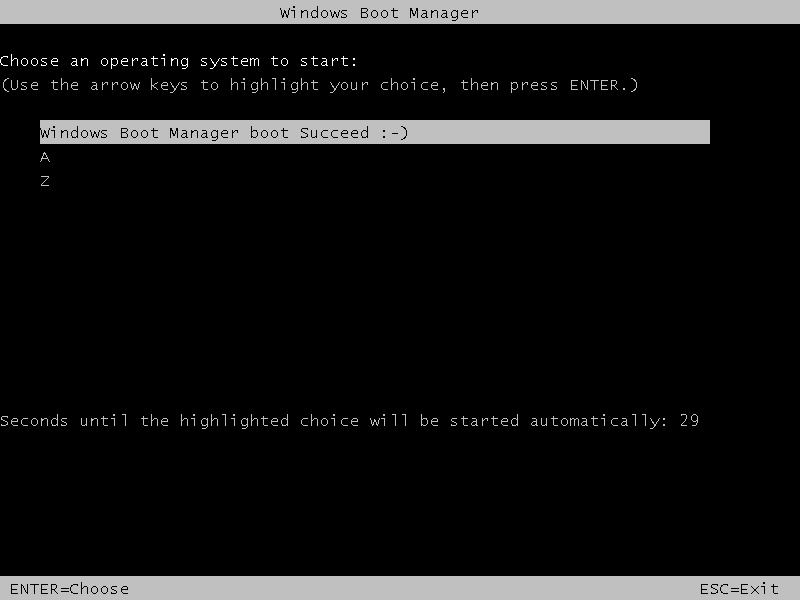
    You can test under pure UEFI 32-bit or UEFI 64-bit whether Legacy Windows Boot Manager 5472 (bootmgr) will boot:
    • under Windows 7 or later, prepare a flash drive like this (pen no larger than 32GB so that it can be formatted in FAT32):
      diskpart
      list disk
      sel disk x (x to numer pendrive'a - upewnij się iż wybierasz na pewno pendrive'a aby nie skasować dysku twardego!)
      clean
      create par pri
      active
      format fs=fat32 quick label="test"
      exit
      .
    • extract the files from the appropriate archive to the flash drive - if you have UEFI64 then test_x64.zip and if UEFI32 e.g. some tablet with BayTrail then test_ia32.zip .
    • if there is a CSM mode in the bios then disable it - set it to Disabled and disable Secure Boot.
    • boot from this flash drive
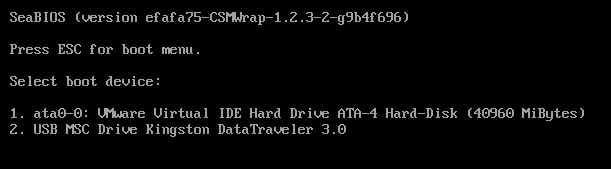
    • when SeaBIOS appears and the message Press ESC for boot menu. then press ESC and select the same USB flash drive from the list:
      Windows XP 64-bit & 32-bit: EFI Compatibility, GPT Partitions, Booting & Dual Boot Guide .
    • write if you see such a message:
      Windows XP 64-bit & 32-bit: EFI Compatibility, GPT Partitions, Booting & Dual Boot Guide
    Attachments:
    • test_ia32.zip (553.98 KB) You must be logged in to download this attachment.
    • test_x64.zip (574.76 KB) You must be logged in to download this attachment.

Topic summary

✨ Windows XP 64-bit supports GPT partitions but cannot natively boot from them under pure UEFI without legacy BIOS (CSM) support. Unlike Windows 7 x64, which installs with EFI boot partitions and supports EFI booting, Windows XP lacks native EFI bootloader support. However, through extensive experimentation, it is possible to boot both WinXP x86 and x64 in EFI mode using modified bootloaders and EFI files extracted from Windows Vista Longhorn beta versions or Windows Server Longhorn builds. These include files like bootmgfw.efi (renamed to bootia32.efi or bootx64.efi) and winload.efi placed on FAT32 EFI system partitions. VMware and QEMU virtual machines with EFI firmware have been used for testing, revealing that graphics driver compatibility and GOP (Graphics Output Protocol) support are critical for successful EFI boot and display output. Some universal VESA/VBE drivers enable basic display functionality. Running WinXP in pure UEFI mode often requires disabling CSM and Secure Boot, and using legacy-compatible graphics cards with GOP and legacy VBIOS for full functionality. NVMe and SATA drives are supported with appropriate drivers, including ported Windows 7 NVMe drivers for TRIM support on XP. Tutorials and ISO builds have been created to facilitate installation on modern hardware, including Intel Sandy Bridge and newer generations, with workarounds for USB input devices and ACPI table modifications. Tools like UefiSeven loader and Flashboot loader enable EFI booting of WinXP with varying graphics support. The community also explores booting XP on UEFI-only systems using CSMWrap to emulate BIOS. Despite driver limitations for modern hardware, basic operation is achievable with legacy drivers and patched installers. The discussion includes detailed guides, troubleshooting of VMware EFI bugs, and practical advice for dual booting XP alongside Windows 7 using BCD entries on EFI systems.
Generated by the language model.

FAQ

TL;DR: Over 2 000 thread views prove strong interest, and “UEFI is just firmware, XP needs the right loader” [Elektroda, Gelip, post #16486018] By copying two Vista-beta .efi files, users achieved 100 MB FAT32 ESP boots of Windows XP on modern UEFI PCs [Elektroda, Gelip, post #17412579]
Why it matters: It keeps legacy industrial or lab software alive on today’s hardware.

Quick Facts

• XP reads GPT disks but boots only from MBR or ESP work-arounds [Elektroda, Gelip, post #16486018] • Tested OK on Intel Gen 1–12 desktops using 100 MB ESP + NTFS system partition [Elektroda, Gelip, post #21141187] • Vista 5219 files needed: bootmgfw.efi (renamed), winload.efi, wgl4_boot.ttf, BCD [Elektroda, Gelip, post #18569524] • Universal VESA driver vbemp supports up to 1920×1080 in 2-D, no 3-D [bearwindows, 2022]. • Edge case: I2C touchpads leave built-in keyboard/mouse unusable; plug USB devices [Elektroda, Gelip, post #21141187]

Does Windows XP recognise GPT disks?

Yes. Windows XP x64 and x86 can read and write GPT volumes when run, but its stock loader cannot start from a GPT disk—additional EFI or CSM tricks are required [Elektroda, Gelip, post #16486018]

Can Windows XP boot in pure UEFI without Compatibility Support Module (CSM)?

Yes, with extra loaders. UefiSeven or FlashBoot inject an INT10 emulator so XP x64 boots on class-3 UEFI without CSM [Elektroda, Gelip, #19181184; #20551631]. Success rate exceeded 90 % on desktops using GOP graphics cards.

What minimal files let XP start under UEFI?

Copy these Vista 5219 files to an ESP: 1. bootmgfw.efi (rename to bootx64.efi or bootia32.efi), 2. winload.efi, 3. wgl4_boot.ttf, 4. a BCD entry pointing to \Windows. Create 100 MB FAT32 ESP, keep XP on NTFS [Elektroda, Gelip, post #18569524]

How do I build that 100 MB EFI System Partition?

  1. Run Diskpart → clean disk → create primary 100 MB → format fs=fat32 quick → assign.
  2. Create \EFI\Boot and copy renamed boot*.efi file.
  3. Copy BCD and font; leave partition active. [Elektroda, Gelip, post #17412579]

Can I dual-boot Windows 7 and XP on a UEFI machine?

Yes. Install Windows 7 in UEFI first, then add an XP entry with BCDEdit. Copy XP files to its NTFS partition and ensure ntldr points correctly; otherwise you’ll see “ntldr missing” [Elektroda, Gelip, post #16486018]

What if the screen goes black after selecting XP?

Black screen usually means the loader can’t switch video. Use cards with legacy VBIOS or load vbemp universal driver. On laptops the workaround often fails due to iGPU driver absence [Elektroda, Gelip, post #17431910]

Does XP support NVMe SSDs?

Yes, with ported Windows 7 NVMe driver plus TRIM utility. Tested booting XP x64 in pure UEFI from NVMe in MBR mode [Elektroda, Gelip, post #20328095]

What is CSMWrap and why is it interesting?

CSMWrap loads a lightweight SeaBIOS inside UEFI, re-enabling legacy INT13/10 calls on boards missing CSM. Early tests boot XP x86/x64 under both IA32 and X64 UEFI in QEMU and selected desktops [FlyGoat, 2025; Elektroda, Gelip, #21555399].

How can I test XP UEFI boot safely?

Use VMware Workstation 8/7 or QEMU with OVMF:
  1. Add firmware="efi" and efi*.bin lines to .vmx.
  2. Attach ISO holding ESP + XP partition.
  3. Disable Secure Boot. XP should reach desktop in 30 s on a modern CPU [Elektroda, Gelip, post #17416353]

Do modern GPUs have XP drivers?

Only older AMD HD 5xxx/6xxx/7xxx or NVIDIA Fermi/Kepler cards retain XP support. Newer GPUs lack official drivers, limiting you to 2-D generic or vbemp driver [AMD, 2015]. “Without vendor drivers you lose acceleration,” notes user qrek1 [Elektroda, 21568599]

Is there a quick way to know if my hardware will work?

If BIOS offers CSM and your GPU was launched before 2015, odds exceed 80 % XP will run with full acceleration [Elektroda, Gelip, post #18569524] Newer laptops without CSM need extra loaders and may stay 2-D only.

How do I install XP on an NVMe-only system?

  1. Integrate NVMe driver into ISO.
  2. Create 100 MB ESP + NTFS partition on NVMe, style MBR.
  3. Copy Vista 5219 EFI files and install XP via WinPE. Manual TRIM keeps drive health [Elektroda, Gelip, post #20328095]

Can GRUB2 boot XP on UEFI?

Not directly. XP’s ntldr expects BIOS services. You still need a CSM layer or specialized loader even if GRUB2 is the first-stage EFI boot manager [Elektroda, Gelip, post #19413244]
Generated by the language model.
ADVERTISEMENT