logo elektroda
logo elektroda
X
logo elektroda

Is OSB Harmful in a Child's Room? Renovation Team's Suggestions & Safety Measures

Jorysiu79 22266 15
ADVERTISEMENT
Treść została przetłumaczona polish » english Zobacz oryginalną wersję tematu
  • #1 17434441
    Jorysiu79
    Level 6  
    Hello, the renovation team offered us to finish the slants in the OSB attic, the idea is great, of course, visually also not bad. But no one said about the harmfulness of these plates ... children will live.
    The rooms are about 25 m2, the entire wall with a slant on the length of 6.40, moreover, I am sending a photo in the attachment. I am referring to you experienced people, please, what should I do about it? Leave as is? The more opinions I read, the more confused I am. I don't want to break down my unknowing harm to my teens, and they are getting ready to sleep in their rooms today.
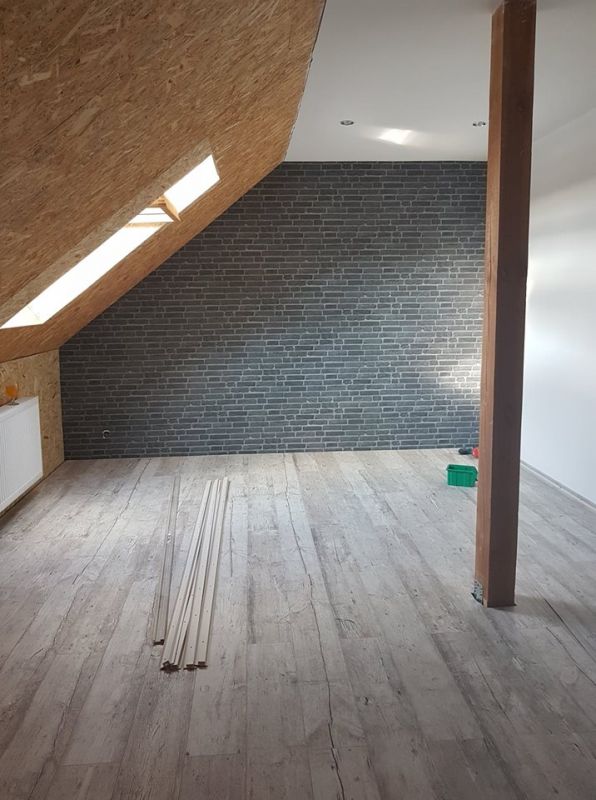
    Is OSB Harmful in a Child's Room? Renovation Team's Suggestions & Safety Measures
    is it enough to paint it with something?
  • ADVERTISEMENT
  • #2 17434478
    siewcu
    Level 35  
    Where did you read about the harmfulness of OSB boards? I ignore the questionable sense, costs, visual aspects and "standard" technical solutions in such a place (ie mineral wool and drywall on top), but I would not care. OSB boards are used in many places and nobody pays attention to the supposed harmfulness, I even asked someone about it quickly and said not to worry about it at all. In addition, you can see that the team is weak, because it is not done aesthetically.
  • ADVERTISEMENT
  • #3 17434487
    Jorysiu79
    Level 6  
    I know that the quality leaves a lot to be desired, unfortunately, when a woman is alone on the battlefield, the effects are the same ... but this is not the end of this work because I have suspended the work for the moment.
    As for the harmfulness of the plates. The gentleman who founded the lighting informed me that they contain formaldehydes and other toxic chemicals

    Added after 23 [minutes]:

    and you cannot put GK on it

    Added after 1 [minutes]:

    I got just this answer to my query:


    A raw plate as a finish is a visually interesting idea ???
    The OSB board gives off formaldehyde and it cannot be found in living quarters in the form you have.
    There are even standards that define the maximum area of OSB in living quarters. Here I see no alternative but to disassemble these panels and finish them with something else, plaster or wooden board.

    and someone removed it from the main forum where I pointed out my problem ..
  • Helpful post
    #4 17434543
    Strumien swiadomosci swia
    Level 43  
    Call a specialist and have him put plaster on the board.
    It looks very bad.
  • #5 17434551
    Jorysiu79
    Level 6  
    and the drywall can not put on it?
  • #6 17434591
    Parowy
    Level 22  
    Hello my friend,
    as long as I have been working on repairs, I have never heard of something like this, and probably about many other things as well :)

    Out of curiosity, I read a little about it and
    https://www.swisskrono.pl/mdb/Plyta-OSB/produkt

    The text mentions the hygiene class E1, so
    https://wuteh.com.pl/klasa-higienicznosci-e1/

    These are specific companies, so the reliability of this information can be different.

    For the sake of peace, I would recommend you to find out what exactly and what manufacturer of discs were used, then obtain a technical sheet and approvals of this product, you can come to the forum and we will read whether it is harmful or not :)
    As for the quality of workmanship, well ... I am not a carpenter, but a lot .. does not stop :)
  • #7 17434593
    siewcu
    Level 35  
    How should the GK go, it is OSB for disassembly and mineral wool underneath (probably not there, but that's just my guess) and a frame to make the GK properly.
  • #8 17434596
    Parowy
    Level 22  
    Jorysiu79 wrote:
    and the drywall can not put on it?


    It is possible, as long as these specific boards meet the requirements of the mentioned E1 class :)
  • ADVERTISEMENT
  • #9 17434598
    siewcu
    Level 35  
    Parowy wrote:
    As for the quality of workmanship, well ... I am not a carpenter, but a lot .. does not stop :)

    In this case, there is no question of build quality. At the end of the plate, zero fold (and if they wanted to, the plate was stained with paint after painting the ceiling, a protruding piece of an angle bar at the post ...
  • #10 17434613
    Anonymous
    Level 1  
  • ADVERTISEMENT
  • #11 17434633
    Jorysiu79
    Level 6  
    Parowy wrote:
    Hello my friend,
    as long as I have been working on repairs, I have never heard of something like this, and probably about many other things as well :)

    Out of curiosity, I read a little about it and
    https://www.swisskrono.pl/mdb/Plyta-OSB/produkt

    The text mentions the hygiene class E1, so
    https://wuteh.com.pl/klasa-higienicznosci-e1/

    These are specific companies, so the reliability of this information can be different.

    For the sake of peace, I would recommend you to find out what exactly and what manufacturer of discs were used, then obtain a technical sheet and approvals of this product, you can come to the forum and we will read whether it is harmful or not :)
    As for the quality of workmanship, well ... I am not a carpenter, but a lot .. does not stop :)


    Added after 5 [minutes]:

    siewcu wrote:
    How should the GK go, it is OSB for disassembly and mineral wool underneath (probably not there, but that's just my guess) and a frame to make the GK properly.

    THERE IS A FRAME AND WOOL
  • #12 17434660
    Parowy
    Level 22  
    atari_robbo wrote:
    Toxic formaldehyde is released from such OSB boards, therefore they are not suitable for use in living quarters, especially in children's rooms.


    There are appropriate standards for this, let's get to know the specifics of the discs used in this case, before we give a verdict.

    atari_robbo wrote:
    ... the Workers ...

    It hurt me personally ;)
  • #13 17434689
    Jorysiu79
    Level 6  
    Parowy wrote:
    Jorysiu79 wrote:
    and the drywall can not put on it?


    It is possible, as long as these specific boards meet the requirements of the mentioned E1 class :)


    that is, it must meet!
    According to the book "Documentation and specifications in public procurement" in the field of OSB boards:
    - formaldehyde content - class 1 | = 8mg / 100g
    Let me put it this way, I'll try to get information from a warehouse ..

    I feel helpless, deceived and I will honestly say stupid ... and I'm terribly sorry that I got so messed up

    Added after 13 [minutes]:

    Parowy wrote:
    Jorysiu79 wrote:
    and the drywall can not put on it?


    It is possible, as long as these specific boards meet the requirements of the mentioned E1 class :)


    I will check the approvals in the warehouse and keep asking ..
  • #14 17434741
    Strumien swiadomosci swia
    Level 43  
    Just paint it. Colorless.

    Secondly, you cannot even imagine how much formaldehyde is generated by kitchen furniture. I have a Chinese meter, the morning massacre is in the kitchen.
  • #15 17434747
    Parowy
    Level 22  
    Jorysiu79 wrote:
    I feel helpless, deceived and I will honestly say stupid ... and I'm terribly sorry that I got so messed up


    Don't worry, you are not the first, not the only and not the last.
    There will still be a lot of water in the Dunajec before normal, responsible people will deal with such works.
    I am also sorry for my colleagues, although I had no idea about this issue myself, the question remains how the contractor will approach such a problem.

    We are waiting for information, keep your head up :)
  • #16 17434781
    Anonymous
    Level 1  

Topic summary

✨ The discussion revolves around the safety of using OSB (Oriented Strand Board) in children's rooms, particularly in an attic renovation. Concerns were raised about the potential harmfulness of OSB due to formaldehyde emissions and other toxic chemicals. Some participants suggested that OSB is commonly used without issues, while others emphasized the need for caution, especially in living spaces for children. Recommendations included consulting a specialist for proper finishing, such as applying plaster or using drywall, and ensuring that the OSB meets safety standards (E1 class). The conversation highlighted the importance of verifying the manufacturer's specifications and the potential need to replace OSB with safer materials.
Generated by the language model.

FAQ

TL;DR: OSB can be used in kids’ rooms if indoor formaldehyde stays under 0.1 mg/m³; WHO says, "The 30‑min guideline value is 0.1 mg/m³." Seal or cover OSB, ventilate, and verify low‑emitting panels. [WHO, 2010]

Why it matters: Parents need quick, practical steps to make sloped‑ceiling bedrooms safe without unnecessary demolition.

Quick Facts

  • E1 emission class for wood panels: ≤0.124 mg/m³ (EN 717‑1) or 8 mg/100 g (perforator). “E1” is the typical indoor standard. [EPF: Formaldehyde release classes]
  • WHO indoor air guideline: 0.1 mg/m³ over 30 minutes to prevent irritation and protect sensitive groups. [WHO, 2010]
  • OSB is commonly made with pMDI resin and has no added formaldehyde; emissions are very low. [APA: Formaldehyde and Engineered Wood]
  • Heat and humidity raise emissions; keep 30–50% RH and moderate temperature to limit levels. [EPA: Formaldehyde in Your Home]
  • Cheap handheld meters are unreliable; use passive badges or lab analysis for accurate testing. [Formaldehyde in Homes]

Is it safe to leave OSB exposed in a child’s room?

Safety depends on indoor formaldehyde levels, not OSB alone. Aim below 0.1 mg/m³ over 30 minutes. Increase ventilation and control humidity. Sealing exposed OSB edges and faces helps reduce emissions. “The 30‑min guideline value is 0.1 mg/m³.” If odor or irritation persists, add barriers or replace panels. [WHO, 2010]

Do OSB boards emit formaldehyde, and how much?

OSB is typically bonded with pMDI resin, which contains no added formaldehyde. Resulting emissions are very low compared with urea‑formaldehyde products. Many OSB products meet stringent indoor emission expectations. Check manufacturer documentation for emission data and certifications. “OSB is manufactured with low‑emitting phenolic or isocyanate resins.” [APA: Formaldehyde and Engineered Wood]

What does E1 mean, and how do I confirm my OSB meets it?

E1 is a European emission class for wood panels. It means ≤0.124 mg/m³ (EN 717‑1) or ≤8 mg/100 g by perforator. Ask your supplier for the CE mark, Declaration of Performance, and test method used. Keep documentation for your records and future buyers. [EPF: Formaldehyde release classes]

Can I put drywall (GK) over OSB to reduce exposure?

Yes. Adding an inert barrier, or sealing exposed surfaces, reduces emissions reaching the room. Gypsum board plus taped joints creates a continuous barrier. Combine with ventilation and humidity control for best results. “Coatings and overlays can reduce formaldehyde emissions from pressed wood products.” [CPSC, 2013]

Is painting OSB enough to make it safe?

Painting or sealing all faces and edges reduces emissions. Use a low‑VOC, film‑forming primer and finish. Apply at recommended thickness, allow full cure, and ventilate. For strongest barrier, consider multiple coats or a dedicated sealant. “Seal all exposed surfaces to reduce emissions.” [CPSC, 2013]

Do any standards limit how much OSB area I can have in a room?

EU practice controls panel emissions by class (E1/E2), not by surface area limits. Compliance is shown via testing and CE documentation. Designers manage area, ventilation, and finishes to meet indoor air quality goals. There is no generic room‑area cap in the E1 framework. [EPF: Formaldehyde release classes]

How can I make the room safer today without tearing out OSB?

Use this quick plan:
  1. Boost ventilation and run exhaust or a portable fan to outside.
  2. Seal all OSB faces and edges with a low‑VOC barrier coating.
  3. Add taped gypsum board if you still smell odors. “Coatings and overlays can reduce emissions.” [CPSC, 2013]

How should I test formaldehyde levels accurately?

Use a passive badge or a laboratory air sample for reliable numbers. Place samplers away from windows and vents at breathing height. Avoid relying on cheap handheld meters; they often misread other gases. Hire an IAQ professional if results are unclear. [Formaldehyde in Homes]

Will heat or humidity make the OSB smell or off‑gas more?

Yes. Higher temperature and humidity increase formaldehyde emissions. Keep indoor RH at 30–50% and use cooling or dehumidification. Improve ventilation when installing and after sealing. “Higher temperatures and humidity can increase formaldehyde levels.” If irritation persists, remove the source. [EPA: Formaldehyde in Your Home]

How long does OSB off‑gas?

Emissions are highest when new and decline with time. Good ventilation and moderate conditions accelerate the drop. Typical indoor formaldehyde ranges about 0.02–0.04 ppm in many homes. Test after finishing and again after a few weeks of airing. [ATSDR: Toxicological Profile for Formaldehyde]

Is it okay to plaster directly onto OSB?

Direct plaster over wood‑based panels is not recommended due to movement and adhesion issues. Best practice is to install gypsum board and plaster over that. Use correct fixings to studs and follow system guidelines. This yields a stable, crack‑resistant finish. [British Gypsum: Plastering onto wood-based backgrounds]

Are kitchen cabinets and particleboard bigger emitters than OSB?

Often, yes. Products made with urea‑formaldehyde resins, like some particleboard and MDF, emit more than pMDI‑bonded OSB. Manage emissions by selecting low‑emitting cabinetry and sealing exposed edges. Ventilate and control indoor humidity. [EPA: Formaldehyde in Your Home]

What if my OSB isn’t E1 or I can’t verify the brand?

Treat it as unknown. Increase ventilation and humidity control first. Then seal all surfaces and edges or cover with taped drywall. If irritation or elevated measurements continue, remove or replace the panels. “Remove or seal the source to reduce exposure.” [CPSC, 2013]

Can I rely on CARB/EPA composite wood labels for OSB?

CARB/EPA rules cover hardwood plywood, MDF, and particleboard. Structural panels like OSB are excluded from those labeling limits. Check manufacturer data for OSB emissions and E1 or NAF claims. Keep certificates with your project records. [CARB Composite Wood ATCM FAQs]
Generated by the language model.
ADVERTISEMENT