logo elektroda
logo elektroda
X
logo elektroda

Constructing 112L Aquarium LED Beam: 80cm, 48W, Epistar Diodes, Soft-On Switch, & Power Supply

duke3 16371 13
Best answers

How can I wire an 80 cm, 48 W aquarium LED beam with Epistar power LEDs, and can I add a soft-start switch to it?

Your 48 W power-LED beam should stay on a constant-current driver, not a 12 V PSU, and the LEDs must be arranged to match the driver's series/voltage requirements; if you switch to 12 V, you would need a redesign with resistors [#17498487] The proposed 50 W / 350 mA / 150–170 V driver has no dimming function, so it will not give a true soft-start by itself [#17493053] For a soft-on effect, a manual LED dimmer or slow-brightener module is the better direction; the RF remote dimmer mentioned in the thread reportedly powers up at 100% first and only then returns to the stored setting [#17498242] One reply also suggested that 2 minutes is hardly noticeable biologically, while 10–15 minutes looks more natural [#17493053] Another note was that 112 L may be overlit with too many LEDs, and that a low-voltage 12 V/24 V approach is safer near condensation [#17493053]
Generated by the language model.
ADVERTISEMENT
Treść została przetłumaczona polish » english Zobacz oryginalną wersję tematu
  • #1 17492766
    duke3
    Level 10  
    Posts: 69
    Rate: 12
    Hello,
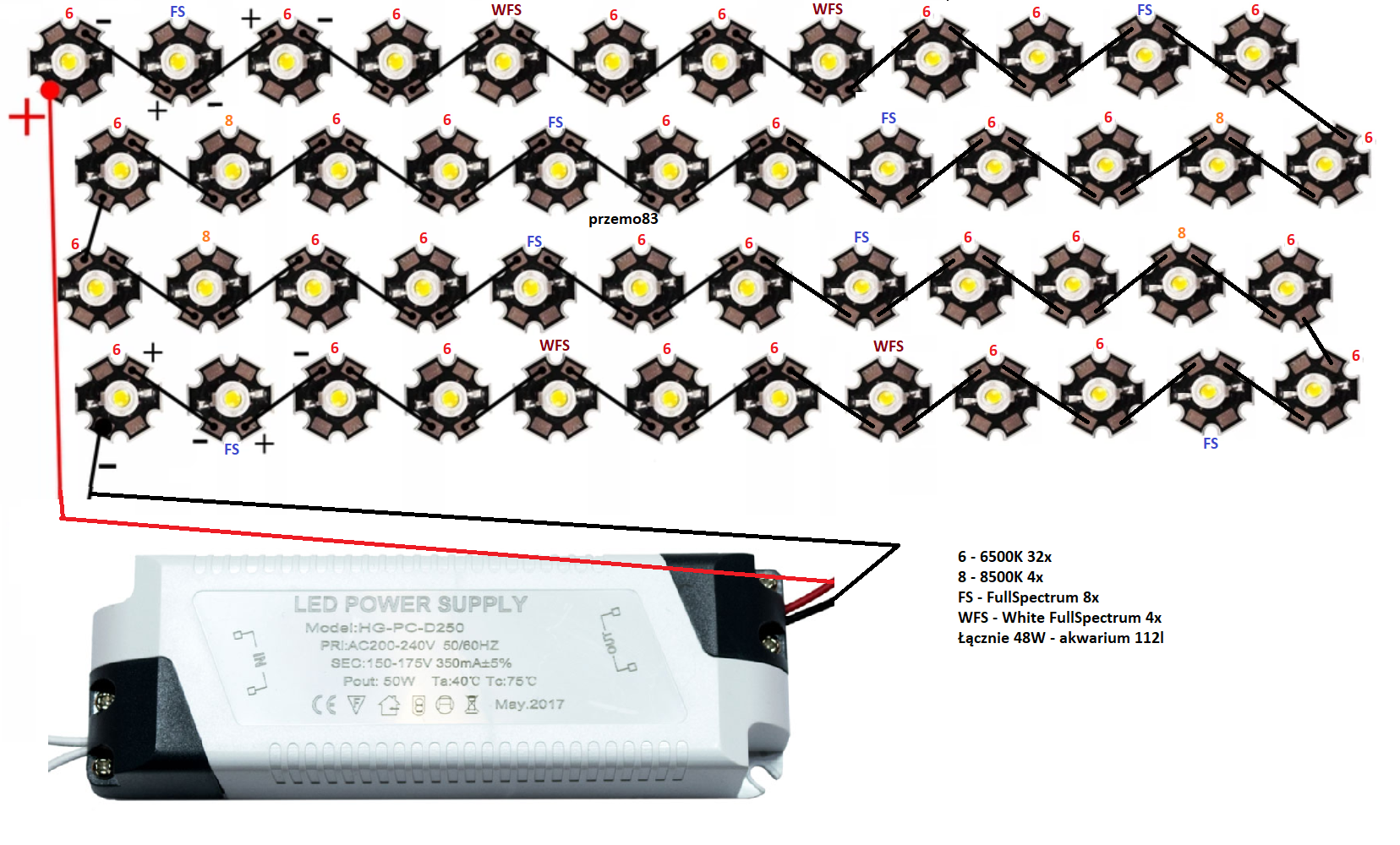
    I need help to build a 112l aquarium led beam, I would like to build a beam 80cm wide, 48W in total, such as the diagram below
    32 LEDs 6500k
    4 LEDs 8500k
    8 FullSpectrum LEDs
    4 WhiteFullSpectrum LEDs
    POWER LED 1W EPISTAR diodes, everything will be glued to the aluminum profile 80x16cm
    Constructing 112L Aquarium LED Beam: 80cm, 48W, Epistar Diodes, Soft-On Switch, & Power Supply

    Is the diagram above correct? (please make corrections if necessary)
    Will it work as it is?
    The beam will be powered by DRIVER LED 50W 350mA 150 - 170V 43 - 50W power supply (auction on Allegro no: 6930550511)
    I would like to insert a "soft on" switch into the beam so that when turned on, the light would not scare the fish, but gradually brightened - let's say 25% in, for example, 2 minutes, how to insert it and where? can you do something like this at all? (please mark it on the diagram)

    Thanks in advance for your help and explaining what and how as simple and straightforward as possible :)
  • ADVERTISEMENT
  • #2 17492804
    enhanced
    Level 43  
    Posts: 10437
    Help: 963
    Rate: 880
    The scheme is, of course, about plus to minus and so on. Lots of soldering and fun.

    When I was doing the beam, I did not use the driver, but I took a 12V power supply and 12v PCB sockets with 3 places for diodes and resistors. It is faster to install and each module works separately, so if something falls, the 3 LED module will fall, not the whole.

    I saw such a soft on switch on the Allegro but with some low amount of watts supported.

    Such an amount is an exaggeration for such a small aquarium and the radiator will not do it.

    I recommend ordering lenses from aliexpress - both versions, i.e. ready-made ones that you put on and those with a housing to which you insert the lenses and put such a set on the diodes.

    There are also ready-made modules for 12V SMD diodes on the Allegro.

    Constructing 112L Aquarium LED Beam: 80cm, 48W, Epistar Diodes, Soft-On Switch, & Power Supply
  • #3 17492861
    duke3
    Level 10  
    Posts: 69
    Rate: 12
    You say that the beam is too strong for the aquarium, according to the ledow calculator it came out about 0.40 W / liter - I think it is just right for a plant aquarium :)

    I was also thinking about these 3 smd LED modules (probably Samsung golden something on Allegro), but it seems to me that they are just weaker than power led

    What is the advantage of the power supply over the driver?
    If I had to give up the driver, what power supply should I put in? (I plug it normally in place of the driver on the diagram?)
    And how with this "soft on" module? (I don't know much about it and I haven't seen anything like that on the Allegro)
  • ADVERTISEMENT
  • #4 17492885
    enhanced
    Level 43  
    Posts: 10437
    Help: 963
    Rate: 880
    This finished strip is Rigid alu AQUA GROW bar plant growth [50cm] , I was also ordering a 10CM rail and since it's dirt cheap I ordered it. So that the glue and the clip to the power supply and ready.

    It shines well, but the disadvantage is that it shines everywhere and you can not insert lenses. But the assembly is the easiest.

    For a plant aquarium there are too many 6500 LEDs - more colored or Full Spectrum.

    I gave this beam from the screen to 140 L 50CM of the height of the aquarium. A beam 16 cm wide and there, if I'm not mistaken, I made 4 rows of these modules. Two separate cables so that I don't have to shine the whole thing. The manual dimmer is for now because, unlike the remote control, it does not break.

    You choose the wattage as usual - 12V and amps depending on the Watts you need. Since 40W, you have to take, of course, a reserve, i.e. about 60W power supply, i.e. 12Vx5A = 60W power supply. Better branded than that Chinese crap.

    I am thinking over 120W or a stronger delta / fotron, or there are some computer / server power supplies with one 12V line, and a more specific manual dimmer. Because one aquarium turned into three.

    And the beam above is warming up at full speed.

    edit
    As for the gradual lightening, I saw something like this
    AVT1975 Slow brightener for 12V LED strips
    There are also special devices for arduino, probably above PLN 100-150 - you will look for it, you will find it. But I do not know if this brightening should not be done so that, for example, 2 modules with 3 LEDs brighten, and not the entire beam at once.

    edit2
    My beam, however, had 2 rows and such LEDs.
    Constructing 112L Aquarium LED Beam: 80cm, 48W, Epistar Diodes, Soft-On Switch, & Power Supply
  • ADVERTISEMENT
  • #5 17493053
    Anonymous
    Level 1  
  • #6 17493545
    duke3
    Level 10  
    Posts: 69
    Rate: 12
    Thanks to everyone for the advice :)

    Zorba is probably just simple, as I had so much in the diagram that I will give a power supply instead of the driver, and in the future it will be possible to add something for it later ...

    As for this AQUA GROW skirting board, I also thought about it because I would only buy the strip, stick it in the profile and from the head ...
    @enhanced do you think that 3 pieces of such a 70 cm strip will serve the entire aquarium? (as the only light)
  • #7 17495398
    enhanced
    Level 43  
    Posts: 10437
    Help: 963
    Rate: 880
    Test it and you will see for yourself. The price is so low that there is no need to cry or take more or less. In the meantime, I would order LEDs from China (I haven't found any sockets), lenses and housings. Because it will come out much cheaper, so you can safely choose.

    Now only this LED strip, aluminum strip and thermal adhesive (1 tube is enough), power supply with spare.
    Get plugins for this pattern
    DC plug 2.1 / 5.5mm | Male coupling | Screw
    of course the female one to the set.
  • #8 17498189
    duke3
    Level 10  
    Posts: 69
    Rate: 12
    Exactly what power supply to buy to power these 48W? Will anything else be needed in addition to the power supply?
  • ADVERTISEMENT
  • Helpful post
    #9 17498242
    enhanced
    Level 43  
    Posts: 10437
    Help: 963
    Rate: 880
    A switch that fits the sockets.
    https://allegro.pl/przelacznik-led-wlacznik-przelotowy-on-off-czarny-i7029302859.html

    How do you want to dim with the remote control - after switching it off, it remembers the settings, but the start is 100% and then the setting goes so it's not so cool.
    https://allegro.pl/sniemniacz-led-mono-pilot-radiowy-rf-6a-72w-i7029587199.html

    You may need any of these.
    https://allegro.pl/geszczo-dc-2-1-5-5mm-zlaczka-zenska-srubowa-i7122528561.html
    https://allegro.pl/wtyk-dc-2-1-5-5mm-zlaczka-meska-srubowa-i7122531014.html

    A splitter like you want to make two separate lines or something
    https://allegro.pl/rozdzielacz-rozgaleziacz-dc-2-1-5-5-mm-1-do-2-i7057129173.html

    Such a 60W power supply, so with a reserve.
    https://allegro.pl/zasilacz-12v-przelotowy-60w-z-kablem-zasilajacym-i7138978911.html

    The manual dimmer could be given because it blocks the current when turned on, so if it was turned off at a minimum, it will turn on at the minimum, and not as in the case of the remote control, there will be a flash and only the earlier setting.
    https://allegro.pl/sniemniacz-manulany-tasm-led-z-wlaczniku-4a-48w-i5309643451.html

    And the automatic on / off switch with a large number of settings at a good price
    https://www.castorama.pl/produkty/instalacja/...amatory/programator-elektroniczny-emt700.html
    Of course, it turns on rather than brightens / dims the light.

    Kabulki, I hope you have it, because you do not need more than the thermally conductive paste to stick these strips.

    Possibly, because I do not know how you will put it - raise this beam above the aquarium with the use of angle tails and a channel of alu applied to the side walls of the aquarium.
  • #10 17498473
    duke3
    Level 10  
    Posts: 69
    Rate: 12
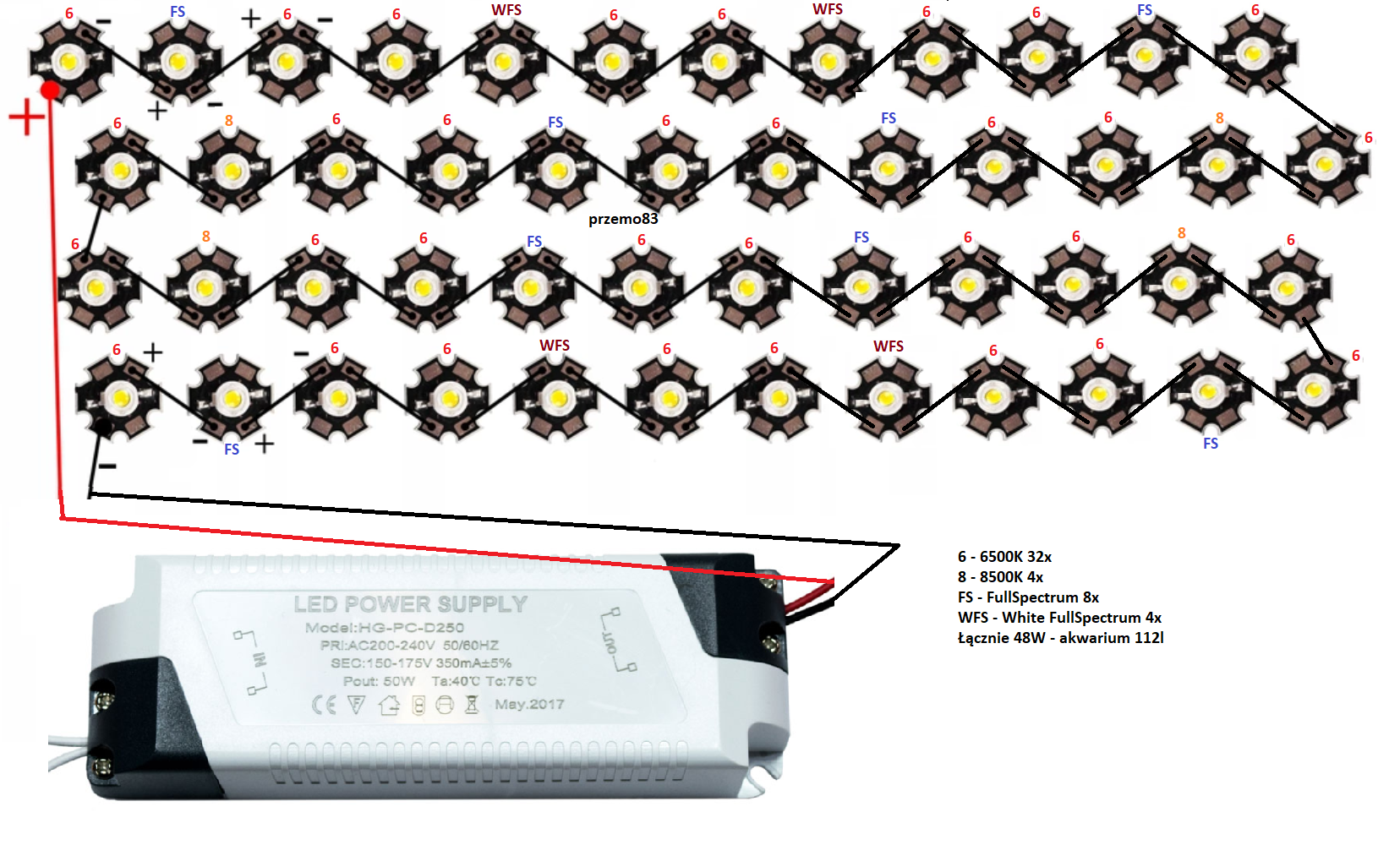
    Damn, we did not understand each other a bit, I will not put these strips, but I will do a beam on the power leds according to the diagram from 1 post:
    Constructing 112L Aquarium LED Beam: 80cm, 48W, Epistar Diodes, Soft-On Switch, & Power Supply

    and now instead of the driver I would give a power supply, would it be suitable ?:
    https://allegro.pl/zasilacz-instalacyjny-modulowy-led-12v-60w-i7287356851.html " target="_blank" rel="nofollow noopener ugc" class="postlink inline" title="" > https://allegro.pl/zasilacz-instalacyjny-modulowy-led-12v-60w-i7287356851.html

    This remote control dimmer that you gave will deal with it somehow to sleep? Normally the diodes, the dimmer behind the diodes and the power supply?
    Because I understand that for this power supply I plug in diodes in series on one side, and 230V on the other
  • #11 17498487
    enhanced
    Level 43  
    Posts: 10437
    Help: 963
    Rate: 880
    Well, this pattern will not work.
    These drivers run constant current and no resistors are needed anymore. The 12V power supply gives off constant voltage and you have to combine with resistors and of course the number of LEDs per system to set the 3v LEDs with pennies so that they do not burn them.
  • #12 17498509
    duke3
    Level 10  
    Posts: 69
    Rate: 12
    Damn it lies :D it is left to do exactly as in the diagram with such a driver and without a dimmer :(
  • #13 17498525
    enhanced
    Level 43  
    Posts: 10437
    Help: 963
    Rate: 880
    Yeah. As for me, it's a lot of work in such a combination. Most often it comes down to soldering wires, making them more.

    I prefer 12V, plates for 3 pieces and go. It is soldered between modules and not every diode.
  • #14 17498539
    duke3
    Level 10  
    Posts: 69
    Rate: 12
    Thanks for the help :) I guess I'll let my friend do this and I have a headache :)

Topic summary

✨ The discussion revolves around constructing a 112L aquarium LED beam measuring 80cm wide and utilizing 48W of power. The user seeks advice on the configuration of 32 LEDs at 6500K, 4 at 8500K, 8 Full Spectrum LEDs, and 4 White Full Spectrum LEDs, all using 1W EPISTAR diodes mounted on an aluminum profile. Participants suggest alternatives to the proposed driver, recommending a 12V power supply for safety and ease of installation. Concerns are raised about the power output being excessive for the aquarium size, with suggestions to use a dimmer for gradual light increase to avoid startling fish. Various components, including LED modules, lenses, and connectors, are discussed, along with the importance of proper wiring and resistor use when switching from a driver to a power supply.
Generated by the language model.

FAQ

TL;DR: A typical 112 L tank is ~40 cm high; "use low‑voltage 12–24 V for safety." Prefer constant‑current for long series strings, or 12 V modules with resistors for easy dimming. A 10–15 minute soft‑start feels more natural than 2 minutes. [Elektroda, Anonymous, post #17493053] Why it matters: DIY aquarists need safe, dimmable LED builds that won’t shock fish, overheat, or fail prematurely; this FAQ shows how.

Quick Facts

Will a constant‑current LED driver run a long series string without resistors?

Yes. Constant‑current drivers regulate current, so series strings do not need separate resistors. "These drivers run constant current and no resistors are needed anymore." Verify the LED string’s forward‑voltage range matches the driver’s window before wiring. [Elektroda, enhanced, post #17498487]

Does the 50 W, 350 mA driver support dimming or a soft‑start?

No. The referenced driver does not offer dimming, so it cannot fade up on its own. If you need a soft‑start, use a dimmable 12–24 V setup or a separate control module. A 10–15 minute ramp is closer to natural lighting. [Elektroda, Anonymous, post #17493053]

Is 12 V or 24 V safer above a humid aquarium?

Use low voltage. "The idea of a low voltage 12 V ... 24 V power supply is very reasonable, if only for reasons of safety." Condensation can form on fixtures over water, so reduce shock risk with SELV gear and good insulation. [Elektroda, Anonymous, post #17493053]

What power supply size do I need for about 48 W of LEDs?

Choose a 12 V supply with reserve. For roughly 40–48 W of load, select about 60 W (12 V × 5 A). This overhead improves reliability and keeps temperatures down. Prefer reputable brands over low‑quality units. [Elektroda, enhanced, post #17492885]

Can I swap my driver for a 12 V supply without other changes?

No. A 12 V supply is constant‑voltage. You must add current‑limiting (resistors) and group LEDs appropriately, such as 3‑LED modules. Do not reuse a pure series string directly on 12 V, or you risk LED damage. [Elektroda, enhanced, post #17498487]

How can I add a gentle soft‑on (gradual brightening)?

Use a 12 V dimming module between the supply and LED modules. Builders cite AVT1975 for slow brightening of 12 V LED strips. You can also use Arduino‑based controllers for programmable ramps. Start with 10–15 minutes for a natural effect. [Elektroda, enhanced, post #17492885]

Remote RF dimmer or manual inline dimmer: which starts softer?

Manual inline. Remote RF units often power up at 100% before restoring the last level, causing a brief flash. A manual dimmer “will turn on at the minimum” if the knob is set low. This avoids startling fish at switch‑on. [Elektroda, enhanced, post #17498242]

What LED spectrum mix suits a planted aquarium?

Reduce plain 6500 K and add more Full Spectrum or colored diodes for plant growth. A contributor noted the original mix had too many 6500 K pieces. Balance spectrum and placement before simply adding watts. [Elektroda, enhanced, post #17492885]

Do I need lenses, and will rigid bars accept them?

Lenses help direct light into deeper tanks, but some rigid bars can’t take lenses. One builder said a popular rigid strip “shines everywhere” and does not accept lenses. If you need control, pick diode mounts compatible with optics. [Elektroda, enhanced, post #17492885]

Will three 70 cm AQUA GROW bars light a 112 L tank?

They are cheap enough to test. Buy, mount, and evaluate coverage; add more or switch to discrete LEDs with lenses if needed. Meanwhile, order LEDs and optics so you can iterate without delay if output is insufficient. [Elektroda, enhanced, post #17495398]

Which connectors and accessories should I have on hand?

Use 2.1/5.5 mm DC plugs (male and female), optional DC splitters, and a suitable dimmer. A programmable timer is useful for on/off control. Thermal adhesive or paste helps mount modules to aluminum. Match switch and dimmer current ratings. [Elektroda, enhanced, post #17498242]

Will a 2‑minute soft start help fish or plants?

A 2‑minute ramp changes little biologically. A contributor noted plants won’t see much difference between instant on and 2 minutes. Aim for 10–15 minutes if you want a more natural transition. [Elektroda, Anonymous, post #17493053]

How hot will the LED beam run, and what about heatsinks?

Expect notable heat at full power. One builder reported the beam warming up strongly at 100% output. Oversize the aluminum profile, ensure airflow, and consider reducing total wattage or adding optics to use power more efficiently. [Elektroda, enhanced, post #17492885]

What watt‑per‑liter ratio did this build target?

The original poster calculated about 0.40 W per liter and felt it was suitable for planted growth. Use this as a starting point, then refine spectrum, optics, and distribution to match plant density and tank depth. [Elektroda, duke3, post #17492861]

How do I wire a 12 V build using 3‑LED modules and a dimmer?

  1. Assemble 3‑LED modules with resistors on 12 V PCB carriers and mount to aluminum.
  2. Daisy‑chain modules, then place a 12 V dimmer between the power supply and the module string.
  3. Use proper DC plugs and test each module; each module works independently. [Elektroda, enhanced, post #17492804]
Generated by the language model.
ADVERTISEMENT