Why does a Denon DHT-S514 soundbar start cutting out and skipping after about 30 minutes of use, and could it be overheating?
The problem is most likely a hardware fault in the soundbar’s amplifier/main board, often triggered by heat rather than the optical or Bluetooth input itself [#18971957][#18313541] Some owners reported that the unit goes into thermal protection after warming up, with sound dropping out while the radiator and power section get very hot [#18313541][#18353793] One service center found a damaged motherboard and replaced the whole board, and another user said that replacing the board solved the fault for about PLN 350 [#18353793][#19062526] Other reported fixes were replacing the electrolytic capacitors on the board, which helped in one case and completely stopped the chokes from heating in another [#18942078][#19062526] A third reported fix was reflowing/resoldering the DSP processor, which restored stable sound because the solder quality seemed to worsen with heat [#19062597]
AI summary based on the discussion. May contain errors.
Hello. I have a problem with the Denon dht-s514 soundbar. After half an hour of operation, the sound begins to interrupt and skip. Can it overheat? I will add that I already bought a used one, but so far everything has been fine. Is there anyone who can help? Or any service near Katowice? Water it to the TV with an optical cable
@Szkielko19831983 did you deal with the problem? I have exactly the same problem, after it warms up the sound starts to stop. I took it apart and the radiator cooling the power amplifiers heats up a lot and that is a problem, but why does it heat up?
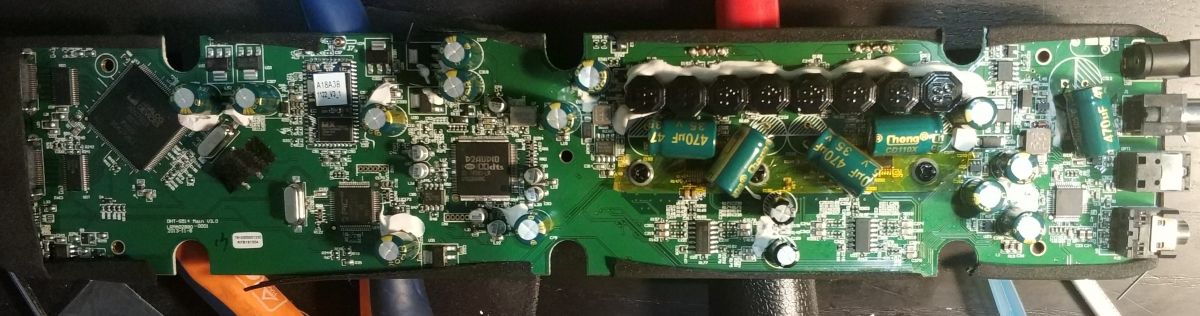
In my soundbar, the output chokes and some of the power amplifiers get warm. When listening at a moderate volume, the chokes can be so hot that they burn. Interestingly, the chokes get a little warm even if I physically disconnect the speakers at the plug; they are not very hot, but noticeably warm. The voltage from the 24V stable power supply and on the power supply and on the capacitors at the power amplifier. It looks to me like the TPA3118 power amplifiers are damaged in some way. The sound is clear and does not indicate any deficiencies.
Hello, unfortunately I have the same defect. After about 20 minutes, the sound turns off and until the radiator cools down, the sound comes only from the sub. I will only add that the defect appeared only after the warranty period had expired.
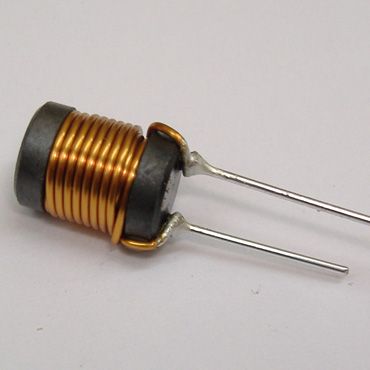
I tried replacing capacitors near the heating chokes, but it did not work... the chokes continued to heat up. So I replaced the chokes on one input with 15uH and 3A, they heat up only a little, the rest are hot. I`ll order a set of chokes and replace them, we`ll see.
Correction, after tests on loud music, unfortunately the temperature of the chokes is quite high, not high enough for the thermal protection to work, but some chokes are clearly hot.
Maybe my answer will help someone, after sending it to an authorized service center, the motherboard was found to be damaged. The cost of the repair is PLN 350. After the repair, it heats up in the same way as before the repair, but it works like new 😄😄😄 .so the core of the problem is thermal protection, in my opinion😄
Hello, My equipment is going for repair under warranty for the third time. The symptoms are the same as yours, the motherboard was recently replaced. The problem is common in this model, just read the opinions on MM ("not a store for idiots"). Next time I will replace the chokes myself - which ones will be the most optimal for this model?
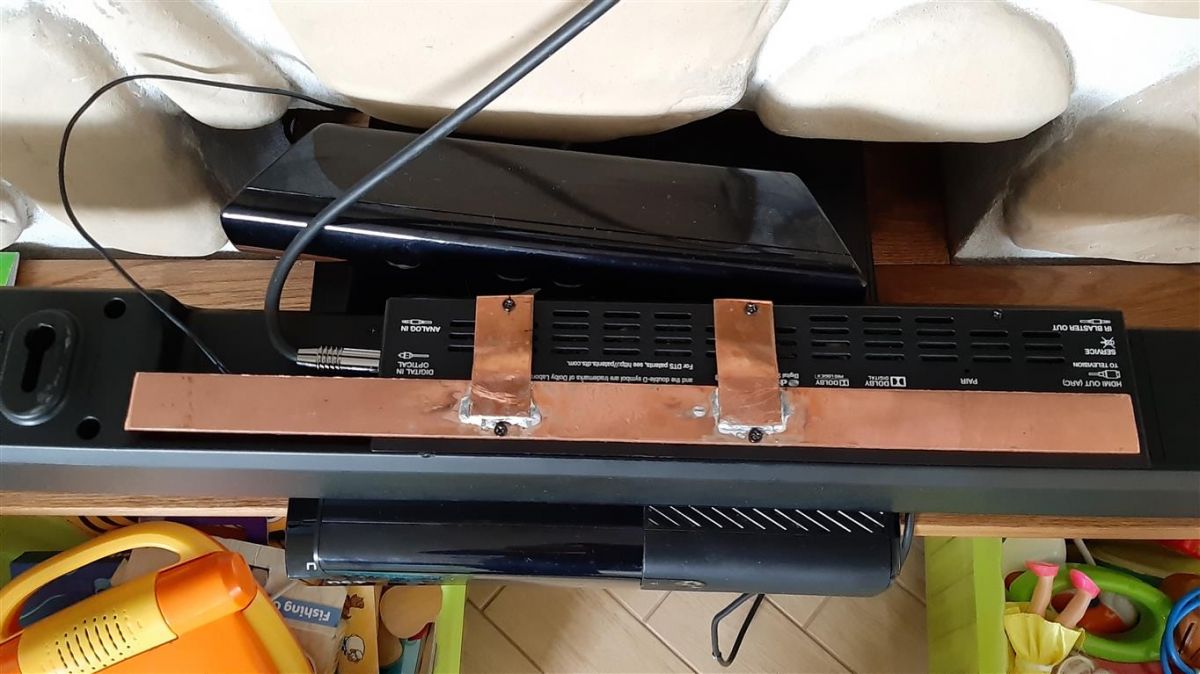
The chokes are too large for the housing, so I had to cut a hole, after which the chokes protrude about 3 mm from the housing. Unfortunately, these chokes also get hot, so I assembled the heat sink from 3x30mm copper flat bars and attached the heat sink with existing screws. Since I couldn`t solder the chokes perfectly straight, I put a rolled aluminum foil between the heat sink and the choke cores. After pressing and fastening with screws, the heat sink is invisible.
When used after an hour, the radiator is about 45 degrees!!! For now, thermal protection does not turn off the soundbar. I`m a bit of an amateur, but I haven`t found a better way.
More than 2 months have passed with this modification of mine, i.e. replacing the chokes and the radiator. During this time, the soundbar did not turn off even once. The tightened flat bar is about 45-50 degrees C.
Hello, I had the same problem of the chokes heating up, but the problem is not with them but with the electrolytic capacitors. I replaced all 100uF/35V - 2 pcs, 470uF/35V - 4 pcs, 1000uF/10V - 13 pcs. and the chokes stopped heating up and the soundbar works properly.
Hello, this is my first comment on this forum. I have the same problem. I replaced all capacitors like the guy above. But unfortunately it didn`t help. The chokes are still heating up. Which after a while results in audio jerking. Replace these chokes? Anything else to mention? Make a radiator? Throw it in the trash?
Hello. I will share my experience with this soundbar. I also struggled with sound interruption. Replacing the power amplifiers with new ones did not help. In my opinion, the problem lies in the D2-74583-LR sound processor. Unfortunately, I couldn`t find it anywhere to confirm this. The customer sent the Denon to Warsaw and they replaced the entire board there - apparently that`s their procedure.
DC blocking capacitors likely cause warm-up clicks
Hello, I wanted to share my observations about the problems with DHTS514, as they have occurred to me once again. I am not an electronics expert, and the presented conclusions are based on the collected knowledge. Failure 1 Since new, I had a problem with starting the beam, the subwoofer turned on immediately, but the beam (sound) turned on a few minutes later. Warranty repair – "Replacement main".
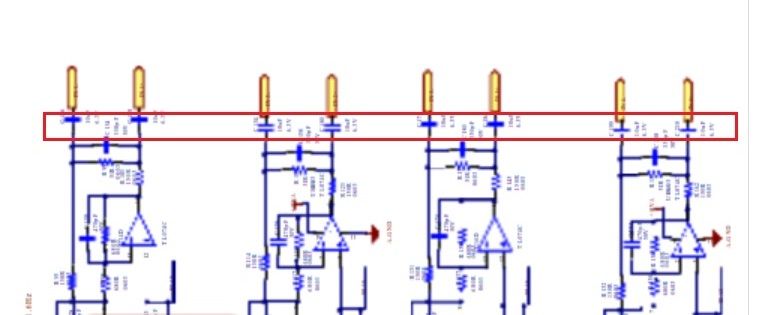
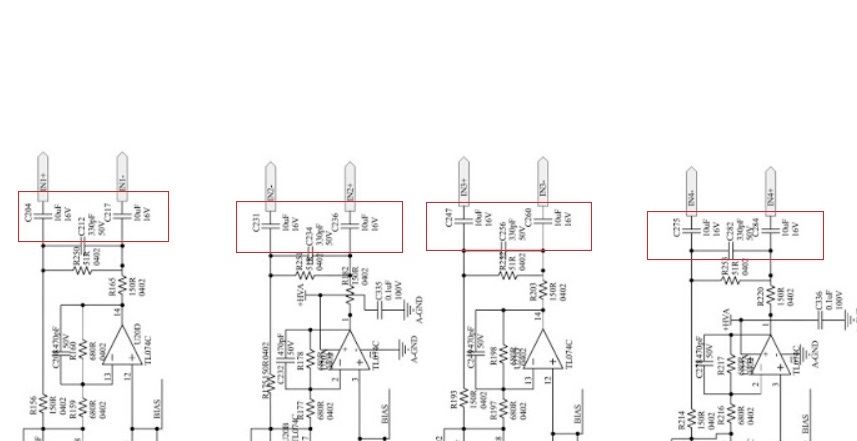
Failure 2 This is probably the most common condition and I think it may apply to some of the cases described here - after it warms up, there is a popping, clicking, knocking, sound fading, etc. In my case it started after 1-1.5 hours of work and it sounded like this: https://youtu.be/CsNcH5D750w The fault was repaired under warranty - "Replacement of music track capacitors" - which solved the problem for about 3 years. It`s the capacitors - replacing electrolytes helps in some, but not in others, I don`t know which ones were replaced in my case. However, I came across an interesting description of the repair of DHT100, where the culprit for such symptoms were DC blocking capacitors between the TL074 analog filter and the input of the TPA3118. In DHT100 they are 6.3v 10uF and the author recommends replacing them with at least 25V, preferably 1uF. “During startup the spikes on these caps will be about the full 24 Volt of the power supply” “failure modes of MLCC capacitors” “So if you ever have no-sound or clicks/ticks/glitches take a look at the DC blocking caps.”
Our DHT514s already have 16V 10uF, but maybe it would be worth checking their voltage and possibly replacing them with at least 25V as recommended? I encourage you to read the source material.
Failure 3 This is a crash I`m currently struggling with and I wanted to ask for help. After turning it on "cold", regardless of the selected signal source, you can hear slight noise in the background: https://youtu.be/XIJ5ZRHukgM Over time, they become stronger, so that after about 3-4 minutes of operation, nothing but noise can be heard: https://youtu.be/8D2v8j4QwY0 Based on the symptoms and manufacturer`s guidelines, the service determined the need to replace the motherboard - the cost was PLN 750. You can also buy such a CD online for about USD 150-170. Basically, the decision was made to write off the beam and replace it with something new, but regardless, I would like to fight a bit - for my own satisfaction. And here`s my question, do you have any suggestions in which direction to look? I was thinking about replacing the electrolytic capacitors, just to be sure, but is that the way to go?
Resoldering DSP processor fixed intermittent sound loss
Hello In my case, the problem was that it did not want to start, i.e. the first two diodes were lit and nothing could be done. Sometimes, however, it was possible to start it, but then the sound disappeared after some time. After disassembling, I noticed that the sound sometimes comes back when you touch the PCB somewhere. The power amplifier section gets very hot, but the DSP processor also has quite a high temperature. And that`s who my suspicions fell on. Removing the old solder with a desoldering rope and re-soldering with lead-added filler in a good-quality flux helped. Generally, I believe that many problems result from the device heating up and the poor quality of the binder, perhaps it is inappropriate. In many cases of sound problems, resoldering the DSP processor can help.
Create an account, log in here and be active on the forum — ads won't appear. Earn points for registering and replying.
The Denon DHT-S514 soundbar is experiencing sound interruptions and skipping after approximately 30 minutes of use, potentially due to overheating. Users have reported similar issues, with some identifying overheating of power amplifiers and chokes as a common problem. Solutions discussed include reducing input signal levels, replacing heating chokes, and changing electrolytic capacitors. Some users have sent their devices to authorized service centers, where motherboard replacements were performed. However, issues often persist, indicating a design flaw in thermal protection or components like the D2-74583-LR sound processor. Various users have attempted DIY repairs with mixed results, suggesting that overheating components are a significant factor in the sound problems. AI summary based on the discussion. May contain errors.
TL;DR: On Denon DHT‑S514, heat‑related dropouts often begin after 1–1.5 hours, and “Replacement of music track capacitors solved the problem for about 3 years.” This FAQ covers diagnosis, capacitor/inductor fixes, and when to choose board service. [Elektroda, jollymorgan, post #19062526]
Why it matters: Owners and repairers of the DHT‑S514 get fast, field‑tested steps to stop audio cut‑outs and restore stability.
Why does my Denon DHT‑S514 cut out or click after warming up?
Heat‑stressed audio path capacitors and aging parts cause clicks, pops, and fading after warm‑up. A warranty repair that replaced “music track capacitors” fixed the issue for about three years. Time‑based onset (around 1–1.5 hours) is a key sign. [Elektroda, jollymorgan, post #19062526]
Will lowering the source volume help diagnose input clipping?
Yes. Reduce the signal level from your TV or Bluetooth device and listen. If artifacts disappear, you were overdriving the input. “Reduce the signal level to test.” This isolates distortion from thermal or component faults. [Elektroda, yokoon, post #18139011]
Does the dropout happen on both optical and Bluetooth?
Yes. One owner reported the same interruptions using the TV’s optical output and over Bluetooth. This points away from a single input issue and toward the soundbar electronics. [Elektroda, Szkielko19831983, post #18139018]
How can I tell if it’s overheating versus a logic or board fault?
Watch the timeline. Clicking and fading after 1–1.5 hours suggests heat‑sensitive capacitors. Rapid progression from slight noise to only noise within 3–4 minutes on cold start signals a deeper board fault that often leads to a mainboard replacement. [Elektroda, jollymorgan, post #19062526]
Which capacitors should I replace first on the DHT‑S514?
A successful field recap replaced 2×100µF/35V, 4×470µF/35V, and 13×1000µF/10V electrolytics. After this, the chokes stopped heating and the bar worked properly. “Chokes stopped heating and the soundbar works properly.” [Elektroda, Eryk1978, post #18942078]
Will inductor replacement alone fix the thermal shutdown?
Replacing with 10 µH 5 A parts reduced heating, but some chokes still ran hot at loud playback. Shutdowns were avoided, yet temperatures remained elevated. Expect improvement, not a full cure, without further thermal measures. [Elektroda, mick, post #18321151]
What inductor and cooling mod has proven stable long‑term?
A user fitted 7 A chokes and a copper flat‑bar heatsink. The radiator held about 45–50 °C, and the bar “did not turn off even once” over two months. This combo stopped thermal protection trips. [Elektroda, mick, post #18468253]
Why are my output chokes hot even with speakers disconnected?
One teardown showed warm chokes even with the speaker plug physically disconnected. The 24 V rail was stable. This points to switching stage losses or a fault within the power amp or LC filter, not the drivers. [Elektroda, mick, post #18277935]
Is the DSP (D2‑74583‑LR) a known culprit in these failures?
Yes. Replacing the power amplifiers did not help in one case. The technician suspected the D2‑74583‑LR DSP, and the service replaced the entire mainboard as their procedure. [Elektroda, sylwan1, post #18971957]
What will authorized service typically do, and what might it cost?
Service diagnostics often end with a mainboard replacement. One owner was quoted PLN 750 for the swap. The same person noted boards available online for about $150–$170 if you self‑install. [Elektroda, jollymorgan, post #19062526]
How‑To: Add a heatsink to the DHT‑S514 inductors (3 steps)
Replace hot chokes with higher‑current (e.g., 7 A) parts and test fit.
Add a copper flat‑bar heatsink spanning choke cores; use foil as a thermal shim.
Secure using existing screws; accept a small vent cutout if height demands.
After this, users reported ~45–50 °C and no shutdowns. [Elektroda, mick, post #18468253]
I replaced all electrolytics and still get jerky audio. What next?
Some units continue heating after full recap. Next steps include upgrading the output chokes and adding a heatsink. If symptoms persist, plan for a mainboard swap through service. This path restored stability in other cases. [Elektroda, Adasze, post #18956284]
Which DC‑blocking caps should I check or uprate on DHT‑S514?
Inspect C204, C217, C231, C236, C247, C260, C275, and C284 ahead of the TPA3118 inputs. They can see high startup spikes. Consider replacing them with parts rated at least 25 V to improve robustness. [Elektroda, jollymorgan, post #19062526]
My soundbar shows two LEDs and won’t start. Any field‑proven fix?
Resolder the DSP with quality flux and leaded solder. Intermittent behavior that changes when touching the PCB suggests marginal joints. “Resoldering the DSP processor can help.” Heat cycling stresses these joints over time. [Elektroda, choleszek, post #19062597]
Could the TPA3118 power amps be failing here?
One teardown suspected TPA3118 damage due to hot chokes and amplifiers. However, audio remained clear and the 24 V rail was stable, pointing to surrounding components instead. [Elektroda, mick, post #18277935]
AI summary based on the discussion. May contain errors.







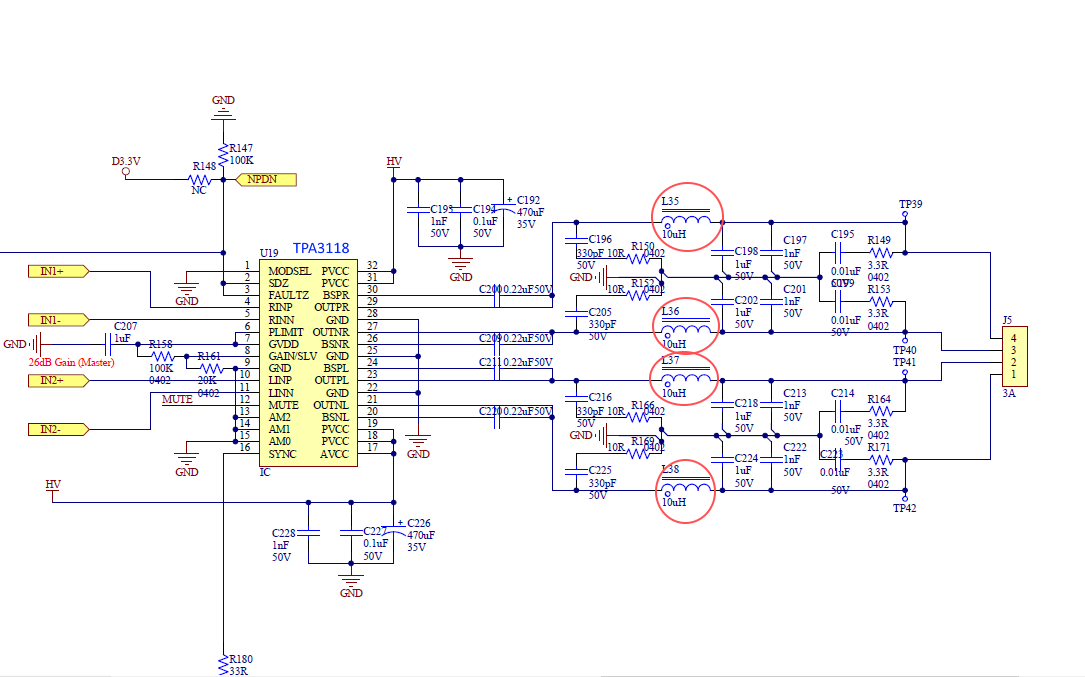
 I`m going to cool the choke cores, but I still don`t have time