Basic Parameters of the Pico Development Board
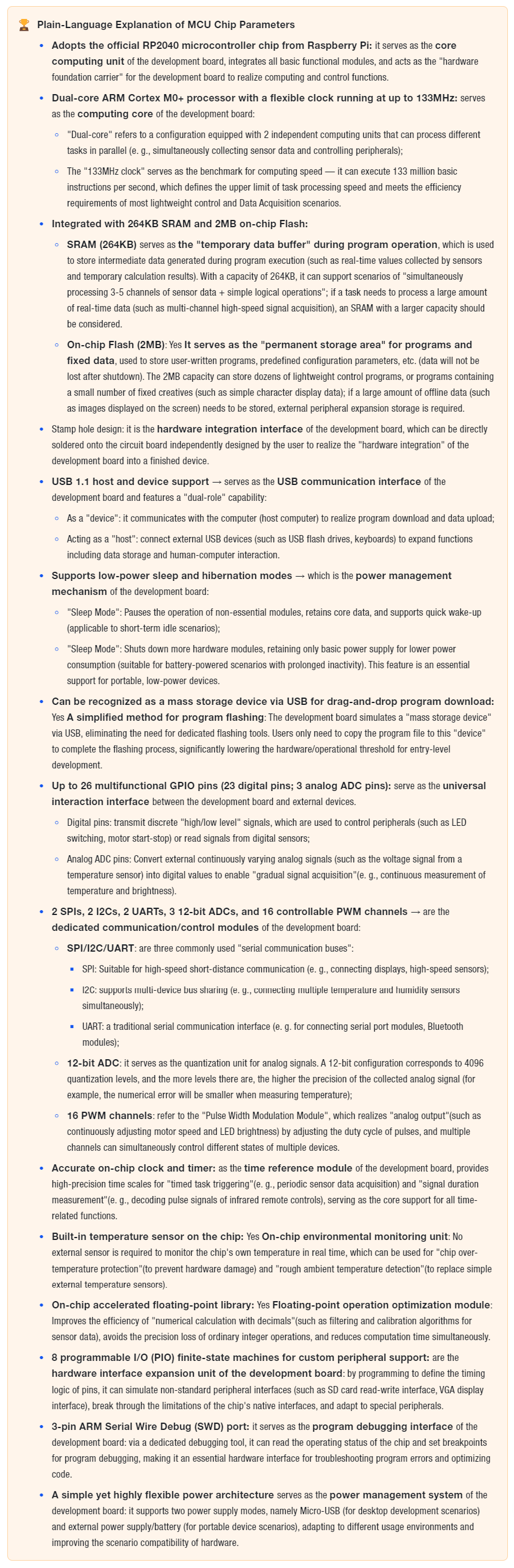
- It adopts the RP2040 microcontroller chip independently designed by Raspberry Pi officials;
- Equipped with a dual-core ARM Cortex M0+ processor, it features a flexible clock with an operating frequency of up to 133 MHz;
- It integrates 264 KB of SRAM and 2 MB of on-chip Flash, and features a stamp hole design that can be directly soldered and integrated onto the baseboard independently designed by users.
- USB 1.1 host and device support;
- Supports low-power sleep and hibernation modes;
- It can be recognized as a mass storage device via USB for drag-and-drop program download;
- Up to 26 multifunctional GPIO pins:
- 23 digital pins;
- 3 analog ADC pins;
- 2 SPIs, 2 I2C interfaces, 2 UARTs, 3 12-bit ADCs, and 16 controllable PWM channels;
- Accurate on-chip clock and timer;
- The chip has a built-in temperature sensor;
- On-Chip Accelerated Floating-Point Library
- 8 programmable I/O (PIO) finite-state machines for custom peripheral support
- Flexible user-programmable high-speed IO
- It can simulate interfaces such as SD card and VGA
- 3-pin ARM Serial Wire Debug (SWD) port
- A simple yet highly flexible power supply architecture
- Can be powered via Micro-USB
- Can be powered by an external power supply/battery
- It adopts the RP2040 microcontroller chip independently designed by Raspberry Pi officials;
- Equipped with a dual-core ARM Cortex M0+ processor, it features a flexible clock with an operating frequency of up to 133 MHz;
- It integrates 264 KB of SRAM and 2 MB of on-chip Flash, and features a stamp hole design that can be directly soldered and integrated onto the baseboard independently designed by users.
- USB 1.1 host and device support;
- Supports low-power sleep and hibernation modes;
- It can be recognized as a mass storage device via USB for drag-and-drop program download;
- Up to 26 multifunctional GPIO pins:
- 23 digital pins;
- 3 analog ADC pins;
- 2 SPIs, 2 I2C interfaces, 2 UARTs, 3 12-bit ADCs, and 16 controllable PWM channels;
- Accurate on-chip clock and timer;
- The chip has a built-in temperature sensor;
- On-Chip Accelerated Floating-Point Library
- 8 programmable I/O (PIO) finite-state machines for custom peripheral support
- Flexible user-programmable high-speed IO
- It can simulate interfaces such as SD card and VGA
- 3-pin ARM Serial Wire Debug (SWD) port
- A simple yet highly flexible power supply architecture
- Can be powered via Micro-USB
- Can be powered by an external power supply/battery