logo elektroda
logo elektroda
X
logo elektroda

Grinn Collaborates with Renesas to Launch Grinn ReneSOM-V2H

(Sponsored)
magic9  0 834 Cool? (0)
📢 Listen (AI):

TL;DR

  • Grinn and Renesas launched the Grinn ReneSOM-V2H, a production-ready System-on-Module for AI- and vision-enabled edge devices.
  • The module uses Renesas RZ/V2H with a built-in AI accelerator and pre-integrated connectivity, letting engineers move from concept to mass production faster.
  • It measures 37mm x 42.6mm and delivers 8TOPS via DRP-AI3, plus PCIe Gen3, USB 3.2, and 4x MIPI-CSI interfaces.
  • Grinn says the platform can cut development cycles by up to 12 months and suits industrial vision, robotics, autonomous systems, and smart infrastructure.
Generated by the language model.
Bringing a high-performance AI product to market usually takes years of grueling hardware development. Today, Grinn is working together with Renesas to change that narrative. Grinn announced a collaboration centered on the launch of the Grinn ReneSOM-V2H, a production-ready System-on-Module (SOM) that allows engineers to move directly from concept to application.


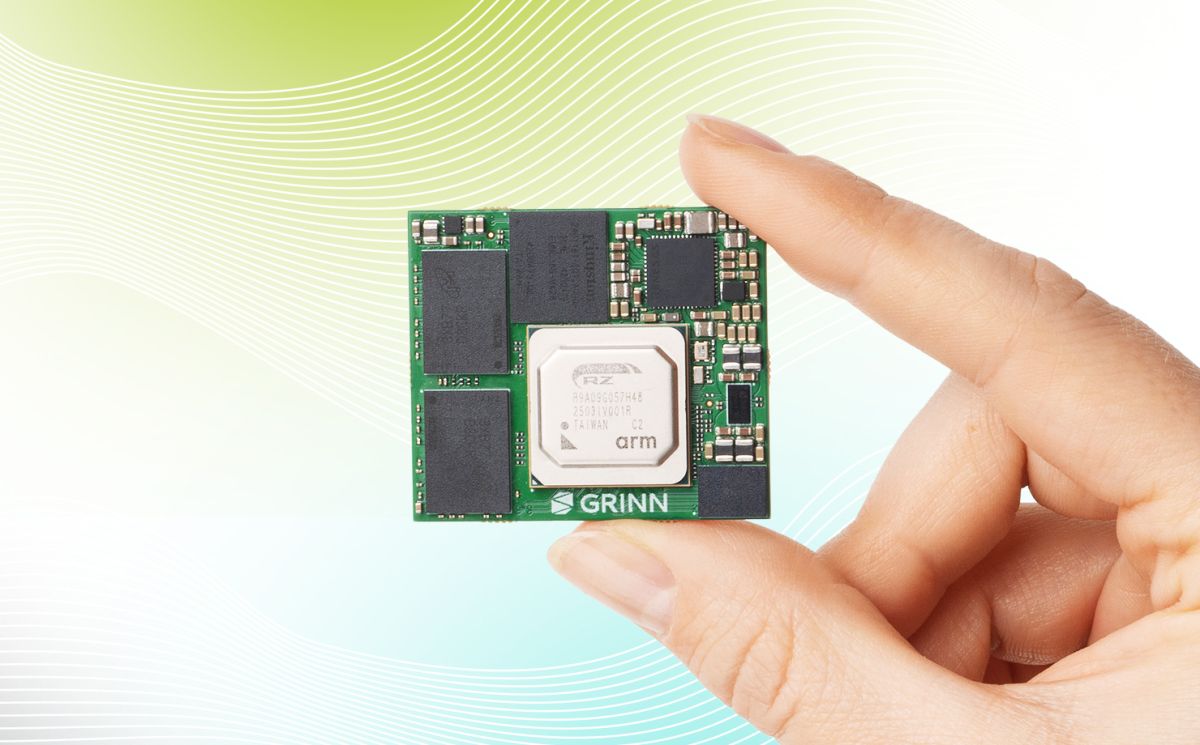
Hand holding a small green GRINN circuit board with an ARM chip in the center.


Grinn significantly lowers the barrier to entry for companies developing AI- and vision-enabled devices. Customers can shorten development cycles by up to 12 months, which is increasingly critical in today’s fast-moving technology landscape. Instead of investing extensive resources in processor bring-up, high-speed interface design, and system validation, developers can focus on their application and differentiation. The Grinn ReneSOM-V2H enables rapid prototyping and smooth transition to mass production, helping customers move from concept to deployed product faster and more efficiently.

“By combining Renesas processing technology with Grinn’s expertise in System-on-Module design, we have created the smallest solution of its kind.”, said Robert Otręba, CEO of Grinn. “This cooperation allows companies to adopt advanced AI and vision capabilities without the typical complexity associated with high-performance embedded platforms.”

Grinn selected the Renesas RZ/V2H processor as the foundation for this new product line due to its exceptional AI performance and versatility. Notably, the Grinn ReneSOM-V2H stands as the world’s smallest system-on-module based on the RZ/V2H processor.

The processor’s ability to handle up to four cameras simultaneously, combined with high-speed data throughput via USB 3.2 and PCIe Gen 3, makes it a powerhouse for vision-based systems. Furthermore, its industrial-grade temperature resilience ensures it can perform reliably in the most demanding environments.

“The Grinn ReneSOM V2H is a pre integrated compute module that includes the RZ/V2H MPU with a built in AI accelerator, connectivity and key interfaces to power modern edge AI vision systems,” said Luca Bartolomeo, Vice President of Business Development, Solutions at Renesas. “The module has everything developers need to rapidly deploy a broad range of applications including smart cameras and industrial vision systems.”


Technical Overview: The Grinn ReneSOM-V2H

The ReneSOM-V2H is a remarkably compact (37mm x 42.6mm) yet powerful platform designed for intelligent edge applications. It integrates AI acceleration, advanced vision processing, and deterministic control into a single, industrial-grade module.

Key Specifications:
    • Processing Power: RZ/V2H (4x Cortex-A55, 2x Cortex-R8, 1x Cortex-M33).
    • AI Acceleration: Integrated DRP-AI3 delivering 8TOPS for real-time inference.
    • High-Speed I/O: PCIe Gen3 (4-lane) and USB 3.2 (10Gbps) for maximum bandwidth.
    • Vision Connectivity: 4x MIPI-CSI interfaces supporting multi-camera arrays.
    • Form Factor: The world’s smallest RZ/V2H SOM; custom LGA design with 260-pin SO-DIMM compatibility.
    • Operating Range: Rated for extreme industrial temperatures (-40°C to 85°C).


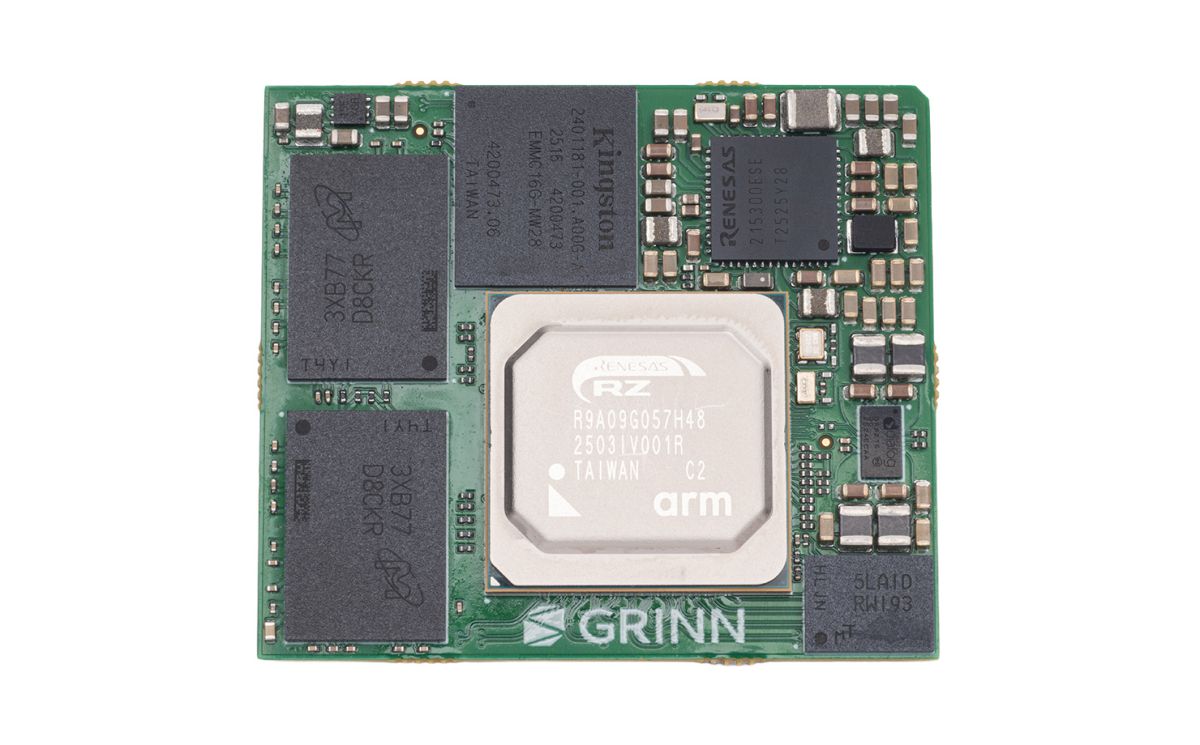
GRINN computer module with a Renesas RZ chip and several memory ICs on a green PCB

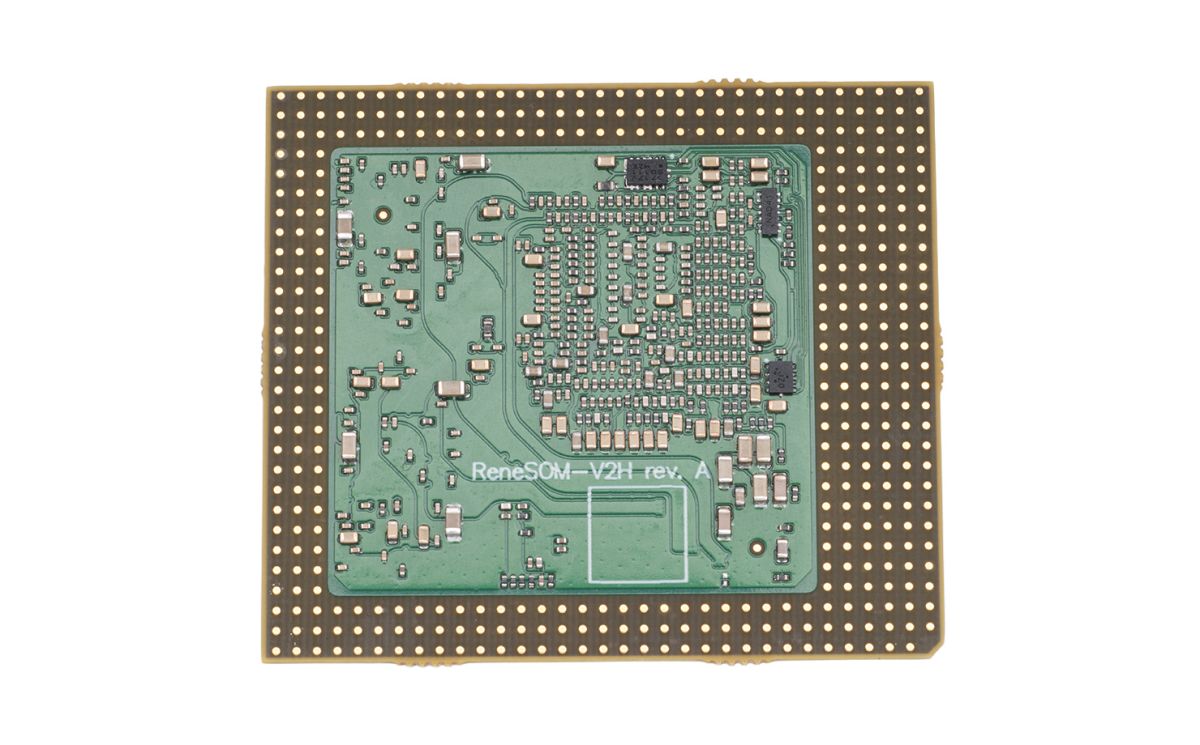
Underside of an IC module with green PCB and grid of gold pads; text “ReneSOM‑V2H rev. A”.


Target Applications: Built for real-world deployment, the ReneSOM-V2H is the ideal fit for Industrial Vision & Inspection, Robotics, Autonomous Systems, and Smart Infrastructure. By providing full LGA pin access, Grinn has simplified carrier board design, ensuring that time-to-market becomes a tangible competitive edge for their clients.

For more information regarding the ReneSOM-V2H and the Grinn-Renesas partnership, please visit grinn-global.com.


ABOUT GRINN

Grinn is an electronics design house dedicated to building IoT solutions from scratch. They’re with their clients at every step – from the concept stage to a market-ready product. At Grinn, they don’t just design IoT solutions; they refine, optimize, and elevate them to give their clients a competitive edge. Through expert engineering, in‑house testing, and top‑tier partnerships, they turn ideas into reality – fast and efficiently.

Beyond custom design services, Grinn offers a growing portfolio of off-the-shelf hardware building blocks. Their System on Modules give development teams a proven, production-ready compute foundation to accelerate time-to-market. For customers who need a complete, out‑of‑the‑box platform, their Single Board Computers deliver the performance and connectivity required for demanding IoT applications.
Find out more at grinn-global.com.

[Advertising Cooperation with GRINN sp. z o.o.]

About Author
magic9
magic9 wrote 1236 posts with rating 508 , helped 19 times. Live in city Kielce. Been with us since 2010 year.

Comments

FAQ

TL;DR: Grinn’s ReneSOM‑V2H is a 37×42.6 mm production‑ready SOM delivering 8 TOPS via DRP‑AI3; “the smallest solution of its kind,” says CEO Robert Otręba. It supports four cameras, PCIe Gen3 x4, USB 3.2 10 Gbps, and −40 to 85°C operation. [Elektroda, magic9, post #21854976]

Why it matters: It can cut AI/vision hardware development cycles by up to 12 months so teams move from concept to deployment faster.

Quick Facts

Form factor options (mounting vs. ecosystem compatibility)

Option Description
Custom LGA Full LGA pin access for simplified carrier design and compact builds.
260‑pin SO‑DIMM compatible Fits workflows needing SO‑DIMM style carrier ecosystems.

[Elektroda, magic9, post #21854976]

What is the Grinn ReneSOM‑V2H in one sentence?

Grinn ReneSOM‑V2H is a production‑ready 37×42.6 mm System‑on‑Module built on Renesas RZ/V2H, combining 8 TOPS AI acceleration, multi‑camera vision, and industrial‑temperature reliability for rapid concept‑to‑product deployment. [Elektroda, magic9, post #21854976]

Which processor and cores does ReneSOM‑V2H use?

It uses Renesas RZ/V2H with 4× Cortex‑A55 for applications, 2× Cortex‑R8 for real‑time control, and 1× Cortex‑M33 for low‑power tasks, plus an integrated DRP‑AI3 accelerator. [Elektroda, magic9, post #21854976]

How many cameras can it handle simultaneously?

It supports up to four cameras at once via 4× MIPI‑CSI interfaces, enabling multi‑angle or stereo vision pipelines for inspection and robotics. [Elektroda, magic9, post #21854976]

What high‑speed interfaces are available for expansion?

It provides PCIe Gen3 with four lanes for accelerators or NVMe, and USB 3.2 at 10 Gbps for high‑bandwidth peripherals such as vision sensors or storage. [Elektroda, magic9, post #21854976]

Is the ReneSOM‑V2H suitable for harsh environments?

Yes. It is rated for industrial temperatures from −40°C to 85°C, supporting reliable operation in outdoor, factory, and unconditioned enclosures. [Elektroda, magic9, post #21854976]

What makes it faster to bring to market than custom boards?

The SOM is production‑ready, avoiding processor bring‑up and high‑speed interface design. Grinn states customers can shorten development cycles by up to 12 months versus ground‑up designs. [Elektroda, magic9, post #21854976]

Which applications are the best fit?

It targets Industrial Vision & Inspection, Robotics, Autonomous Systems, and Smart Infrastructure, where multi‑camera input and deterministic control are required. [Elektroda, magic9, post #21854976]

How small is it compared to typical AI SOMs?

At 37 mm × 42.6 mm, it is described as the world’s smallest SOM based on the Renesas RZ/V2H, maximizing compute density in constrained designs. [Elektroda, magic9, post #21854976]

Does it support standard carrier ecosystems?

Yes. It uses a custom LGA for full pin access and is also compatible with 260‑pin SO‑DIMM, easing carrier design and reuse. [Elektroda, magic9, post #21854976]

What do experts from Grinn and Renesas say?

Grinn CEO Robert Otręba calls it “the smallest solution of its kind,” and Renesas VP Luca Bartolomeo says it has “everything developers need to rapidly deploy” edge AI vision systems. [Elektroda, magic9, post #21854976]

How do I prototype quickly with ReneSOM‑V2H?

Start with a carrier using the LGA or 260‑pin SO‑DIMM footprint. Configure camera inputs over the 4× MIPI‑CSI lanes. Deploy AI models to the DRP‑AI3 accelerator for 8 TOPS real‑time inference. [Elektroda, magic9, post #21854976]

What are the key bandwidth numbers I should plan around?

Plan for PCIe Gen3 x4 (aggregate up to ~32 GT/s raw) and USB 3.2 10 Gbps for peripherals; camera ingress uses 4× MIPI‑CSI lanes native to the RZ/V2H. [Elektroda, magic9, post #21854976]

Is the module ready for mass production or only for prototyping?

It is designed for rapid prototyping and a smooth transition to mass production, reducing risk and time spent on validation. [Elektroda, magic9, post #21854976]

What are the limits I should note before designing my carrier?

The processor exposes four MIPI‑CSI interfaces; designs needing more simultaneous sensors require aggregation strategies on the carrier. Thermal design must respect the −40°C to 85°C rating envelope. [Elektroda, magic9, post #21854976]

Why choose RZ/V2H over a discrete CPU + NPU combo?

RZ/V2H integrates application, real‑time, and microcontroller cores with DRP‑AI3 on one MPU, reducing board complexity and enabling deterministic vision control on a compact SOM. [Elektroda, magic9, post #21854976]

What problem does ReneSOM‑V2H solve for AI camera builders?

It removes years of bring‑up work by providing compute, I/O, and vision connectivity in a tiny, industrial‑grade module so teams ship smart cameras faster. [Elektroda, magic9, post #21854976]
Generated by the language model.
%}