Built a DIY bulb tester for safely repairing an old radio, with a custom 3D-printed enclosure and panel layout.
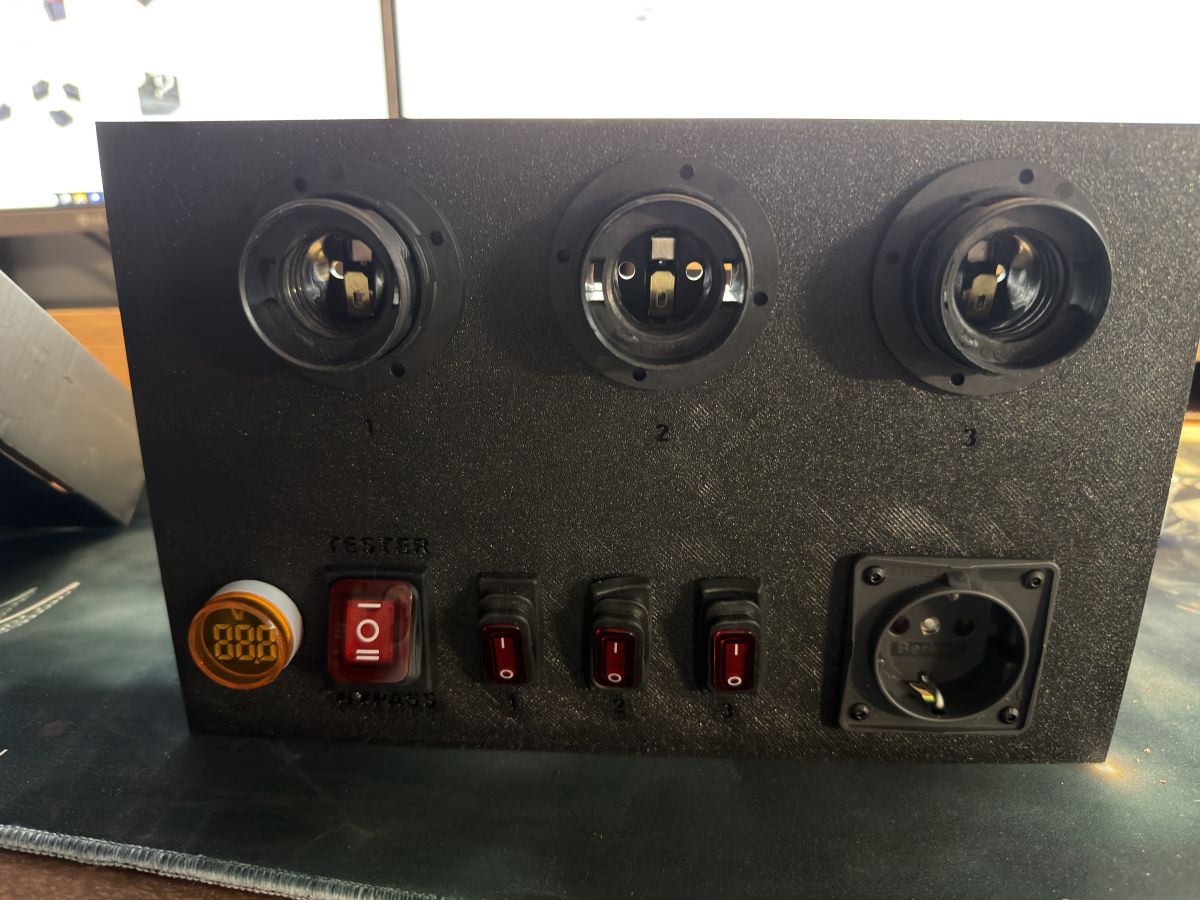
A KCD4 main switch selects TESTER or BYPASS mode, while three KCD3 switches enable different bulb wattages to control limiting current.
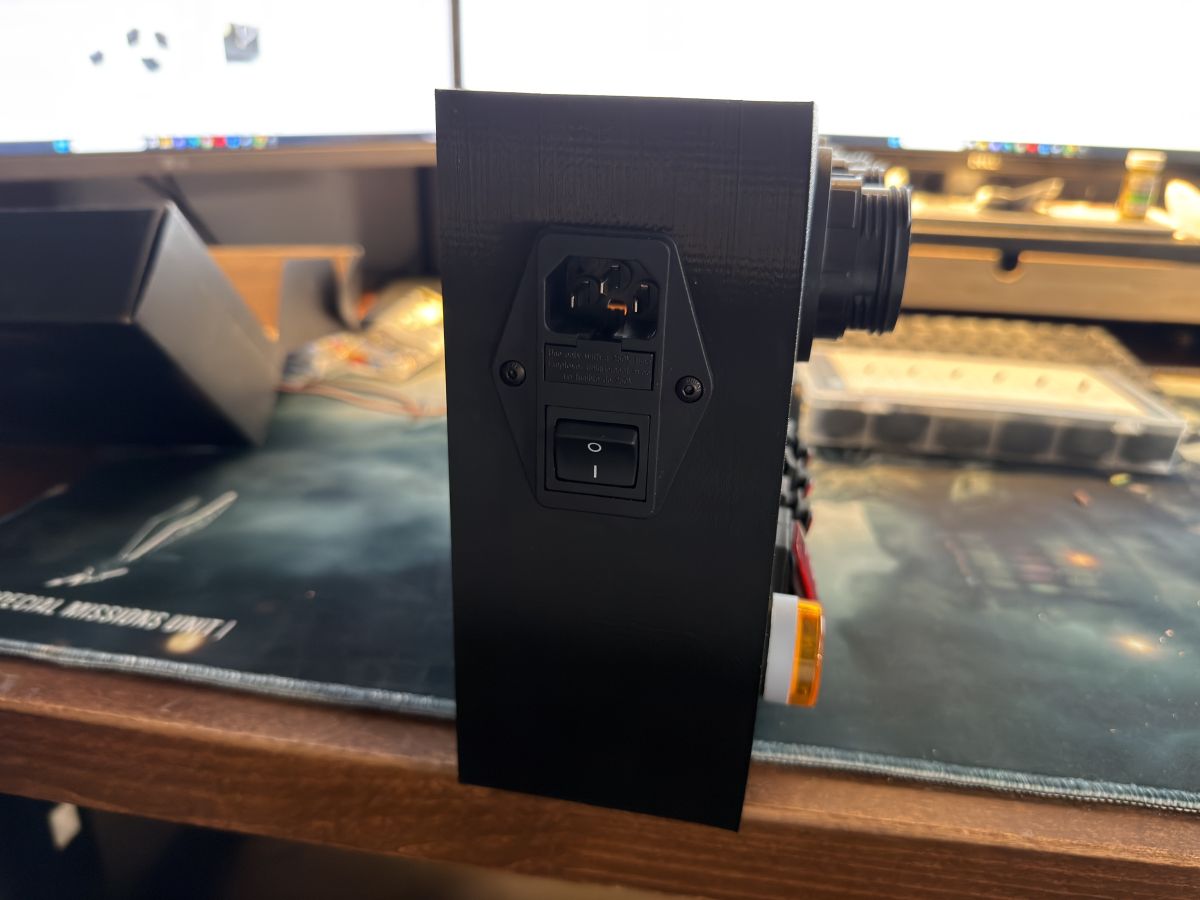
The enclosure was printed on an Ender 3 V3 Plus, uses 4 mm walls, M3 screws with brass inserts, and an IEC inlet with double 6A fuses.
Wiring uses WAGO 221 connectors, LgY 1.5 mm² wire, and an AD16 voltmeter behind the input socket; the next upgrade is an output ammeter.
AI summary based on the discussion. May contain errors.
Good morning.
My first project. Some time ago I wanted to repair an old radio from my father-in-law as a gift for my wife, but I didn't want to burn it out extra. So I came up with a bulb tester. It was supposed to be as simple as possible, but somehow I got worked up and added a few extra components. I plan to add one more - an ammeter on the output. The whole layout, as well as the design with the case printing, realised by me.
Key information about the design:
1. Enclosure: Designed in CAD and printed on an Ender 3 V3 Plus. The walls are 4 mm thick, which provides great rigidity.
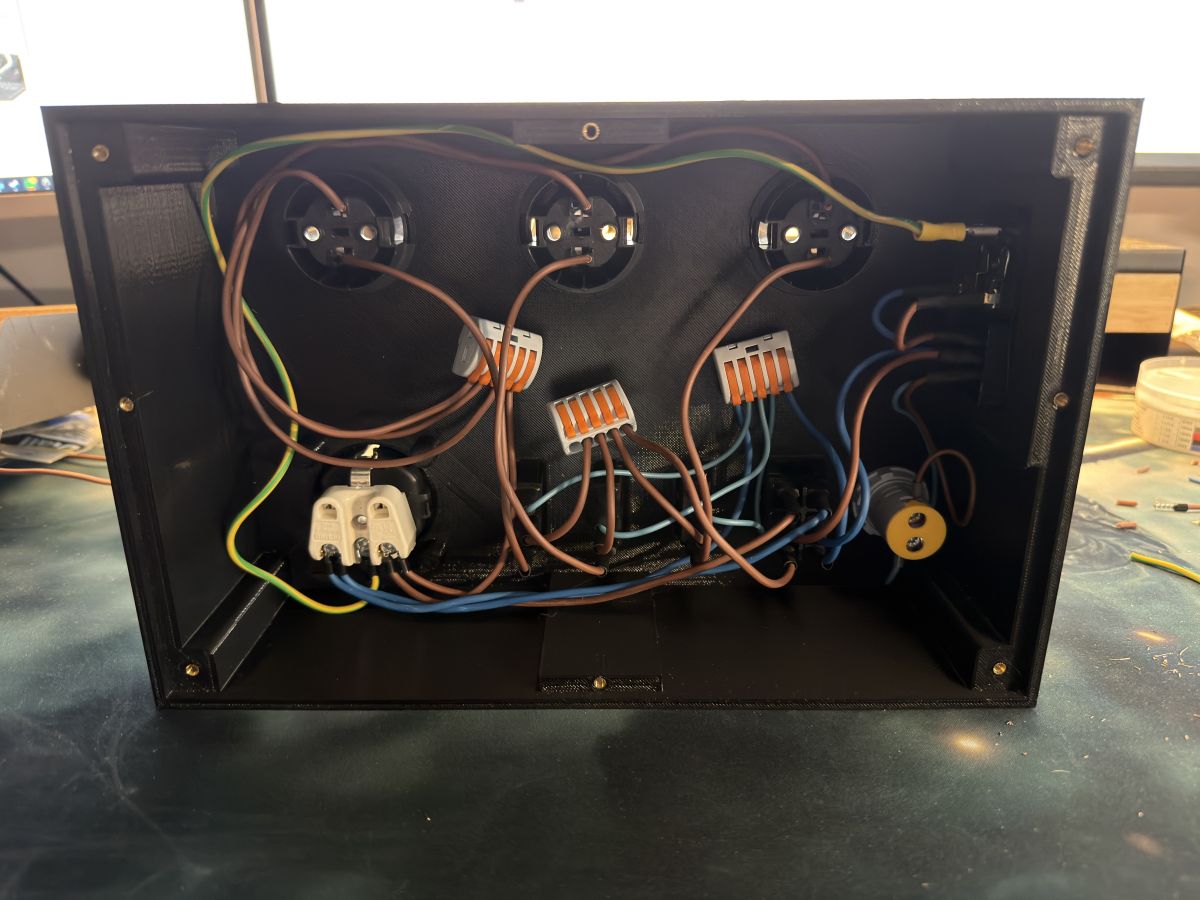
2. Assembly: All components (sockets, panel) are mounted with M3 screws screwed into brass inserts molded into the plastic. This avoids the threads becoming worn in the print.
3. Power supply: I used an IEC socket with a double 6A fuse. The filter limits the continuous current to 6A (about 1380W), which is sufficient in my conditions.
4. Operating logic: The main switch KCD4 allows you to select TESTER mode (via the bulbs) or BYPASS mode (direct). The three switches KCD3 allow the selective connection of bulbs of different wattages, giving control over the limiting current.
5. Safety: the PE protective conductor is pulled directly from the power socket to the pin in the Schuko output socket.
6. Interior: Connections based on WAGO 221 connectors (star topology) and LgY 1.5 mm² wires.
7. Monitoring: AD16 voltmeter plugged in directly behind the input socket (piggyback), so it works independently of the tester mode. (As an indicator that the IEC socket is switched on.
8. We plan to add an Ammeter on the output to monitor the current drawn.
About Author
Rothgnaar wrote 3 posts with
rating 12 .
Live in city Włocławek.
Been with us since 2010 year.
This is interesting and helpful I often use such a tester but on one bulb.
If I can advise, the bypass/test switch should be such that it always goes back to test
because sometimes when checking the... [Read more]
viayner
19 Mar 2026 06:03
Hello,
i was a little confused by the title at the beginning, as in the old days, when there was a shortage of everything, especially meters, testers where the indicating element was an incandescent bulb... [Read more]
szeryf3
19 Mar 2026 07:19
Very cool you came up with this tester.
I hope it will perform well. [Read more]
pcichomski
19 Mar 2026 09:30
A cool and useful item. I use one too, but in my house it's more coarse. If you don't have one then I would recommend some sort of indicator that you have voltage applied to the output socket - while still... [Read more]
Rothgnaar
20 Mar 2026 18:50
Thank you. I need to look for such a switch. This is my first project so I haven't taken everything into consideration yet :)
Added after 1 [minute]:
Thank you! This is my first project, I'll... [Read more]
Marian B
21 Mar 2026 12:17
In my opinion, all types of projects, even very simple ones, should be accompanied by a wiring diagram. Then you don't have to read the description many times to understand what it's all about. A quick... [Read more]
rakato11
22 Mar 2026 16:07
I completely agree with this. As soon as I started reading the post, I looked for a diagram but there wasn't one.
Anyway, great idea for inspiration. I've been planning to build something like this for... [Read more]
tos18
22 Mar 2026 16:22
Nicely done. Although the vago connectors could have been avoided
Don't you think it would be more useful to measure the voltage on the output socket ? [Read more]
gulson
22 Mar 2026 20:26
For a first project, the design is very impressive, it also looks quite safe and also reusable without fear of damage.
And then there's the noble motivation - repairing a commemorative radio. How did... [Read more]
jarekgol
23 Mar 2026 12:36
You can still make an extra socket for a kettle of water, this increases the short-circuit current to about 10A, useful for power tools. But in your case, the filter may not be able to cope with it.
I... [Read more]
Rothgnaar
14 Apr 2026 12:23
- About you I thought, maybe I will make one and add it here, thanks for your attention.
The WAGOs had the advantage that I can undo them at any time. But ultimately the rail was to be mounted in... [Read more]
zybex
15 Apr 2026 09:14
This could be solved by using a relay that would switch the bypass/test supply with its contacts. In order not to get confused this bypass would require an additional button to be pressed. A relay of course... [Read more]
FAQ
TL;DR: With 4 mm printed walls and a 6 A / about 1380 W IEC inlet, this DIY bulb tester gives safer first power-up for old radios; as one commenter noted, "a quick glance at the circuit diagram and you know everything." It suits hobbyists who want TESTER and BYPASS modes, selectable bulb limits, and room to add an output ammeter later. [#21865368]
Why it matters: A well-laid-out bulb tester can prevent damage during first power-up, but the thread shows that clear switching logic, protective earth wiring, and a readable schematic matter as much as the enclosure.
Option
What it does
Best use from the thread
Main limit mentioned
TESTER mode
Powers the load through selected bulbs
First checks of radios and other repaired devices
Limits current by bulb selection
BYPASS mode
Direct mains feed
Normal operation after checks
Easier to leave on by mistake
Bulb tester + isolation transformer
Adds current limiting plus isolation
Old radios and tube work
Requires an extra transformer
Key insight: The strongest takeaway is simple: keep the safety path obvious. Put PE directly to the Schuko earth pin, make the selector default back to TEST if possible, and publish a schematic so others can verify the wiring quickly.
Quick Facts
The enclosure was designed in CAD, printed on an Ender 3 V3 Plus, and uses 4 mm walls for rigidity in a mains-powered build. [#21865368]
The power entry uses an IEC socket with a double 6 A fuse and filter; the author states the filter limits continuous current to 6 A, or about 1380 W. [#21865368]
Internal wiring uses WAGO 221 connectors in a star topology with LgY 1.5 mm² wire, prioritizing modular assembly and rework. [#21865368]
Sockets and the front panel are fixed with M3 screws threaded into brass inserts molded into the printed plastic, reducing thread wear in the print itself. [#21865368]
One higher-power expansion idea in the thread uses 4 × 400 W halogen bulbs and can raise short-circuit current to about 10 A, but a 6 A IEC filter may become the bottleneck. [#21868626]
How do I design a DIY bulb tester with TESTER and BYPASS modes like this project?
Build it around one main selector and several bulb-selection switches. In this project, the KCD4 switch chooses TESTER mode through bulbs or BYPASS mode direct, and three KCD3 switches connect bulbs of different wattages. Use a clear front panel, keep PE separate, and place the voltmeter where it stays on whenever the IEC inlet is energized. That keeps the logic easy to follow and easy to expand later with an ammeter. [#21865368]
What is a bulb tester and how does it protect an old radio or other device during first power-up?
A bulb tester is a simple current-limiting mains tool that powers a device through incandescent bulbs, so a fault draws through the lamp path instead of straight from the outlet. In this thread, it was built specifically to avoid damaging an old radio during first power-up. One commenter summed up its value well: it can "save more than one device from damage." That makes it useful for cautious first tests after repair. [#21865663]
Why would measuring voltage at the output socket be more useful than using an AD16 voltmeter on the input side?
Output voltage tells you what the device under test actually receives. The installed AD16 meter sits directly behind the input socket, so it only confirms that the IEC inlet is switched on and stays independent of TESTER or BYPASS mode. A commenter argued that measuring the output would be more useful because it would show the real voltage after the bulb path, not just mains presence at the inlet. [#21868054]
What is an IEC socket with a double 6A fuse and filter, and how does it affect the maximum load in a bulb tester?
"IEC socket" is a mains appliance inlet that accepts a detachable power cord, often combining fusing and EMI filtering in one panel part. In this build, it has a double 6 A fuse and filter, and the author states that the filter limits continuous current to 6 A, or about 1380 W. That means the tester should stay within that load ceiling even if the bulbs or connected equipment could otherwise draw more. [#21865368]
How should I wire the PE protective conductor in a Schuko output socket for a safe mains-powered tester?
Wire the PE conductor directly from the power-entry socket to the earth pin of the Schuko output socket. The author explicitly says the protective conductor is pulled straight through to the output earth contact. That approach keeps the safety earth independent of TESTER or BYPASS switching, which is the key point for a mains-powered enclosure. [#21865368]
What is a WAGO 221 connector and why would someone use a star topology with LgY 1.5 mm² wires inside this kind of tester?
"WAGO 221 connector" is a lever-type electrical connector that joins conductors quickly, allows repeated rewiring, and keeps connections compact inside an enclosure. The build uses WAGO 221 parts in a star topology with LgY 1.5 mm² wires. That choice makes branch connections orderly, supports modifications, and fits a project where the builder may still add an output ammeter or revise the internal layout later. [#21865368]
Which switch type is best for a bulb tester bypass/test selector that automatically returns to TEST mode?
Use a selector that springs back to TEST mode automatically. A commenter warned that it is easy to leave the unit in BYPASS during repeated checks, and recommended a switch that always returns to TEST. The builder accepted that point and said they needed to look for such a switch. That makes a momentary or return-to-safe selector the best fit discussed in the thread. [#21865590]
Bulb tester vs isolation transformer: which one is better for repairing old radios and tube equipment, and when should I use both?
The thread treats them as complementary, not competing. The bulb tester limits current during first power-up, while one commenter recommended adding an isolation transformer as extra protection for repairs, especially when working on tube circuits. Use the bulb tester for cautious startup, and use both together when you want current limiting plus electrical isolation during bench work. That is the clearest repair workflow suggested in the discussion. [#21865750]
How do I add an ammeter to the output of a bulb tester to monitor current draw safely?
Add the ammeter on the output side so it reads the current drawn by the connected device, not just the tester inlet. The builder specifically plans "an Ammeter on the output," and that matches the thread’s push for more useful output-side monitoring. A practical three-step approach from the discussion is: 1. keep the existing tester logic, 2. place the ammeter at the output, 3. retain the separate PE path unchanged. [#21866851]
What bulb wattages should I choose for the three KCD3 switches to get useful current limiting ranges?
Choose three different wattages so each KCD3 switch adds a distinct current limit step. The thread does not give exact wattages for this build, but it does confirm the design goal: selective connection of bulbs of different wattages for control over limiting current. For higher-power work, one commenter described using 4 × 400 W halogen bulbs, which shows that larger stages are useful when small lamps become too restrictive. [#21868626]
How do I create a wiring schematic for a simple bulb tester so the build is easier to understand and reproduce?
Draw the full mains path, switch positions, bulb branches, meter location, and PE route on one page. Multiple commenters said the project needed a schematic because a diagram lets readers understand the design at a glance instead of rereading the description. One comment captured the reason clearly: "a quick glance at the circuit diagram and you know everything." That makes the schematic essential for reproduction. [#21867256]
What should I watch out for when using a 3D-printed enclosure for a mains-powered tester made on an Ender 3 V3 Plus?
Prioritize rigidity, thread durability, and safe component mounting. This enclosure was printed on an Ender 3 V3 Plus with 4 mm walls, and the builder used brass inserts plus M3 screws instead of threading directly into plastic. The main failure risk mentioned indirectly in the thread is wear or looseness in the printed case, so avoid relying on raw printed threads for frequently removed sockets or panels. [#21865368]
How do brass threaded inserts improve durability when mounting sockets and panels in a printed enclosure with M3 screws?
They stop the printed plastic from wearing out under repeated assembly. The builder mounted sockets and the panel with M3 screws into brass inserts molded into the print, specifically to avoid thread damage in the printed material. That matters in a tester enclosure because sockets, switches, and panels may need tightening or replacement more than once during upgrades and repairs. [#21865368]
What are the pros and cons of using WAGO connectors versus direct point-to-point wiring in a bulb tester enclosure?
WAGO connectors make internal wiring easier to organize and modify, while direct wiring reduces part count. This project uses WAGO 221 connectors in a star layout, which supports clean branching and future changes. A commenter still noted that the WAGO connectors could have been avoided, so the trade-off is clear: easier rework versus a simpler, more direct internal build with fewer connector blocks. [#21868054]
How can I expand a DIY bulb tester for higher-power loads like power tools, and what limits would a 6A IEC filter impose?
Expand it by adding higher-wattage lamp stages or an extra high-load outlet path, but keep the inlet limit in mind. One commenter suggested an extra socket that could raise short-circuit current to about 10 A, useful for power tools. Another described using four 400 W halogen bulbs. The limiting factor in this build is the IEC filter rated at 6 A, so that inlet could block any real move into the 10 A range. [#21868626]
AI summary based on the discussion. May contain errors.







Comments
This is interesting and helpful I often use such a tester but on one bulb. If I can advise, the bypass/test switch should be such that it always goes back to test because sometimes when checking the... [Read more]
Hello, i was a little confused by the title at the beginning, as in the old days, when there was a shortage of everything, especially meters, testers where the indicating element was an incandescent bulb... [Read more]
Very cool you came up with this tester. I hope it will perform well. [Read more]
A cool and useful item. I use one too, but in my house it's more coarse. If you don't have one then I would recommend some sort of indicator that you have voltage applied to the output socket - while still... [Read more]
Thank you. I need to look for such a switch. This is my first project so I haven't taken everything into consideration yet :) Added after 1 [minute]: Thank you! This is my first project, I'll... [Read more]
In my opinion, all types of projects, even very simple ones, should be accompanied by a wiring diagram. Then you don't have to read the description many times to understand what it's all about. A quick... [Read more]
I completely agree with this. As soon as I started reading the post, I looked for a diagram but there wasn't one. Anyway, great idea for inspiration. I've been planning to build something like this for... [Read more]
Nicely done. Although the vago connectors could have been avoided Don't you think it would be more useful to measure the voltage on the output socket ? [Read more]
For a first project, the design is very impressive, it also looks quite safe and also reusable without fear of damage. And then there's the noble motivation - repairing a commemorative radio. How did... [Read more]
You can still make an extra socket for a kettle of water, this increases the short-circuit current to about 10A, useful for power tools. But in your case, the filter may not be able to cope with it. I... [Read more]
- About you I thought, maybe I will make one and add it here, thanks for your attention. The WAGOs had the advantage that I can undo them at any time. But ultimately the rail was to be mounted in... [Read more]
This could be solved by using a relay that would switch the bypass/test supply with its contacts. In order not to get confused this bypass would require an additional button to be pressed. A relay of course... [Read more]