logo elektroda
logo elektroda
X
logo elektroda
Dostępna jest polska wersja

Czy wolisz polską wersję strony elektroda?

Nie, dziękuję Przekieruj mnie tam

How many radios are in a radio? FM 87-108 MHz RDA5807S do-it-yourself kit

p.kaczmarek2 2895 28

TL;DR

  • The HU-017A kit builds a beginner FM radio around an RDA5807S tuner, STC8K17 microcontroller, 74HC595 display driver and TDA2822M audio amplifier.
  • The design uses a ready-made RDA5807S module tuned over I2C, a 3.3 V AMS1117-3.3 regulator, and a four-digit 7-segment display for frequency readout.
  • The kit cost about 10 PLN in promotion, and the package included a speaker, antenna, battery basket, USB cable and bilingual manual.
  • Assembly required mostly through-hole soldering with a few SMD parts, careful polarity and orientation checks, and the radio worked immediately after verification.
  • The main limitation is that it feels more like assembly than true radio design, because the FM tuner is prebuilt and the project needs no tuning or coil winding.
Generated by the language model.
ADVERTISEMENT
Treść została przetłumaczona polish » english Zobacz oryginalną wersję tematu
📢 Listen (AI):
  • How many radios are in a radio? FM 87-108 MHz RDA5807S do-it-yourself kit
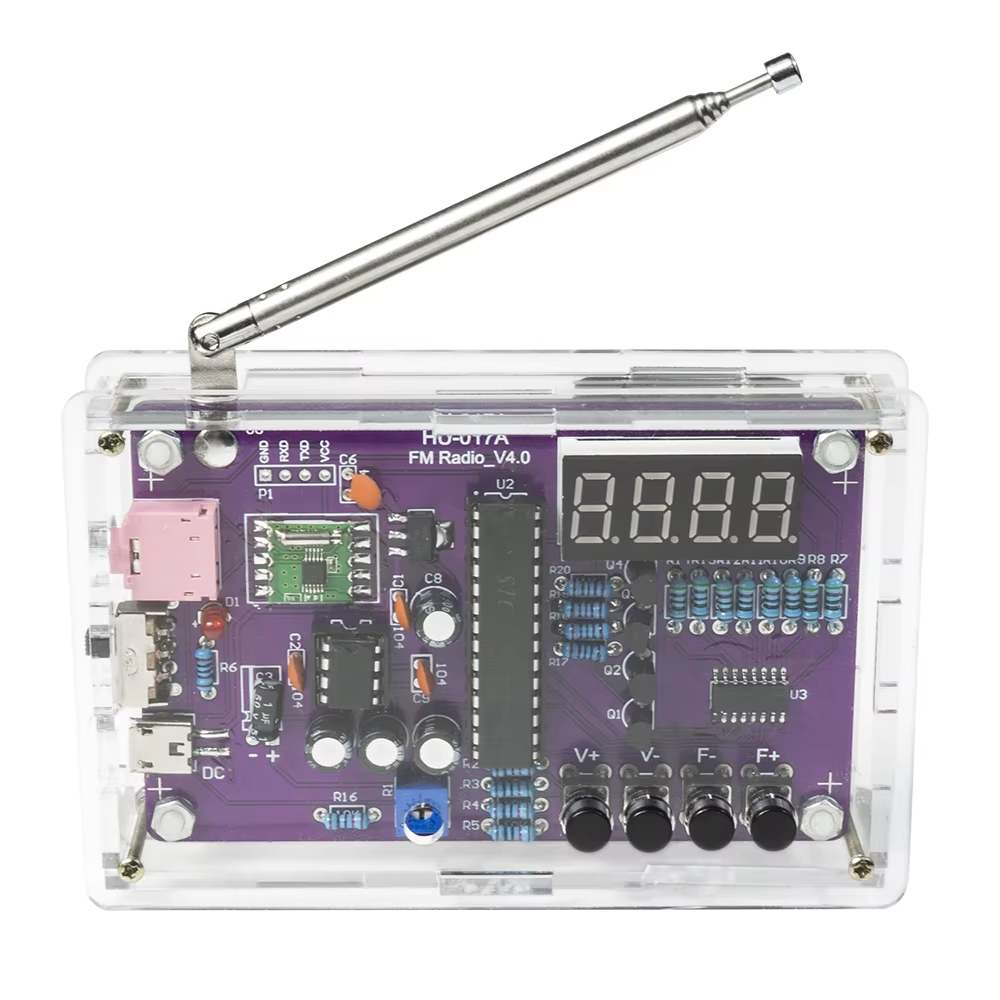
    What kind of soldering kit for a beginner? The HU-017A kit shown here costs just under a dozen zloty, and you can get it even cheaper in a promotion. It allows you to build a simple FM radio based on a ready-made RDA5807S module, a microcontroller with a 7-segment display for tuning and a TDA2822M audio amplifier. A slightly more expensive version with an enclosure is also available.
    How many radios are in a radio? FM 87-108 MHz RDA5807S do-it-yourself kit
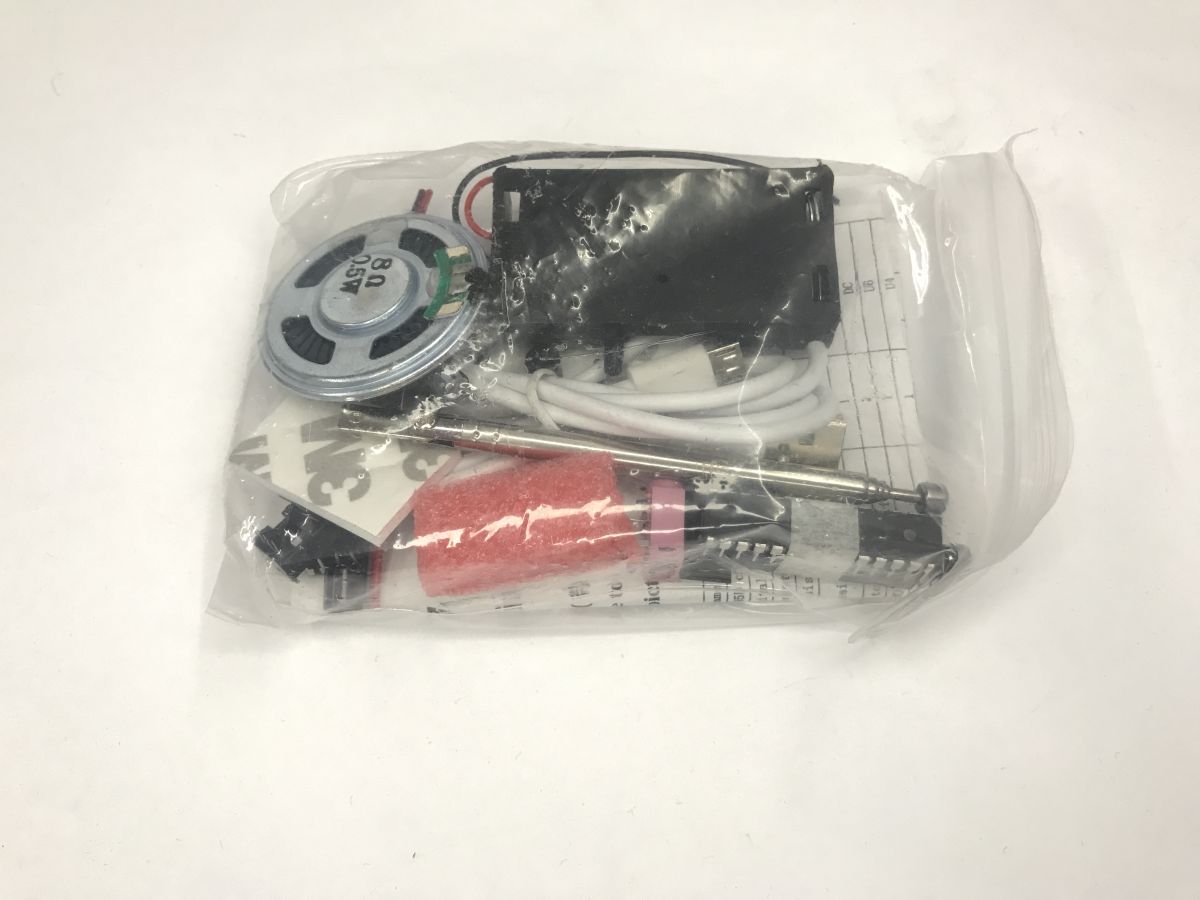
    Let's start with the contents of the kit. I got mine in a promotion, I paid about 10 PLN. Let's see what's inside:
    How many radios are in a radio? FM 87-108 MHz RDA5807S do-it-yourself kit
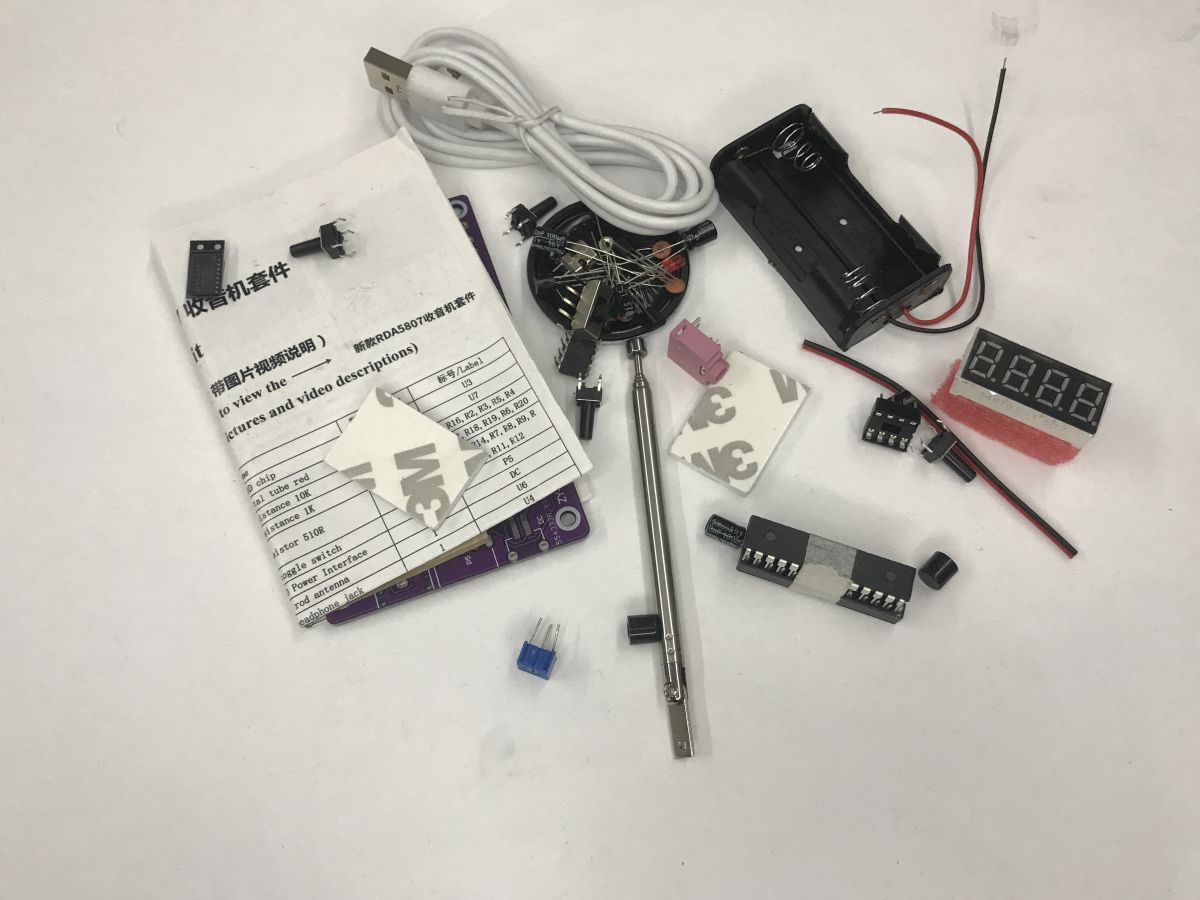
    Loudspeaker and antenna you know, components and board too, but they even gave a battery basket and USB cable. Not bad.
    How many radios are in a radio? FM 87-108 MHz RDA5807S do-it-yourself kit
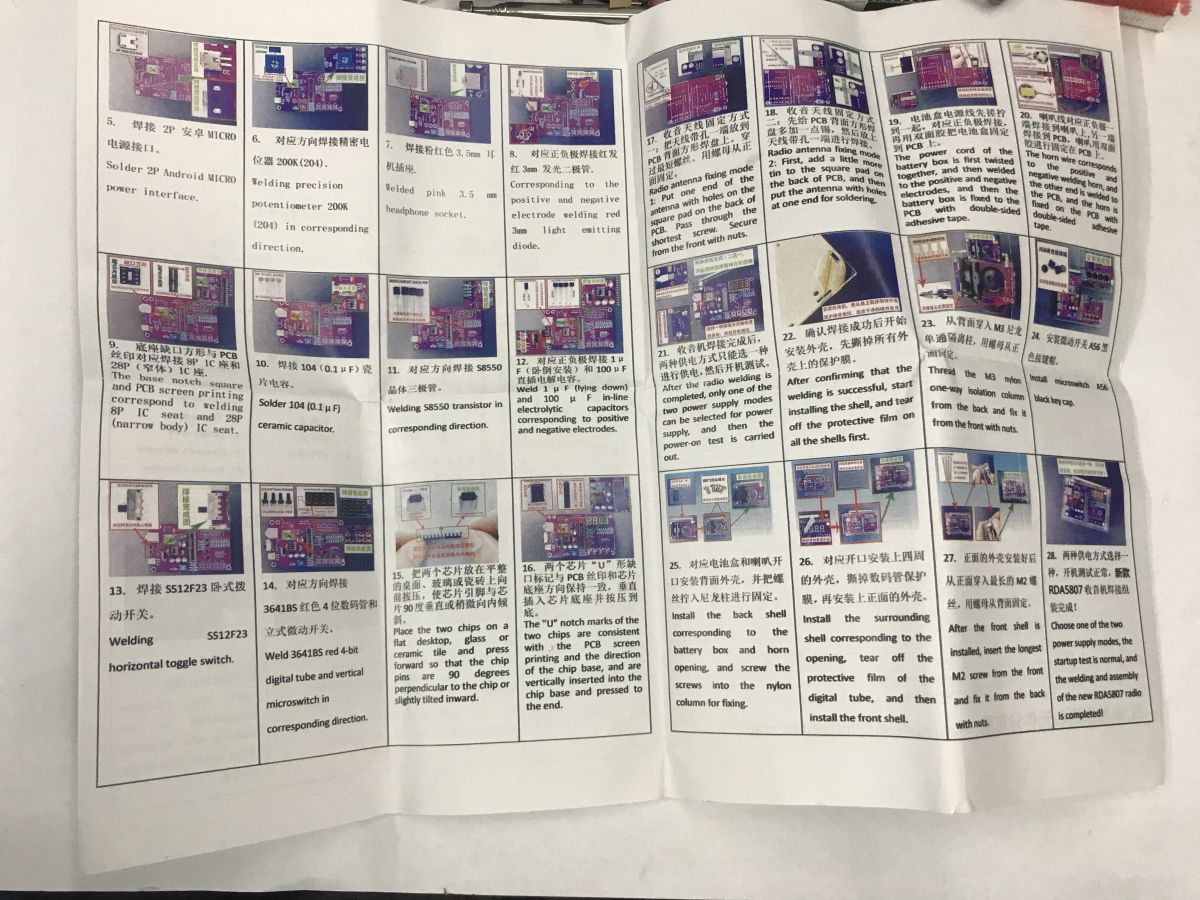
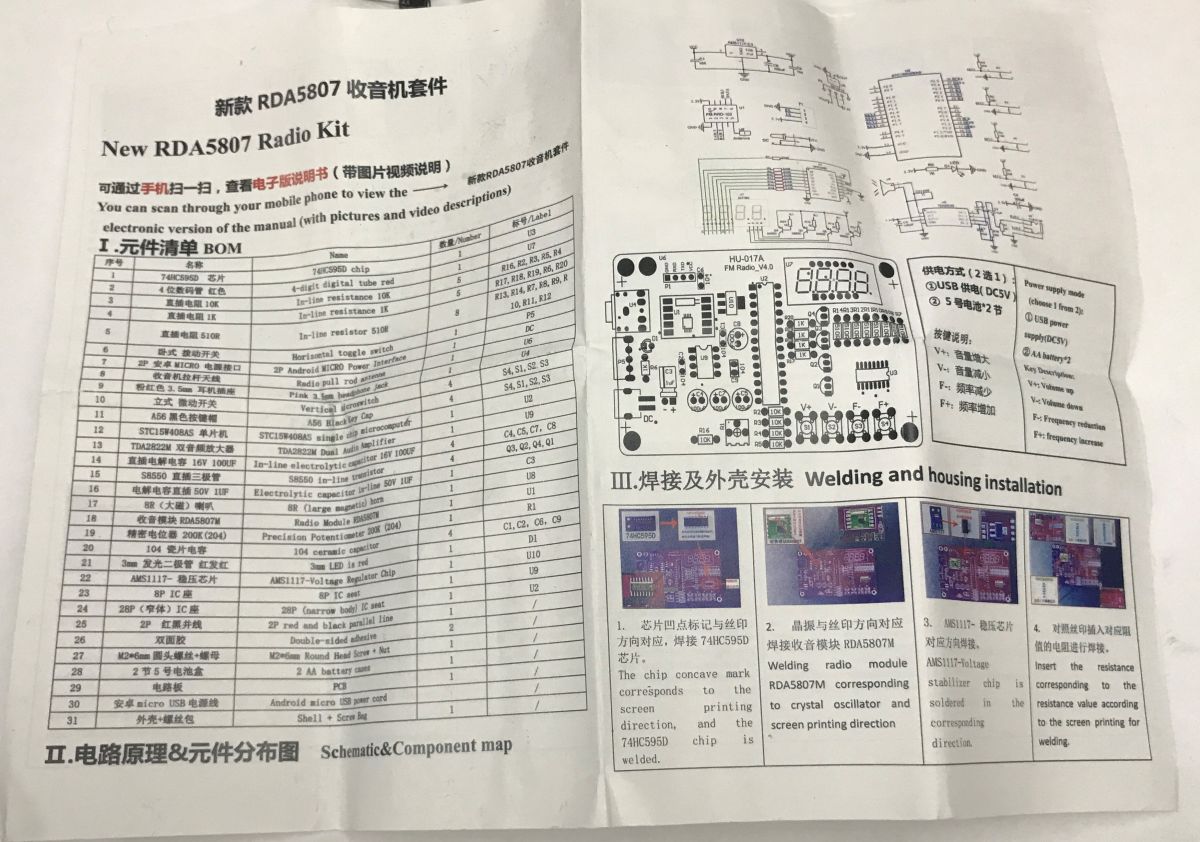
    The seller has thought of everything - there is even a bilingual manual. For this reason, I will shorten my argument a bit here, but will still present the assembly of this radio.
    How many radios are in a radio? FM 87-108 MHz RDA5807S do-it-yourself kit How many radios are in a radio? FM 87-108 MHz RDA5807S do-it-yourself kit
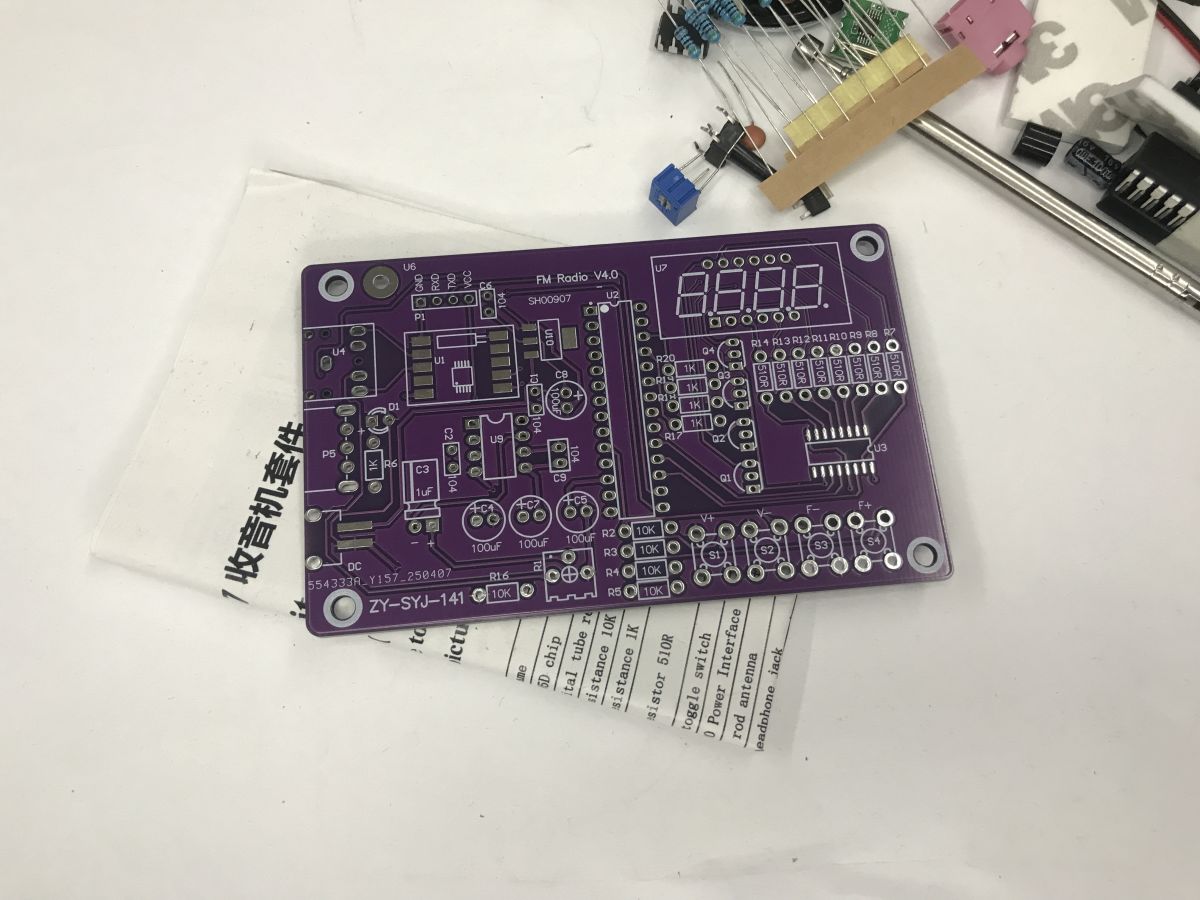
    I always start by wiping the tile with isopropanol. Any dirt or grease makes soldering difficult. Hygiene of the soldering iron tip is also important, but the board should not be forgotten either.
    How many radios are in a radio? FM 87-108 MHz RDA5807S do-it-yourself kit
    Most of the components are assembled by threading, although there are a few sparse SMD parts. It's best to start with the tiniest circuits, then the soldered ones won't interfere so much with the assembly of the next ones.
    How many radios are in a radio? FM 87-108 MHz RDA5807S do-it-yourself kit
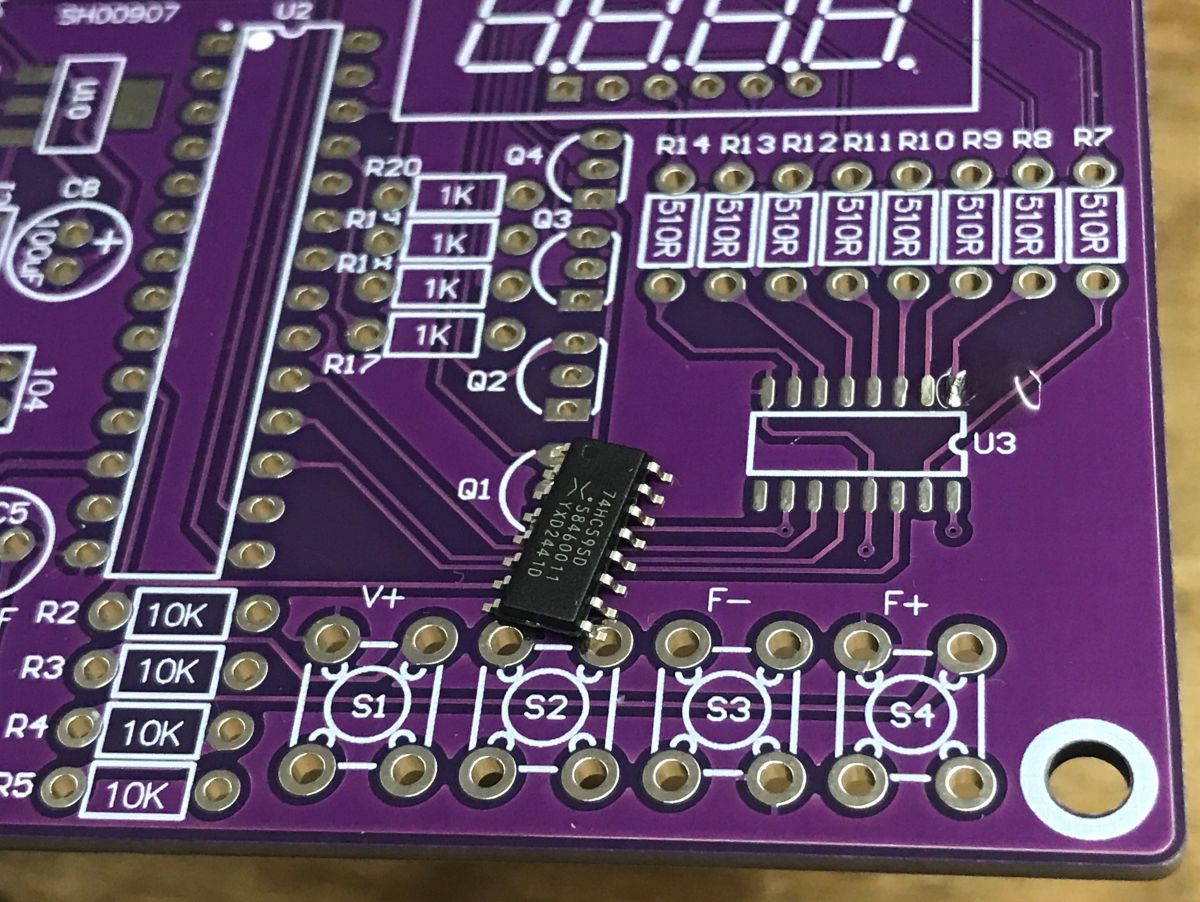
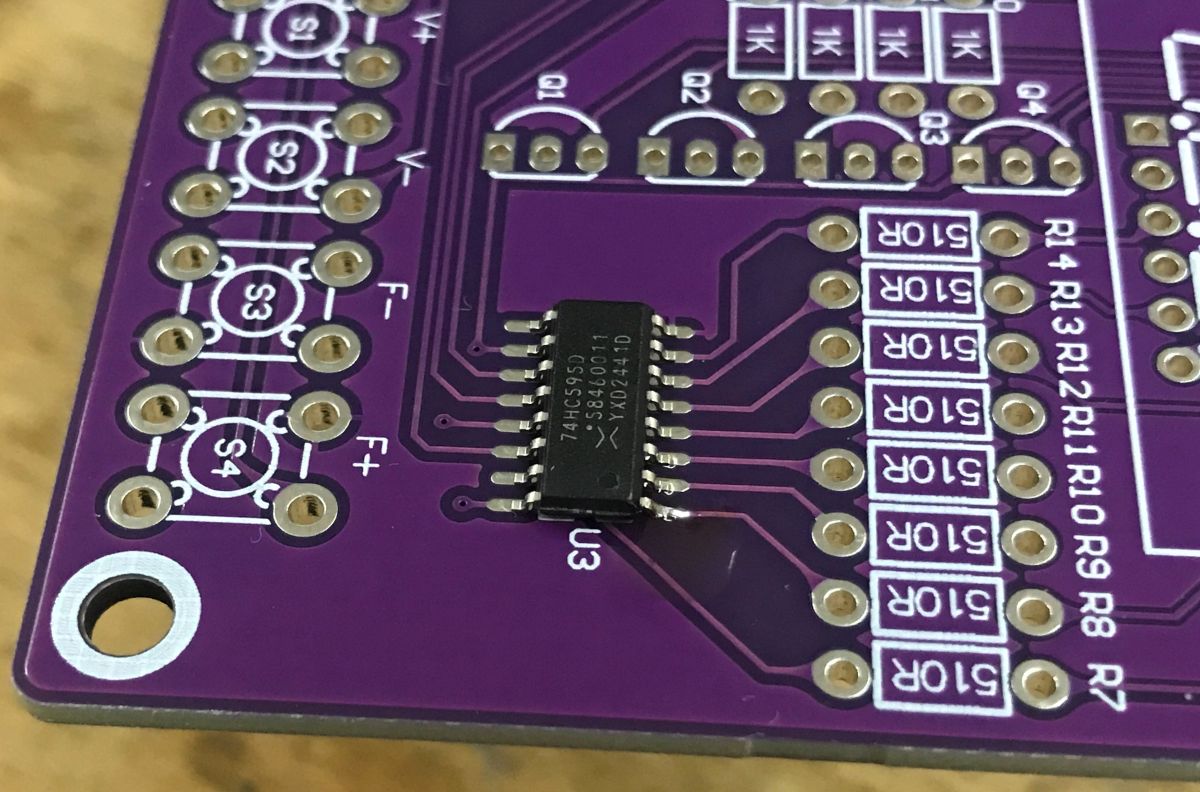
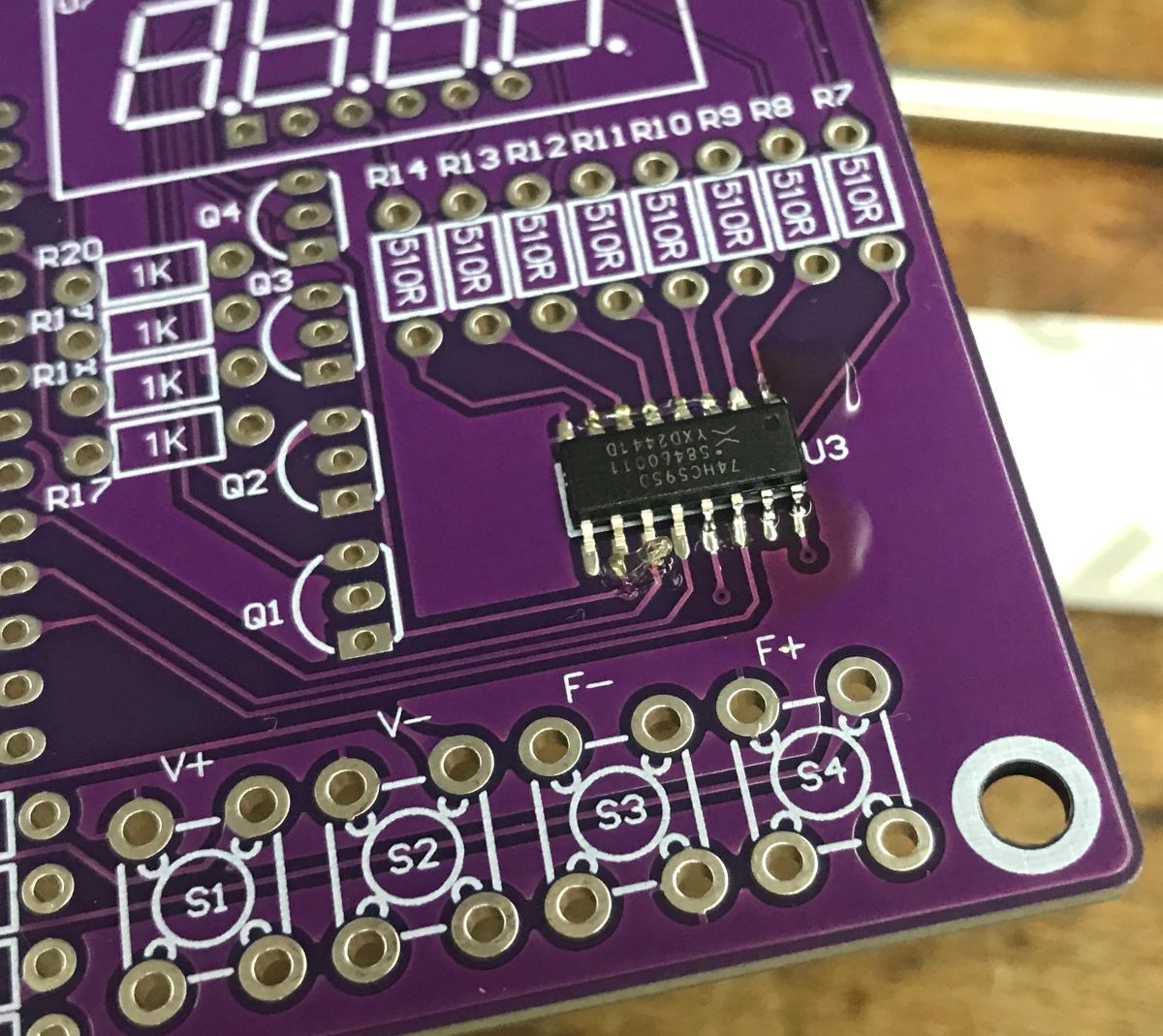
    The smallest is probably the 74HC595D sliding register. It allows you to control the display with fewer pins on the MCU side. I discussed it in a separate topic .
    How many radios are in a radio? FM 87-108 MHz RDA5807S do-it-yourself kit
    It must be fitted according to the marking of the first pin (dot/cut). My method of soldering is to apply solder (and always a little flux - for convenience) to one pad, then "grab" the chip by one leg, and solder the others. It is important to heat the pad and apply the binder to it - not directly to the soldering tip.
    How many radios are in a radio? FM 87-108 MHz RDA5807S do-it-yourself kit
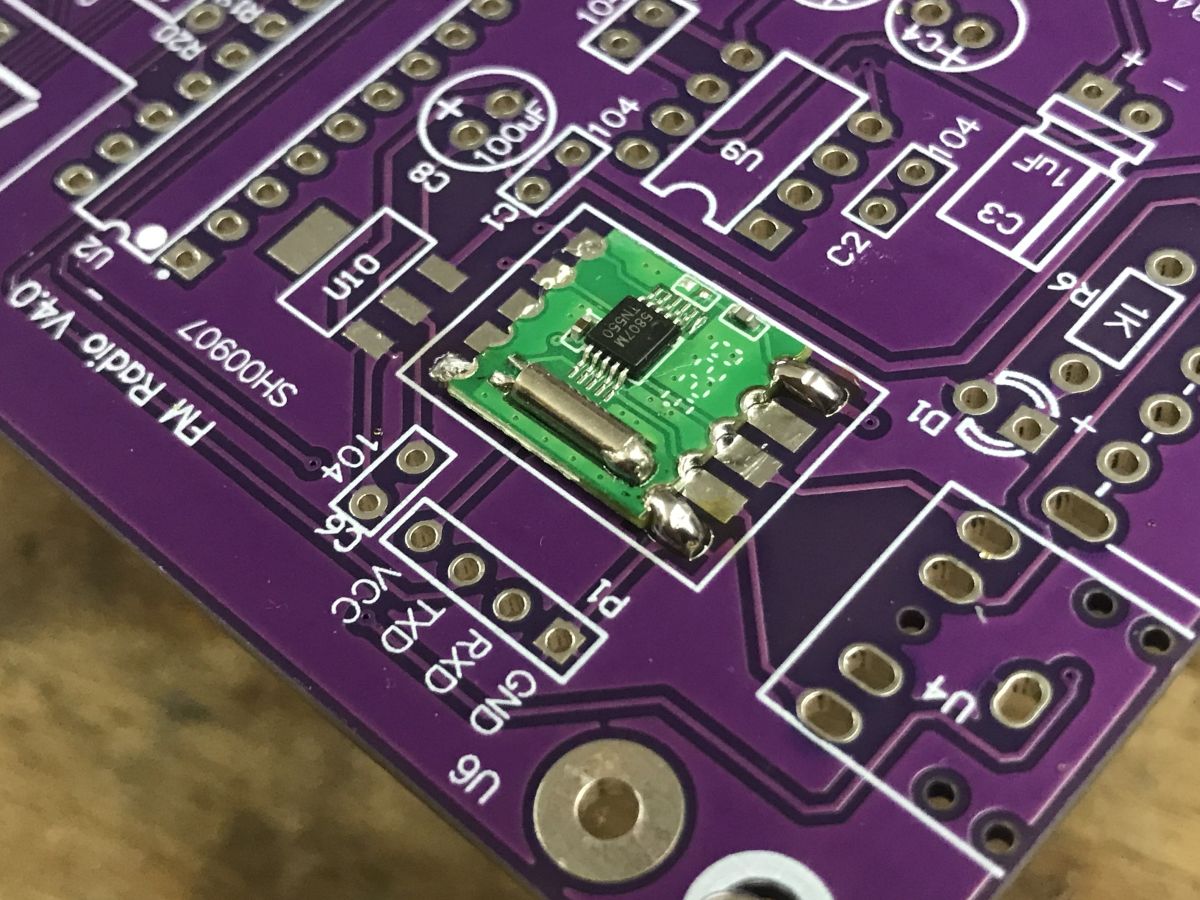
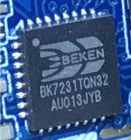
    The second thing that needs to be soldered initially is the radio.... or rather the radio module - the RDA5807S. This is the one that receives the radio signals and converts them to audio output, tuning is done digitally via I2C protocol from the microcontroller. Here I have a similar method and again, care must be taken to ensure the correct orientation, you can't solder 180 degrees inverted.
    How many radios are in a radio? FM 87-108 MHz RDA5807S do-it-yourself kit
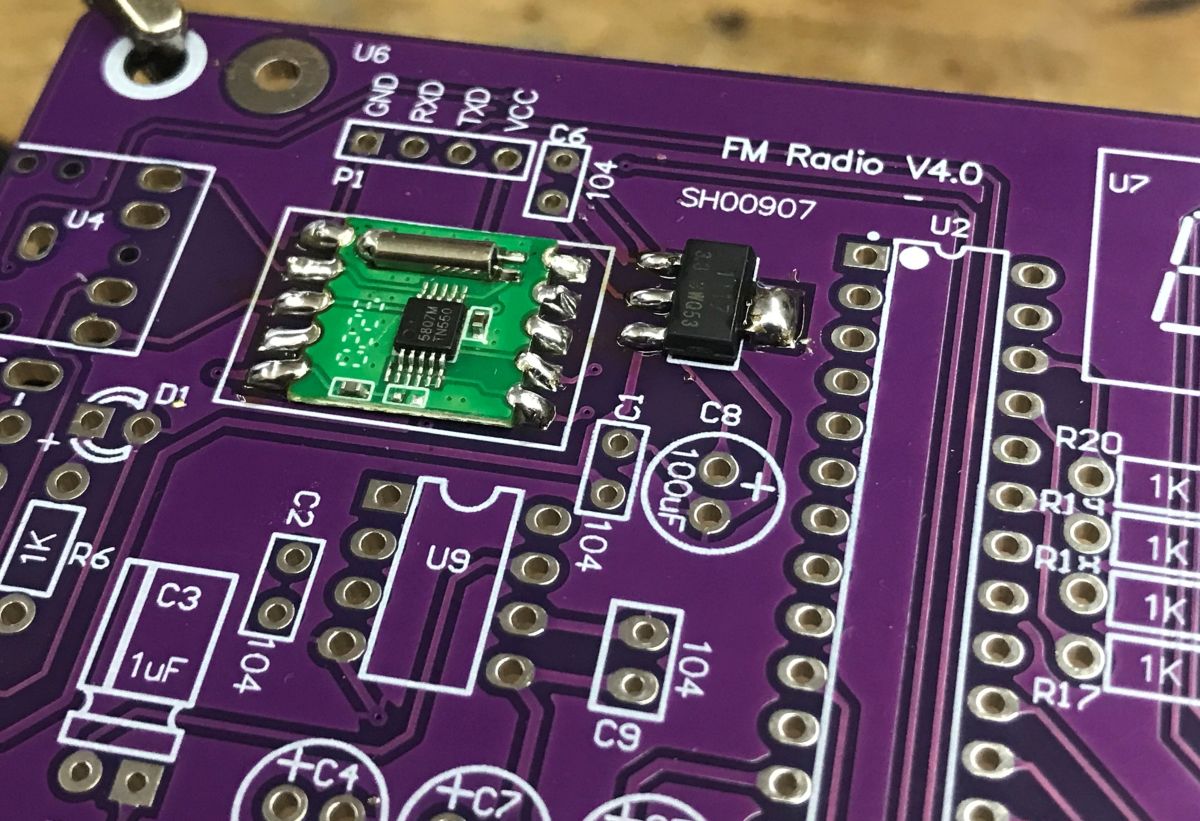
    Right next to it you need to solder the LDO that supplies it with 3.3 V, taking 5 V as input. It is also important to have good contact between the component and the large pad, which acts as a heat sink, although in this particular case there is not much heating.
    How many radios are in a radio? FM 87-108 MHz RDA5807S do-it-yourself kit
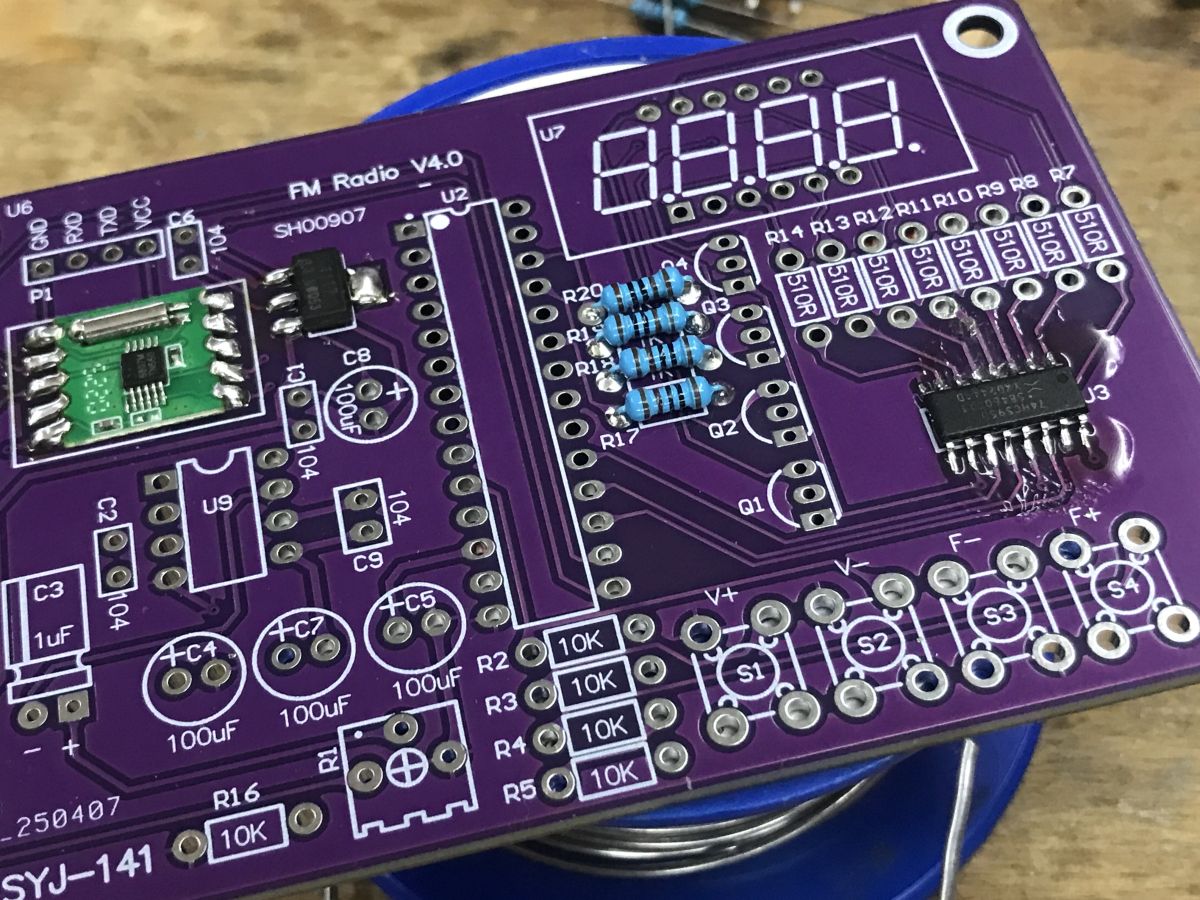
    Then one by one - the resistors. You just have to verify them with either a barcode or a multimeter. You can't get the values wrong, here we have two different ones, 10kΩ and 510Ω.
    How many radios are in a radio? FM 87-108 MHz RDA5807S do-it-yourself kit
    Of the SMD components, there is still the USB socket, or rather, its contacts are surface-mounted and the legs are threaded.
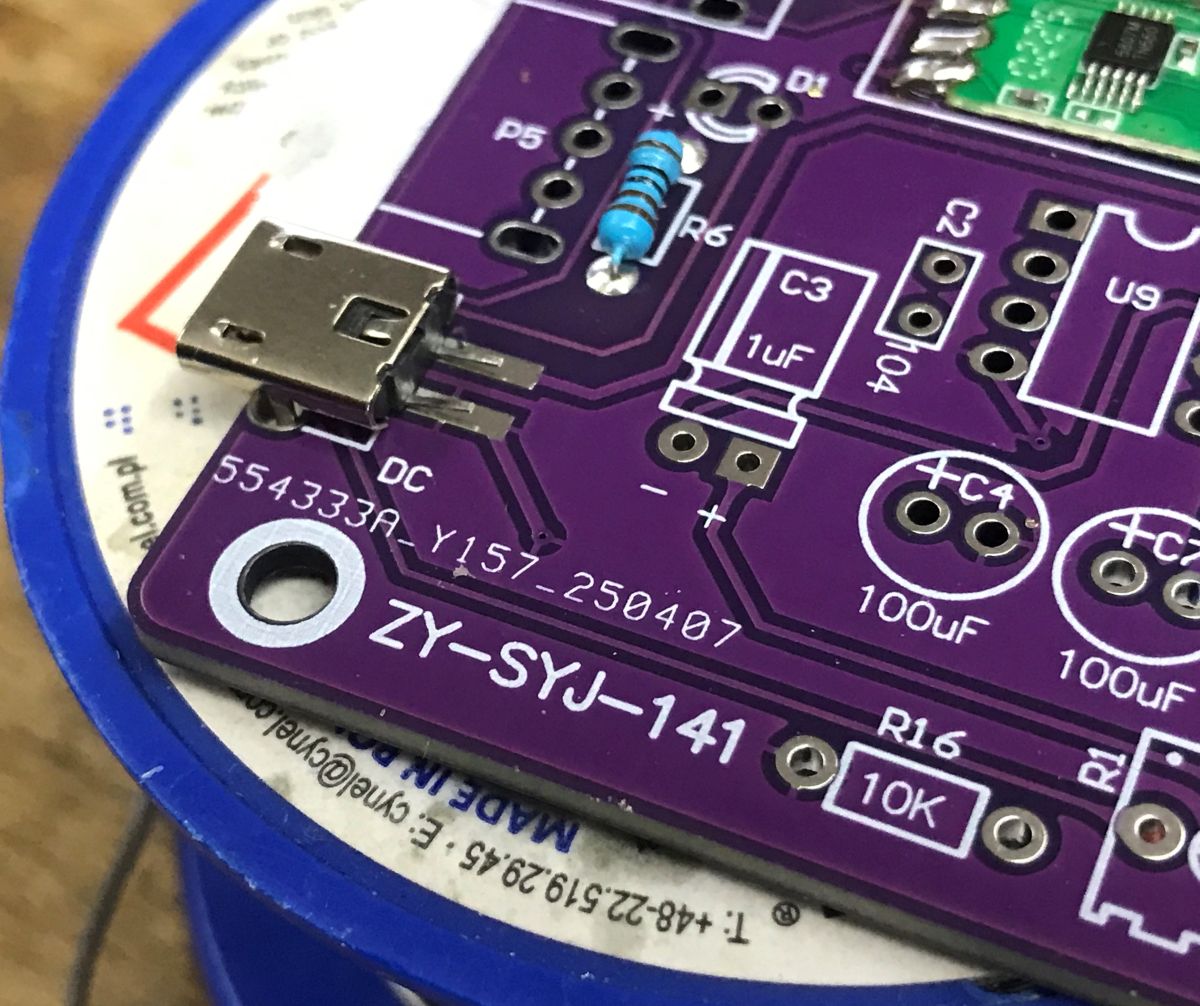
    How many radios are in a radio? FM 87-108 MHz RDA5807S do-it-yourself kit How many radios are in a radio? FM 87-108 MHz RDA5807S do-it-yourself kit
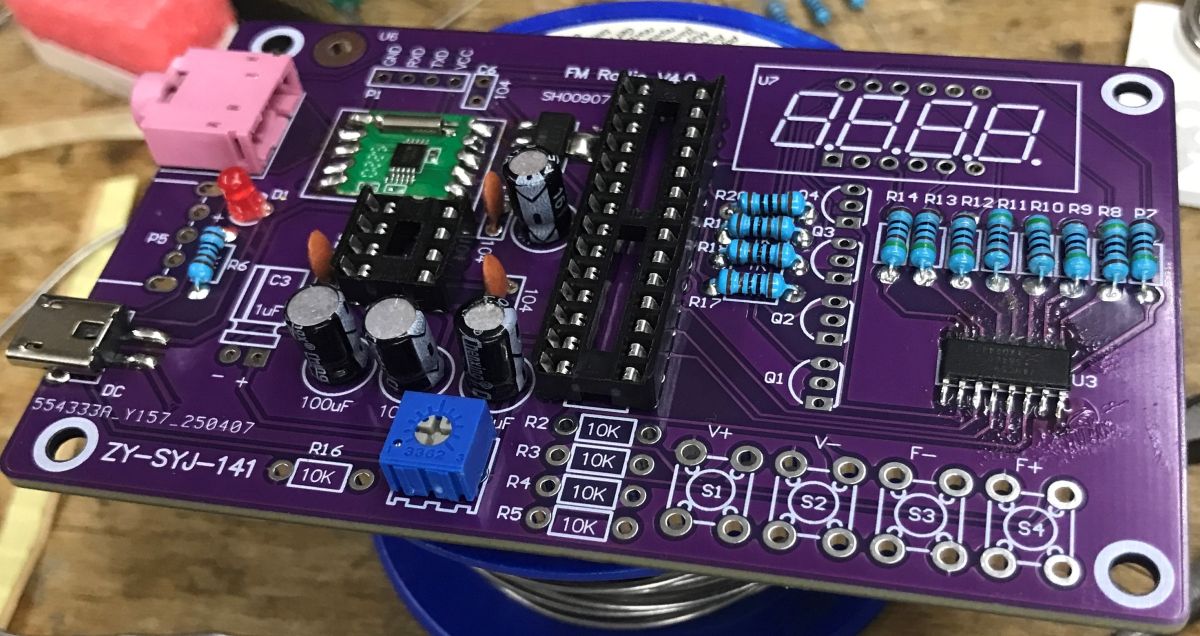
    With electrolytic capacitors and transistors you also need to take care of polarity.
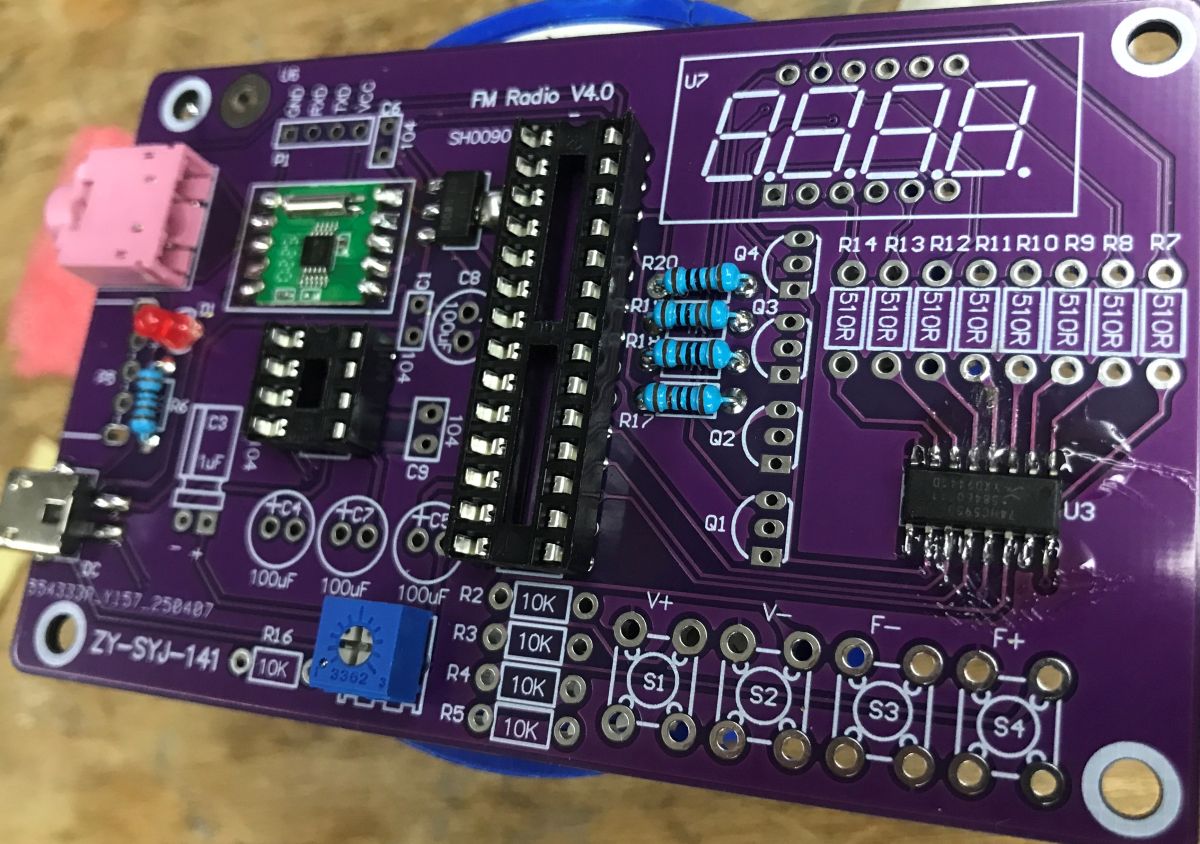
    How many radios are in a radio? FM 87-108 MHz RDA5807S do-it-yourself kit Purple FM radio PCB with soldered components and footprint for a 4-digit 7-segment display Assembled FM Radio V4.0 PCB with 4-digit 7-segment display, buttons, and USB connectors
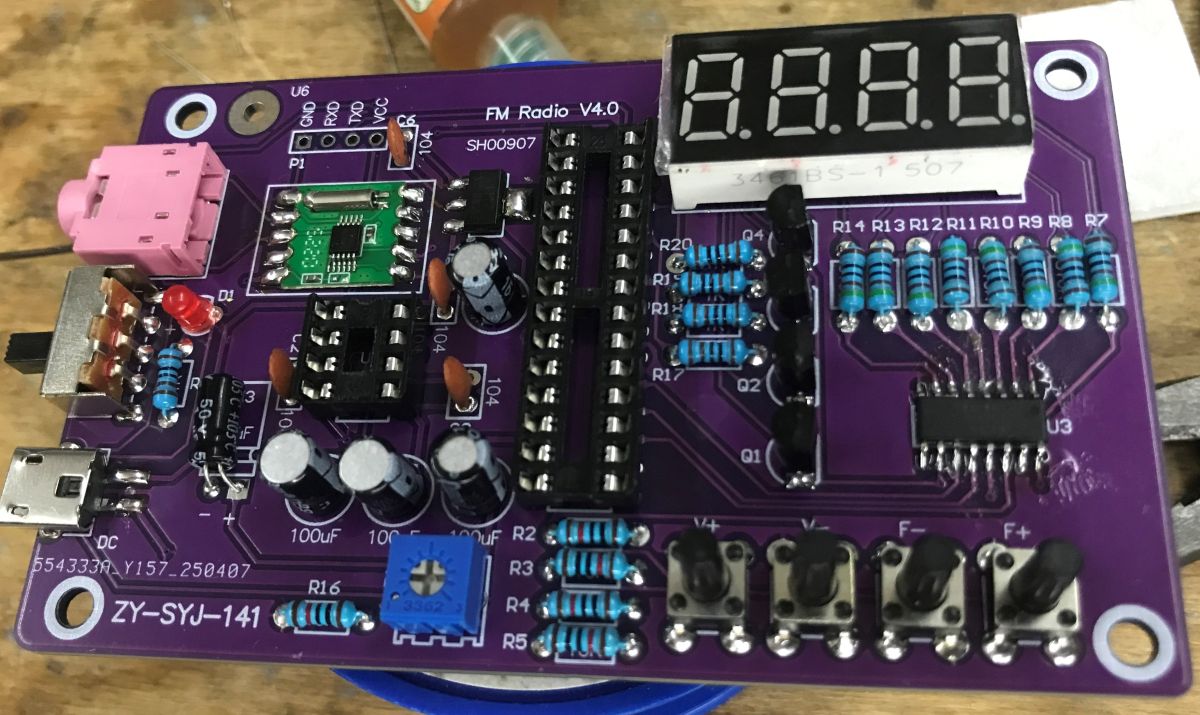
    Finally I also solder the bases, here again taking care of the orientation, although for the base itself it is a purely cosmetic matter, however a reverse soldered base would be misleading. Then I dogleg the legs of the components (MCU and amplifier) and put them in the bases.
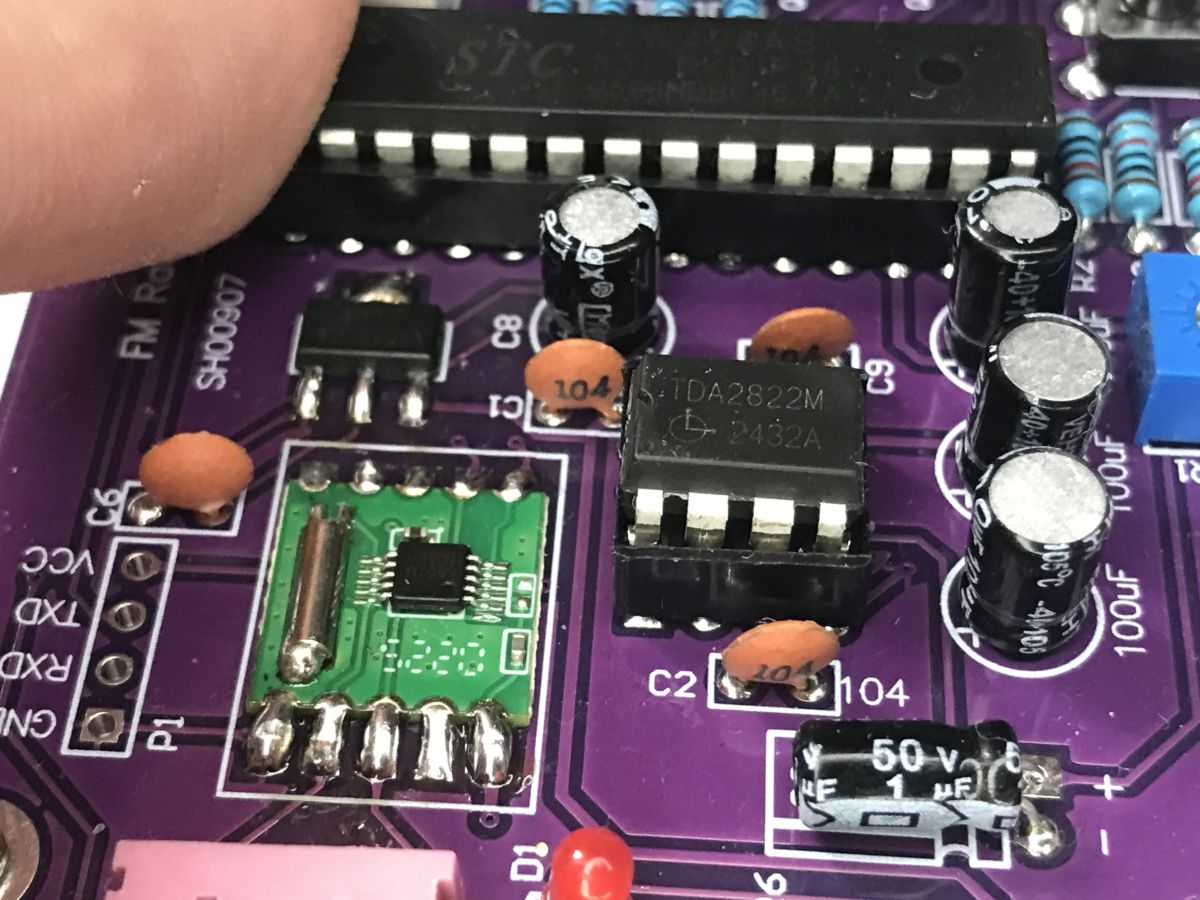
    Close-up of a purple PCB with an FM tuner module, TDA2822M IC, and several electrolytic capacitors
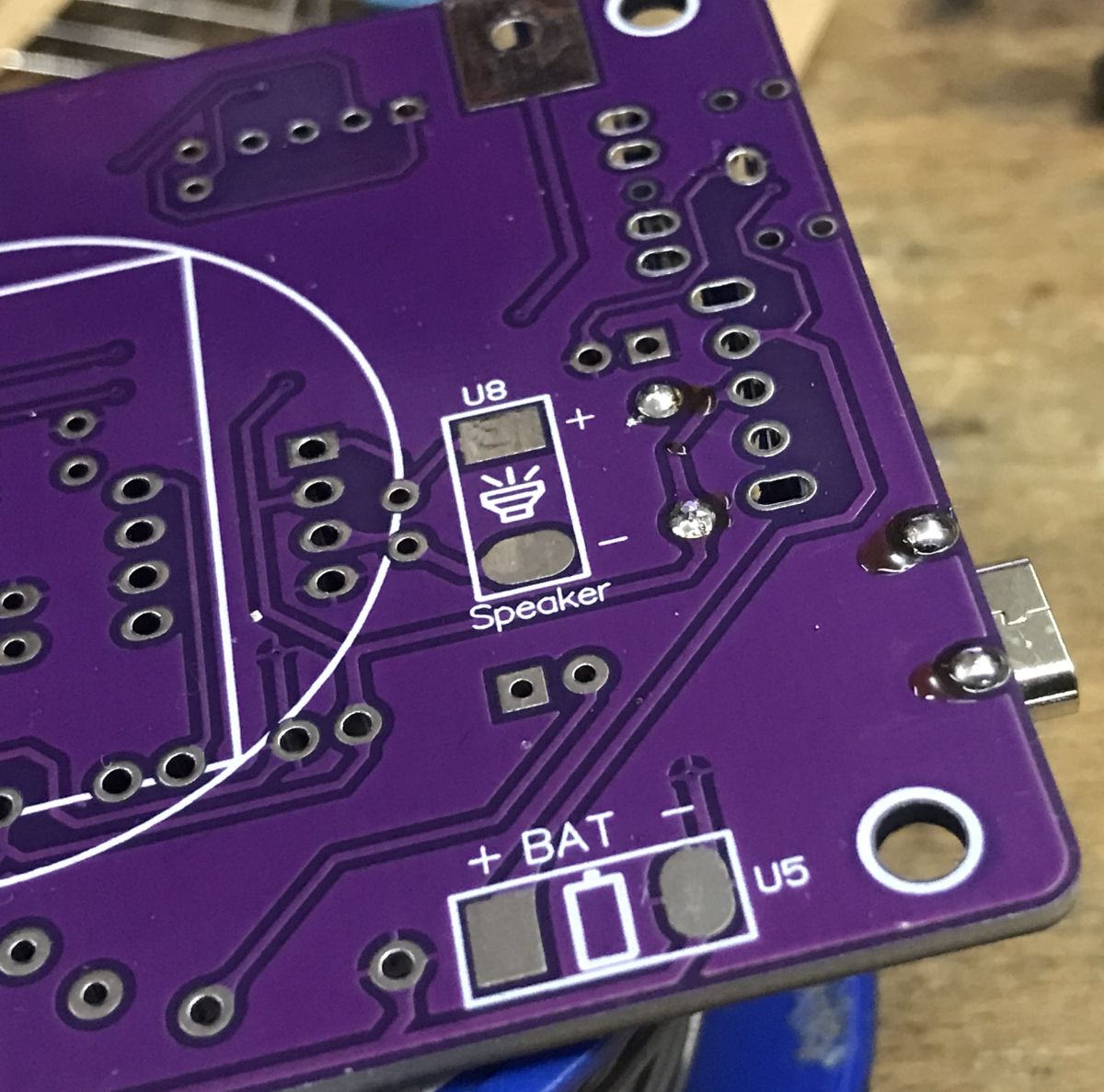
    Still remains to solder the speaker (I take the wires, pads and solder), mount the antenna and it's time for the final verification of the solders and connections. Just for the record - the radio works straight away.

    Finally, we will quote the schematic of the radio (almost - because in the topic there is a version with a register and here without):
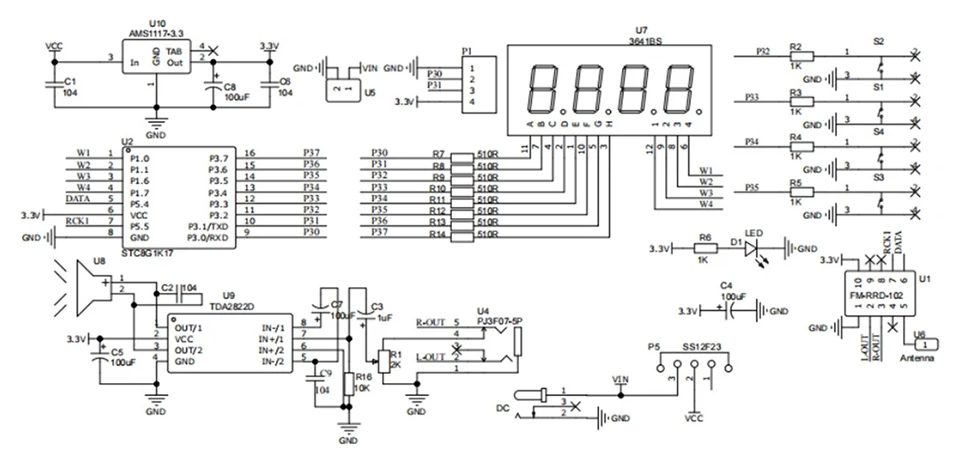
    Schematic diagram of a simple FM radio with microcontroller, 7-segment display, and audio amplifier
    The radio from the HU-017A kit consists of several simple functional blocks. The power supplied from the USB or DC socket is stepped down and stabilised by the AMS1117-3.3, which provides 3.3 V for the electronics. The main controller of the unit is the STC8K17 microcontroller, which operates the buttons, display and communication with the FM tuner. Station reception is performed by the RDA5807S module, which receives the signal from the antenna and, via the I2C bus, is tuned by the microcontroller. The current frequency is displayed on a four-digit 7-segment display controlled by a 74HC595 shift register. The audio signal from the tuner goes to the volume control potentiometer and then to the TDA2822 amplifier, which drives the speaker. Pushbuttons allow you to change the frequency and control the radio, and an LED indicates power to the unit.

    So what is the problem with this radio?
    Basically none - just buying a "do-it-yourself radio" at some point I'd expect more of a DIY radio receiver, probably still with a coil to be wound (or at least soldered on), and here we essentially have a ready-made FM tuner and solder only its control and amplifier. Only is this really a downside?
    The project itself is undoubtedly trivial to get up and running, requires no tuning and will work out of the box. Just right for a beginner's first start.
    Have you also assembled your own radio as part of your electronics learning, and if so, according to which schematic?

    Cool? Ranking DIY
    Helpful post? Buy me a coffee.
    About Author
    p.kaczmarek2
    Moderator Smart Home
    Offline 
    p.kaczmarek2 wrote 14637 posts with rating 12649, helped 655 times. Been with us since 2014 year.
  • ADVERTISEMENT
  • #2 21898310
    ZbeeGin
    Level 39  
    Posts: 4320
    Help: 602
    Rate: 453
    I see an opportunity to improve this receiver somewhat. On the headphone socket, pins 3 and 4 could be connected. This would allow stereo listening on the headphones and full mono on the speaker (the socket pins would connect both channels).

    As for building my own radios, in my youth I went through all of them from the booklet: 'The Simplest Radio Receivers' by Wiktor Chojnacki.
  • Passive resistive combiner needed for mono output

    #3 21898432
    2N4427
    Level 20  
    Posts: 295
    Help: 34
    Rate: 142
    >>21898310 I also noticed that the mono speaker is only the right channel. But channel summing is not done by shorting the outputs! Has the colleague checked the datasheet of the circuit? After all, these are outputs suitable for 32-ohm headphones, what output impedance can there be, especially compared to a 2 kΩ potentiometer? This can be done on a passive resistive combiner (lossy of course).

    https://www.elektroda.pl/rtvforum/topic2339274.html
    Attachments:
    • RDA5807SP.pdf (802.73 KB) You must be logged in to download this attachment.
  • ADVERTISEMENT
  • #4 21898602
    Mateusz_konstruktor
    Level 37  
    Posts: 4226
    Help: 269
    Rate: 1104
    I understand that the battery cage is linked to the battery supply.
    Where is this connected and what does this option look like?
  • Ready-made FM kit offers little learning value

    #5 21898743
    elukam
    Level 18  
    Posts: 404
    Help: 8
    Rate: 181
    p.kaczmarek2 wrote:
    Buying a 'do-it-yourself radio' at some point I would expect more of a DIY radio receiver, probably still with a coil to be wound (or at least soldered on), and here we essentially have a ready-made FM tuner and solder only its control and amplifier. Only is this really a downside?
    The project itself is undoubtedly trivial to get up and running, requires no tuning and will work out of the box. Just right for a beginner's first start.
    Did you also assemble your own radio as part of your electronics learning, and if so, according to which schematic?
    There is a little bit of nerdiness, as with any working "self-assembled" device. But it doesn't add any knowledge. Even a long-wave detector on a germanium diode gives an incomparably greater injection of knowledge than this kit. At most, you can learn how to solder. Development comes from acquiring knowledge to overcome difficulties, not from soldering something that cannot fail to work. Ready-made kits are for lazy people not for enthusiasts :)
  • Soldering kits still teach electronics basics

    #6 21899192
    krychast
    Level 20  
    Posts: 1187
    Help: 11
    Rate: 159
    Look at the price o evaluate the cost-effectiveness. It is always some youngster who will be infected by the passion of soldering and electronics. Our Polish kits also consisted of soldering a board with components. No one wants to count the inductance of coils etc., they were replaced by chokes and the finished diy projects started from the very beginning. It was fun anyway and maybe it is - I have no idea if young people can use a soldering iron.
  • #7 21899335
    elukam
    Level 18  
    Posts: 404
    Help: 8
    Rate: 181
    And that is how it is supposed to be. People are supposed to consume and they are not supposed to want to count or know how to count. An excess of knowledge in society would upset the age-old proportions and social order :)
  • #8 21899337
    krychast
    Level 20  
    Posts: 1187
    Help: 11
    Rate: 159
    >>21899335
    it's not about consumption - I used to make PCBs with oil paint and a matchstick and a carpet spilled from ferric trichloride--a 1mm drill bit put into a 500W Celma drill--now that's a gulf. I'm leaving aside the point of making PCBs at home in the age of PCB Way and other platforms.
  • #9 21900257
    sq3evp
    Level 39  
    Posts: 6564
    Help: 219
    Rate: 871
    >>21899337
    This is how it was done, the chloride I probably still have in the boat in granule form.
  • Critique of schematic flow and kit educational value

    #10 21900403
    Stanley_P
    Level 28  
    Posts: 1305
    Help: 61
    Rate: 289
    p.kaczmarek2 wrote:
    Finally, we will quote the schematic of the radio

    A'speaking of just the schematic. I don't think it's very educational (and this is, among other things, the role of the set) that the signal counting from the left goes into the speaker, and from the right goes out into the ether through the antenna. And it is not a transmitter ;-) I guess that such was supplied by the manufacturer, and maybe the general rules of drawing are different in slant-eyed people. However, with us it has become accepted that in diagrams the signal flow is generally from left to right. Other than that, galvanically, in terms of connections etc, it seems correct ;-)

    Added after 5 [minutes]:

    elukam wrote:
    There's a bit of nerdiness, as with any working "independently twisted" device. But it does not add any knowledge. Even a long-wave detector on a germanium diode gives an incomparably greater injection of knowledge than this kit. At most, you can learn how to solder. Development comes from acquiring knowledge to overcome difficulties, not from soldering something that cannot fail to work. Ready-made kits are for lazy people not for enthusiasts

    Apparently yes, but on the other hand it's better and learning/exercising at least soldering than firing up an internet radio app on a smartphone ;-) (because I don't know if they still have FM on board any modern models)
  • ADVERTISEMENT
  • Kit is for assembly, not circuit design

    #11 21900427
    2N4427
    Level 20  
    Posts: 295
    Help: 34
    Rate: 142
    >>21899335 Gosh, and in the days before self-assembly kits (1980s "Młody Technik", "Radioelectronic"), who counted anything? He would redraw from an article in a monthly magazine a finished picture of a circuit board design onto a sheet of laminate. What outstanding creativity in the field of electronics did he learn this way? Painting with varnish on a plate? Mixing the reagent with water in the correct ratio? Washing varnish off an etched wafer? Drilling holes?

    After all, this is not a proposition for people who can design a circuit from scratch and then make it.
  • Kit has no educational value

    #12 21900605
    elukam
    Level 18  
    Posts: 404
    Help: 8
    Rate: 181
    I have never in my life redrawn a finished pcb design from Radio Electronics or MT. And 'whatever counts' I learned very quickly and since then more and more a percentage of each realization was mine and not copied.
    So don't make general assertions based on your own experience, because there are worlds beyond your ;)
    I'm not analysing who this kit is for, just that it has no educational value. For anyone. And that is not the purpose for which it was produced, to teach anyone anything.
  • Beginners can start with ready-made modules

    #13 21900712
    2N4427
    Level 20  
    Posts: 295
    Help: 34
    Rate: 142
    A colleague first learnt "to count anything" (and very quickly, according to him) and then made the first board according to his own design. And others proceeded in a different order and for them there was the suggestion of the monthly magazines "Młody Technik", "Radioelektronik". Anyway, in the case of good projects, changing anything for the sake of principle was the 'sin of youth'. Where on the scale of experience was the novice, and where was any of the authors of the article?

    It is no insult to anyone to make a first (or second and third...) layout based on someone else's design, including from a ready-made kit. Nor is it an insult to incorporate a ready-made module (why kick down an open door?) into an amateur's individual design, which by its very nature need not be optimal in terms of volume, for example.

    We are talking about novices, people taking their first steps in electronics, because this seems to have escaped the Fellow.

    What my beginnings and experiences are, my colleague does not know. Even today, after many years, once every few months on a Sunday afternoon, for the sheer pleasure of it, I like to solder a self-assembly module I have bought (e.g. to beat the order to the free shipment threshold) and to please my eye with a clean, careful workmanship. It's my "robbery right" and I don't care what anyone thinks about it.
  • Kit teaches no electronics skills

    #14 21900989
    elukam
    Level 18  
    Posts: 404
    Help: 8
    Rate: 181
    Again: the only thing I was referring to is that this kit teaches no one anything, has no educational value. And I am not judging the motivations of the purchasers.

    What came out completely by the way was what the general ideas are about the "career path" and skills in technical fields in general. And what you wrote doesn't surprise me at all, because in my youth I knew a lot of beginner electronics engineers and I know how they started and I also know about many of them how they finished. I'm not surprised, but rather saddened, because I've seen countless times in my life that Poland is a country of reproductions and copies, both in technology and outside of it. And this is reflected in the economy, its level and state. Comparing with some others. Of course there are exceptions, but they are marginal and have little impact on the whole. These exceptions are dramatically few and none that I personally know of. This is some kind of national virus of a hidden internal sense of inferiority masked by a false pride, just as unjustified.
  • Triac heatsink can sit at mains potential

    #15 21901344
    sq3evp
    Level 39  
    Posts: 6564
    Help: 219
    Rate: 871
    For beginners it is good - put together, there is a chance it will work and it is for this radio, not some blinker on diodes and 2 transistors.
    In my case, the control of the lights was implemented on logic gates giving the impression of randomness of blinking, i.e. controlling the outputs on triacs. By the way, I found out that the triac's heatsink is on L or N potential, depending on how you switch on the power plug.
    Ze 2 power supplies - one still works on an LM317 and a typical application scheme with diodes (to teg filters on the coils and HF decoupling capacitors), which saved me because the bridge was soldered incorrectly. You have to learn from your mistakes (preferably someone else's) and gain experience.
  • Theory-first approach reduces practical errors

    #16 21901713
    elukam
    Level 18  
    Posts: 404
    Help: 8
    Rate: 181
    A small but important point: you have to learn from books. Errors in practical experience will occur anyway, they are unavoidable. But they should provide the impetus for learning and not be the basis for it. This is the difference between a "real engineer" and a "service technician". There is nothing more practical than good theory. Whoever understands it is ahead of others and wins.
    If someone knows what he or she is doing because he or she knows it, has background knowledge of the phenomena, errors (including those that are surprising and have never been encountered before) are sporadic and quickly rectifiable.
  • #17 21901989
    sq3evp
    Level 39  
    Posts: 6564
    Help: 219
    Rate: 871
    It is a fact.
    Theory is a matrix for calculating the parameters of a transistor.
    A truth table for miimising functions in digital circuits, etc etc etc.
    Some practice is repair, measurements.
    And here and there will be an engineer or a service technician.
  • Knowledge matters more than rote troubleshooting

    #18 21902095
    2N4427
    Level 20  
    Posts: 295
    Help: 34
    Rate: 142
    >>21901713 >>21901989 Full agreement with both Colleagues. But this is effectively countered by the fundamental principle of modern education "school is supposed to give skills, not knowledge". This mantra emerged at the turn of the millennium with the Buzek government's ill-fated education reform (who still remembers Minister Handke?). Knowledge in physics and related sciences is the basis for understanding the world and its phenomena. Nothing becomes obsolete faster than skills (especially those without knowledge) - especially those related to the reigning technology of the day. To put it brutally, modern schooling is geared towards producing asparagus pickers. So we already have two generations of 'clickers' - find a youtube video on a particular solution to a certain narrow problem, apply it point by point, immediately forget it and God forbid try to understand the nature of the problem and the resulting solution.

    Both types are present on Elektroda: the engineer (knowledge) and the service technician (skills). The latter, after many years of practice, will have hundreds/thousands of solutions in his/her head - most often, in 99% of cases, working flawlessly. The engineer without service practice will take more time to find a solution in these 99% of cases (if only to search the internet and analyse which ideas make sense, rather than giving one straight off the top of his head). This leaves a gap where theoretical knowledge will find a solution to a problem that escapes standard procedures.

    I have watched many threads on Elektroda where the questioner has been met with the impatience and irritation of the helper "do as I tell you, and don't complicate, don't ask, don't bother". Such a questioner, who wants to understand and learn something in the process, is a pearl that needs to be framed in gold, not thrown into a box of rusty nuts.
  • Importance of physics and math fundamentals

    #19 21902099
    sq3evp
    Level 39  
    Posts: 6564
    Help: 219
    Rate: 871
    2N4427 wrote:
    Knowledge in physics and related sciences is the basis for understanding the world and its phenomena. Nothing becomes obsolete faster than skills (especially those without knowledge) - especially those related to the reigning technology of the day. To put it brutally, modern schooling is geared towards producing asparagus pickers. So we already have two generations of 'clickers' - find a youtube video on a particular solution to a certain narrow problem, apply it point by point, immediately forget it and God forbid try to understand the nature of the problem and the resulting solution.

    Both types are present on Elektroda: the engineer (knowledge) and the service technician (skills). The latter, after many years of practice, will have hundreds/thousands of solutions in his/her head - most often, in 99% of cases, working flawlessly. The engineer without service practice will take more time to find a solution in these 99% of cases (if only to search the internet and analyse which ideas make sense, rather than giving one straight off the top of his head). This leaves a gap where theoretical knowledge will find a solution to a problem that escapes standard procedures.

    I must comment - I agree 300%.

    One can then read posts where one does not see that one is referring to the sine lun tangent of an angle explaining that the cosine of the same angle is no longer the same thing.
    Trigonometric concepts are alien and arguments then like:
    "it is not true that the sun rises in the east sets in the west only sets in the west rises in the east".
    The basis of physics and metematics is the basis of everything.
  • Internet and parental pressure are weakening student skills

    #20 21902169
    elukam
    Level 18  
    Posts: 404
    Help: 8
    Rate: 181
    Quote:
    this is effectively countered by the fundamental principle of modern education "school is supposed to give skills, not knowledge". This mantra emerged at the turn of the millennium with the Buzek government's ill-fated education reform (who still remembers Minister Handke?).
    I would definitely not blame the education reform for the current state of affairs. The reform was certainly not perfect, but it was necessary. For formal reasons it was necessary to adapt the Polish system to, let's say, the European one. Let's say, because the system is not uniform, but it has to allow for adjustment at particular stages, no one is an island, people migrate. For substantive reasons, it was necessary to modernise education from a state of adjustment to a socialist economy to a free market economy. This is both about the type and the scope of knowledge. Of course, mistakes were made, e.g. sciences were marginalised and the compulsory matriculation exam in mathematics was removed at the expense of the humanities. This is unfortunately the fault of the imbibing of society and its authorities with pseudo-populist views and the influence of the CC on the authorities. But, for example, the introduction of grammar schools had very good effects, CONFIRMED by research. Unfortunately, when it actually solidified and started to work, the best of it was trashed by (indeed) right-wing populists. Except, let's be clear, at the express demand of the working people of towns and villages.
    Today, the problem is different and is due to 2 things. Firstly, because every authority is afraid of the parents who actually decide on school development. And how one develops something that dilettantes are trying to manage is known. The second reason is the influence of the internet in the sense of mobile+tiktok+games on the brains of young people. I know first-hand that they are very different from 10-15 years ago. They can't buy in, they can't remember. It's not a matter of upbringing, it's an ACQUIRED change in the level of brain function during the pre-school years. Parents and the environment are to blame. The experts are sounding the alarm, the majority (for now, of course) do not see the problem. Because who would bother with what the scientists say.... The problem will arise when these people start working and deciding things.
    Quote:
    I have watched many threads on Electrode where the questioner is met with impatience and annoyance by the helper "do as I tell you, and don't complicate, don't ask, don't bother". Such a questioner, who wants to understand and learn something in the process, is a pearl that needs to be framed in gold, not thrown into a box of rusty nuts.
    Agreed, although I have mostly in my mind such attitudes of "I don't want anything, give a ready-made solution". Chinese "solder and don't think" kits priced below European costs don't help. They take away the need to learn, to think and on top of that they destroy the market including the jobs of the buyers of these kits.
  • Kit works well despite documentation errors

    #21 21903307
    edz
    Level 13  
    Posts: 81
    Help: 2
    Rate: 38
    A very nice radio.

    For a start, for learning great!!!
    Just the fact that once assembled it works! For encouragement and motivation for something more difficult.

    After all, there will be time for painting, etching, drilling tiles too.
    And those wonders from "Radioelectronic" or "Young Technician" usually had mistakes. The circuit board design did not match the schematic diagram, the values of elements were different on the schematic diagram and different in the parts list, the diagram showed a wrong pnp transistor, etc. etc...
    The man worked hard to make the circuit, connected it up and... the search for errors began :-)
  • Chinese kits can spark curiosity despite educational flaws

    #22 21903430
    2N4427
    Level 20  
    Posts: 295
    Help: 34
    Rate: 142
    elukam wrote:
    For substantive reasons, it was necessary to upgrade education from a state of adjustment to the socialist economy to a free market economy . It is both about the type and the extent of knowledge. Of course mistakes have been made, e.g. the marginalisation of science subjects, the removal of compulsory matriculation in mathematics, at the expense of adding to the burden of humanities subjects. This is unfortunately the fault of the imbibing of society and its authorities with pseudo-right-wing views and the influence of the CC on the authorities . But, for example, the introduction of grammar schools had very good effects, CONFIRMED by research. Unfortunately, when it actually solidified and started to work, the best of it was trashed by <br/span> (and how) right-wing populists . Only that - let's be clear - at the express request of the working people of towns and villages .

    The reason I can't agree is that what you write is heavily influenced by various propaganda clichés and labels. "KK" is not responsible for the removal of maths from the baccalaureate or for "topping up the humanities"; at most it has to do with the 2 (now 1) hours of religion in school per week, or 2/30 (now 1/30) of school time. That is, 3-7%.

    But mostly because there is no such thing as socialist and free market mathematics/physics . Graduates of the communist education system found their way very well into exile; the Achilles' heel of that system was at best teaching Russian as a foreign language at school, but they were able to cope with that.

    On the other hand, I agree with the question of the impact on brain development of using a tablet/smartphone from the cradle. Here there are already convincing research results that explain what we observe on a social scale. Chinese kits can spark curiosity in the beginner and the desire to go further. The obstacle to this is unlikely to be them per se, but the widespread inability to focus on anything lasting longer than 15 seconds, developed in the era of Tik-tok and rollerskates.

    If there are no bugs in this set such as happened in RE or MT (as mentioned above), then I find it worthwhile. I would be happy to buy it and run it.
  • ADVERTISEMENT
  • Education ideology weakened science subjects

    #23 21903564
    elukam
    Level 18  
    Posts: 404
    Help: 8
    Rate: 181
    2N4427 wrote:
    I cannot agree because what you write is heavily influenced by various propaganda clichés and labels. "KK" is not responsible for the removal of mathematics from the Baccalaureate or for the "overload of humanities subjects"; it is at most related to the 2 (now 1) hours of religion in school per week, or 2/30 (now 1/30) of school time. That is, 3-7%.
    Just because something is stigmatised does not mean that it must be untrue. I have been involved with education for many years. After the regime change, when representatives of the "highest party and state authorities" replaced representatives of the "highest church and state authorities" at all ceremonies, there was a strong ideological turn also in the whole education system. Not only did history start to be taught in a different way (which is obvious and normal), but a number of disturbing and science-reversing things happened. Attempts to introduce creationism into the natural sciences. The increasingly deep ideological manipulation of literature in the Polish language. The introduction of religion into schools (a trifle) but not in the sense of "religion" only in the sense of the Catholic religion on an exclusive basis. Worse still, the establishment of this subject as equivalent to all others. At the height of the madness it came to the point where a graduate of a religious competition was treated like a winner of a mathematics Olympiad and was given the same priority admission to universities. Reducing the importance of mathematics by withdrawing the compulsory baccalaureate. Lowering of matriculation thresholds.
    The mere substitution of religion for science subjects at 2 hours a week is no small thing, it is a disaster. Ideology, on top of religion, in place of hard science.
    Quote:
    But above all because there is no such thing as socialist and free market mathematics/physics .
    Well of course there isn't and I didn't write anything like that, it's just your usual manipulation to weaken the speaker's statement.
  • Chinese kit as a good electronics starter

    #24 21903602
    2N4427
    Level 20  
    Posts: 295
    Help: 34
    Rate: 142
    Manipulation? Explain, please, how "modernising education from a state of fit with a socialist economy to a free market economy" involves "marginalising science subjects, removing the compulsory maths baccalaureate, at the expense of topping up the humanities" (both are quotes from you).

    For me, the object of evaluation is not the declarations made before actions, but the actual fruits of those actions. I am not judging you, but what has happened to education.

    Besides, I am not an emigrant who just came to Poland after 40 years, but I have lived here all the time. School has been an ideological battleground since 1989 until now and students are indoctrinated by each teacher according to their own views - one can be an apostle of creationism (whatever that means) and the other an apostle of tolerance (in whatever form "KK" doesn't like). "The increasingly deep ideological manipulation of literature on the Polish language" - yes, I have seen it, but not at all by those you write about. And I have attended parents' meetings and listened to what parents say.

    I suggest you really don't mix "KK", "pseudo-(right-wing)" etc. into the problem of "how to encourage young people into electronics". A Chinese kit - as long as it works and there are no bugs requiring the adept to consult internet forums - is something cool to start with, and may the one who starts with it in electronics (preferably with the help of someone experienced, e.g. a son with his father) catch the bug and go further.
  • Religious indoctrination undermines science education

    #25 21903770
    elukam
    Level 18  
    Posts: 404
    Help: 8
    Rate: 181
    2N4427 wrote:
    Manipulation? Explain, please, how "modernising education from a state of fit with a socialist economy to a free market economy" involves "marginalising science subjects, removing the compulsory maths baccalaureate, at the expense of adding to the humanities" (both are quotes from you).
    You are manipulating again. The quotes are from me, but the way they are logically linked is yours. I'd rather not explain what you've imagined for yourself. i just don't know if you're doing it on purpose or simply can't read.
    Quote:
    School has been an ideological battleground from 1989 to the present day and students are subject to indoctrination by each teacher according to his own views - one may be an apostle of creationism (whatever that means) and the other an apostle of tolerance (in a form arbitrarily disliked by "KK"). "The ever-deepening ideological manipulation of literature on the Polish language" - yes, I have seen it, but not at all by those you write about. And I have been to parents' meetings, I have listened to what parents say.
    And before 89 also teachers smuggled their views more or less openly into the educational process. The only thing that changes in this regard is the packages of these views.
    How long did you go to these meetings and when? Year after year for 30 years that you know? Other than that, nothing happens at the interviews. What happens is in the background, pressure on headmasters, pressure on superintendents, associations and parties pushing on politicians. And the subservience of these politicians to parents in order to stick it to them and thus get elected in the next term.
    Quote:
    I suggest you really don't mix "KK", "pseudo-(right-wing)" etc. into the problem of "how to encourage young people to go electronic".
    Discussion has veered off topic, but there is a definite cause-and-effect relationship here with a delayed but strong and long-lasting effect: saturation with religion = propagation of darkness -> denial of science, undermining the importance of its achievements -> pushing science education into the background -> foolish folk = more willing believers -> closing the circle of dependence. The disinclination to science in general is an inevitable side-effect of this process, which is hard to stop because it is CONVENIENT. Mediocrity is always convenient, achievement is costly.
  • #26 21904087
    edz
    Level 13  
    Posts: 81
    Help: 2
    Rate: 38
    Well...!!! Ladies and gentlemen!

    .There is no denying that RADIO works :-)
    ......Bo... the discussion has heated up.
    ...........On air and almost on paper!
    .................From electronics to politics!
    ......................From the soldering iron to the synagogue!
    ...........................From the transistor to the pastor!
    ................................From laminate to philosophical treatise!
    :-)
  • RDA5807S module worked well with Arduino controller

    #27 21905348
    2N4427
    Level 20  
    Posts: 295
    Help: 34
    Rate: 142
    >>21904087

    From education to manipulation!
    From darkness to mediocrity!

    Thank you for your poetic summation of the discussion; I've had my fill.

    >>21898192 Dear thread author: you have encouraged me to buy this set as part of a Sunday afternoon pleasure.

    p.kaczmarek2 wrote:
    Did you also assemble your own radio as part of your electronics learning, and if so, to what schematic?

    I started out (as I'm sure almost everyone does) with a Warsaw I long wave receiver. The project from "ABC Techniki" (winding coils on two cardboards in the shape of mirrors) was abandoned, and the era of projects from "Młody Technika" arrived - a radio in a matchbox and a radio with UL1111. Then the interest went to VHF receivers - a super-reaction receiver; poor results. Then, in MT, there was a project for a superheterodyne receiver with tuning by simultaneous ejection/insertion of cores, but it was not worth the effort, because in the second half of the 1980s, electronic exchanges began, where you could get modules from Unitra equipment (UKF heads, phonon modules from TV sets, whole unsoldered circuit boards from audio equipment). The TV sound module (FM path and demodulator, and FM amplifier) could be adapted to VHF radio (change of circuits and ceramic filters from 6.5 MHz to 10.7 MHz) and connected to the output of a VHF head unit (tuned by capacitive aggregate, not by voltage) and an ARCz circuit could be added. It was also fun with empty boards - first identify the device, then, on the basis of the description and diagram in "Radiolektronik" or a service manual bought in a bookstore, install the UKF part (FM path and demodulator, stereo decoder with PLL, e.g. UL1621, and m.cz. amplifiers) and run with some own modifications.

    I also already tested the RDA5807S chip a few years ago - I bought the same module on eBay as in the pictures and ran it together with my own controller written on an Arduino with a display - it was also fun for a Sunday afternoon. It worked very decently, but it was not far from the transmitters (less than 20 km in a straight line); the test chip never left the desk, so I have no idea how the RDA5807S performs under more demanding conditions.
    Attachments:
    • 84-nw-12-odbiornik_superheterodynowy.pdf (1.95 MB) You must be logged in to download this attachment.
    • 84-nw-06-superreakcyjny_odbiornik.pdf (1.29 MB) You must be logged in to download this attachment.
    • 84-nw-10-mini_odbiornik.pdf (1.13 MB) You must be logged in to download this attachment.
    • 85-nw-04-odbiornik_radiowy.pdf (1.05 MB) You must be logged in to download this attachment.
  • R&D engineering requires physics, not repair recipes

    #28 21905717
    filipcichowskidev
    Level 12  
    Posts: 90
    Help: 4
    Rate: 157
    >>21902095

    With the first part of the post - about the scourge of "clickers" and the lack of fundamental knowledge - I agree 100%. Without physics and an understanding of phenomena, there can be no development. However, your distinction between "engineers (knowledge)" and "servicemen (skills)" is artificial and heavily unfair to the former.

    You assume that an engineer is a theoretician who has to search the internet for solutions to 99% of standard problems. Meanwhile, the job of an R&D engineer is not to fix what someone has already figured out. A service engineer restores a known piece of equipment to its factory condition based on repeatable fault patterns. An engineer solves problems that .... no one has solved yet.

    I design electronics for satellite drives on a daily basis. I build circuits from scratch, commission them and then test them in vacuum chambers and extreme temperatures. There are no 'standard repair procedures' in space. Experience from RTV service is almost useless here. What matters here is hard knowledge (the physics you mentioned) translated into a real, working solution that has to survive in extreme conditions. Example: I attach great importance to changes in the properties of passive components in vacuum and extreme temperatures, you have to bear in mind radiation ageing, the latch-up phenomenon in semiconductors involving the switching of a parasitic thyristor structure under the influence of cosmic radiation.

    Interesting fact: electrolytic capacitors are not used in space, and tantalum capacitors are treated as a necessary evil in inverters.

    I therefore fully support your last paragraph. Such a questioner on the forum, who wants to understand "why" and not just "how to solder", is a rare and valuable case - the very material for a future engineer-creator, not just a reproducer.
  • #29 21906002
    sq3evp
    Level 39  
    Posts: 6564
    Help: 219
    Rate: 871
    >>21905717
    I agree with the post in its entirety.
    A service technician can sometimes fix things without knowing how something works.
    The engineer has to use the knowledge gained to try and find the cause of the fault. Sometimes finding results in new solutions. Sometimes it results in completely new solutions that have nothing to do with what was badly designed and implemented.
📢 Listen (AI):

FAQ

TL;DR: Za około 10 PLN dostajesz kit FM 87–108 MHz dla początkujących; najkrócej: „radio działa od razu”. Ten FAQ wyjaśnia kolejność lutowania, rolę RDA5807S, zasilanie 3,3 V, audio mono/stereo i najczęstsze błędy montażowe w HU-017A. [#21898192]

Dlaczego to ważne: Ten zestaw rozwiązuje typowy problem początkującego: pozwala szybko uruchomić radio bez strojenia cewek, ale wymaga poprawnego montażu kilku newralgicznych elementów.

Cecha HU-017A z RDA5807S Bardziej klasyczne DIY radio
Odbiornik FM gotowy moduł RDA5807S własny tor strojenia i cewki
Uruchomienie bez strojenia, od razu po montażu zwykle wymaga strojenia
Trudność dla początkującego niska wyższa
Zakres pracy 87–108 MHz zależny od schematu

Kluczowy wniosek: W tym kicie „radio” to w praktyce kilka bloków funkcjonalnych: tuner RDA5807S, mikrokontroler, wyświetlacz, stabilizator 3,3 V i wzmacniacz TDA2822M. Największe ryzyko nie leży w uruchomieniu, tylko w odwrotnym wlutowaniu elementów i błędnym sumowaniu kanałów audio.

Quick Facts

  • Cena zestawu w opisie wynosiła około 10 PLN, a komplet obejmował płytkę, elementy, głośnik, antenę, koszyk baterii i przewód USB. [#21898192]
  • Radio pracuje w paśmie FM 87–108 MHz i pokazuje częstotliwość na 4-cyfrowym wyświetlaczu 7-segmentowym. [#21898192]
  • Układ używa dwóch napięć zasilania: 5 V na wejściu oraz 3,3 V z AMS1117-3.3 dla elektroniki tunera i sterowania. [#21898192]
  • W zestawie występują co najmniej dwa kluczowe typy rezystorów: 10 kΩ i 510 Ω; przed lutowaniem trzeba je sprawdzić kodem paskowym lub multimetrem. [#21898192]
  • Wyjść lewego i prawego kanału nie wolno zwierać bezpośrednio; poprawne sumowanie mono wymaga pasywnego sumatora rezystorowego. [#21898432]

How do you assemble the HU-017A FM radio kit step by step, and which parts should be soldered first for the easiest build?

Najłatwiej zacząć od najmniejszych elementów SMD, a dopiero potem przejść do przewlekanych. 1. Oczyść płytkę izopropanolem i wlutuj 74HC595D, moduł RDA5807S oraz AMS1117-3.3. 2. Wlutuj rezystory 10 kΩ i 510 Ω, gniazdo USB, kondensatory, tranzystory i podstawki. 3. Na końcu zamontuj mikrokontroler, TDA2822M, głośnik i antenę oraz sprawdź polaryzację i orientację. Taka kolejność zmniejsza ryzyko, że większe części będą przeszkadzać podczas lutowania. [#21898192]

What is the RDA5807S module in this DIY FM radio kit, and what exactly does it do in the receiver?

RDA5807S to gotowy moduł tunera FM, który odbiera sygnał radiowy z anteny i zamienia go na sygnał audio dla dalszych bloków radia. „RDA5807S” to moduł tunera FM, który odbiera sygnał z anteny, pracuje jako gotowy blok odbiorczy i jest strojony cyfrowo przez mikrokontroler, zamiast wymagać ręcznego strojenia obwodów. W HU-017A mikrokontroler zmienia jego ustawienia po I2C, a dalej audio trafia do potencjometru i wzmacniacza TDA2822M. [#21898192]

What is a 74HC595 shift register, and why is it used to drive the 4-digit 7-segment display in the HU-017A radio?

74HC595 to rejestr przesuwny użyty po to, by sterować wyświetlaczem mniejszą liczbą pinów mikrokontrolera. „74HC595” to rejestr przesuwny, który zamienia szeregowe dane z mikrokontrolera na kilka wyjść równoległych, dzięki czemu można obsłużyć wiele segmentów LED bez zajmowania dużej liczby linii MCU. W HU-017A obsługuje on 4-cyfrowy wyświetlacz 7-segmentowy pokazujący częstotliwość. To upraszcza projekt i oszczędza wyprowadzenia STC8K17. [#21898192]

Why does the HU-017A kit use an AMS1117-3.3 LDO regulator, and which parts of the radio need 3.3 V instead of 5 V?

AMS1117-3.3 obniża napięcie wejściowe 5 V do 3,3 V potrzebnych części elektroniki. W opisie schematu podano, że zasilanie z USB lub gniazda DC jest stabilizowane właśnie przez AMS1117-3.3, a autor zaznacza też, że LDO zasila moduł RDA5807S napięciem 3,3 V z wejściowych 5 V. To oznacza, że co najmniej tuner FM wymaga 3,3 V, a reszta układu współpracuje z tym podziałem zasilania. Ważny detal montażowy: pad pod LDO jest duży i powinien dobrze odprowadzać ciepło. [#21898192]

How should the RDA5807S, 74HC595D, electrolytic capacitors, and transistors be oriented so they are not soldered in backwards?

Te elementy trzeba ustawić zgodnie z oznaczeniami na obudowie i nadruku płytki. Przy 74HC595D autor każe pilnować znacznika pinu 1, opisanego jako kropka lub wycięcie. Modułu RDA5807S nie wolno wlutować obróconego o 180°. Kondensatory elektrolityczne i tranzystory także wymagają poprawnej polaryzacji i kierunku. Podstawki można teoretycznie wlutować odwrotnie, ale byłoby to mylące przy późniejszym wkładaniu układów. Najczęstszy błąd początkującego to zaufanie kształtowi części zamiast nadrukowi na PCB. [#21898192]

What’s the best way to solder the small SMD parts in this kit, like the 74HC595D, RDA5807S module, and USB socket, if you’re a beginner?

Najprostsza metoda to najpierw złapać jeden pad, ustawić element, a potem przylutować pozostałe wyprowadzenia. Autor robi to tak: daje cynę na jeden pad, dodaje trochę topnika, chwyta układ jedną nóżką i dopiero wtedy lutuje resztę. Podkreśla też ważną zasadę: grzej pad i podawaj spoiwo na pad, nie bezpośrednio na grot. W HU-017A dotyczy to szczególnie 74HC595D, modułu RDA5807S i styków gniazda USB, którego nogi są przewlekane, ale kontakty montowane powierzchniowo. [#21898192]

Why is the mono speaker in this radio connected to only one channel, and how should left and right channels be summed correctly?

Głośnik mono jest tu podłączony tylko do jednego kanału, bo bezpośrednie łączenie lewego i prawego wyjścia byłoby błędem. W dyskusji zwrócono uwagę, że w praktyce na głośnik trafia tylko prawy kanał. Jednocześnie doprecyzowano, że sumowanie kanałów nie polega na zwarciu wyjść. Poprawna metoda to pasywny sumator rezystorowy, który dodaje oba kanały z pewną stratą poziomu. To bezpieczniejsze dla wyjść audio niż ich bezpośrednie połączenie. [#21898432]

How do you make the headphone output stereo while keeping the speaker output mono in a radio based on the RDA5807S?

Słuchawki stereo i głośnik mono da się połączyć, ale nie przez zwarcie kanałów na wyjściu. W dyskusji padł pomysł, by w gnieździe słuchawkowym połączyć piny 3 i 4, aby słuchawki grały stereo, a głośnik miał pełne mono po przełączeniu styków w gnieździe. Zaraz potem doprecyzowano ważny warunek: sumowanie kanałów do mono trzeba zrobić rezystorowo, nie zwarciem lewego i prawego wyjścia. W praktyce oznacza to osobny tor stereo dla słuchawek i pasywny sumator przed torem głośnika mono. [#21898432]

What happens if you short the left and right audio outputs together instead of using a resistive combiner?

Zwarcie lewego i prawego wyjścia może przeciążyć wyjścia audio i jest uznane za niepoprawne rozwiązanie. W dyskusji wyraźnie napisano, że kanałów nie sumuje się przez zwieranie wyjść, mimo że są one przeznaczone dla słuchawek 32 Ω. Zwrócono też uwagę, że przy potencjometrze 2 kΩ sama relacja impedancji nie usprawiedliwia takiego połączenia. Bezpieczna metoda to pasywny sumator rezystorowy, nawet jeśli wprowadza stratę sygnału. To jest kluczowy przypadek graniczny w tym kicie audio. [#21898432]

Which resistor values are used in the HU-017A kit, and how can you verify 10 kΩ and 510 Ω parts before soldering?

W zestawie występują dwa wskazane przez autora typy rezystorów: 10 kΩ oraz 510 Ω. Przed lutowaniem trzeba potwierdzić ich wartości kodem paskowym albo multimetrem. To ważne, bo autor wprost ostrzega, że nie można pomylić wartości. Najpraktyczniej rozdzielić oba typy jeszcze przed rozpoczęciem montażu i mierzyć losowe sztuki dla kontroli. Przy tak prostym radiu nawet jedna zamiana może utrudnić start lub dać mylące objawy przy sterowaniu i audio. [#21898192]

What is the TDA2822M audio amplifier in this radio kit, and how does it work with the volume potentiometer and speaker?

TDA2822M to wzmacniacz audio, który podnosi poziom sygnału z tunera do wartości wystarczającej dla głośnika. W opisie schematu autor podaje prosty tor: sygnał audio z RDA5807S trafia najpierw na potencjometr głośności, a potem do TDA2822, który napędza głośnik. To oznacza, że potencjometr reguluje poziom przed wzmacniaczem, a sam TDA2822M realizuje końcowe wzmocnienie mocy. Układ jest wkładany do podstawki po zagięciu wyprowadzeń, tak samo jak mikrokontroler. [#21898192]

Where does the battery cage connect in the HU-017A radio kit, and what does the battery power option look like in practice?

W pokazanych postach nie podano dokładnego punktu podłączenia koszyka baterii na płytce. Autor tylko potwierdza, że w zestawie jest koszyk baterii, a w opisie schematu pisze o zasilaniu doprowadzanym z USB lub gniazda DC. Z tego materiału da się więc potwierdzić samą obecność opcji bateryjnej w zestawie, ale nie jej szczegółowe okablowanie ani napięcie baterii. Jeśli chcesz odtworzyć to połączenie, sam wątek nie daje kompletnej odpowiedzi. [#21898602]

How does the STC8K17 microcontroller communicate with the RDA5807S over I2C to control FM tuning from 87 to 108 MHz?

STC8K17 steruje RDA5807S cyfrowo przez magistralę I2C i w ten sposób ustawia odbieraną częstotliwość FM. Autor schematu wprost pisze, że strojenie odbywa się cyfrowo przez I2C z mikrokontrolera, a częstotliwość jest pokazywana na 4-cyfrowym wyświetlaczu 7-segmentowym. Wątek nie podaje adresów I2C, rejestrów ani sekwencji komend. Daje jednak jasny podział ról: STC8K17 obsługuje przyciski, wyświetlacz i komunikację z tunerem w paśmie 87–108 MHz. [#21898192]

What should you check first if the HU-017A radio kit powers up but does not receive stations or has no sound from the speaker?

Najpierw sprawdź orientację elementów i jakość lutów. 1. Zweryfikuj, czy RDA5807S i 74HC595D nie są obrócone, a kondensatory oraz tranzystory mają poprawną polaryzację. 2. Sprawdź lutowanie LDO 3,3 V, głośnika, anteny i gniazda USB. 3. Potwierdź wartości rezystorów 10 kΩ i 510 Ω oraz poprawne osadzenie MCU i TDA2822M w podstawkach. Autor zaznacza, że po poprawnym montażu „radio działa od razu”, więc brak odbioru zwykle wskazuje na błąd montażowy, nie na konieczność strojenia. [#21898192]

How does a beginner FM radio kit with a ready-made RDA5807S tuner compare with a more traditional DIY radio that uses coils and tuning circuits?

Kit z RDA5807S jest prostszy, szybszy do uruchomienia i lepszy na pierwszy projekt. Autor sam zauważa, że kupując „radio do samodzielnego montażu”, spodziewałby się bardziej klasycznego odbiornika z cewką do nawinięcia lub przynajmniej wlutowania. Tutaj dostajesz gotowy tuner FM, a sam montaż dotyczy głównie sterowania, wyświetlacza i wzmacniacza. Zaletą jest brak strojenia i natychmiastowy start. Wadą jest mniejsza „radiowa” edukacja niż przy tradycyjnym odbiorniku z obwodami rezonansowymi. [#21898192]
Generated by the language model.
ADVERTISEMENT