There is an opinion among some lovers, or rather fanatics, of audio equipment that the wires in circuits should not be made of oxygen-free copper alone, but preferably of silver-plated copper. Some audiophiles go even further and even recommend gold-plated cables. Where did this opinion come from and to what extent is it correct? I am already explaining it to you.
At first glance, the myth about silver's positive effect on sound is due to the fact that silver has lower resistivity than copper. This is true, but the difference between the resistivity of copper and silver is only about 6% (1.72×10-⁸ Ω-m for copper and 1.59×10-⁸ Ω-m for silver). From this it can be concluded that it would be cheaper to increase the diameter of the cables by 6% than to make them entirely of silver. On the other hand, silver plating of the conductors itself has a completely negligible effect in terms of reducing resistivity.
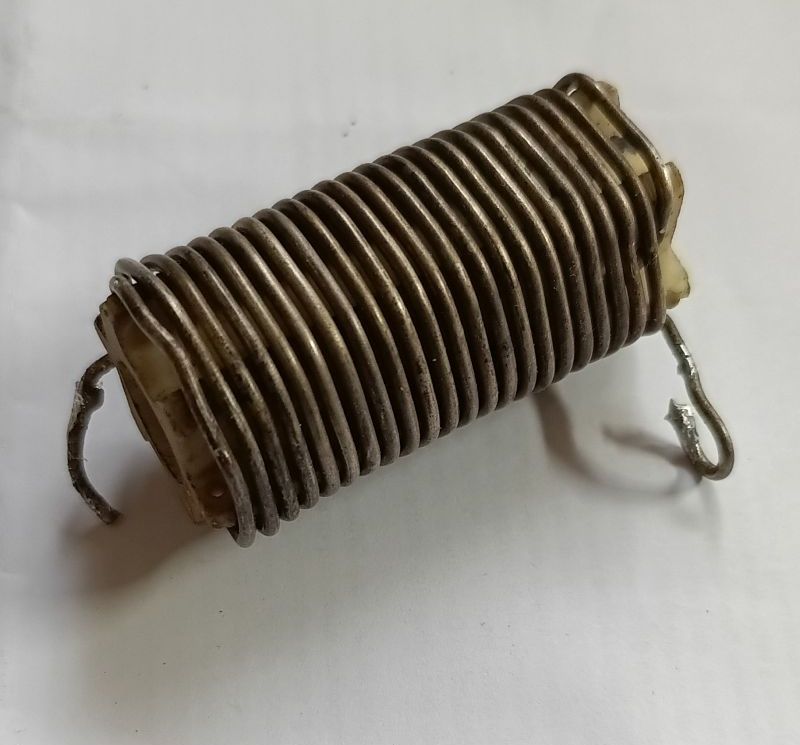
Typical coil from a military radio. Photo by Tadas (LY1CE)
But the myth lives on. In my opinion, its origin is in professional communications equipment, mainly military, from the tube era. At that time, silver-plated wires were indeed widely used, but this was only for high-frequency circuits and it was never intended to be used in acoustic circuits. It is true that in old equipment you can find silver-plated contacts in switches and relays, but there silver has a completely different role.
In the analogue communications era, short-term and long-term stability was an important parameter and depended heavily on the quality of the coils in the resonant circuits. This is where silver-plated wires were used extensively. The operating frequencies of these circuits usually exceeded 3 MHz. At such frequencies, the skin effect, which occurs in AC circuits and causes the current density near the surface of the conductor to be greater than inside the conductor, becomes very evident.
The thickness of the skin layer for non-magnetic metals is inversely proportional to the square root of the frequency and resistivity. For silver, it is approximately 65 µm at a frequency of 1 MHz. In practice, however, the thickness of the silver layer on such conductors is usually much less. This means that silvering the conductors is not intended to reduce their resistivity.
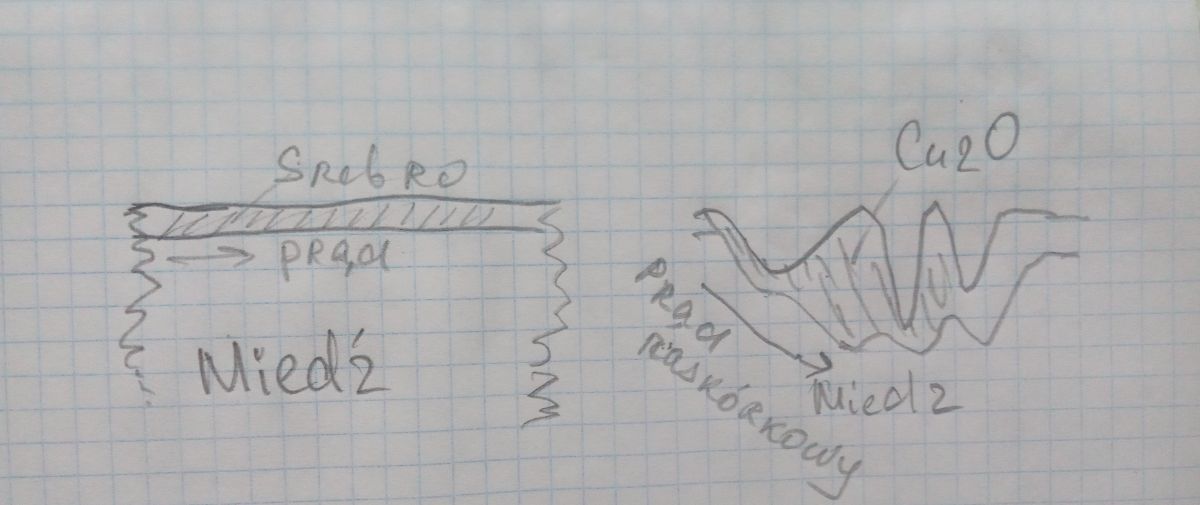
Anyone who has dealt with copper products knows how quickly copper oxidises and becomes covered in patina, requiring regular cleaning and polishing to maintain its shine. In electronic equipment, especially in resonant circuits, 'shine' refers to the quality of the epidermal layer. Copper oxides and their derivatives quickly reach a thickness of a few nanometres at room temperature, and moisture further accelerates this process.
After a few years, the oxide layer increases the resistivity of the epidermal layer - not because the oxides themselves have higher resistivity (in fact, copper oxides are dielectrics), but as a result of an increase in the effective path length of the current in this layer. Instead of flowing along as straight a path as possible, the current must bypass the irregularities created by the oxides. This leads not only to a reduction in the circuit's goodness, but also to a deterioration in resonance performance.
Silver and gold are not susceptible to oxidation, at least under terrestrial conditions. And it is precisely silver that is used as a protective agent for copper against oxidation. Admittedly, silver is also sometimes used as an epidermal current conductor on metals other than copper, or even on non-metals, but these cases are rather rare.
On the other hand, silver reacts with sulphur compounds present in the air, leading to the formation of a dark tarnish. However, this is very thin and does not significantly affect the properties of the conductors. In electronic equipment, this tarnish can be found especially in the immediate vicinity of insulators, which in former times were often made of rubber containing sulphur.
The conclusion is simple: silver plating of conductors in acoustic circuits makes no sense from the point of view of sound quality, because at acoustic frequencies the skin effect is negligible. Gold in such circuits even worsens the performance, as it has a resistivity about 30% higher than copper (2.44×10-⁸ Ω-m). This is of little significance in circuits with small currents, but in power circuits this difference already becomes significant.








Comments
Hello, a small correction: - silver and gold are oxidisable under terrestrial conditions, they just need "a lot of encouragement", but simplifying on their surface we do not have a typical oxide layer. -... [Read more]
In the Soviet Union, gold was used in military equipment for this reason. Military customers were not very familiar with electronics and physics, but gold-plated cables or contacts were impressive - "however... [Read more]
Hello, I see it more like this: "lovers of gold teeth" accept everything gold. The aforementioned group has always been greedy for gold. Greetings. [Read more]
Exactly, it is that state of mind of a certain group of people to whom no sound arguments appeal. [Read more]
To quote a classic: "golden, yet humble". And the marble speaker cable holders? They also enhance the listening experience :) [Read more]
To be precise, you only need to increase the cross-sectional area by that much, not the diameter. By increasing the diameter 6% you get a drop in resistance of over 11%, and to get 6% lower you only need... [Read more]
What is this? How dare you write such heresies! Our audio cables are different and worth every price! And, in fact, the idea of increasing the diameter of the copper wire is a good one and the smarter... [Read more]
Hello, I would add here a note of reason, if we are talking, for example, about a signal cable of, say, 1 m in length connecting a CD with an amplifier and it has a resistance of 0.012 ohms, does its... [Read more]
Wooo Lordee not the sort of thing you sometimes see on audio forums! Example ? A guest heard the difference in the sound of a set, CD + amplifier with DAC connected and here attention focus.... with a... [Read more]
There are some people who, if you gild the 230V plug of their shaver, immediately have smoother skin after shaving. And they FEEL it!!! :) I'm not saying there are no audiophiles, just listen to the... [Read more]
Rather well shielded cables. [Read more]
There are some audiophiles who didn't even realise at the "audioshoot" that one of the speakers was wired the other way round and played in counterphase XD Not to mention how, in a blind test, two CDs... [Read more]
Hello, And all things being equal, I think a distinction needs to be made between audiophiles and those pretending to be considered audiophiles. There is a group that hears a lot, despite appearances... [Read more]
Gold plating and silver plating, either all-over or selective(!), makes sense in HF circuits where skin elect and signal stability related to surface quality are very important. Specific gold plating... [Read more]
Silver plated contacts, a hard alloy, are used in the power industry to reduce arc resistance when switching on/off reflectors. Reducing the resistance results in a decrease in the power lost in the arc... [Read more]
Sory, but I won't believe it ! What effect does an optical cable have on a digital signal ? I'm talking about a section of 0.5m , what changes the individual bits ? This is absurd ! On such a distance,... [Read more]
For audio signal cables, it is sufficient to give an antenna coax for WIFI, for example. An irrefutable argument then arises. Since such a cable carries 5GHz, it will also carry audio frequencies. [Read more]
Antenna and other cables found in radio technology are matched long lines. This has nothing to do with the transmission of audio signals between anything. In the past, I think only microphones were connected... [Read more]
But after all, this does not interfere with the acoustic frequencies in any way. Such cables have minimised capacitance, a dielectric with excellent properties, very good screening, low resistance, especially... [Read more]