

logo elektroda
logo elektroda
X
logo elektroda

Where does the myth of silver-plated and gold-plated audio cables come from, does it make sense?

andreyatakum 1896 39

TL;DR

  • The piece examines the audiophile claim that silver-plated or gold-plated audio cables improve sound quality.
  • It traces the myth to professional and military high-frequency communications gear, where silver plating helped resonant circuits and oxidation resistance.
  • Copper's resistivity is 1.72×10-⁸ Ω-m, silver's is 1.59×10-⁸ Ω-m, only about 6% lower.
  • The conclusion is that silver plating in acoustic circuits makes no sense because skin effect is negligible at audio frequencies, while gold is worse.
  • Silver-plated conductors mattered in circuits above 3 MHz, where skin effect and copper oxidation could affect coil stability and resonance.
Generated by the language model.
ADVERTISEMENT
Treść została przetłumaczona polish » english Zobacz oryginalną wersję tematu
📢 Listen (AI):
  • There is an opinion among some lovers, or rather fanatics, of audio equipment that the wires in circuits should not be made of oxygen-free copper alone, but preferably of silver-plated copper. Some audiophiles go even further and even recommend gold-plated cables. Where did this opinion come from and to what extent is it correct? I am already explaining it to you.

    At first glance, the myth about silver's positive effect on sound is due to the fact that silver has lower resistivity than copper. This is true, but the difference between the resistivity of copper and silver is only about 6% (1.72×10-⁸ Ω-m for copper and 1.59×10-⁸ Ω-m for silver). From this it can be concluded that it would be cheaper to increase the diameter of the cables by 6% than to make them entirely of silver. On the other hand, silver plating of the conductors itself has a completely negligible effect in terms of reducing resistivity.
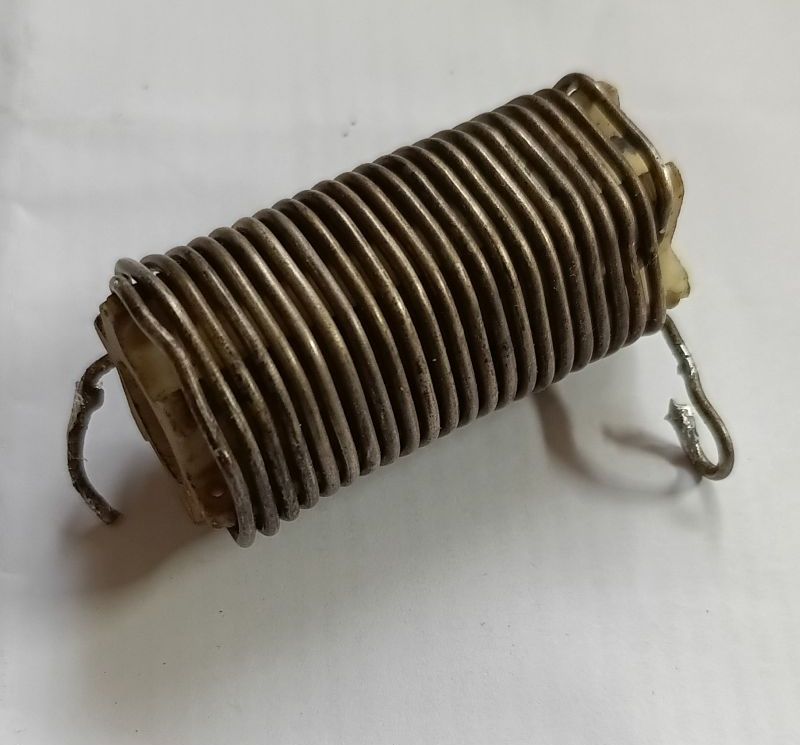
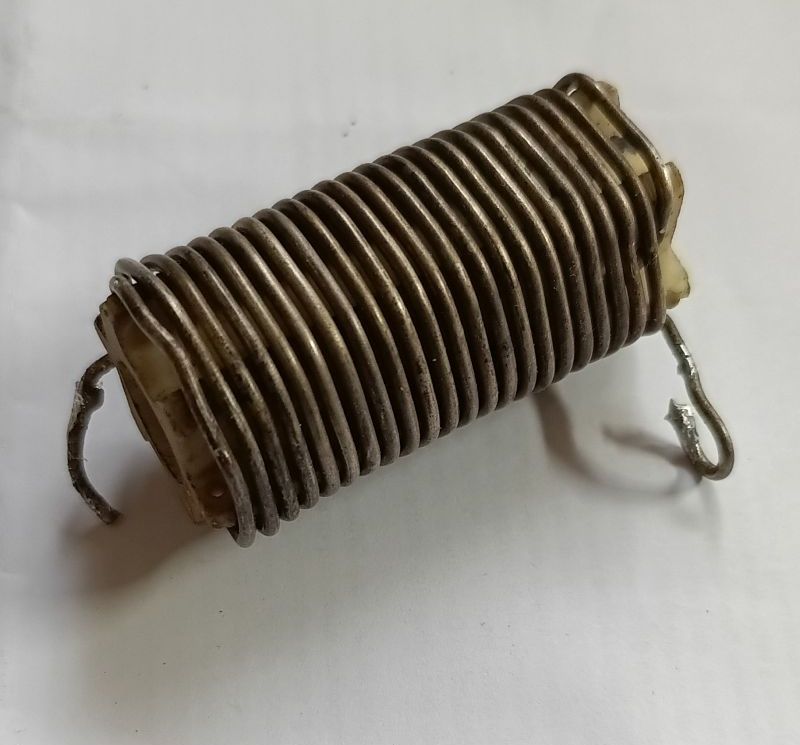
    Metal extension spring with hooks on both ends on a white background.

    Typical coil from a military radio. Photo by Tadas (LY1CE)


    But the myth lives on. In my opinion, its origin is in professional communications equipment, mainly military, from the tube era. At that time, silver-plated wires were indeed widely used, but this was only for high-frequency circuits and it was never intended to be used in acoustic circuits. It is true that in old equipment you can find silver-plated contacts in switches and relays, but there silver has a completely different role.
    In the analogue communications era, short-term and long-term stability was an important parameter and depended heavily on the quality of the coils in the resonant circuits. This is where silver-plated wires were used extensively. The operating frequencies of these circuits usually exceeded 3 MHz. At such frequencies, the skin effect, which occurs in AC circuits and causes the current density near the surface of the conductor to be greater than inside the conductor, becomes very evident.
    The thickness of the skin layer for non-magnetic metals is inversely proportional to the square root of the frequency and resistivity. For silver, it is approximately 65 µm at a frequency of 1 MHz. In practice, however, the thickness of the silver layer on such conductors is usually much less. This means that silvering the conductors is not intended to reduce their resistivity.

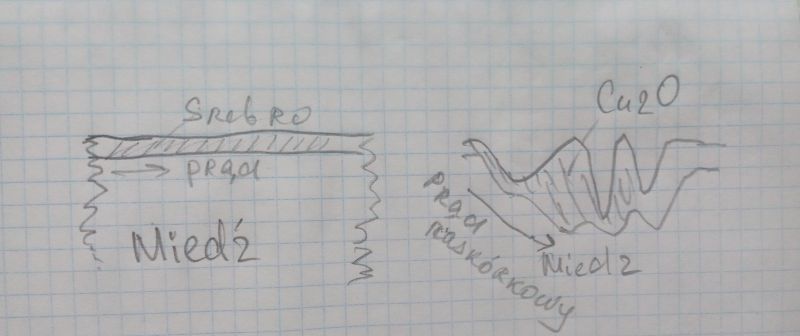
    Anyone who has dealt with copper products knows how quickly copper oxidises and becomes covered in patina, requiring regular cleaning and polishing to maintain its shine. In electronic equipment, especially in resonant circuits, 'shine' refers to the quality of the epidermal layer. Copper oxides and their derivatives quickly reach a thickness of a few nanometres at room temperature, and moisture further accelerates this process.
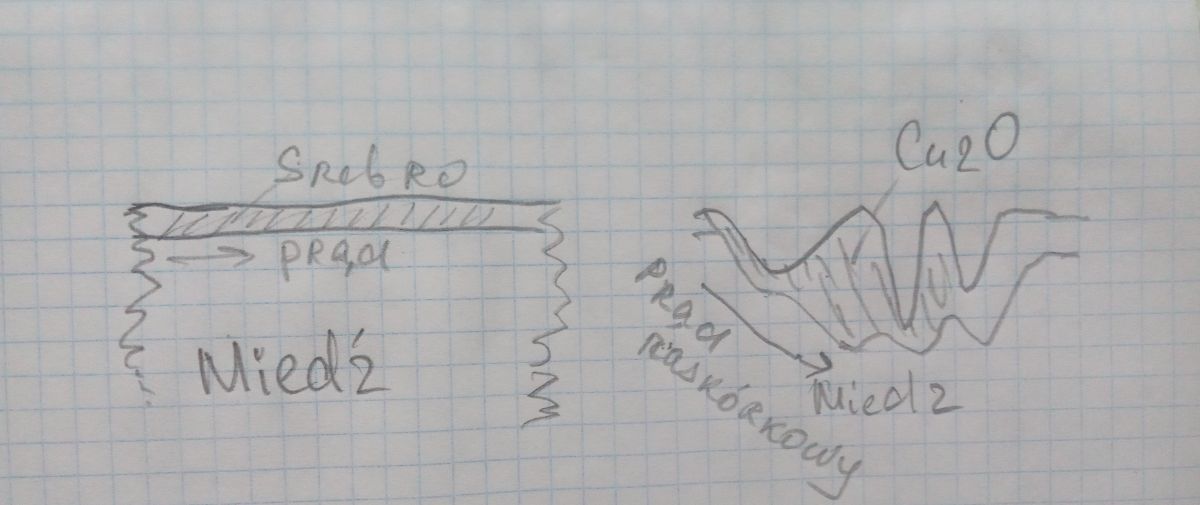
    After a few years, the oxide layer increases the resistivity of the epidermal layer - not because the oxides themselves have higher resistivity (in fact, copper oxides are dielectrics), but as a result of an increase in the effective path length of the current in this layer. Instead of flowing along as straight a path as possible, the current must bypass the irregularities created by the oxides. This leads not only to a reduction in the circuit's goodness, but also to a deterioration in resonance performance.
    Graph-paper sketch of silver and copper layers and Cu2O on copper, with handwritten notes about current.


    Silver and gold are not susceptible to oxidation, at least under terrestrial conditions. And it is precisely silver that is used as a protective agent for copper against oxidation. Admittedly, silver is also sometimes used as an epidermal current conductor on metals other than copper, or even on non-metals, but these cases are rather rare.
    On the other hand, silver reacts with sulphur compounds present in the air, leading to the formation of a dark tarnish. However, this is very thin and does not significantly affect the properties of the conductors. In electronic equipment, this tarnish can be found especially in the immediate vicinity of insulators, which in former times were often made of rubber containing sulphur.
    The conclusion is simple: silver plating of conductors in acoustic circuits makes no sense from the point of view of sound quality, because at acoustic frequencies the skin effect is negligible. Gold in such circuits even worsens the performance, as it has a resistivity about 30% higher than copper (2.44×10-⁸ Ω-m). This is of little significance in circuits with small currents, but in power circuits this difference already becomes significant.

    Cool? Ranking DIY

    About Author
    andreyatakum
    Level 15  
    Offline 
    andreyatakum wrote 749 posts with rating 1078. Live in city Antalya. Been with us since 2021 year.
  • ADVERTISEMENT
  • #2 21907270
    viayner
    Level 43  
    Posts: 10606
    Help: 1558
    Rate: 2029
    Hello,
    a small correction:
    - silver and gold are oxidisable under terrestrial conditions, they just need "a lot of encouragement", but simplifying on their surface we do not have a typical oxide layer.
    - silver sulphide has/can have a much thicker layer than copper oxides, sulphides easily reach single um when copper oxides are the order of 100 nm, red copper oxides (Cu20) cannot be seen around 100nm. Black copper oxides (CuO) are already thicknesses of the order of um, but they require a temperature incentive - observed, for example, when electrical arcs or short circuits occur.
    A colleague has not yet mentioned one aspect - gold cables just look nice, well, and visiting colleagues will "drop their jaws".
    Regards.
  • ADVERTISEMENT
  • #3 21907279
    andreyatakum
    Level 15  
    Posts: 749
    Rate: 1078
    viayner wrote:
    Mate has not yet mentioned one aspect - gold cables just look nice

    In the Soviet Union, gold was used in military equipment for this reason. Military customers were not very familiar with electronics and physics, but gold-plated cables or contacts were impressive - "however made of gold, tz works well" and they accepted the manufacturer's proposed equipment.
  • ADVERTISEMENT
  • #4 21907289
    viayner
    Level 43  
    Posts: 10606
    Help: 1558
    Rate: 2029
    Hello,
    I see it more like this: "lovers of gold teeth" accept everything gold.
    The aforementioned group has always been greedy for gold.
    Greetings.
  • #5 21907304
    lukepopek
    Level 5  
    Posts: 7
    Help: 1
    Rate: 2
    >>21907289 Exactly, it is that state of mind of a certain group of people to whom no sound arguments appeal.
  • ADVERTISEMENT
  • #6 21907313
    sq3evp
    Level 39  
    Posts: 6445
    Help: 212
    Rate: 849
    viayner wrote:
    Hello,
    I see it more like this: "lovers of gold teeth" accept everything gold.
    The aforementioned group has always been greedy for gold.
    Greetings.

    To quote a classic: "golden, yet humble".
    And the marble speaker cable holders? They also enhance the listening experience :)
  • #7 21907325
    acctr
    Level 39  
    Posts: 4547
    Help: 389
    Rate: 2013
    andreyatakum wrote:
    From this it can be concluded that it would be cheaper to increase the diameter of the conductors by 6% than to make them entirely of silver.

    To be precise, you only need to increase the cross-sectional area by that much, not the diameter.
    By increasing the diameter 6% you get a drop in resistance of over 11%, and to get 6% lower you only need to increase the diameter by about 3.1%.
    Helpful post? Buy me a coffee.
  • #8 21907383
    gulson
    System Administrator
    Posts: 29312
    Help: 148
    Rate: 6016
    andreyatakum wrote:
    The conclusion is simple: silvering conductors in acoustic circuits makes no sense at all from the point of view of sound quality, because at acoustic frequencies the skin effect is negligible. Gold in such circuits even worsens the performance, as it has a resistivity about 30% higher than copper (2.44×10-⁸ Ω-m).

    What is this? How dare you write such heresies! Our audio cables are different and worth every price!

    And, in fact, the idea of increasing the diameter of the copper wire is a good one and the smarter ones have never spared on the diameter of audio cables.
  • #9 21907416
    viayner
    Level 43  
    Posts: 10606
    Help: 1558
    Rate: 2029
    Hello,
    gulson wrote:
    ...And in fact, the idea of increasing the diameter of the copper cable is a good one and what wiser people have never spared on the diameter of audio cables.

    I would add here a note of reason, if we are talking, for example, about a signal cable of, say, 1 m in length connecting a CD with an amplifier and it has a resistance of 0.012 ohms, does its replacement with an audiophile, thick one with a resistance of 0.009 ohms have any justification in relation to this resistance? (Values taken from 'air', to flag up the problem).
    Regards.
  • #10 21907631
    rosomak19
    Level 23  
    Posts: 1062
    Help: 2
    Rate: 382
    viayner wrote:
    I would add a note of reason here, if we are talking, for example, about a signal cable of, say, 1 m in length connecting a CD with an amplifier and it has a resistance of 0.012 ohms, does its replacement with an audiophile, thick cable with a resistance of 0.009 ohms have any justification in relation to this resistance? (values taken from "air", to signal a problem).

    Wooo Lordee not the sort of thing you sometimes see on audio forums! Example ? A guest heard the difference in the sound of a set, CD + amplifier with DAC connected and here attention focus.... with a 0.5m long fibre optic cable. Such guys should already be employed in a car factory in the press department, instead of specialised microphone systems detecting that a given press is about to break down.
    As far as the subject is concerned, I personally see the point of using some kind of material with better conductivity only where there are weak signals. As far as audio is concerned, this could be the turntable, or more precisely the cabling of the tonearm and the cable connecting the preamplifier to the turntable.
  • #11 21907710
    Bazyl
    Level 16  
    Posts: 426
    Help: 14
    Rate: 43
    There are some people who, if you gild the 230V plug of their shaver, immediately have smoother skin after shaving. And they FEEL it!!! :)
    I'm not saying there are no audiophiles, just listen to the "0dB" series videos on YT, but 0.5% of the population is endowed with this gift. The rest are poseur lansiars and buffoons.
  • #12 21907751
    kulmar
    Level 33  
    Posts: 1901
    Help: 184
    Rate: 371
    rosomak19 wrote:
    With regard to the subject, personally, I can see the point of using, some material with better conductivity, only where there are weak signals.

    Rather well shielded cables.
  • #13 21907756
    rosomak19
    Level 23  
    Posts: 1062
    Help: 2
    Rate: 382
    There are some audiophiles who didn't even realise at the "audioshoot" that one of the speakers was wired the other way round and played in counterphase XD Not to mention how, in a blind test, two CDs were played, one home-made and the other a foreign, top-of-the-range one. Well, the audiophiles found that the former played better. How surprised they were.
  • #14 21907921
    viayner
    Level 43  
    Posts: 10606
    Help: 1558
    Rate: 2029
    Hello,
    rosomak19 wrote:
    There are some audiophiles, that even on the "audioszoł" did not realize, that one of the speakers, is inversely connected and plays in counter-phase XD Not to mention, that in a blind test, two CDs played, one of domestic production, and the other one foreign, a sophisticated one. Well, the audiophiles found that the former played better. What was their surprise.

    And all things being equal, I think a distinction needs to be made between audiophiles and those pretending to be considered audiophiles.
    There is a group that hears a lot, despite appearances it is possible to hear such subtle differences as connecting a CD to an amplifier via an audio cable or optically, but here comes the subjective choice of what is better for us and the fact that a "weak" CD sounded better confirms this. "Splendid" equipment is sometimes "overkill", and simple designs really can sound good. Those who were surprised by the better sound, or perhaps rather the 'wrong' choice of CD, are more a group pretentious or fearful of their choice as it will be judged.
    Personally, I believe that equipment is supposed to sound in a way that suits the particular listener, and whether it is of the lower or upper end of quality/price is, for me, of marginal importance.
    As for "shoals", I don't like them, everything is overclocked and in the noise you can't really distinguish much.
    Regards.
  • #15 21908158
    elukam
    Level 18  
    Posts: 400
    Help: 8
    Rate: 177
    Gold plating and silver plating, either all-over or selective(!), makes sense in HF circuits where skin elect and signal stability related to surface quality are very important.
    Specific gold plating was used in professional equipment for the need to preserve their longevity at a time when electronics were expensive.
    Selective gold plating is still used in high-quality professional equipment where there is no room for trouble caused by the loss of a contact.
    In consumer electronics, technical coatings that provide relative protection against corrosion and give a visual effect are completely sufficient and only make sense. In audio it will be better to cover the contact with tin rather than effectually with gold <1um, because it is more durable and gives better contact.
    Signal deterioration on audio signal cables, if it occurs at all, is only due to the capacitance of the cable, as matched cables are not used in audio.
    On loudspeaker (long) cables, the cross-section is too small. If the resistance of the cable to the loudspeaker is 5% or less of the impedance of the loudspeaker, this is quite enough and no one will hear anything. It is only this resistance that counts, the connection can be and rusty steel wire.
  • #16 21908196
    sq3evp
    Level 39  
    Posts: 6445
    Help: 212
    Rate: 849
    elukam wrote:

    Selective gold plating of contacts is still used in high quality professional equipment where there is no room for trouble due to loss of some contact.

    Silver plated contacts, a hard alloy, are used in the power industry to reduce arc resistance when switching on/off reflectors. Reducing the resistance results in a decrease in the power lost in the arc and easier cooling and therefore smaller quench chambers. In addition, using gas for insulation reduces the size.

    Skin effect in audio waveforms is a very minor phenomenon. More important is shielding and symmetry to avoid interference.
    Silver plating and gold plating can be used, and can do no harm, but this is probably more to avoid oxidation of the contacts.
  • #17 21908275
    rosomak19
    Level 23  
    Posts: 1062
    Help: 2
    Rate: 382
    viayner wrote:
    There is a group that hears really a lot, against all appearances it is possible to hear such subtle differences as connecting a CD to an amplifier via audio cable or optically

    Sory, but I won't believe it ! What effect does an optical cable have on a digital signal ? I'm talking about a section of 0.5m , what changes the individual bits ? This is absurd ! On such a distance, even with a fishing line you can connect the optical inputs of both devices and it will work perfectly.
  • #18 21908338
    Macosmail
    Level 35  
    Posts: 2847
    Help: 227
    Rate: 856
    For audio signal cables, it is sufficient to give an antenna coax for WIFI, for example. An irrefutable argument then arises. Since such a cable carries 5GHz, it will also carry audio frequencies.
  • #19 21908444
    elukam
    Level 18  
    Posts: 400
    Help: 8
    Rate: 177
    Antenna and other cables found in radio technology are matched long lines. This has nothing to do with the transmission of audio signals between anything. In the past, I think only microphones were connected by matched long length symmetrical cable (stage microphones).
  • #20 21908585
    Macosmail
    Level 35  
    Posts: 2847
    Help: 227
    Rate: 856
    But after all, this does not interfere with the acoustic frequencies in any way. Such cables have minimised capacitance, a dielectric with excellent properties, very good screening, low resistance, especially immunity to skin effect, but resistance is of little importance anyway because the input impedance of typical audio inputs is 10-47kOhm. This is a typical voltage match. Likewise for an oscilloscope probe. The waveguide impedance of a typical probe cable is 50-200Ohmm and the input impedance of an oscilloscope is, after all, 1MOhm.
    Such an example. An RF cable from a satellite LNB to a tuner carries a signal that contains SOME hundreds of HD TV channels, many of them with multi-channel high quality audio.
    Yes it is digital modulation, but it is based on subtle differences in PHASE which is what audiophiles and manufacturers try to explain the 'difference' in sound.
    There is no reason to question the suitability of such a cable for acoustic signals.
    That is why there is and will be no better audio cable than a 10zl/m aerial cable.
    And all audiophile "interconnects" for thousands of zloty are nothing but a cash grab.
  • #21 21908665
    elukam
    Level 18  
    Posts: 400
    Help: 8
    Rate: 177
    In RF cables, it is the loss and not the capacitance that is minimised. Wires for gigahertz can have a very small diameter and therefore a relatively large unit capacitance.
    Oscilloscope probes for 1M inputs are matched using the RC divider principle and this method is only suitable up to around 500MHz (with very high quality dedicated probes and short cables) and above that either passive or active probes are used, but impedance matched to 50 ohm inputs.
    In general you are starting to create another ideology along the lines of audiophile :) Just watch as audiophiles start switching to F or SMA connectors :)
  • #22 21908724
    sq3evp
    Level 39  
    Posts: 6445
    Help: 212
    Rate: 849
    The normal cable for cinch, otherwise known as RCA is 50Ω for audio and video.
  • #23 21908780
    acctr
    Level 39  
    Posts: 4547
    Help: 389
    Rate: 2013
    sq3evp wrote:
    A normal cinch cable, otherwise known as RCA is 50Ω for audio and video.

    Rather not, for audio the characteristic impedance of the cable (as a transmission line) has virtually no meaning, for composite video there are cables with an impedance of 75 Ω.
    Helpful post? Buy me a coffee.
  • #24 21908848
    Macosmail
    Level 35  
    Posts: 2847
    Help: 227
    Rate: 856
    elukam wrote:
    In RF cables, loss is minimised, not capacitance. Wires for gigahertz can have a very small diameter and therefore a relatively large unit capacitance.
    Oscilloscope probes for 1M inputs are matched using the RC divider principle and this method is suitable in snatches up to about 500MHz (with very high quality dedicated probes and short cables) and above that either passive or active probes are used but impedance matched to 50 ohm inputs.
    In general you are starting to create another ideology along the lines of audiophile :) Just watch as audiophiles start switching to F or SMA connectors :)


    Assuming a typical audio output has an output impedance of 150Ohm on average and assuming a large cable capacitance of 50pF per metre of length then the cut-off frequency (-3dB) comes out to 22MHz. Well, I guess that's enough for the audio bandwidth? ;-)
    And just so. Why don't audiophiles, instead of investing in an interconnect for several thousand dollars, simply rebuild the audio output of their equipment so that its impedance drops to a few Ohms. After all, this is orders of magnitude more important for the "driving" of a cable than changing a cable between one for 20PLN and the most expensive one in existence.
    They do not have to go to HF connectors, but they do have to go to good coax, if it has the right diameter and is flexible enough. And NOTHING else is needed. No one in a truly blind test will hear the difference.
  • #25 21908849
    sq3evp
    Level 39  
    Posts: 6445
    Help: 212
    Rate: 849
    For video is also sufficient.
  • #26 21908868
    elukam
    Level 18  
    Posts: 400
    Help: 8
    Rate: 177
    Macosmail wrote:
    Assuming that a typical audio output has an output impedance of 150Ohm on average and assuming a large cable capacitance of 50pF per metre of length then the cut-off frequency (-3dB) comes out to 22MHz. Well, I guess that's enough for the audio bandwidth? ;-)
    Rather, the standard output impedance will be 10x higher and the capacitance of a 50 ohm rf cable is ~100pF/m. Plus the output capacitance and input capacitance, not negligible. But all together it still gives a pole ~1.5 orders above hifi. So you've answered for yourself, what sense does it make to use a grazed HF cable with connections counted in centimetres.
    Quote:
    Why audiophiles, instead of investing in an interconnect for a few thousand, don't simply rebuild the audio output of their equipment to get its impedance down to a few Ohms. After all, this is orders of magnitude more important for the "driving" of a cable than changing a cable between one for 20PLN and the most expensive one in existence.
    They do not have to go to HF connectors, but they do have to go to good coax, if it has the right diameter and is flexible enough. And NOTHING else is needed. No one in a truly blind test will hear a difference.
    No one will hear anything, even if they were to connect with a mains cable from an iron. It's foam-beating, with these cables. It takes real effort to mess up something real in audio with a signal cable between components. The problems, if there are any, lie quite elsewhere.
  • #27 21910399
    pikarel
    Level 39  
    Posts: 4982
    Help: 409
    Rate: 1826
    You write about cables connecting audio equipment, so I will describe my experience with a case from 44 years ago :)

    I will describe the situation; The tape input/output on the Amateur Stereo has a 220kΩ resistor in series with the output pin of the socket.
    The M531S, on the other hand, has a strangely solved recording eavesdropping; what is fed to the recording head after the recording amplifier is also fed - after a filter on 4 elements - to the audio path, so we hear what will be recorded.
    So what: in listening to the M531S there was a lack of treble, which also resulted in a lack of treble in the recorded material.
    The capacitance of the DIN-DIN connection cable was so great that it limited the bandwidth of the recording from above, when connecting the Amateur Stereo to the M531S cassette recorder.
    What did I do? I removed the 220kΩ resistors, soldered 10kΩ in their place - and "scythe all the way".

    I wonder how much capacitance that 2m long wire had that it made an effective low-pass filter, or as my late colleague used to say - a high-pass filter :)
    Anyone fancy a count?
  • #28 21910437
    Janusz_kk
    Level 39  
    Posts: 5734
    Help: 218
    Rate: 1439
    pikarel wrote:
    Anybody feel like counting?

    Nah count it, that's what the formula sheet is for :) I fired it up gave it 1nF and 220k and it came out 723 hz -3db.
  • #29 21910573
    TechEkspert
    Editor
    Posts: 7128
    Help: 16
    Rate: 5501
    Interesting case! You have touched on a case where, with faulty device design, audio connection cables can really make a difference and affect the sound.
  • #30 21910641
    Macosmail
    Level 35  
    Posts: 2847
    Help: 227
    Rate: 856
    220k is a big overkill. I've had a cursory look at this schematic and there are indeed such resistors, but it's probably more of an input than an output.
    Maybe they need to start selling audiophiles special cable drivers ;-)
    Since they have demagnetisers for CDs and vinyl this too will sell.
📢 Listen (AI):
ADVERTISEMENT