





Pulsar – a retro sound card with an MP3 decoder and up to 16MB of DRAM
TL;DR 
- Pulsar is a retro Sound Blaster clone built to add hardware MP3 playback for 386/486-era PCs, with up to 16 MB of DRAM.
- An AT89S8253 replaces the 8051 and manages SPI communication with the VS1063 plus ISA bus control and DREQ/SS/DSS lines.
- A 673104ANL DRAM controller addresses up to 16 MB, generating addresses from a 4-bit BCD code through three 74LS138 decoders.
- The board also adds OPL3 YMF262 synthesis, two YAC512 DACs, digital potentiometers, microphone inputs, relay switching, and an op-amp mixer.
- It deliberately omits Game Blaster support and the Game Port, though J6 leaves room for a Game Port daughterboard.
AI summary based on the discussion. May contain errors.
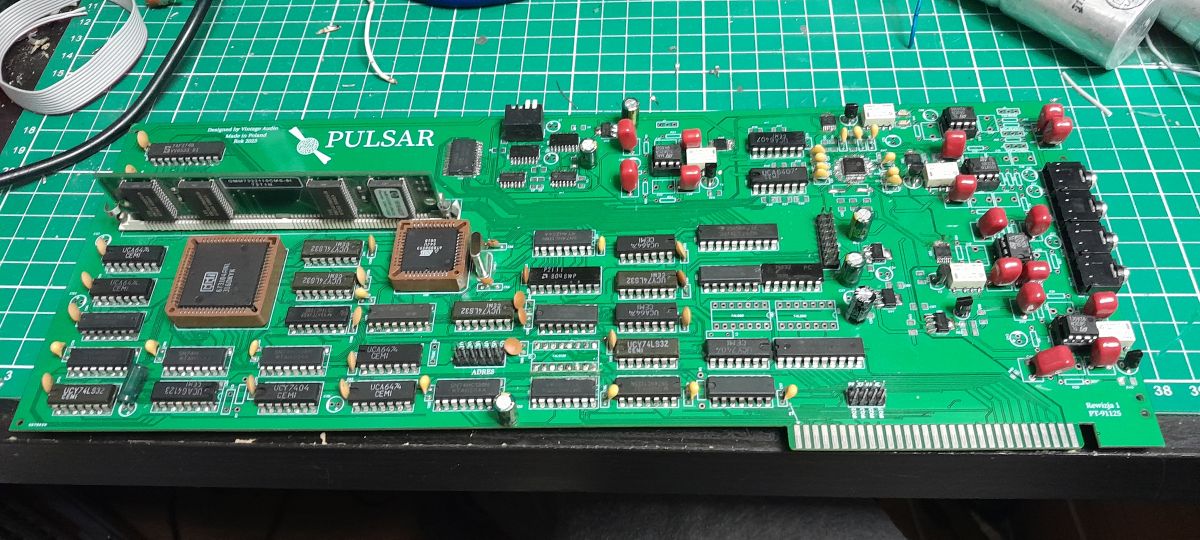
I think it’s high time to present the design for the Pulsar sound card – a Sound Blaster clone enhanced with:
- The replacement of the 8051 with the AT89S8253; in terms of instructions, it is still an 8051, but it features an added hardware SPI controller, which is crucial for communication with the VS1063. The microcontroller converts parallel data to serial data, reads and sets flags for the ISA bus control logic, reads states from the DREQ line, and sets states on the SS and DSS lines – in short, it handles full SPI communication with the VS1063.
-Hardware MP3 decoder based on the VS1063 chip – this is a 32-bit chip communicating via SPI. The chip also provides balance control, bass and treble adjustment, a 6-band graphic equaliser, EQ presets (including Country, Rock, Disco, electronic music, etc.) and a master volume control. This chip was also used in the Prisma MP3 card for the Amiga – hence the inspiration.
- A hardware DRAM memory controller based on the 673104ANL chip – the 673104 is capable of addressing up to 16 MB of memory – addresses are generated from a 4-bit BCD code via three 74LS138 decoders. The controller works in conjunction with the Arbitrator and anti-hazard circuits, which prevent situations where, for example, the ISA bus is simultaneously writing data to the card and reading data from it. This is where the DRAM buffer comes into play: if the ISA is busy at any given moment and the uC wishes, for example, to write data to the ISA, it will be able to write the data to DRAM. Once the ISA is freed up, the data can be read from DRAM.
- SRAM for the 89S8253 on the 2111 chip – used to store constants and variables utilised by the uC. It acts as an extension of the uC’s internal memory.
- Digital potentiometers – these allow the volume of individual inputs to be adjusted and the signals to be mixed.
- An OPL 3 YMF262 FM synthesiser has been added, along with two YAC512 DACs with a resolution of 20 bits per channel – 2x10 bits for the left channel and 2x10 bits for the right channel
- Support for dynamic, electret and condenser microphones.
- Input switching and muting via relays.
- Option to connect a MIDI interface by disconnecting the OPL3 synthesiser.
- Mixer based on an operational amplifier.
There are therefore quite a few changes compared to the original SB 1.0.
The assumption was that, since computers with 386 and 486 processors, and even more so those with 286, 186 and 8086/8088 processors, could not cope with software-based MP3 decoding due to their low processing power, an ISA sound card with a hardware decoder/encoder was required.
The choice of Sound Blaster 1.0 and 1.5 was no accident – the topology of the SB 1.0 and SB 1.5 had been thoroughly documented online, including a dump of the DSP1321 (8051) contents. An 8-bit ISA card was deliberately chosen to ensure the card was also compatible with the PC XT. I deliberately opted out of Game Blaster support – firstly, because few games supported Game Blaster, and secondly, because the prices of Philips SAA1099 chips ran into the hundreds, or even thousands, of zlotys per unit. I omitted the Game Port due to a lack of space – all the control signals for the Game Port electronics and the power supply are routed to connector J6. This allows for the addition of a Game Port daughterboard.
The project is still in progress. However, it’s already making quite an impression.
Comments
That really is impressive! Sound cards, apart from those connected via the gameport, sometimes had an IDE controller. Later SoundBlaster models featured expandable memory, which I believe was related to... [Read more]
The current draw must be enormous with so many standard TTL circuits... I had a few of those; CD drives (sometimes dedicated ones) worked on that port, but floppy drives didn’t really. It wasn’t... [Read more]
The card is similar in size to those on the VESA Local Bus. Incidentally, the ISA standard hung on for a long time; later motherboards retained a single ISA slot at the bottom of the board. On the ISA... [Read more]
Found on YouTube: COVOX – a free sound card [FASHION ITEMS 322] [Read more]
From the standard TTL series we have: UCA6474 – 5 pcs, 7404 – 2 pcs, UCA6407 – 2 pcs and UCA64123 – 1 pc. A total of 10 pcs. The rest are: 74HC08 – 4 pcs, 74HCT08 – 1 pc, 74LS32 – 6 pcs, 74F32 – 1 pc,... [Read more]
Could the card be 16-bit and switch to 8-bit ISA when it encounters such an interface? 8-bit cards worked in 16-bit slots. I didn’t expect there to be such an active DIY community around ISA sound cards. https://github.com/schlae/snark-barker https://www.vogons.org/viewtopic.php?t=94701 https://github.com/labs-lv/blasterboard https://www.alexandrugroza.ro/microelectronics/system-design/isa-audio-interface/index.html https://picogus.com/ https://github.com/skiselev/isa-opl2 There’s... [Read more]
I think it could be done – it’s just a matter of adding a third 74245 plus a circuit to switch between the lower and higher bits, something like the IHB in the 8086 It’s all down to the rising prices... [Read more]
It’s a shame you didn’t ‘show off’ earlier; a couple of weeks ago I took two early-generation Gravis cards and an AWE32 to the recycling centre. I’d have given them away for free, just so they didn’t end... [Read more]
DIY graphics cards with ISA slots and VGA output are also available, for example the Graphics Gremlin: https://github.com/schlae/graphics-gremlin and even an HDMI version with an ISA slot: https://yeokhengmeng.com/2023/09/hdmi-isa-graphics-card-for-vintage-pcs/ https://github.com/yeokm1/graphics-gremlin-hdmi There... [Read more]
In the early nineties, I worked for a company that bought computer hardware and resold it at a profit; nowadays, that’s called a distributor, or something like that. The main supplier was a Taiwanese... [Read more]
Beautiful retro electronics – it’s enough to make you blush just looking at it 😁 A couple of weeks ago, I was having a clear-out in my junk room and found some similar treasures – perhaps not quite as... [Read more]
It’s probably unnecessary these days. But I remember when I ‘switched’ from my last SB ISA sound card – I think it was an AWE64 – to a newer PCI one; I was very disappointed with the sound quality of... [Read more]
Unnecessary? Absolutely not – it’s very much needed :D . All the more so if someone’s building a retro PC on a vintage motherboard. [Read more]
On 486 motherboards, disk controllers were usually already built-in. In older computers, the motherboard only had a keyboard socket (large DIN). All other interfaces were on expansion cards. A standard... [Read more]
After all, there used to be Multi I/O cards: IDE (PATA), LPT, RS232 (COM). I even had one with a joystick port. [Read more]
Of course it works, but you need to reduce the bitrate to 64 kbit/s – Adam Śmiałek adapted this for the Towary Modne on a DX2 25 MHz, whilst a bitrate of 256 or 320 kbps whereas 64 kbps is telephone-call... [Read more]
@bsw and @arturavs – Are you reciting this from memory, or do you have any cheat sheets? :D I still remember the PC386 era, but to have all those details stuck in your head? – respect. And as for building... [Read more]
On my 486, 128 kbps files still play without any problems – and that used to be the standard output bitrate... (acceptable quality and file size) :-) Adam Śmiałek is forcing himself to use Windows, whilst... [Read more]
@efi222 from memory: :D . Just as @bsw says. If anyone needs them, I’ve got a few 486DX4s from various manufacturers. [Read more]