
logo elektroda
logo elektroda
X
logo elektroda

[Solved] Long-term Load Capacity of Cu 4mm2 Cable: Comparing Wire & Rope Current Resistance

kpaweł 98811 12
Best answers LABEL_AI_GENERATED

How much more long-term current can a 4 mm² copper stranded cable carry than a solid wire, and what percentage difference is there?

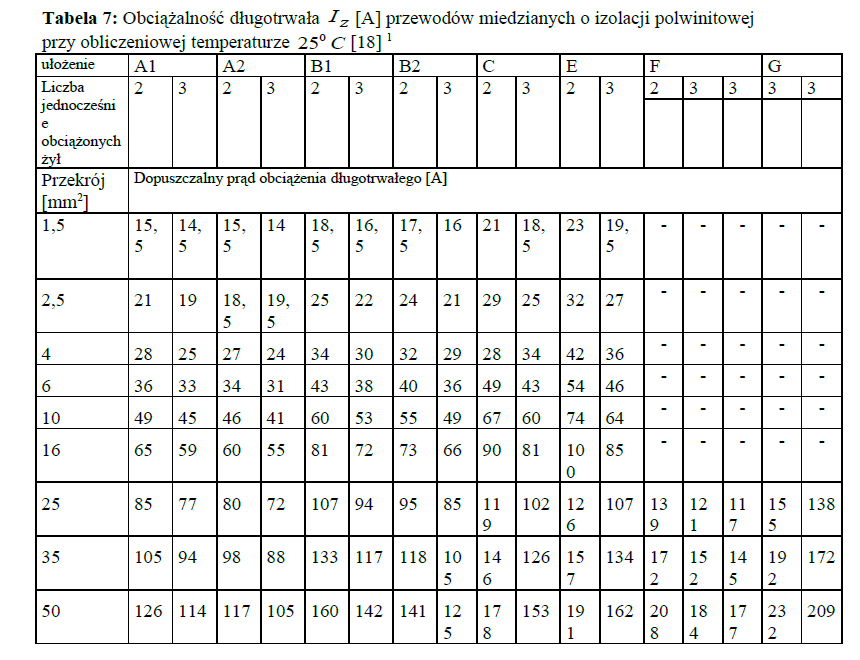
A 4 mm² copper cable does not carry more long-term current just because it is stranded; the permissible current depends mainly on the cooling and installation conditions, not on whether the conductor is rope or wire [#10265761] For a 4 mm², 2-core cable, one cited table gives about 34 A, while another example for a 5×4 mm² cable laid in a pipe on a wall gives 29 A [#10265680][#10265835] The referenced source points to Table 7 on page 10, with page 9 showing the routing conditions used for that table [#10266397] So there is no fixed percentage advantage for “rope” over “wire”; the current rating is determined by how the cable is installed and cooled [#10265761]
AI summary based on the discussion. May contain errors.
ADVERTISEMENT
Treść została przetłumaczona polish » english Zobacz oryginalną wersję tematu
  • #1 10265663
    kpaweł
    Level 20  
    Posts: 728
    Help: 4
    Rate: 89
    Hello - I am looking for information on the above-mentioned topic. There are data for the wire everywhere, and I can't find the link. Does anyone have any data. The rope can withstand a greater current than the wire. How much is this percentage?
  • ADVERTISEMENT
  • #2 10265680
    dar1231
    Level 12  
    Posts: 35
    Rate: 6
    Please refer to the table of long-term load capacity of cables. There are various studies in this regard. The results do not differ much. From what I remember, the long-term load capacity of a 4m2 2-core cable is 34A. It should be remembered that the load capacity for cables laid in the wall is different than for cables laid loose or in trays.
  • #3 10265761
    retrofood
    VIP Meritorious for electroda.pl
    Posts: 31317
    Help: 1140
    Rate: 4797
    The long-term load capacity does not depend on the rope or wire, but on the cooling conditions. That is, everything that surrounds the cable.
  • #4 10265835
    kpaweł
    Level 20  
    Posts: 728
    Help: 4
    Rate: 89
    5x4mm2 cable - strand, laid in a pipe on the wall. Ambient temperature from 15 to 30 degrees in summer. There are 29 A in the table.
  • ADVERTISEMENT
  • #5 10265851
    jarecki 86
    Electrician specialist
    Posts: 1203
    Help: 127
    Rate: 294
    kpaweł wrote:
    The rope can withstand a greater current than the wire.

    Could you please provide a source for this information?
  • #6 10266015
    kpaweł
    Level 20  
    Posts: 728
    Help: 4
    Rate: 89
    I do not know why you highlighted it: "The cable withstands more current than the wire" - because it is exactly the truth. The source is:
    Attachments:
    • 1.pdf (1.07 MB) You must be logged in to download this attachment.
  • #7 10266191
    slawo12311
    Level 19  
    Posts: 274
    Help: 35
    Rate: 87
    The given pdf is quite extensive, please indicate the pages where it is described.
  • #8 10266397
    kpaweł
    Level 20  
    Posts: 728
    Help: 4
    Rate: 89
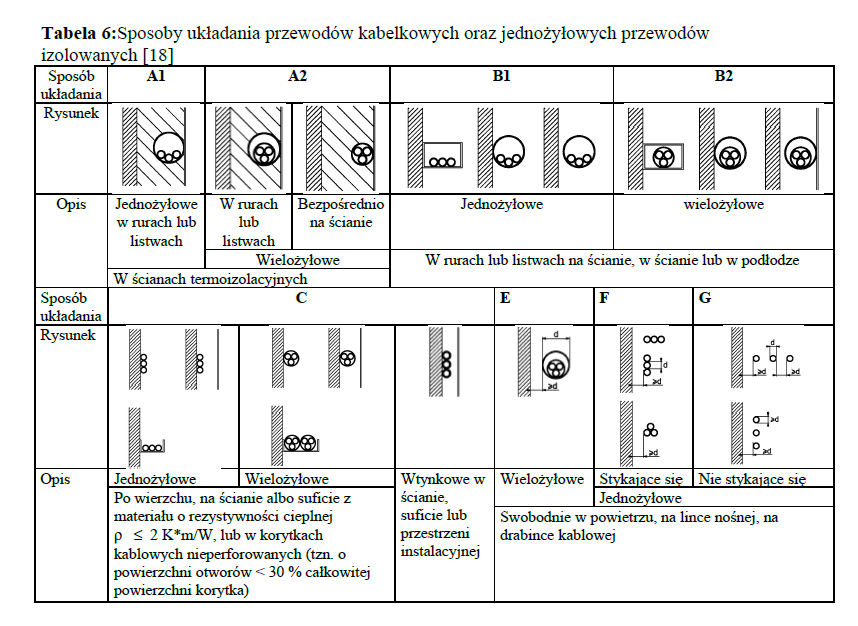
    Table No. 7; page 10. And page 9 is the cable routing for this table.
  • ADVERTISEMENT
  • #9 10266432
    michalekk1
    Level 24  
    Posts: 758
    Help: 54
    Rate: 105
    For everyone who doesn't download PDF:
    Table 6:
    Long-term Load Capacity of Cu 4mm2 Cable: Comparing Wire & Rope Current Resistance

    Table 7:
    Long-term Load Capacity of Cu 4mm2 Cable: Comparing Wire & Rope Current Resistance

    As for me, there is nothing about a string and a wire, but I don't know, maybe I'm not looking at it?
  • #10 10266442
    slawo12311
    Level 19  
    Posts: 274
    Help: 35
    Rate: 87
    I also did not find information about the structure of the conductors.
  • #11 10266473
    Miniax
    Electrician specialist
    Posts: 1438
    Help: 173
    Rate: 290
    Maybe your colleague has mistaken the term multicore with multiwire?
  • ADVERTISEMENT
  • #12 10266860
    jarecki 86
    Electrician specialist
    Posts: 1203
    Help: 127
    Rate: 294
    kpaweł wrote:
    I do not know why you highlighted it: "The cable withstands more current than the wire" - because it is exactly the truth.
    There are three truths: dirty truth, yes, and shit.
    Here we are dealing with the last case.
  • #13 19354714
    TR
    Level 12  
    Posts: 31
    Rate: 8
    I came across this table, but there is a bug in it. For the type C column, the load capacity of 2.5mm2 for 2 wires is greater than for 4mm2 (29A and 28A).

Topic summary

LABEL_AI_GENERATED
The discussion centers on the long-term load capacity of a 4mm² copper cable, comparing its current resistance to that of a rope. Participants note that the load capacity for a 4mm² 2-core cable is approximately 34A, with variations depending on installation conditions, such as whether the cable is laid in a wall or loose. It is emphasized that the load capacity is influenced more by cooling conditions than by the type of conductor (wire vs. rope). A specific example mentions a 5x4mm² cable laid in a pipe on a wall, with a load capacity of 29A at ambient temperatures between 15 to 30 degrees Celsius. References to tables and PDFs containing relevant data are provided, although some participants express difficulty in finding specific information regarding the comparison between wire and rope conductors.
AI summary based on the discussion. May contain errors.
ADVERTISEMENT

