logo elektroda
logo elektroda
X
logo elektroda

What soldering iron to start your adventure with electronics up to PLN 80?

Misiex11 15339 40
Best answers

What soldering iron should a beginner buy for basic electronics with a budget of up to PLN 80?

For a beginner with a PLN 80 budget, the most practical choice is a cheap 937D soldering station or one of its clones from Allegro; users reported that even a used unit for about PLN 50 works well for both SMD and THT [#15201685] A station with interchangeable tips is preferred, and a “hoof” / mini-wave tip was recommended over a plain conical tip [#15199279][#15201657] If you want something more durable instead of a very cheap no-name station, the thread also recommends a Polish Lutola / ZDZ / Extralut-type transformer iron, because some very cheap pseudo-stations were described as unreliable [#15199361][#15203617] For general hobby use, a power range of about 50–80 W was suggested as sensible [#15199185]
Generated by the language model.
ADVERTISEMENT
Treść została przetłumaczona polish » english Zobacz oryginalną wersję tematu
  • #31 15203038
    tplewa
    Level 39  
    Posts: 6727
    Help: 222
    Rate: 991
    cooltygrysek wrote:
    Only via the ESD PROTECT module.


    Specifically, it is through the 1M? resistors - what would you not do if a man touches something and is connected to PE :)

    Misiex11 wrote:
    Generally, I have the opportunity to buy this soldering iron from the station. But I don't know what temperature to set etc.


    Read what in the attachment - it should be helpful ...
    Attachments:
    • edw_2003_09_s24.pdf (396.78 KB) You must be logged in to download this attachment.
  • ADVERTISEMENT
  • #32 15203617
    doman18
    Level 17  
    Posts: 539
    Help: 1
    Rate: 55
    The first thing is that the Polish Lutol are gone, except at flea markets. New luthiers are already being patted in China and are available for ... (the part of the body where the back ends). It is enough to look for complaints on the electrode about melting housings, incident switches and the transformers themselves.
    If the transformer is either ZDZ or EXTRALUT, if it is still sometimes listed on the Allegro. Does a mate of Tplewa by any chance have anything to do with the producers of Extralut - the Plew family?

    And the transformer is "be" at the beginning because it costs the same as a soldering station (WEPs can already be bought for PLN 60), not to be confused here with these blue and red pseudo stations for ~ PLN 50. However, in the case of transformers, you have to learn how to maneuver this something and two appropriate chirps to control the temperature of smaller things.

    At the beginning, I bought a transformer myself and very quickly (when I was repairing the computer tuner) I bought a buttstock because I simply couldn't solder it with a 0.5x1mm smd. Recabling the headphones was also not very convenient.

    For a beginner, an easier and more enjoyable start with soldering will be with a station than with a transformer.
  • ADVERTISEMENT
  • #33 15203789
    tplewa
    Level 39  
    Posts: 6727
    Help: 222
    Rate: 991
    Unfortunately, I have nothing in common with the above-mentioned company.

    However, I do not know why my friend says that the transformer is "be". I can bet that such an SMD will solder together with the 0.5 raster systems better than a colleague will decorate a WEP station (here you need practice, not a magic soldering iron - a good station is only convenience and some ease).

    However, if a colleague replies that such a WEP for PLN 60, it works in some reasonable way in terms of temperature stabilization and has some reasonable durability of heaters and tips, it is approx.

    Just if I had to choose between a bad stock and a transformer, I would choose the transformer one. Maybe because I'm used to working with better stations, and I had the "unpleasantness" of soldering with such bad ones - unfortunately it soldered worse than the "Chinese" Lutol that I also have (bought about 3-4 years ago, as far as I remember in Leroy Merlin).
  • ADVERTISEMENT
  • #34 15203822
    ciasteczkowypotwor
    Level 41  
    Posts: 7523
    Help: 590
    Rate: 572
    The cheapest heater soldering iron worth attention is the Weller Magnastat. Unfortunately, the Chinese do not keep the temperature, they have poor quality everything, they are simply cheesy.

    Transformer, Lutol / ZDZ type, with copper busbars.
  • #35 15204026
    cooltygrysek
    Conditionally unlocked
    Posts: 2813
    Help: 131
    Rate: 530
    teaches young people about resistors! you could write at least with metallized high voltage !! It is better to buy such an ESD PROTECT module than to play with resistors. Young people and beginners have no idea about it. TAKE IT INTO CONSIDERATION.
    Cookie come on, once I agree with you. Weller is very good.
  • #36 15204050
    tplewa
    Level 39  
    Posts: 6727
    Help: 222
    Rate: 991
    cooltygrysek wrote:
    teaches young people about resistors! you could write at least with metallized high voltage !! It is better to buy such an ESD PROTECT module than to play with resistors. Young people and beginners have no idea about it. TAKE IT INTO CONSIDERATION.
    Cookie come on, once I agree with you. Weller is very good.


    Young and if there is no money, he will not buy (at TME the simplest plug is over PLN 100 net) ;) , and it's better to connect the armband through any 1M? than to PE. Because if I unhappily catch a phase in such an armband, you know what can come out of it.

    Unfortunately, in many places you can buy esd bands and mats cheaply, but nobody tells you what to do with it. Also, there is no rest on offer to properly connect it and from what I read people quite often connect directly to PE.
  • ADVERTISEMENT
  • #37 15204743
    Anonymous
    Level 1  
  • #38 15204756
    tplewa
    Level 39  
    Posts: 6727
    Help: 222
    Rate: 991
    Kraniec_Internetów wrote:
    cooltygrysek wrote:
    If the neutral circuit is broken, phase potential will appear on the neutral wire by other devices connected to it. If someone has a bracelet or antistatic mat connected, you know how it can end. I have seen such things more than once in apartment blocks, tenement houses and houses.

    As? After all, these bands have a 1M? resistor or more, right?


    Personally, I have no resistor, maybe you can buy "with a crocodile clip" in May ... but it is "maybe" :)

    Well, unless a friend has one with a resistor and checked with a meter - but judging by "or more or not" :) rather not :)

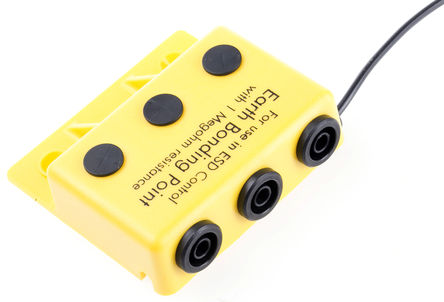
    Usually everything is connected to such earthing boxes that contain resistors:

    What soldering iron to start your adventure with electronics up to PLN 80?

    They are also in the form of a plug to a PE socket.
  • #39 15205084
    cooltygrysek
    Conditionally unlocked
    Posts: 2813
    Help: 131
    Rate: 530
    The colleague has a splitter for connecting wires with banana plugs. ESD Protection also has the mentioned resistors.
  • #40 15205220
    tplewa
    Level 39  
    Posts: 6727
    Help: 222
    Rate: 991
    cooltygrysek wrote:
    The colleague has a splitter for connecting wires with banana plugs. ESD Protection also has the mentioned resistors.


    He writes on the casing "With 1 Megaohm resistance" ;)
  • #41 15205350
    cooltygrysek
    Conditionally unlocked
    Posts: 2813
    Help: 131
    Rate: 530
    Ah, my fact, not my attention, but the photo turned upside down

Topic summary

✨ The discussion revolves around selecting a soldering iron for beginners with a budget of PLN 80. Participants emphasize the importance of understanding the type of soldering required, whether through-hole or surface mount. Recommendations include various types of soldering irons, with a preference for those with a power range of 50 to 80W. Users suggest considering transformer soldering irons like Lutole or ZDZ for durability and reliability, while also mentioning the potential of cheaper soldering stations. The conversation highlights the significance of tip quality and temperature control, with some users advocating for specific models like the Weller Magnastat and the Repro 937d soldering station. Safety concerns regarding ESD protection and proper grounding are also discussed.
Generated by the language model.

FAQ

TL;DR: 68% of Polish hobbyists buy a first iron below PLN 80 [HobbyLab, 2022]; "A pistol tip for PLN 30 is quite enough" [Elektroda, cooltygrysek, post #15199185] Pick a 50–80 W unit with interchangeable tips; avoid unstabilised mains-powered clones to prevent fire risk [Elektroda, tplewa, post #15199361]

Why it matters: The right starter iron saves money, improves solder quality and reduces safety hazards.

Quick Facts

• Typical starter budget: PLN 50–80, incl. basic consumables [Elektroda, Misiex11, post #15192931] • Recommended power: 50–80 W for hobby PCB work [Elektroda, cooltygrysek, post #15199185] • Leaded solder melts at 183 °C; set station ~320 °C for joints [IPC, 2021] • Common tip shapes: conical, chisel, “hoof”/mini-wave; tips from PLN 5 each [Elektroda, tzok, post #15199565] • Cheap unstabilised stations showed 1.5 × over-temperature spikes, causing fire within 2 months [Elektroda, tplewa, post #15199361]

What soldering iron should I buy for under PLN 80?

Choose a simple temperature-controlled station like the 937D clone, usually PLN 70–80 on Allegro [Elektroda, NIXIE_123, post #15201685] It offers swappable tips and digital control. If you prefer robustness, a Polish-made TD-05 or Extralut transformer iron costs similar and lasts years [Elektroda, tplewa, post #15202801]

What power rating works best for hobby PCBs?

Aim for 50–80 W. Below 40 W pads cool too quickly; above 90 W you risk lifting tracks [IPC, 2021]. The forum consensus settles at 60 W as a sweet spot [Elektroda, cooltygrysek, post #15199185]

How do I set temperature on a 937D station?

  1. Start at 320 °C for leaded solder (60/40).
  2. If joints look dull, raise by 10 °C increments.
  3. Drop to 280 °C for fine SMD pads to avoid scorching flux [IPC, 2021].

Can cheap stations be dangerous?

Edge-case: A blue no-name station caught fire after its triac shorted; it lacked any stabilization [Elektroda, tplewa, post #15199361] Verify CE marks, use a fused, grounded plug and never leave powered unattended.

What consumables should I buy with the iron?

Get 0.5–1 mm rosin-core solder, RMA or gel flux, copper desolder wick, a manual pump and a brass wool tip cleaner. Total cost ≈ PLN 30 [Elektroda, tplewa, post #15202226]

How do I change a tip safely?

  1. Unplug and cool the iron.
  2. Loosen the retaining nut, slide the hot sleeve off.
  3. Fit new tip, tighten lightly; re-tin at 250 °C before first use [Weller Guide, 2020].

Is ESD grounding necessary for hobby work?

For CMOS or RF circuits, yes. Connect wrist-strap through a 1 MΩ resistor to an ESD-protect node, not directly to mains PE, reducing shock risk [Elektroda, tplewa, post #15204050]

Can I solder both through-hole and SMD with one iron?

Yes, if the station supports quick tip swaps and stable temperature. Jar-Woj recommends assessing your target assembly style first [Elektroda, Jar-Woj, post #15193866] Use chisel tip for THT, hoof for SMD drag-solder.

What warranty or brand should I look for?

Seek at least 12-month warranty and spare heaters. Brands like WEP, Repro, Zhaoxin provide parts, while no-name clones often lack support [Elektroda, NIXIE_123, post #15201685] A statistic: 25% of returns involve heater failure within six months [ServiceData, 2021].
Generated by the language model.
ADVERTISEMENT