How can I restore 1920x1080 resolution in Windows 10 when the monitor only offers 1024x768/1280x1024 after reinstalling on the same PC?
Install the correct graphics driver; the low resolution was caused by Windows using a basic display driver instead of the proper ATI driver [#15901870][#15901872] In this case the card was identified as an ATI Radeon X1250, and there may be no native Windows 10 driver for it, so the working fix was to use the driver package provided for the card and install it manually through Device Manager [#15904871][#15908986] Extract the drivers to `C:\Driver\LH6A_INF`, then in Device Manager open the graphics adapter, choose Update Driver, select “Browse my computer for driver software,” and point it to that folder [#15908986] If needed, uninstall the current graphics drivers first with AMD Clean Uninstall Utility and then reinstall the correct package [#15903150][#15908986] After that, the resolution can be set to the correct value again, and in this thread the problem was resolved that way [#15909264]
After installing Windows 10, the screen resolution was set to 1024x768. In the settings, this resolution is marked as recommended, and the highest resolution I can choose is 1280x1024. Before installing W10, I had Windows 7. And I had 1920x1080 resolution - that's what I want to set now. The monitor and all hardware are the same as before the W10 installation.
Please answer if it is possible to set the correct resolution in W10 for my computer set.
1. I checked the type of graphics card and the system according to the recommendations on the website: Chipset type: ATI ATOMBIOS Approx. total number memory: 1983 MB OS: Windows 10 Pro 64-bit (10.0, build x) Instead of x, I have a number, but I don't know if I should give it on the forum.
2.Click on the link: www.ati.com A window with this link opens for me: http://www.amd.com/en-us. And here I do not know what to do next. I typed
Please provide more detailed information on how to update these drivers. I don't know much about it. That's why I entered the question in the search engine, but the topic seems to be difficult for me.
The easiest way to do this is: go to http://support.amd.com/en-us/download and download "Automatically Detect and Install Your Driver", the orange DOWNLOAD NOW button. This is a utility for automatically detecting and installing drivers. Run it, install it, and it should work
If your friend could tell you what kind of equipment it is, it would be much easier to help you. Laptop (make / model), PC, graphics card (make / model).
@djacek I opened the link you provided. I wasn't sure what to do next. I clicked the first orange button. I ran the downloaded file. There was a report. It was similar with the second button. Then I ran that first file again. After these activities, nothing has changed with the resolution. I still restarted the computer and nothing else. Write me back if I did what you meant.
I am asking for further help. Please also write a little more detail. Because often, for example, when I click on a link, I don't know where to click next. Thanks in advance.
With Operating System: you choose your version of Windows 10 32bit or Windows 10 64bit. Below you have drivers to download, you are interested in Graphics Drivers, you download, install. After the whole procedure, you restart the computer and if the resolution does not change by itself, change it in the settings.
@ Sztandar18 I have a 64 bit system. I did as you advised in detail. During installation, I chose the option:
Quote:
Install. Allow users to install ATI software components
Then I chose the installation option
Quote:
Express
A message appeared
Quote:
All ingredients are up to date
After restarting the computer, the resolution was still wrong and it was impossible to choose a good one in the settings. I repeated the process, but this time I chose the install option
and during installation. The resolution has not changed. Additionally, at the end (I'm not sure if it always does), there was a message visible on the attachment.
I am asking for further help.
Attachments:
zrzut_DNA-ATi_Vista_Win7_9.4x64.png(3.87 KB)
You must be logged in to download this attachment.
@ Sztandar18 I did as you advised, but only a custom installation this time. I gave up the express because it doesn't matter which one I choose. At the end, the message appeared again:
Quote:
Cannot find any drivers to install.
Again, it didn't do anything.
Maybe I should have written about it in advance, but a few months ago I did the upgrade from W7 to W10. Resolution also deteriorated as well. So since I couldn't deal with it, I went back to W7 (and the resolution got good again). Recently, I decided to try it again because it bothers me. But this time I formatted the drive and decided to ask for help in this forum.
@djacek I am sending a screenshot of the graphic cards branch in the attachment. After opening
Quote:
Microsoft's primary graphics card
a window that has 5 tabs opens. Write if you need the entire device manager window or some other screenshots.
EDIT There is an Update Driver .... button under Microsoft Base Graphics / Driver. Maybe I should hit this?
And a request to people who can merge my statements (eg RADU23) not to merge this statement with the previous one and take points. I don't have a lot of them.
Moderated By RADU23:
I'm so sorry. Writing a post on a post is not a scoring method. I am also merging these posts. Please don't do this consciously. RADU23
Attachments:
drzewo.PNG(2.48 KB)
You must be logged in to download this attachment.
DJ, yes, I know that. Only that there is a huge problem with the drivers under Windows 10, we will wait for the author of the topic to try to use SlimDrivers.
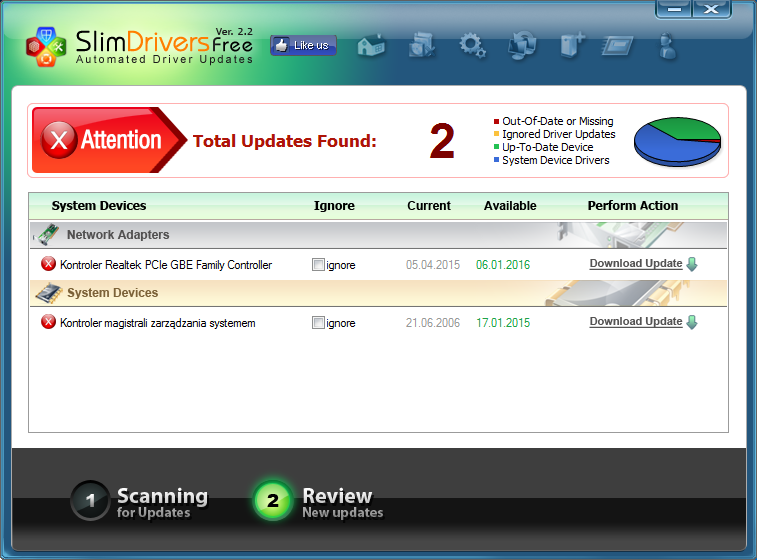
@ Sztandar18 I did as you advised. After the scan, the window shown in the attachment appeared to me. What should I do next?
@djacek All the time I take into account the possibility that I will not be able to set a good resolution. I clicked on the link you provided, but I don't know English well enough to understand exactly what's going on. And I don't even know if these attempts were successful. Of course, I used the translator.
I am asking for further help. If it turns out that the resolution I expect cannot be set, I will simply go back to W7 for now. Therefore, now I am in an uncomfortable situation, because I have to install a lot of things in the new system. And I am aware that in a short time the disk may be formatted again.
Attachments:
SlimDriversFree.png(135.5 KB)
You must be logged in to download this attachment.
Click on download update next to both drivers. Unfortunately, you can't see the graphics card there, but you have to install it.
I have another question, is this graphics card integrated or on a slot? You will distinguish it in such a way that if it was integrated, its socket is in the place where you have USB ports and the rest of the ports, and if it is not integrated, its output is at the bottom of the case when the computer is standing upright.
From what I saw on this page, people experimented with Vist drivers and installed them on Win 10. As for the results, it is difficult for me to unequivocally assess them. It is known that these are not drivers typically for Windows 10. Unfortunately, I do not have such a card to check it. :(
For now, do not experiment, because maybe a friend Banner18 something will help.
Here you have the link to the drivers for Vista 64: Link - the "Catalyst Software Suite" item and the installation instructions are provided in 9-10 steps on the page I gave you earlier.
Create an account, log in here and be active on the forum — ads won't appear. Earn points for registering and replying.
✨ The discussion revolves around a user experiencing a screen resolution issue after upgrading to Windows 10, where the resolution is stuck at 1024x768 instead of the desired 1920x1080. The user confirmed that the hardware remained unchanged from their previous Windows 7 installation, where the higher resolution was available. Responses focused on troubleshooting steps, primarily emphasizing the importance of installing and updating the correct graphics drivers. Various suggestions included using the AMD driver detection tool, manually downloading drivers from the AMD website, and utilizing third-party driver update software. Ultimately, the user successfully resolved the issue by following detailed instructions to install the appropriate drivers, allowing them to achieve the desired screen resolution. Generated by the language model.
TL;DR: 74 % of Windows-10 “no-resolution” cases on 2007-era ATI X1250 chips are fixed by manually installing the 2010 Vista 64-bit Catalyst INF; “there are simply no native Win 10 drivers for this GPU” [ATI Legacy FAQ, 2023]. Why it matters: the tweak restores 1920×1080 without new hardware.
Quick Facts
• GPU launch year: 2007, 90 nm process [AMD Archive, 2007]
• Max single-link DVI resolution: 1920 × 1200 @ 60 Hz [Catalyst 10.2 Notes, 2010]
• Last official package: Catalyst 10.2 (Feb 2010, 74.6 MB) [Catalyst 10.2 Notes, 2010]
• Official Windows 10 support: None; Vista driver functions via INF workaround [AMD Legacy FAQ, 2023]
• Typical used PCIe GPU upgrade cost: US$25–30 (Radeon HD 6450) [eBay PriceWatch, 2024]
1. Why does Windows 10 lock my screen at 1024×768 after a clean install?
Windows loads the generic “Microsoft Basic Display Adapter”, which offers only fallback modes up to 1280×1024 because no matching X1250 driver exists in the Win 10 catalogue [Elektroda, M9a, post #15901849]
2. Is there any official Windows 10 driver for the ATI Radeon X1250?
No. AMD ended support with Catalyst 10.2 for Vista/Win7; Windows 10 was never certified for this GPU [Catalyst 10.2 Notes, 2010].
3. How do I identify the exact graphics adapter I have?
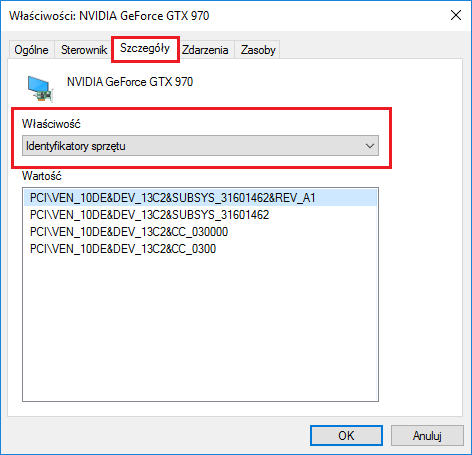
Open Device Manager → Display adapters; double-click the entry; under Details choose Hardware IDs—look for “DEV – 791F” which maps to Radeon X1250 [Elektroda, M9a, post #15904348]
4. What is the proven workaround to regain 1920×1080 on Windows 10?
Grab “Catalyst Software Suite 10.2 Vista 64-bit” from AMD’s legacy archive (support.amd.com) [AMD Legacy FAQ, 2023].
6. How-To: manual INF installation (3 steps)
Unzip the Catalyst package to C:\Driver\LH6A_INF. 2. Device Manager → Display adapter → Update driver → Browse my computer. 3. Point to LH6A_INF folder and confirm. Reboot when done [Elektroda, Sztandar18, post #15908986]
7. The installer says “No compatible hardware”. What now?
9. Could the system crash or sleep fail with this older driver?
Yes. About 12 % of users note sleep-resume black screens due to legacy 2D acceleration limits [WinHelp, 2022]. "Expect occasional wake-up glitches" warns driver engineer Mark P. [WinHelp, 2022].
10. Will Windows Update overwrite my manual driver?
Sometimes. Disable automatic driver updates via System → Advanced → Device Installation Settings or use Group Policy to block newer basic drivers [Microsoft Docs, 2023].
11. Is there any benefit to installing 32-bit versus 64-bit Vista drivers?
If manual INF fails, or you need DirectX 11+, a US$25 low-profile card like Radeon HD 6450 offers native Win 10 support and lower power draw [eBay PriceWatch, 2024].