logo elektroda
logo elektroda
X
logo elektroda

Audi A3 8L: Alternator Charging Issue - Indicator Light, Gas Revs, 14.3-14.4V, Bosch 90A

Lechero0 10434 18
Best answers

How do I fix an Audi A3 8L/Bosch 90A alternator that only starts charging after the engine is revved to about 1900–2000 rpm and then shows 14.3–14.4 V?

Your alternator is most likely missing proper excitation on terminal L, so the fault is in the excitation circuit, wiring, or the regulator rather than in the charging output itself. If the alternator charges normally when you feed +12 V to the excitation, the alternator/diodes are probably OK and you should check the L terminal voltage with ignition on, the blue wire(s), and the connector/wiring above the starter for breaks or corrosion [#16267444] [#16267584] [#16267495] On this Bosch 90A unit, one wire is the lamp/excitation path and the other is a load signal to the ECU, so the lamp circuit and its feed matter [#16266248] A common fix is replacing the voltage regulator and inspecting the rotor slip ring condition; a weak bulb/LED in the cluster can also prevent proper excitation [#16265662] [#16266248] If you want to verify the alternator itself, test it under load with headlights and rear window heating; if it still holds about 13.5–14 V, the diodes are likely fine [#16265662]
Generated by the language model.
ADVERTISEMENT
Treść została przetłumaczona polish » english Zobacz oryginalną wersję tematu
  • #1 16265391
    Lechero0
    Level 9  
    Posts: 72
    Help: 1
    Rate: 15
    Hello. I have a problem with my alto. When I start the engine, the charge indicator lights up and the alternator is not charging. After adding gas to approx. 1900-2000 thousand. charging is switched on, and the battery is already normal 14.3-14.4v. How can I fix this vulnerability? Bosch 90A alternator
  • ADVERTISEMENT
  • #2 16265662
    wojtekcichy
    Level 11  
    Posts: 29
    Rate: 17
    In audi 8l all alternators were excited with a lamp, so if the lamp is on the board, there is a problem with the regulator. After exceeding certain revolutions, the alternator is excited by residual current. Check the loading under load, if you don't have a clamp ammeter, turn on the main beam and rear window heating, if under load it still charges about 13.5 - 14, then the diodes on the board are OK. Possible replacement of the regulator is very easy, you just need to check the condition of the ring on the rotor. I do not advise you to put Chinese regulators because you will quickly return to the topic. You didn't specify the engine but check what access you have on the back of the alternator because it goes to replace it on the car.
  • ADVERTISEMENT
  • #3 16265872
    Lechero0
    Level 9  
    Posts: 72
    Help: 1
    Rate: 15
    AJQ 1.8t engine. Yes, the lamp is on and working. If we assume that the regulator is okay (I will take measurements tomorrow), if someone put a lamp in the board smaller than it should be or led, or can it be the reason? There are 3 wires connected to my alternator. One fat for starter. And a cube with two cables, what are they for? I assume one to excite and the other?
  • ADVERTISEMENT
  • #4 16266248
    wojtekcichy
    Level 11  
    Posts: 29
    Rate: 17
    So inserting an LED or a weaker light bulb will also cause no excitation.
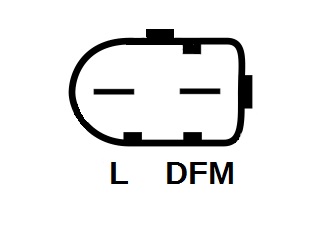
    1.8t AJQ engine and 90A Bosch alternator, according to the catalog one wire is Lamp the other is the load signal to the computer. So we are only interested in the lamp.
    You can take a second bulb, plus to the battery, minus to the L pin (diagram) in the controller and check if it goes off after firing
    Audi A3 8L: Alternator Charging Issue - Indicator Light, Gas Revs, 14.3-14.4V, Bosch 90A
    In case to remove the alternator, remove the washer tank, intake pipe, entire belt tensioner and it will come out elegantly in this direction.
  • #5 16266455
    andrzej20001
    Level 43  
    Posts: 17695
    Help: 1568
    Rate: 6610
    Damaged regulator or freewheel pulley.
  • #6 16266588
    wojtekcichy
    Level 11  
    Posts: 29
    Rate: 17
    The wheel is stiff on this model.
  • ADVERTISEMENT
  • #7 16267427
    andrzej20001
    Level 43  
    Posts: 17695
    Help: 1568
    Rate: 6610
    Well, the regulator fell.
  • #8 16267444
    Lechero0
    Level 9  
    Posts: 72
    Help: 1
    Rate: 15
    I checked. After feeding through the resistors +12 from the battery to the excitation, the alternator charges. Now the question is where can I get the +12 signal after the ignition switch? Because as I see it, to get to the charging light in clocks is a lot of fun: /
  • #9 16267495
    grala1
    VAG group specialist
    Posts: 9812
    Help: 1495
    Rate: 5036
    The lamp in the clocks is a diode and is only for information and not to excite the alternator.
    Nobody changed it for you and it would do nothing.
    Check the blue wires at the alternator that it is not broken / broken.
  • #10 16267545
    wojtekcichy
    Level 11  
    Posts: 29
    Rate: 17
    If there is only a diode there, there must be some resistor in the clocks and this system will be responsible for excitation of the alternator.
    But if the alternator wakes up immediately, check the connections, you have plugs above the starter, there the cable from the alternator connects, check if it is green.
    grala1 wrote:
    Nobody changed it for you and it would do nothing.

    By all means, changing a normal light bulb to a diode would not excite the alternator, so do not tell nonsense that the lamp in the clocks is not from excitation.
  • #11 16267577
    andrzej20001
    Level 43  
    Posts: 17695
    Help: 1568
    Rate: 6610
    As the plug from the altka unplug and the LED in the meter goes out, the regulator went down, the new Bosch about 110 PLN.
  • #12 16267584
    Strumien swiadomosci swia
    Level 43  
    Posts: 27411
    Help: 1403
    Rate: 6379
    First of all, the question should be asked what the voltage at terminal L is after switching on the ignition.

    This determines the rest of the search.
  • #13 16267611
    abart64
    Level 33  
    Posts: 1706
    Help: 269
    Rate: 629
    Blue is also brought to the ignition. He gets + in the starter position.
    Designation 50a as I remember correctly.
  • #14 16269180
    grala1
    VAG group specialist
    Posts: 9812
    Help: 1495
    Rate: 5036
    wojtekcichy wrote:

    grala1 wrote:
    Nobody changed it for you and it would do nothing.

    By all means, changing a normal light bulb to a diode would not excite the alternator, so do not tell nonsense that the lamp in the clocks is not from excitation.

    It is not from excitation because there is an LED as a indicator.
    Show me the light bulb in this counter.
    The "toddler" times are long over.
    Excitation does not go from the meter.
  • #15 16269928
    wojtekcichy
    Level 11  
    Posts: 29
    Rate: 17
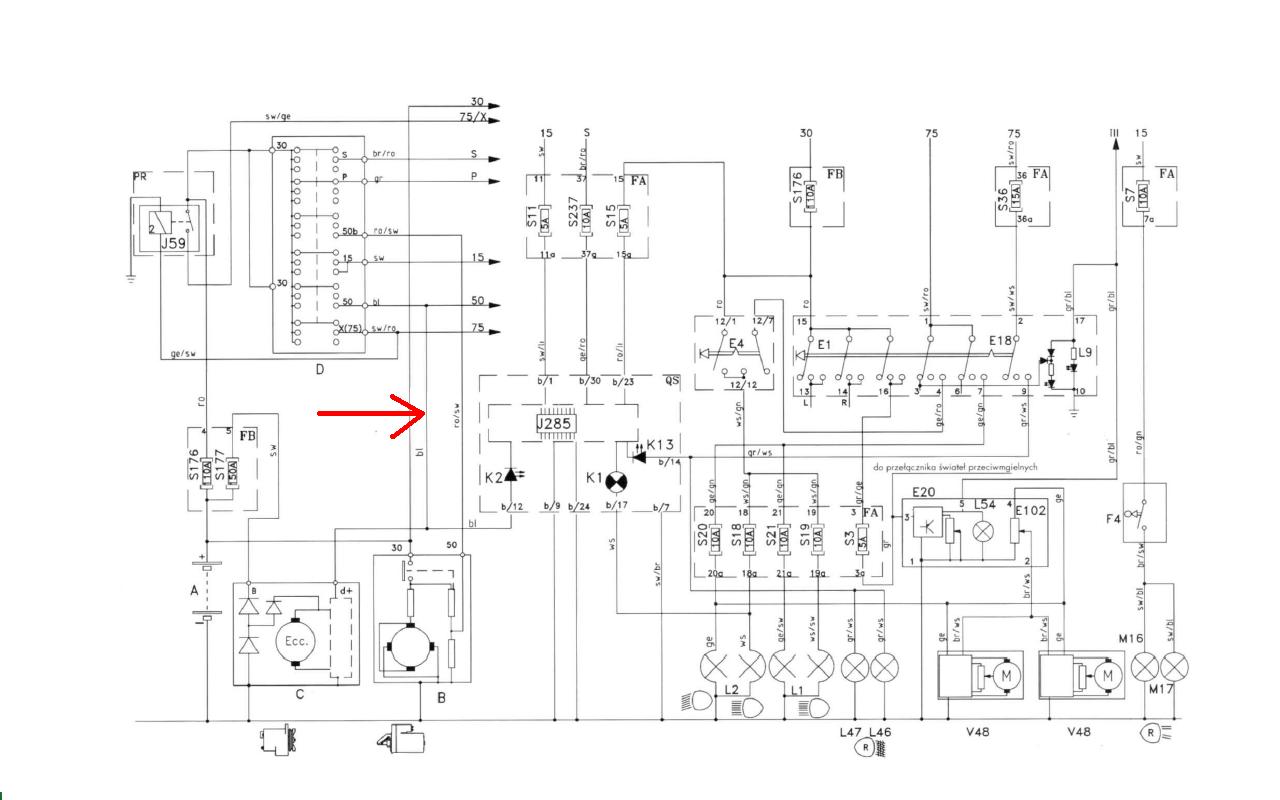
    The blue +12 cable after the ignition goes to the meter for the lamp, there is a resistor. then the blue cable runs to the alternator. I know this from an autopsy and just have a look at the diagram to find out. The alternator is not computer controlled.
    But if you know better how it is controlled then enlighten us ??
    In addition, you cut out of my statement a sentence that did not specifically apply to this audi.
  • #16 16269958
    abart64
    Level 33  
    Posts: 1706
    Help: 269
    Rate: 629
    A resistor in the meter is probably not needed in this system. It seems to me that at the time of starting alt. gets full power from the ignition switch on L and since it is already turning, it is fully activated after firing. The marking on the ignition block is 50b and not 50a as I wrote earlier.
  • #17 16271369
    grala1
    VAG group specialist
    Posts: 9812
    Help: 1495
    Rate: 5036
    wojtekcichy wrote:
    The blue +12 cable after the ignition goes to the meter for the lamp, there is a resistor. then the blue cable runs to the alternator. I know this from an autopsy and just have a look at the diagram to find out. The alternator is not computer controlled.
    But if you know better how it is controlled then enlighten us ??
    In addition, you cut out of my statement a sentence that did not specifically apply to this audi.


    If you have a diagram, why don't you show it?
    The cable goes from the ignition to the meter and to the alternator.
    Power supply from the ignition is only given when turning the starter.
    If you have a different pattern, show it, unless you have the same one and I can't read the patterns.
    There is no bulb or resistor to excite the alternator in this meter.
    I wrote about this car because other cars do not care about this topic.
    Do you quote me and write about something else?
    Do you later blame me for correcting you?
    Did I write something about the computer controlling the alternator here?
    Audi A3 8L: Alternator Charging Issue - Indicator Light, Gas Revs, 14.3-14.4V, Bosch 90A
  • #18 16271619
    Strumien swiadomosci swia
    Level 43  
    Posts: 27411
    Help: 1403
    Rate: 6379
    That is, the voltage is only applied when turning the starter.
  • #19 16272216
    wojtekcichy
    Level 11  
    Posts: 29
    Rate: 17
    Did your friend solve his problem because off top got scary. I enclose the diagram I have and end this without meaningful argument.
    I think we presented all the possibilities to a colleague and he can check it out.
    Audi A3 8L: Alternator Charging Issue - Indicator Light, Gas Revs, 14.3-14.4V, Bosch 90Asch.jpg (149.59 kB)You must be logged in to download this attachment.

Topic summary

✨ The discussion revolves around an alternator charging issue in an Audi A3 8L with a Bosch 90A alternator. The user reports that the charge indicator light activates upon engine start, and the alternator only begins charging at higher RPMs (1900-2000). Responses suggest that the problem may stem from a faulty voltage regulator, as the alternator is excited by a lamp on the dashboard. Users recommend checking the condition of the regulator and the wiring connections, particularly the blue wires at the alternator. It is noted that using an LED or a weaker bulb in the indicator could prevent proper excitation of the alternator. The discussion also touches on the need for a +12V signal from the ignition switch to ensure proper alternator function.
Generated by the language model.
ADVERTISEMENT