logo elektroda
logo elektroda
X
logo elektroda

Wiring 16 SMD 50 GU10 3W LED Bulbs with Dusk Sensor and Stair Switches in Roof Soffit

1sajmon77 15105 11
ADVERTISEMENT
Treść została przetłumaczona polish » english Zobacz oryginalną wersję tematu
  • #1 16679404
    1sajmon77
    Level 10  
    Posts: 17
    Rate: 11
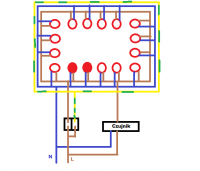
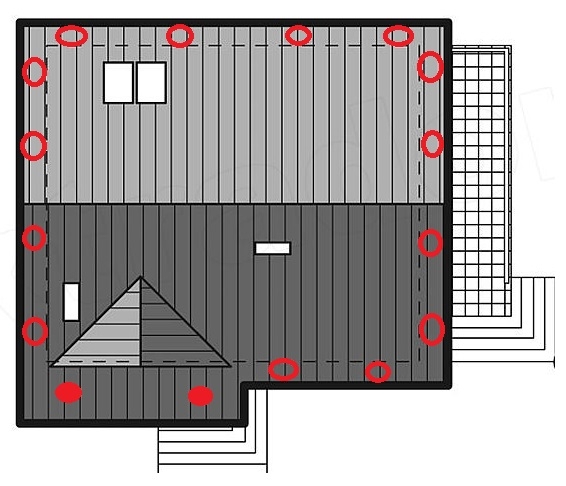
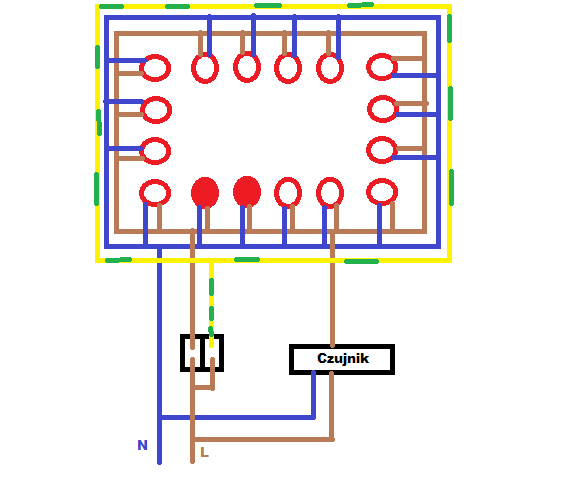
    I want to connect 16 smd 50 GU10 3 W LED bulbs as I drew the diagram attached below. The bulbs are to be permanently connected to the dusk sensor, but I want to be able to turn them on using the switch at home and on the porch with a stair switch. Stair switches would be double to one light all the bulbs and the other and here I do not know how to connect everything so that only two bulbs on the porch that I marked filling the bulb field turned red. I would be very grateful for a hint what and how to connect and what I miss here so that it would not be that I turn on these two bulbs on the porch switch and suddenly also give current from the dusk sensor. I think I mixed it up a bit but maybe someone will understand. Nothing is done and bought, so someone can draw a better diagram.
    Wiring 16 SMD 50 GU10 3W LED Bulbs with Dusk Sensor and Stair Switches in Roof Soffit Wiring 16 SMD 50 GU10 3W LED Bulbs with Dusk Sensor and Stair Switches in Roof Soffit
  • ADVERTISEMENT
  • #2 16679485
    mawerix123
    Level 39  
    Posts: 4150
    Help: 482
    Rate: 950
    1sajmon77 wrote:
    can someone draw a better diagram.


    I think you mean something like that

    Wiring 16 SMD 50 GU10 3W LED Bulbs with Dusk Sensor and Stair Switches in Roof Soffit

    And this is how I look at this drawing and I don't know what the author meant.

    Wiring 16 SMD 50 GU10 3W LED Bulbs with Dusk Sensor and Stair Switches in Roof Soffit
  • #3 16680030
    1sajmon77
    Level 10  
    Posts: 17
    Rate: 11
    what you marked at the beginning was to be an ordinary double switch but I thought that before entering it would also be good to have such and a better use are two double stair switches
  • ADVERTISEMENT
  • #4 16680218
    kortyleski
    Level 43  
    Posts: 12265
    Help: 957
    Rate: 3847
    And since when is the green / yellow wire released?
  • #5 16680467
    1sajmon77
    Level 10  
    Posts: 17
    Rate: 11
    And why not if you can mount a 3x1.5 cable in the soffit with a green-yellow wire that you don't use GU10 bulbs for grounding?
  • ADVERTISEMENT
  • #6 16680504
    mawerix123
    Level 39  
    Posts: 4150
    Help: 482
    Rate: 950
    1sajmon77 wrote:
    And why not if you can mount a 3x1.5 cable in the soffit with a green-yellow wire that you don't use GU10 bulbs for grounding?


    First of all, the provision prohibits the use of a yellow-green wire for purposes other than as a protective conductor, it is necessary to bring a protective conductor to each installation point.
    Secondly, you need to connect a protective conductor to the holders The problem is that most people use holders designed for 12V voltage where there is no protective clamp.
    If you want two circuits then 4x1.5
  • #7 17989235
    JasomiT
    Level 15  
    Posts: 456
    Help: 2
    Rate: 48
    Hello. I will not help you.
    But one thing intrigued me, is the recipe which forbids to run the phase with the green / yellow wire ???
    If there is such a recipe, please support it with some content.
    Recently, an epg man was making my VLL connection with me and gave all four wires yellow / green, why? He answered the question that they had in store.
    I'm curious
  • #8 17989264
    kortyleski
    Level 43  
    Posts: 12265
    Help: 957
    Rate: 3847
    JasomiT wrote:
    Recently, an epg man was making my VLL connection with me and gave all four wires yellow / green, why?

    Who picked it up and who signed it?
    Go to customer service and ask about it. Say that in your opinion this is against the rules
  • #9 17989605
    JasomiT
    Level 15  
    Posts: 456
    Help: 2
    Rate: 48
    So you don't know if such a recipe exists and what the recipe means. Is this regulated by law or any internal company order?
    I found the PN-EN 60446: 2010 standard, but is there a regulation ordering installation in accordance with it, and legal consequences associated with not complying with its provisions?
  • ADVERTISEMENT
  • #10 17989905
    kortyleski
    Level 43  
    Posts: 12265
    Help: 957
    Rate: 3847
    I know the rules. The Penal Code. If an installation that is not in accordance with the standards makes someone crunch, then the prosecutor will pull this code out of his pocket and wave in front of his nose to the person who took the installation done in this way.
  • #11 17990211
    el-dziwak
    Level 11  
    Posts: 11
    Help: 1
    Rate: 8
    kortyleski wrote:
    I know the rules. The Penal Code. If an installation that is not in accordance with the standards makes someone crunch, then the prosecutor will pull this code out of his pocket and wave in front of his nose to the person who took the installation done in this way.


    Standards are not compulsory in Poland, but they remove some responsibility from the contractor. Technically speaking, the current flows through a copper vein and the color of the insulation has nothing to do with it. The use of a yellow-green vein as an active vein is a common practice. Wanting to comply with the standard, electricians using a tape or a T-shirt mean that it is not a PE conductor. This is, of course, a half-measure, but it's very hard to get a 3-wire cable without a vein, theoretically, such wires are the same as hard as a virgin in college.

    Added after 17 [minutes]:

    You can turn on a switch in parallel with the contacts of the twilight automaton but it will be an inconvenient solution - the twilight automaton, after manual activation will not have a chance for automatic shutdown.
    Instead of double stair switches, I would suggest using a selective pulse relay. You can try to combine it with the twilight automaton so that both possibilities of activation work in parallel and independently.
  • #12 17990866
    kortyleski
    Level 43  
    Posts: 12265
    Help: 957
    Rate: 3847
    el-dziwak wrote:
    it is very difficult to get a 3-wire cable without a Ż-vein

    And why would there be such a cable if nowadays PE should be connected to each point?

    Added after 49 [minutes]:

    And when it comes to colors, imagine the situation when the paprak leads to a two-wire chandelier with three wires. Then the hero will hit his house and will want to mount a single-circuit chandelier in the first class of protection. He will do it in his correct opinion correctly, i.e. yellow green on PE, blue on N and black on L. And what? The phase on the chandelier housing ... And the hero did the right thing.
    It's like every car maker arranges the pedals according to his view.

Topic summary

✨ The discussion revolves around connecting 16 SMD 50 GU10 3W LED bulbs to a dusk sensor and stair switches in a roof soffit. The user seeks guidance on wiring the bulbs to ensure they can be controlled by both a home switch and a porch stair switch without interference from the dusk sensor. Various responses address the wiring diagram, the use of protective conductors, and the implications of using a yellow-green wire incorrectly. Suggestions include using a selective pulse relay for better control and ensuring compliance with electrical standards to avoid legal issues. The conversation highlights the importance of proper wiring practices and the challenges of integrating multiple control points for lighting systems.
Generated by the language model.

FAQ

TL;DR: Need to wire 16 GU10 LEDs with a dusk sensor and two-way switches without backfeeding? Use separate circuits and a selective pulse relay; “If you want two circuits then 4x1.5.” [Elektroda, mawerix123, post #16680504] Why it matters: This prevents nuisance operation, maintains safety conductors, and keeps manual and automatic control independent for soffit lighting in homes.

Quick Facts

How do I control 16 GU10 soffit bulbs from a dusk sensor and two locations without backfeeding?

Keep the dusk sensor’s load output and your manual control on a selective pulse relay (impulse relay). Wire both controls to the relay coil so either can toggle, but neither backfeeds the other. Feed the lamp circuits from the relay contacts. This preserves independent auto and manual operation. [Elektroda, el-dziwak, post #17990211]

What cable should I run if I want two independent lighting circuits?

Use a four‑core plus earth cable: 4×1.5 mm² for the actives and neutral as specified, with a dedicated yellow‑green PE. This supports two switched actives while maintaining the protective conductor to each point. “If you want two circuits then 4x1.5.” [Elektroda, mawerix123, post #16680504]

Can I use the yellow‑green wire as a phase conductor to save a core?

No. The yellow‑green core is reserved for protective earth (PE). Reassigning it as phase breaks identification rules and creates future shock risk during maintenance. Always route a proper PE to each luminaire position. [Elektroda, mawerix123, post #16680504]

Do GU10 LED lamps require a protective earth?

Many GU10 holders are for 12 V systems and lack a PE terminal, which is a problem on 230 V fittings. Run PE to every point and use holders and fixtures with proper earthing where Class I applies. [Elektroda, mawerix123, post #16680504]

What goes wrong if I wire a wall switch in parallel with the dusk sensor?

The manual bypass will energize the lamps, but the sensor can’t turn them off automatically afterward. You lose automatic shutoff until you flip the switch again. Use a pulse relay instead to avoid this failure mode. [Elektroda, el-dziwak, post #17990211]

How can I switch only the two porch bulbs separately from the rest?

Create two circuits: porch lamps on Circuit A, remaining soffit lamps on Circuit B. Use 4×1.5 mm² to deliver two switched lives, shared neutral, and PE. Control each circuit via separate contacts on the pulse relay or a dual relay. [Elektroda, mawerix123, post #16680504]

Is there legal risk if I don’t follow wiring standards?

Yes. If harm occurs and the installation deviated from standards, investigators can pursue criminal liability. Proper identification and PE continuity reduce risk and protect occupants and installers. [Elektroda, kortyleski, post #17989905]

What does a ‘stair switch’ mean in this context?

A stair switch is a two‑way (and with intermediate, three‑way) switching setup allowing control from two locations. For dual circuits, use double two‑way devices or, better, a selective pulse relay for cleaner logic and fewer travelers. [Elektroda, el-dziwak, post #17990211]

How much power will 16 × 3 W GU10 LEDs draw, and why does it matter?

The array draws about 48 W. Low power reduces current, but you still need correct conductor count, proper PE, and separation of circuits for selective control. Load is modest; safety and control logic drive design choices here. [Elektroda, 1sajmon77, post #16679404]

What is a selective pulse (impulse) relay, and why use one?

It’s a latching relay that toggles contacts with brief control pulses. Wire both the dusk sensor output and push‑buttons to the coil. Either input toggles lighting without cross‑feeding, preserving automatic off from the sensor. [Elektroda, el-dziwak, post #17990211]

How do I avoid energizing the whole soffit when I only want porch lights?

Physically separate the porch lamps onto their own switched leg. Route distinct switched lives via 4×1.5 mm² and use a dual‑channel control (two contacts). Label circuits clearly to prevent miswiring during future changes. [Elektroda, mawerix123, post #16680504]

Is it acceptable to tape over a yellow‑green core and repurpose it?

Some practitioners mark it to repurpose, but that’s a half‑measure that creates future hazards. Keep yellow‑green exclusively as PE and pull the right cable instead. [Elektroda, el-dziwak, post #17990211]

What’s a safe, simple wiring plan for this project?

Plan two circuits, each with its own switched live, shared neutral, and PE to every lamp point. Use a pulse relay to merge dusk sensor control with manual toggles. This keeps automation and manual use independent and safe. [Elektroda, el-dziwak, post #17990211]

How-to: combine a dusk sensor with manual controls using a pulse relay?

  1. Feed the pulse relay coil from the sensor’s control output and from momentary switches in parallel.
  2. Feed lamp circuits from the relay’s output contacts (separate contact per circuit).
  3. Run 4×1.5 mm² plus PE to split porch and soffit loads. [Elektroda, el-dziwak, post #17990211]

Why is consistent conductor color so important?

Future changes can put phase on a metal housing if colors are misused. Correct colors prevent deadly surprises during renovations and fixture swaps. “It’s like every car maker arranging pedals differently.” [Elektroda, kortyleski, post #17990866]

Do I need to bring PE even if my current GU10 holders don’t use it?

Yes. Run PE to each installation point. Holders or fixtures may change later, and PE must be present for Class I luminaires. This also aligns with identification expectations during maintenance. [Elektroda, mawerix123, post #16680504]
Generated by the language model.
ADVERTISEMENT