FAQ
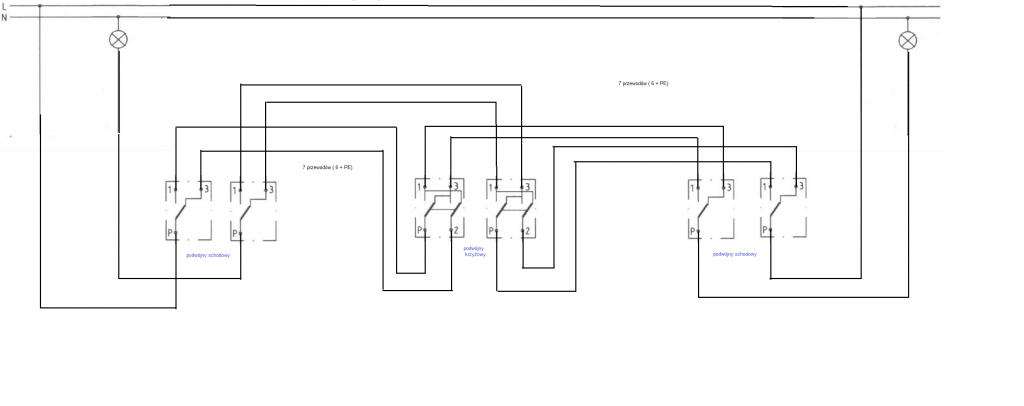
TL;DR: For two independent lights controlled from three places, the shown scheme works; the only flagged issue was “The diagram is OK except for the lack of PE wires.” Note 1 missing PE conductor. [Elektroda, mawerix123, post #16753349]
Why it matters: It helps DIYers fix miswired cross/“stair” circuits and avoid tripping breakers or unsafe, ungrounded installs.
Quick Facts
- The presented wiring pattern was confirmed as correct (“book” layout) for this use case. [Elektroda, ajibaz, post #16757774]
- Using it without a PE (protective earth) means the installation must not be used. [Elektroda, Akrzy74, post #16753495]
- The OP reported 8 conductors arriving at the door cross-switch box for two circuits. [Elektroda, ketiz, post #16753508]
- Legrand Niloe parts used: two cross switches at the door and two double “stair” (two-way) switches by the bed. [Elektroda, ketiz, post #16753258]
- Miswiring can cause both lamps to light together, no lamp to light, or the breaker to trip. [Elektroda, ketiz, post #16753375]
Is the posted diagram actually correct for controlling two lights from three locations?
Yes. A forum expert confirmed the pattern as a standard, correct “book” layout for two independent circuits controlled from three points. “The pattern is correct – ‘book’.” Label the two circuits (A and B) and keep their travelers isolated. [Elektroda, ajibaz, post #16757774]
Why is the PE (protective earth) conductor mandatory here?
PE provides fault protection. Without PE, exposed metal parts can become live during a fault, creating shock risk. A moderator stated such an installation must not be used when PE is missing. Do not energize until PE is present and verified. [Elektroda, Akrzy74, post #16753495]
How many conductors should I expect at the door cross-switch box?
Expect multiple travelers from both circuits and through-conductors. The OP documented 8 conductors at the door cross-switch location for two independent lighting circuits controlled from three places. Plan box fill and ferrules accordingly. [Elektroda, ketiz, post #16753508]
What symptoms point to miswired travelers or commons?
Common symptoms include both lamps turning on together, neither lamp working, or the breaker tripping on operation. These indicate swapped commons, bridged travelers between circuits, or shorted conductors. Fix by tracing and relabeling A/B circuits. [Elektroda, ketiz, post #16753375]
How should I map and label circuits A and B before wiring?
Mark each cable set and identify the two independent switch loops. Label travelers and commons for circuit A and circuit B end‑to‑end. “Accurately mark the wires, or at least the ‘circuits’ A and B.” This prevents cross-connecting travelers. [Elektroda, ajibaz, post #16754083]
How do I connect Legrand Niloe double stair and cross switches for two independent lights?
Use this 3‑step approach:
- Feed L to both double “stair” (two-way) switches; assign left module to Lamp A, right to Lamp B.
- Run each module’s two travelers through its own cross switch, keeping A and B separate.
- Return from the far “stair” commons to Lamp A and Lamp B respectively.
“The pattern is correct – ‘book’.” [Elektroda, ajibaz, post #16757774]
Can I share one phase feed (L) for both circuits at the bed switches?
Yes, you can bring a common phase feed to both double stair switches, but keep the two circuits’ travelers fully isolated. Do not link travelers across circuits; each lamp’s switched live must return only through its own loop to the lamp. [Elektroda, mawerix123, post #16753580]
What does “working zero” mean, and is it acceptable as a substitute for PE?
“Working zero” refers to the neutral (N). Neutral is not a substitute for PE and must not be used as protective grounding. A moderator clarified that a “working zero” is also absent here and does not resolve the missing PE issue. [Elektroda, retrofood, post #16753973]
How should I route neutrals (N) in this setup?
Neutrals typically bypass the switches. Bring N to each lamp, and connect the lamp’s other terminal to the switched live from its loop. The OP described N as common in the room to both light sources, then to lamps, not through the switch. [Elektroda, ketiz, post #16753508]
What if my wire colors don’t match the drawing?
Colors vary by cable and region. Identify functions by testing and labeling, then connect terminals by role: commons to commons, travelers to travelers, per circuit. “The colors of the veins may be different… connect the appropriate ‘connectors.’” [Elektroda, ajibaz, post #16757774]
Are Legrand Niloe modules suitable for cross and stair switching here?
Yes. The build uses Legrand Niloe double stair and cross modules for two independent lighting points. They are appropriate for standard two‑way and crossover arrangements when wired per the verified scheme. [Elektroda, ketiz, post #16753258]
Why did both lamps switch together after wiring?
That indicates crossed travelers or a bridged common between circuits A and B. Separate the two loops, label them, and verify each pair of travelers routes only through its own cross switch. This exact failure pattern was reported by the OP. [Elektroda, ketiz, post #16753375]
The diagram shows no PE—can I just proceed without it?
No. An expert noted the diagram lacked PE and another moderator stated the installation cannot be used in that state. Add a compliant PE conductor to all relevant boxes and fixtures before energizing. [Elektroda, Akrzy74, post #16753495]
What’s the fastest way to debug a tripping breaker on switch toggling?
Open all switches, isolate circuits A and B, and continuity‑test travelers per loop. Restore the correct common on each stair switch. This resolves shorts caused by crossed travelers that trip the breaker when toggled. [Elektroda, ketiz, post #16753375]
Does the community agree the wiring went wrong, not the concept?
Yes. A contributor summarized, “On the diagram you have a well-designed, the work went into the woods.” The concept is sound; the issue is execution and identification. [Elektroda, Strumien swiadomosci swia, post #16757863]