How do I insert and orient a Winbond 25x16 chip in a mini CH341A programmer, and how should it be connected to the board?
Insert the 25x16 chip in the 25xxx socket with the notch/cut aligned to the programmer’s marking, and if the chip is an SMD part, solder it directly to the pads marked 25xxx on the right side [#16755677] The PCB marking can be confusing, so trust the orientation shown on the programmer board rather than the software alone [#16755945][#16756040] If you only press the chip into place without soldering or proper contact, the programmer may not detect it; soldering it into the 25xxx field made it work [#16756257] After selecting the correct memory type in the software, it may show the mounting orientation, but the physical board marking should be the primary guide [#16755945][#16756040]
AI summary based on the discussion. May contain errors.
Hello, I have a mini CH341A programmer and a board for it, I want to program a 25x16 winbond bone and I do not know how to embed it in the programmer and how to set the board in the programmer. I am asking for some instructions because there is absolutely nothing where the bone should be attached.
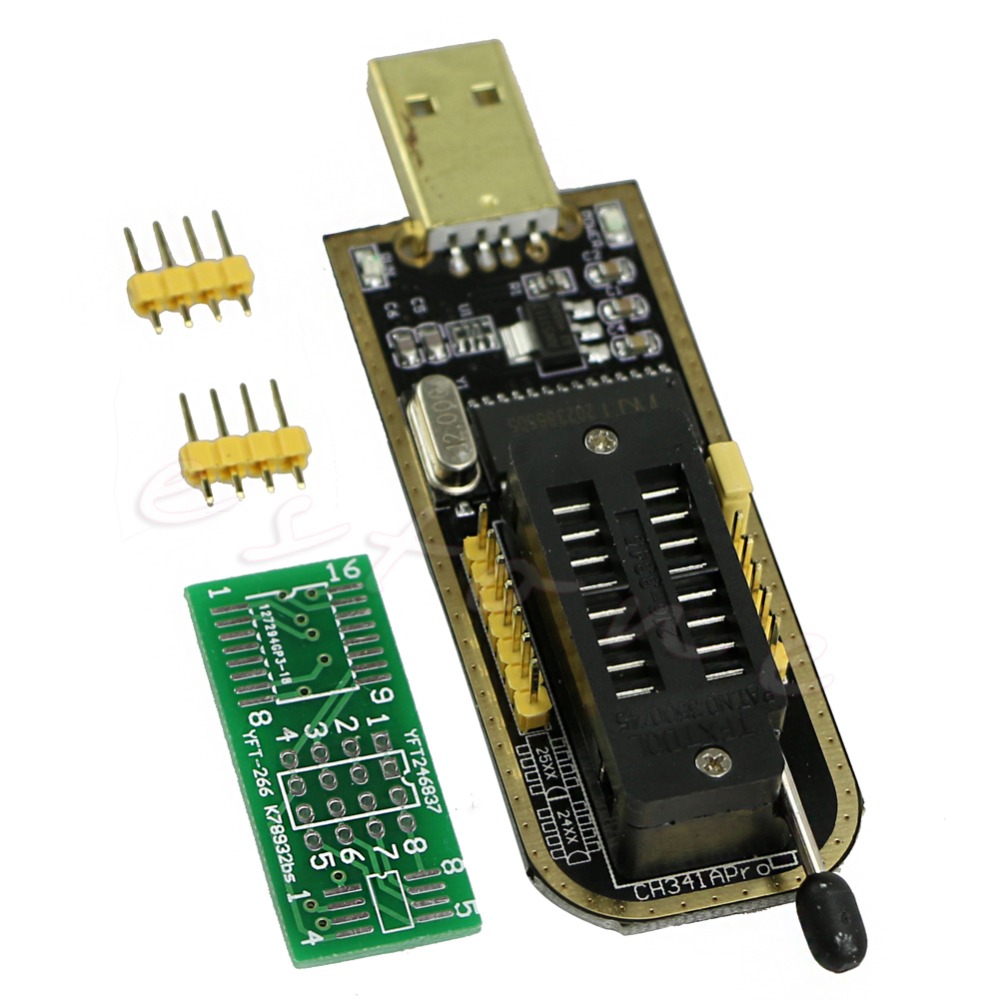
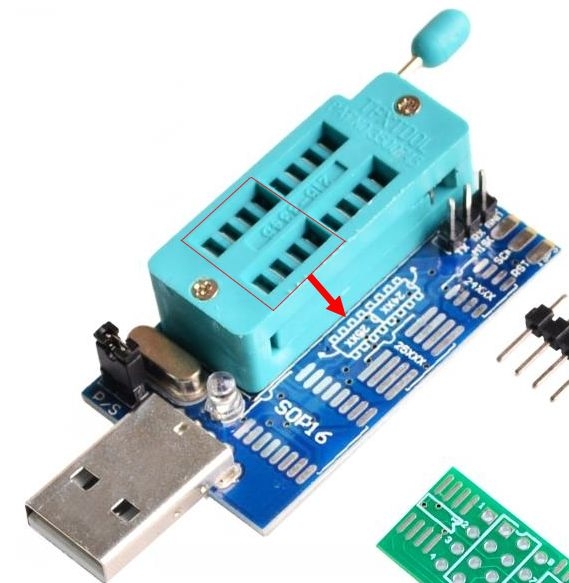
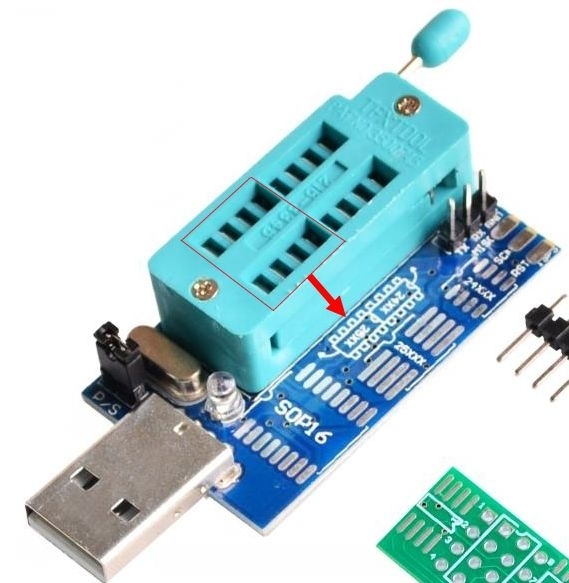
Hello. How is "there is nothing where the bone should be attached"? Even the attached picture shows where and how (the cut in the bone) insert the bone from the 25xxx series. If it is SMD memory, you can solder it directly to the programmer board - on the right side there are solder pads marked as 25xxx. greetings
This marking on the programmer can be confusing. There is a small arrow in which direction the beginning is drawn though the opposite. In the version 1.30 appendix, after selecting the correct memory, it will show you how to mount the memory in the slot.
Attachments:
CH341A - USB Programmer.rar(3.11 MB)
You must be logged in to download this attachment.
In my humble opinion, I will not agree with you. Depending on the version of the program, there are other instructions for mounting the memory in the "slot" and all are incorrect. I have a CH341APro programmer, and so for Hecy I inserted the ST24C04 memory (and what I have, I have a lot of them) according to program indications, contrary to the description put on the programmer and after such treatment it became a "souvenir". Proposal. Mount the given memory as described on the PCB of the type of programmer. Greetings.
I know that the programs also show badly but this marked description on the pcb for the layman is equally "accurate." As for memory damage, I did not even have time to put in a special way.
Works all OK, I didn't solder the chip, just pressed it down and that's why the memory programmer didn't see it. After soldering into the 25xxx field everything OK, thanks for your help.
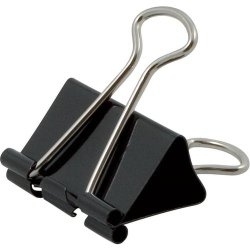
It was necessary not to solder and even to press the clothes peg. It's so bad. Because it is best to spend about PLN 30 on a neatly made clip for SMD systems.
It was necessary not to solder and even to press the clothes peg.
I use the office clip.
As for the messages, I would not care because these programs have different moods. If it detects a bone, delete the memory, then record a new batch, remove it and reinsert it into the bone detection slot and verify the content with the batch, if it is ok you can easily bake the bone into the target place.
Instead of the CH341A program, I recommend the flashrom, because CH341A caused too many problems for me. I had to have several different versions of CH341A because the newer version supposedly programmed, but the verification did not pass, the computer with such a bios did not get up and you had to try older versions until one of them managed. Sometimes he could not detect the memory model even though he had this memory in the database. In addition, CH341A is very slow, I recently programmed the Q64-104hip and flashrom read the batch several times faster, uploaded a new one and verified it, than CH341A did the same batch upload.
Just look for other versions of this program that you have and work with the one that does not spill on your platform. I have the same programmer and several versions of the same software for it.
WinUSB driver and Windows version compatibility issue
In addition, CH341A is very slow, I have recently programmed Q64-104hip and flashrom read the load several times faster, uploaded a new one and verified it than CH341A did just upload the load.
Did you do it under Windows? If so, what was the version and architecture of this Windows - 32 or 64-bit?
I bought the CH341A programmer and actually programming is slow. I know the flashrom program from Linux - I tried to compile a new version from source but I have the old version of Linux. Of course, there is also a port for Windows - ready files can be downloaded on the win-raid.com forum, e.g. in this topic Flashrom 3 Versions.zip but it probably only works on Windows 8 and 10. I tried to run it on Win7 64-bit, WinXP 64-bit and WinXP 32-bit and I always have the same errors:
flashrom
flashrom v0.9.9-86-gd051d86 on Windows 5.2 (x86)
flashrom is free software, get the source code at https://flashrom.org

Calibrating delay loop... OK.
libusb: warning [windows_get_device_list] could not retrieve port number for device '\\.\USB#VID_1A86&PID_5512#5&2A7FCFE4&0&1', skipping: [13] The data is invalid.
libusb: warning [windows_get_device_list] '\\.\USB#VID_1A86&PID_5512#5&2A7FCFE4&0&1' was only detected in late pass (newly connected device?) - ignoring
No usable CH341A USB device found.
Error: Programmer initialization failed.
On the win-raid forum they ensure that these versions certainly work, but I have to ask in which Windows and how to let me know.
Perhaps XP is not a update KB971286 WinUSB 1.9 but in Win7 it should already be and the flashrom fires with the same error as in XP so I don't know if that's it.
I was right that for WinXP it is about KB971286 WinUSB 1.9 only hard to find because it was withdrawn from Windows Update. But somehow I found and built a WinUSB driver for this programmer. To use the WinUSB driver you need:
if you already have some CH341A drivers on your system then you need to uninstall them and remove also the file oemX.inf with WINDOWSInf because when you reconnect WinXP it will automatically reinstall the ones you had
now we install the update on the system Microsoft WinUsb 2.0 WINUSB_UPDATE_XP-SRV03.exe for our platform that is either x86 or amd64
connect the programmer to the USB and in the window that appears choose manual installation and indicate the folder with my driver, that is where the file CH341A.inf
after installation, the driver will be in Device Manager in the Interface
D:\Pobieranie\flashromw>flashrom
flashrom p1.0-109-g3bcd922 on Windows 5.2 (x86)
flashrom is free software, get the source code at https://flashrom.org

Calibrating delay loop... OK.
Found Winbond flash chip "W25Q64.V" (8192 kB, SPI) on ch341a_spi.
No operations were specified.
Tested on WinXP SP2 x64.
I'll allow a high commission on the attachment because it was hard to find this update and a bit of a hassle to write the driver but I managed flashrom_W..USB.zip (9.65 MB)You must be logged in to download this attachment.
Hello I will heat up the topic a bit, again after a year I need to use the programmer and unfortunately I do not know what the problem is, namely plug in, install the driver (installs and correctly recognizes the device in win7 32bit and win10 64bit) unfortunately any version of the program will start in red "no connected". The programmer was certainly functional and now I do not know if he died (on loans) or some other problem, I do not know whether to order the next one with alledrogo?
The programmer was definitely functional and now I don't know if he died (he was on loans)
"Good habit: Don't borrow." I don't know which version of the programmer you have, but if you were to buy a new one, I recommend the one from the attachment.
Attachments:
Programator CH341APro GOLD.jpg(145.62 KB)
You must be logged in to download this attachment.
@gumisie I have the one you recommend, and the problem was as it was written @ E8600 bad jumper, I put it on correctly and it went Thank you for your help
Create an account, log in here and be active on the forum — ads won't appear. Earn points for registering and replying.
The discussion revolves around the setup and usage of the Mini CH341A programmer with a Winbond 25x16 memory chip. Users share their experiences regarding the correct embedding of the memory chip into the programmer, highlighting the confusion caused by the markings on the PCB. Some users suggest soldering the SMD memory directly to the programmer's pads, while others recommend using a clip for better results. Issues with software compatibility, particularly with the CH341A programming software, are noted, with some users advocating for the use of Flashrom as a more reliable alternative. Problems with memory detection and programming errors are also discussed, along with troubleshooting tips for various Windows versions. AI summary based on the discussion. May contain errors.
Why it matters: Correct orientation and software cut flashing time while preventing chip damage.
Quick Facts
• Mini-CH341A costs approx. US $3–$5 [AliExpress price snapshot 2023].
• Black-PCB CH341A outputs 3.3 V; older green boards default to 5 V CH341A Datasheet.
• Winbond 25X16 holds 16 Mbit (2 MB) [Winbond Datasheet 2016].
• Flashrom v0.9.9 reads up to 70 % faster than stock GUI [Elektroda, lekto, post #16756931]
• A quality SOIC-8 clip costs ≈ 30 PLN [Elektroda, krakarak, post #16756267]
Where do I place a Winbond 25X16 chip on the mini CH341A?
Use the SOIC-8 ZIF socket. Align the chip’s notch or dot (pin 1) with the small arrow printed on the board’s left edge [Elektroda, Dydelmax, post #16755677] Pin 1 must sit nearest the arrow to avoid reversed wiring.
Which way should pin 1 face?
Face pin 1 toward the board’s arrow; this is usually toward the USB connector on black boards [Elektroda, E8600, post #16755945] Reversed insertion can short VCC and damage the flash within seconds—an edge-case many users report.
Do I need to solder the SMD chip, or can I use a clip?
The GUI shows "Access violation at address…"—what does it mean?
The error comes from unstable software builds. If the chip still detects, ignore the message, erase, program, re-seat, and verify [Elektroda, E8600, post #16756313] Updating to a newer GUI or flashrom eliminates the crash.
Program says "No connected" even after driver install. Fix?
Use flashrom v0.9.9 or newer. Users measured reads several times faster than the stock app when flashing a 64 Mbit chip [Elektroda, lekto, post #16756931] Flashrom bypasses GUI delays and streams data directly through libusb.
Where do I download flashrom for Windows and how do I install it?
Grab the pre-built ZIP from win-raid.com (Flashrom 3 Versions.zip) or flashrom.org [Elektroda, lekto, post #16762531] Unpack, place flashrom.exe in a folder, and run from Command Prompt: flashrom –p ch341a_spi –r backup.bin. No installer is required.
Flashrom can’t find CH341A on Windows XP. Workaround?
Install WinUSB 1.9 (KB971286) first, then load the custom CH341A WinUSB driver. Remove old OEM INF files, run WINUSB_UPDATE_XP-SRV03.exe, and point Device Manager to CH341A.inf [Elektroda, Gelib, post #18342633] Flashrom will then list the programmer.
After programming, my HP DV6 shows a dark screen and two Caps-Lock blinks. Cause?
The BIOS image is corrupt or mismatched. Two blinks indicate a BIOS checksum failure on DV6 models HP Service Code. Verify your dump against the new file, re-flash, and ensure the chip size matches [Elektroda, dj_master0, post #16756579]
What is the correct jumper setting on black CH341A boards?
For 25-series SPI flash, place the blue jumper on pins marked “1-2” near the edge connector. Moving it to “2-3” shifts the bus to UART and the software will show “not connected” [Elektroda, E8600, post #18710019]
Erase, then write: flashrom –w new.bin; wait for “VERIFIED.”
Power-cycle, read again, compare to new.bin. If identical, solder or clip back.
What happens if I insert the chip backwards?
The CH341A will drive VCC into a data pin. The chip may overheat and fail instantly, as one user turned his ST24C04 into a “souvenir” [Elektroda, gumisie, post #16756040]
AI summary based on the discussion. May contain errors.







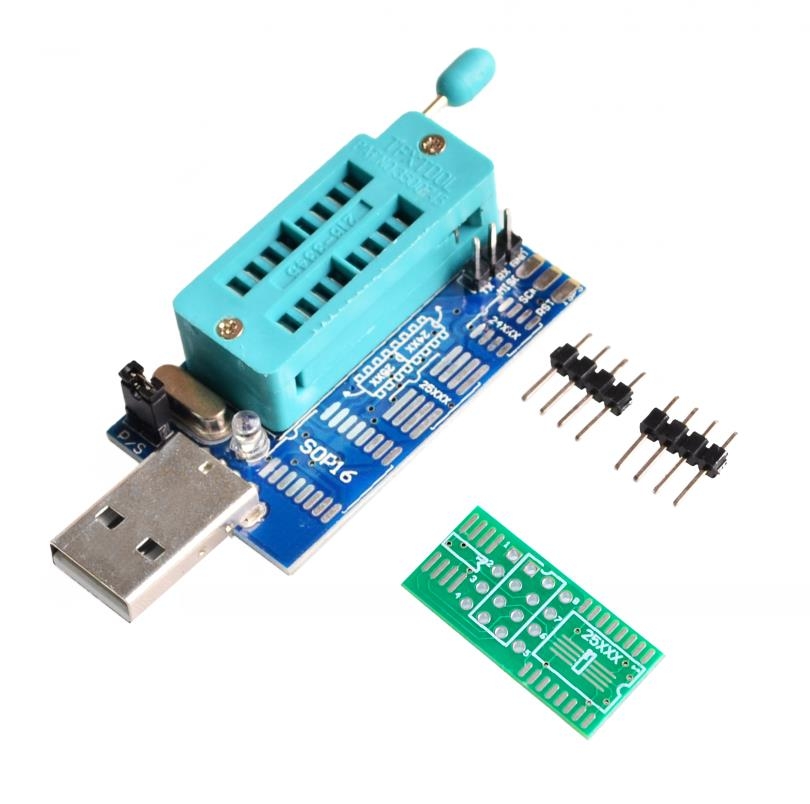
 In the version 1.30 appendix, after selecting the correct memory, it will show you how to mount the memory in the slot.