logo elektroda
logo elektroda
X
logo elektroda

Check Engine Power Without Nameplate: Measuring Old Attic Engine's Power Capacity

Mixerios 28974 38
Best answers

How can I estimate the power of an old electric motor without its nameplate?

You usually cannot determine the exact power from the missing nameplate alone, but you can estimate it from photos and motor dimensions. Measure the shaft diameter and the housing/core dimensions (A/B/D/E, AC, H) or, better, the inner core diameter and core length; with those values the motor can often be identified or narrowed down to a specific model [#16940410] [#16940473] [#18995168] [#18995223] The thread also notes that four-pole motors like these are typically around 1440 rpm, so speed can be inferred from the motor type if the model is known [#18995223] For similar SZJd/SZJe motors, people in the thread estimated anything from about 2.2 kW to 5.5 kW depending on size, and one example was identified as an SZJe 34a with 3 kW, 1430 rpm, and 6.5 A at 380 V star connection [#16940548] [#16940745] [#16940755] [#18995244]
Generated by the language model.
ADVERTISEMENT
Treść została przetłumaczona polish » english Zobacz oryginalną wersję tematu
  • #31 19534826
    Mazda6125
    Level 10  
    Posts: 27
    Help: 4
    Rate: 8
    vorlog wrote:
    Moisten the plate with kerosene / WD40, then (at the right angle) it will become more readable :)
    V.


    I tried, although the best method is probably the black marker (as shown in the photo). Nevertheless, the rest of the data is as if ... worn out, it had to be less stamped than the serial number.

    Ah ... I remembered it. It seems to me that SZJd 44a is written there. However, neither the SZJd 44 / 44a nor the SZJe 44 / 44a is visually similar, nor the data from the table.
    The second issue is when browsing information plates on the Internet, it seems to me that it may be the Tamel company, because the data that I have managed to read are almost in the same places I saw on Google.
  • ADVERTISEMENT
  • #32 19534834
    krzysiek7
    Moderator of Electricians group
    Posts: 4835
    Help: 676
    Rate: 1910
    Mazda6125 wrote:
    It seems to me that SZJd 44a is written there

    I read it that way too. I have the data of these engines, but I do not have them at hand at the moment.
    Mazda6125 wrote:
    However, neither the SZJd 44 / 44a nor the SZJe 44 / 44a is visually similar, nor the data from the table.

    The motor data of the SZJe will not match your motor, it's a different motor series.
  • #33 19534838
    vorlog
    Level 40  
    Posts: 8347
    Help: 527
    Rate: 2581
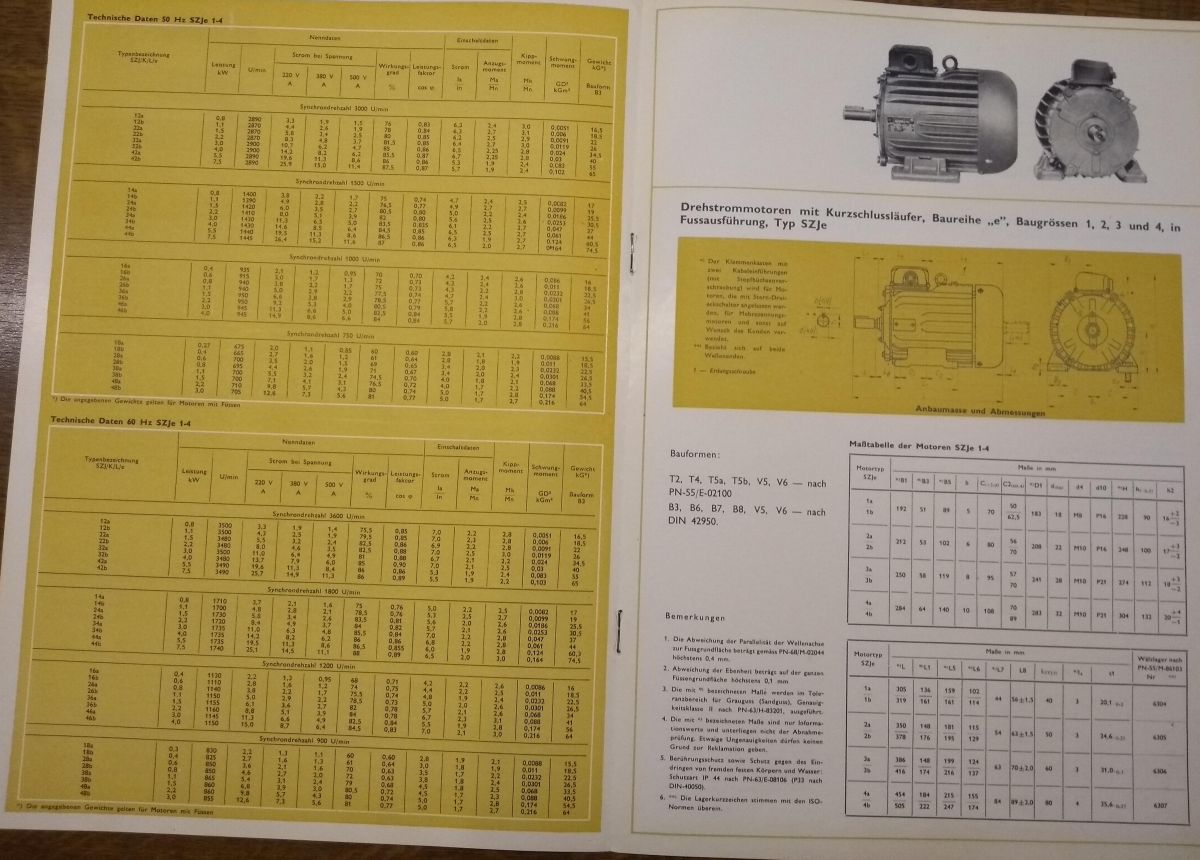
    Piece of old Tamel catalog
    Check Engine Power Without Nameplate: Measuring Old Attic Engine's Power Capacity
    V.
  • ADVERTISEMENT
  • #34 19534840
    krzysiek7
    Moderator of Electricians group
    Posts: 4835
    Help: 676
    Rate: 1910
    Now I was able to read the rated current of 10.5 / 6.1 A from the plate.
    However, it is the SZJd 44b engine; 2.8 kW; 1420 rpm; 6.1 A for 380 V for star connection.
  • #35 19876181
    pabloboss1
    Level 4  
    Posts: 6
    Check Engine Power Without Nameplate: Measuring Old Attic Engine's Power Capacity


    Exactly what value? Can anyone help?
  • ADVERTISEMENT
  • #36 19876192
    Rezystor240
    Level 42  
    Posts: 9240
    Help: 689
    Rate: 1647
    We do not write on several topics at the same time!
  • #37 19876230
    vorlog
    Level 40  
    Posts: 8347
    Help: 527
    Rate: 2581
    pabloboss1 wrote:
    Can anyone help?

    Lord! It is possible to measure nature by metro, there are no calipers nearby?
    I wrote - you have a catalog card with dimensions above - enlarge yourself, it is readable ...
    V.
  • ADVERTISEMENT
  • #38 19876253
    pabloboss1
    Level 4  
    Posts: 6
    If I knew, I wouldn't come in here, how much can I take for one?
  • #39 19876269
    vorlog
    Level 40  
    Posts: 8347
    Help: 527
    Rate: 2581
    Are you sure it is operational? If not, it's as much as times the scrap rate.
    For efficient, maybe PLN 200-300
    V.

Topic summary

✨ The discussion revolves around determining the power capacity of an old engine found without a nameplate. Participants suggest various methods to estimate the engine's power, including measuring the shaft diameter and providing dimensions such as A, B, D, and E. Several users estimate the power based on the engine's size and characteristics, with estimates ranging from 2.2 kW to 5.5 kW. Specific models mentioned include the SZJe and SZJd series, with some users sharing their experiences with similar engines. The importance of dimensions and rotational speed in estimating power is emphasized, along with caution regarding the engine's condition, particularly if it has been overheated or damaged.
Generated by the language model.

FAQ

TL;DR: Using IEC frame tables, a 28 mm shaft (frame 132) typically delivers 5 – 7.5 kW at 1 500 rpm [IEC 60072]. “The diameter of the shaft also proves its power” [Elektroda, Łukasz.K, post #18995168] Measure shaft Ø, stator length and frame size, then match to catalog data.

Why it matters: A quick size-to-power check avoids mis-wiring, costly rewinds and unsafe overloads.

Quick Facts

• IEC frame 132: 28 mm shaft, centre-height 132 mm, 5 – 7.5 kW at 4-pole speed [IEC 60072]. • Polish SZJe 34a: 3 kW, 1 430 rpm, 6.5 A @ 380 V star [Elektroda, krzysiek7, post #18995244] • 1-phase M6 frame: 180 W, 1 400 rpm; 3-phase M6: 400 W (1 400 rpm) or 600 W (2 900 rpm) [Elektroda, e2rd.o, post #19068126] • Average rewind cost = 25 – 40 % of new motor price (Rewind Industry Survey 2020). • Phase-loss can raise current 30 % and scorch windings [Elektroda, krzysiek7, post #18995223]

How can I estimate an induction motor’s power when the nameplate is missing?

  1. Measure shaft diameter (D) and centre height (H).
  2. Measure stator core length (L) and outside diameter.
  3. Compare the numbers with IEC 60072 or original catalog tables. Example: 28 mm shaft and 132 mm centre height correspond to 5 – 7.5 kW at 4-pole speed [IEC 60072]. "The shaft size tells a lot about power" [Elektroda, Łukasz.K, post #18995168]

Which dimensions do posters A, B, D, and E refer to?

A = overall body height, B = overall length between endshields, D = shaft diameter, E = shaft extension length [Elektroda, Krzysztof Reszka, post #18940954] Provide these to match frame charts reliably.

How do I determine the motor’s rotational speed?

Count supply frequency poles: 120 × f / p ≈ synchronous rpm. Most attic finds are 4-pole (≈1 500 rpm at 50 Hz). Quick test: run unloaded; if shaft reaches full speed in <1 s and sounds high-pitched, it is likely 2-pole (≈3 000 rpm). Use a tachometer for confirmation.

What if the windings look dark or burnt?

Dark varnish and melted slot wedges show overheating. Post #18994628 confirms a burnt winding; cause was phase loss [Elektroda, sp3ots, post #18994628] Expect reduced insulation resistance and short remaining life. Rewind or replace before re-energising.

Is rewinding an old SZJd or SZJe motor worth it?

Rewinds cost 25 – 40 % of a new motor (Rewind Industry Survey 2020). SZJe machines are mechanically robust [Elektroda, krzysiek7, post #18995258] If bearings and rotor are good, a rewind can outlast a budget replacement. Otherwise, buy modern IE3 motor for better efficiency.

How much cable cross-section should I use for a 3 kW, 380 V motor?

A 3 kW 400 V motor draws about 6.5 A [Elektroda, krzysiek7, post #18995244] Use 4 × 1.5 mm² rubber or PVC flex; this handles up to 16 A per IEC 60364.

Can I run a 3-phase motor on single-phase supply?

Yes, with a VFD or capacitor start/run. Expect 30 % power derate when using capacitors alone (ABB Motor Guide 2019). For a 3 kW unit, usable output drops to about 2 kW.

How do I safely spin-test an unknown motor?

  1. Megger windings to ≥1 MΩ at 500 V.
  2. Clamp ammeter on each phase, start with DOL on a fused breaker.
  3. Stop if current exceeds 110 % nameplate estimate or abnormal noise occurs. Edge case: missing phase can burn windings within minutes [Elektroda, krzysiek7, post #18995223]
Generated by the language model.
ADVERTISEMENT