logo elektroda
logo elektroda
X
logo elektroda

[Solved] SSD Connection Issues: MOLEX->SATA Adapter vs Distributor & 4 vs 5 Cable Connectors

PeCha 14967 11
ADVERTISEMENT
Treść została przetłumaczona polish » english Zobacz oryginalną wersję tematu
  • #1 17046370
    PeCha
    Level 12  
    Posts: 296
    Rate: 49
    Hello.
    I wanted to connect an SSD drive to the other computer, but at the beginning there was a problem with the power supply for the drive.
    The power supply has only one SATA connector, which is used for the old HDD, which remains as a place for other data.
    Unfortunately, the store lacked the usual MOLEX-> SATA adapter, so I bought an adapter with a MOLEX-> SATA MOLEX distributor.
    Unfortunately it didn't work.
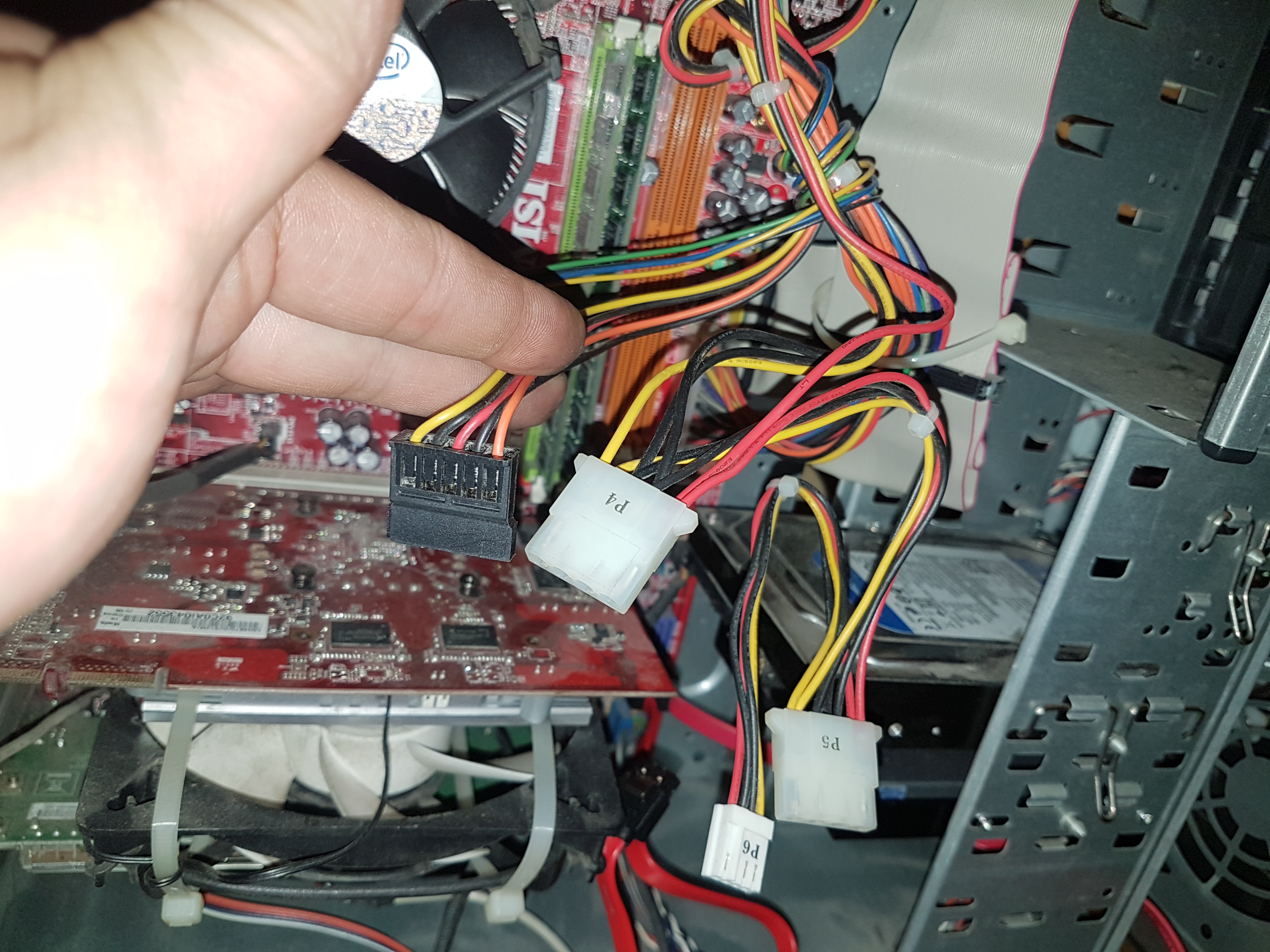
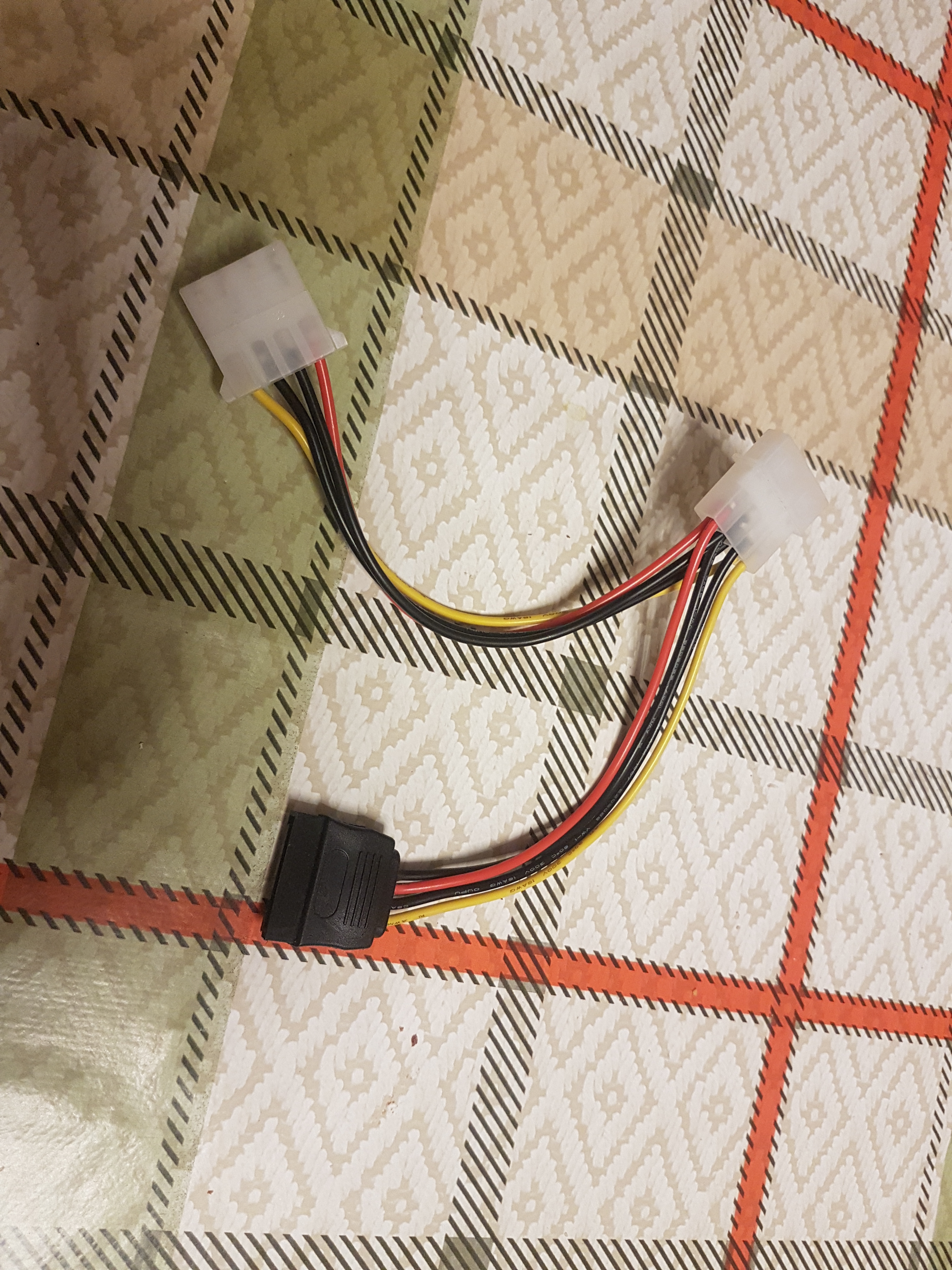
    I noticed, as you can see in the pictures, that the original SATA power supply has 5 cables (yellow, black, red, black, orange),
    and purchased adapter only 4 (yellow, black, red, black).
    However, after reading several similar threads, I saw that the recommended MOLEX-> SATA adapters are just 4 cables and apparently work.

    Could it be that it didn't work for me because I bought a non-ordinary adapter but a splitter?
    Or maybe it's just a 4 and not 5 cable connector?
    Or maybe it matters which MOLEX I connect the adapter / splitter to?
    Possibly what adapter to buy?
    SSD Connection Issues: MOLEX->SATA Adapter vs Distributor & 4 vs 5 Cable Connectors
    SSD Connection Issues: MOLEX->SATA Adapter vs Distributor & 4 vs 5 Cable Connectors

    In the pictures, the colors of the cables with the only SATA connector coming from the power supply and purchased splitter.

    Thanks for the help!
  • ADVERTISEMENT
  • #2 17046411
    Kasek21
    Level 43  
    Posts: 45502
    Help: 4962
    Rate: 3503
    Connect the HDD cable for a while and see if the disk will be detected in the BIOS. If so, leave the SSD connected and HDD connect via the adapter.

    3.3V are missing in these adapters.
    https://pl.wikipedia.org/wiki/Serial_ATA
  • ADVERTISEMENT
  • #3 17046425
    smiland
    Level 15  
    Posts: 84
    Help: 12
    Rate: 8
    Read the required operating voltage on the disk - probably only 5V, i.e. the orange cable is not needed. Check what voltages the power supply gives on molexes - if it is not about 5V and about 12V then there is a problem with the power supply or there is no contact in molexes. SSDs require power only from the 5V line.
  • #5 17046480
    smiland
    Level 15  
    Posts: 84
    Help: 12
    Rate: 8
    Kasek21 wrote:
    smiland wrote:
    SSDs require power only from the 5V line.


    http://www.tomshardware.co.uk/forum/285526-32-power

    My error - I did not express myself precisely: most 2.5-inch laptop SSDs require only 5V - that's why you should read the information from the description on the disk.
  • #6 17046541
    PeCha
    Level 12  
    Posts: 296
    Rate: 49
    Thanks for the quick responses.
    The disk is Plextor PX-128M7VC 128GB.
    Today I connected the second in the second computer, but here the power went directly from the power supply and the cable was five-wire, with orange. Everything went without a problem.
    The one with the described problem I tried to connect yesterday on a different computer, unfortunately I do not remember and I do not remember if I tried to connect the HDD using the adapter purchased. Maybe this week I will be able to check, then I will write.

    But when it comes to the cable itself, I understand that it makes no difference whether it is branching or just an adapter?
  • #7 17046551
    Kasek21
    Level 43  
    Posts: 45502
    Help: 4962
    Rate: 3503
    PeCha wrote:
    But when it comes to the cable itself, I understand that it makes no difference whether it is branching or just an adapter?

    There is no.

    This adapter is sufficient for this SSD. If HDD works on it, it is not a problem with power supply but something else.

    What is this motherboard model?
  • ADVERTISEMENT
  • #9 17049822
    Kasek21
    Level 43  
    Posts: 45502
    Help: 4962
    Rate: 3503
    Kasek21 wrote:
    Connect the HDD cable for a while and see if the disk will be detected in the BIOS. If so, leave the SSD connected and HDD connect via the adapter.

    ?
  • #10 17056312
    PeCha
    Level 12  
    Posts: 296
    Rate: 49
    I connected the HDD with an adapter and it works.
    I connected the SSD with a cable from the power supply and installed it after starting.
    The problem is that it can be seen in the Device Manager, but it cannot be seen in My computer.
    For now, I haven't had time to check something more or start installing Windows on it. I didn't check it in the BIOS either.
  • ADVERTISEMENT
  • #11 17057008
    Kasek21
    Level 43  
    Posts: 45502
    Help: 4962
    Rate: 3503
    PeCha wrote:
    The problem is that it can be seen in the Device Manager, but it cannot be seen in My computer.

    My computer -> Manage -> Disk management.
  • #12 17272722
    PeCha
    Level 12  
    Posts: 296
    Rate: 49
    I connected the HDD with an adapter and it works.
    I connected the SSD with a cable from the power supply and installed it after starting.
    Then I set up the disks using the device:
    My computer -> Manage -> Disk management.

    Everything is nice.

    Thank you so much for help!

Topic summary

✨ The discussion revolves around issues connecting an SSD to a computer due to power supply limitations. The user initially faced problems with a MOLEX to SATA adapter that was a splitter, which did not work because it lacked a 5V line, essential for powering the SSD. After confirming that most 2.5-inch SSDs, like the Plextor PX-128M7VC, require only 5V, the user successfully connected the SSD using a proper power supply cable with five wires. The conversation highlights the importance of ensuring the correct type of adapter and the necessity of checking the power supply's voltage output. Ultimately, the SSD was recognized in the Device Manager but required further setup in Disk Management to be accessible in My Computer.
Generated by the language model.

FAQ

TL;DR: SATA power uses a "15-pin power connector" with 3.3/5/12 V rails; 3.3 V is rarely used. For SSD power issues, a 4‑wire MOLEX→SATA adapter typically suffices. ["Serial ATA"]

Why it matters: This FAQ helps PC builders and upgraders fix SSD power/detection problems when using MOLEX→SATA adapters or splitters.

Quick Facts

  • SATA power has 15 pins carrying 3.3 V, 5 V, and 12 V; 3.3 V is seldom needed by consumer SSDs. ["Serial ATA"]
  • The 4‑pin peripheral “Molex” plug provides 12 V (yellow) and 5 V (red) only; no 3.3 V. ["Molex connector"]
  • SATA pin 3 (3.3 V) can act as Power Disable (PWDIS); asserting it may prevent startup. ["Serial ATA"]
  • SATA link speeds: 3.0 Gbit/s ≈ 300 MB/s, 6.0 Gbit/s ≈ 600 MB/s usable throughput. ["Serial ATA"]
  • New/blank disks must be initialized, partitioned, and formatted in Disk Management to appear in Explorer. ["Initialize new disks"]

Do I need the orange 3.3 V wire to power a 2.5-inch SATA SSD?

Usually no. The SATA power spec includes 3.3 V, 5 V, and 12 V, but many consumer 2.5-inch SSDs do not use 3.3 V. A typical 4‑wire MOLEX→SATA adapter supplies 5 V and 12 V, which is sufficient for most SATA SSDs. If a specific SSD requires 3.3 V, that requirement appears on its label or datasheet. ["Serial ATA"]

Why didn’t my MOLEX→SATA splitter power the SSD when the native SATA lead did?

Most MOLEX→SATA adapters lack the 3.3 V line. As Kasek21 notes: "3.3V are missing in these adapters." Many SSDs still work because they use 5 V only. If the SSD is not detected, test by swapping which device uses the native SATA power lead, then verify detection in BIOS. [Elektroda, Kasek21, post #17046411]

Does it matter which Molex connector I plug the adapter into?

Electrically, each 4‑pin peripheral Molex on the same harness carries 12 V (yellow) and 5 V (red) plus grounds. Use any available plug with firm contacts. If a connector is oxidized or loose, try a different plug to ensure stable power delivery. ["Molex connector"]

Is a power splitter worse than a straight MOLEX→SATA adapter?

Functionally, no. A splitter simply branches the same rails. As one expert put it, "There is no" difference in principle between a branch and a plain adapter, assuming decent build quality. Keep cable quality in mind and avoid obviously flimsy parts. [Elektroda, Kasek21, post #17046551]

Which adapter should I buy to power a 2.5-inch SSD like the Plextor M7VC?

A simple MOLEX→SATA power adapter is sufficient for a 2.5-inch SATA SSD. If available, use the PSU’s native SATA lead for the SSD and power the HDD via the adapter, as suggested in the thread. This setup proved reliable for the OP. [Elektroda, Kasek21, post #17046551]

My SSD shows in Device Manager but not in This PC. How do I fix it?

Initialize and format the drive. How‑To:
  1. Open Disk Management (Win+X → Disk Management).
  2. Initialize the disk (GPT for UEFI systems, MBR for legacy).
  3. Create a New Simple Volume, format NTFS, and assign a drive letter. After this, the SSD appears in Explorer. ["Initialize new disks"]

How can I quickly check if the SSD is detected before installing Windows?

Enter BIOS/UEFI and look for the SSD in the SATA device list. For a quick power test, connect the SSD to the HDD’s native SATA power lead, then power the HDD via the adapter. If the SSD shows in BIOS, power is fine and you can proceed. [Elektroda, Kasek21, post #17046411]

Will an older SATA II board limit my SSD speed?

Yes. SATA 3.0 Gbit/s (often called SATA II) caps sequential throughput around 300 MB/s. Your system will still feel much faster due to SSD latency, but large file transfers won’t exceed that link rate. On SATA 6.0 Gbit/s, the cap is about 600 MB/s. ["Serial ATA"]

Can 3.3 V on SATA pin 3 stop a drive from powering up (PWDIS)?

Yes. Some drives implement Power Disable on pin 3. If 3.3 V is asserted there, the device may remain off. Using a MOLEX→SATA adapter that omits 3.3 V often avoids this edge case, especially with newer or enterprise models. ["Serial ATA"]

What voltage does my Plextor PX‑128M7VC need?

Check the label or datasheet. Most 2.5-inch laptop-class SATA SSDs draw from the 5 V rail only. As smiland clarified, "most 2.5-inch laptop SSDs require only 5V." If yours states 5 V only, a 4‑wire adapter is fine. [Elektroda, smiland, post #17046480]

Is it OK to power a mechanical HDD through the adapter and the SSD from the PSU’s SATA lead?

Yes. In the thread, the HDD worked from the MOLEX→SATA adapter and the SSD from the PSU’s native SATA cable. After initializing the SSD in Disk Management, Windows recognized both drives and the setup worked reliably. [Elektroda, PeCha, post #17272722]

What finally solved the OP’s problem?

They powered the SSD from the PSU’s SATA cable, powered the HDD via the MOLEX→SATA adapter, then initialized and partitioned the SSD in Disk Management. After that, the SSD appeared in Windows and everything worked as expected. [Elektroda, PeCha, post #17272722]
Generated by the language model.
ADVERTISEMENT