logo elektroda
logo elektroda
X
logo elektroda

Remotely turning on the computer (wake on lan) does not work after changing loca

Włodi 7278 13
ADVERTISEMENT
Treść została przetłumaczona polish » english Zobacz oryginalną wersję tematu
  • #1 17343492
    Włodi
    Level 19  
    Posts: 728
    Help: 20
    Rate: 46
    Hello.

    I wanted to be able to turn on my computer remotely from where I am currently on vacation. I configured UEFI, enabling the necessary options (MSI Z77A-G45 board), I wrote back the network card's mac from the console, in the router (connect box from UPC) I forwarded the port. I noticed that the router stops sending a signal to the card when the computer shuts down, so I added an exception in the router, giving it a mac, and from then on the computer started to wake up remotely. On the computer from which I want to wake up, I downloaded a small application "wake on lan", in which I enter:

    - mac of the network card of the computer to be woken up
    - external IP of the computer to be woken up (read from "my ip" websites, etc.)
    - subnet mask: "255.255.255.255"
    - the method of sending the "Internet" packet
    - the port that I forwarded in the connect box

    Before leaving, I tested it five times to make sure everything works by disconnecting from the connect box's wifi network and connecting to the one provided by the mobile (mobile hot spot, play network). I did longer time intervals between attempts. It worked every time. Currently, the only thing that has changed is that the laptop with the mobile from which I share the Internet is located in a different place in Poland. I control the state of the computer's operation through the team viewer. I send the magic package in the same way as on the spot, I share the link from the same phone.

    What do you think could be wrong? Is there any chance to save this connection? The computer and the router are of course connected to the electricity on site.
  • ADVERTISEMENT
  • Helpful post
    #2 17343515
    makosuu
    Network and Internet specialist
    Posts: 2984
    Help: 369
    Rate: 369
    Common Wake on LAN problems on home devices (computers). The entry in the ARP table on the router may have expired. There's no Intel vpro here so the computer won't renew the address lease, so gimme. The solution is to add a static entry to the ARP table in the router, the best solution is a router with openwrt and sending packets from its level.
    DNS set up? After all, you have a floating address, and that's the basis of access from the outside.
    PS: if the router restarted, it lost the ARP entry for 100% and the public address changed. The solutions to both problems are listed above. And to turn on the computer, all you can do is call someone and tell them to press the switch, and give them a public address. Then you must set Ddns on the router, and if the scrap from UPC allows, it is entered into the ARP table. And it's best to put Compal in bridge mode and its own router.

    Unless a miracle happens and the computer turns on. Then only the activities described above without calling.
  • ADVERTISEMENT
  • #4 17343545
    makosuu
    Network and Internet specialist
    Posts: 2984
    Help: 369
    Rate: 369
    By sending a Wake on LAN packet to a specific port, you can wake up the computer and port forwarding is definitely applicable here, because this packet must somehow get behind the NAT.
  • #5 17343576
    JacekCz
    Level 42  
    Posts: 8670
    Help: 760
    Rate: 1460
    makosuu wrote:
    By sending a Wake on LAN packet to a specific port, you can wake up the computer and port forwarding is definitely applicable here, because this packet must somehow get behind the NAT.


    Then explain how, since in the LAN network it is a broadcast packet. A computer that is turned off does not have a TCP address, so NAT (TCP service) does not occur.
  • #6 17343584
    makosuu
    Network and Internet specialist
    Posts: 2984
    Help: 369
    Rate: 369
    Yes, in this case the turned off computer has no address. But above I wrote about entries in the ARP table. And equipment with vPro normally renews the address, from there you can go to its website, force shutdown, turn on, restart, boot from USB.
  • ADVERTISEMENT
  • #7 17343615
    JacekCz
    Level 42  
    Posts: 8670
    Help: 760
    Rate: 1460
    makosuu wrote:
    Yes, in this case the turned off computer has no address. But above I wrote about entries in the ARP table. And equipment with vPro normally renews the address, from there you can go to its website, force shutdown, enable, restart, boot from USB.


    You're making too much guesswork. The ARP table is not necessary because it is broadcast etc etc ... the sleeping card itself detects what is addressed to it.

    VPro is not Wake on lan (it is much older than the first one), although it is clear to human sense that their combination gives usable quality.
    Don't connect this one phenomenon with what happens next.
  • #8 17343749
    tzok
    VIP Meritorious for electroda.pl
    Posts: 38663
    Help: 3162
    Rate: 6409
    In my experience, in this type of configurations, it only works when sending this packet from the router, because only then can it be a broadcast packet. It is not possible to send a broadcast packet addressed to the LAN over the Internet. The router will pass the unicast MagicPacket through the redirected port and direct it to the interface associated with the destination IP address (usually redirects), but as already noted, only until it has the IP address of this computer in its ARP table. In addition, a switch and its switching table are integrated into the router along the way. There, after some time, the MAC address of the turned off computer will expire.
  • ADVERTISEMENT
  • #9 17343875
    Włodi
    Level 19  
    Posts: 728
    Help: 20
    Rate: 46
    I read before setting up just about ARP. The idea was to add the card's mac address as an exception to be turned on by the magic package. I don't know if I found the right tab in the router options, because sometimes they are under different more friendly names (with ARP in the name I didn't come across after looking through all the tabs), but I found something that looked familiar There was a list of devices that are connected to the router, mac addresses, and expiration times in milliseconds (?). At the very bottom there was an option where you could add a mac address and mark it as an exception to these rules and not apply to it at this time. That's what I did, because earlier the computer was able to be turned on remotely once, and after some time not anymore. After adding this rule, this problem disappeared and I specifically waited a few hours to try again to see if it would expire and it was successful.

    In UPC, i.e. where the computer to wake up is located, I have a fixed external IP. I definitely have a dynamic IP in play from which I am trying to connect to that computer, if it matters.

    Port forwarding from what I read is required, when we send a packet from a network other than local, the unknown port may be blocked.
  • Helpful post
    #10 17343920
    tzok
    VIP Meritorious for electroda.pl
    Posts: 38663
    Help: 3162
    Rate: 6409
    Włodi wrote:
    There was a list of devices that are connected to the router, mac addresses, and times in milliseconds after which they expire (?).
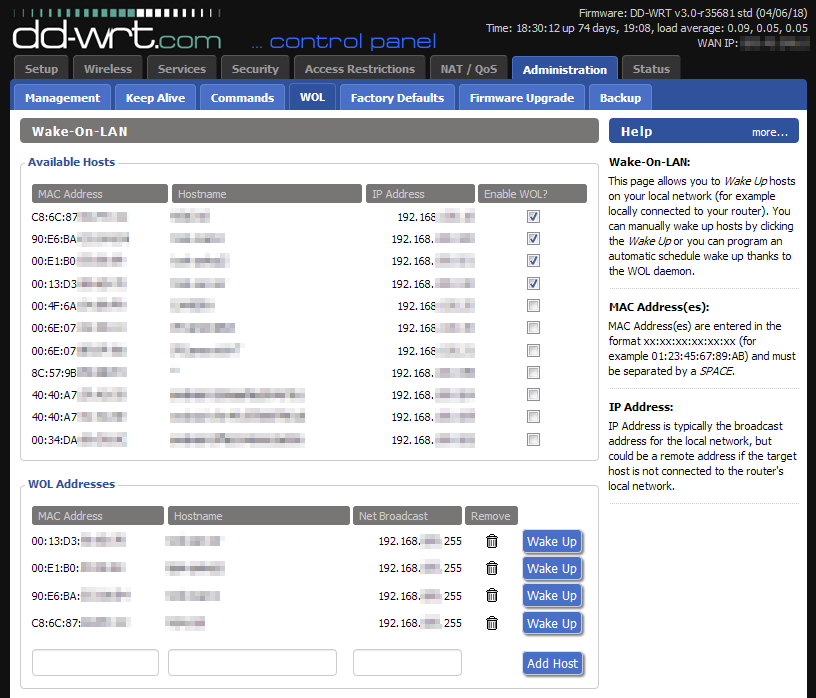
    Not in ms, just in s... and that was the DHCP table. A static IP address reservation is not the same as a static ARP entry. The router sends the packet over the Ethernet interface, so it must wrap it with an Ethernet frame. To do this, it needs to know the destination MAC address, which corresponds to the target's IP address. For this purpose, it uses ARP - if communication with this host has already taken place, there is an appropriate entry in the ARP table, if not (or it has been inactive for a long time), then there is no entry. Thus, before sending the proper packet, an ARP request is broadcast for the MAC address of the host with the indicated IP address. Unfortunately, the computer is turned off and will not respond to such a query. Due to the lack of response, the router does not know how to address the Ethernet frame containing the Magic Packet. Does your router have the ability to remotely log in to its configuration panel (under the external IP and on the indicated port)? If so, is it possible to initiate WOL from the configuration panel? In DD-WRT it looks like this:
    Remotely turning on the computer (wake on lan) does not work after changing loca

    After thinking about the matter, the only problem may be the ARP of the router, because the MAC table of the switch will also expire, but here it will manifest itself in sending the frame through all interfaces.
  • #11 17343975
    makosuu
    Network and Internet specialist
    Posts: 2984
    Help: 369
    Rate: 369
    Włodi wrote:

    In UPC, i.e. where the computer to wake up is located, I have a fixed external IP. I definitely have a dynamic IP in play from which I am trying to connect to that computer, if it matters.

    In Play, you don't even have a public IP at home, and it doesn't matter.


    Compal 99% has no option to add a static ARP entry or send WOL packets. It's best to switch it to bridge mode and connect your own router.

    WoL packets can be sent over the internet and I checked that. This is 100% working. I even use it often.
  • #12 17345311
    KOCUREK1970
    Network and Internet specialist
    Posts: 35138
    Help: 3786
    Rate: 5326
    Włodi wrote:
    In UPC, i.e. where the computer to wake up is located, I have a fixed external IP.

    On what equipment does UPC work there - modem and its own router or modemorouter, is there no IPv6 enabled there?
  • #13 17346433
    Włodi
    Level 19  
    Posts: 728
    Help: 20
    Rate: 46
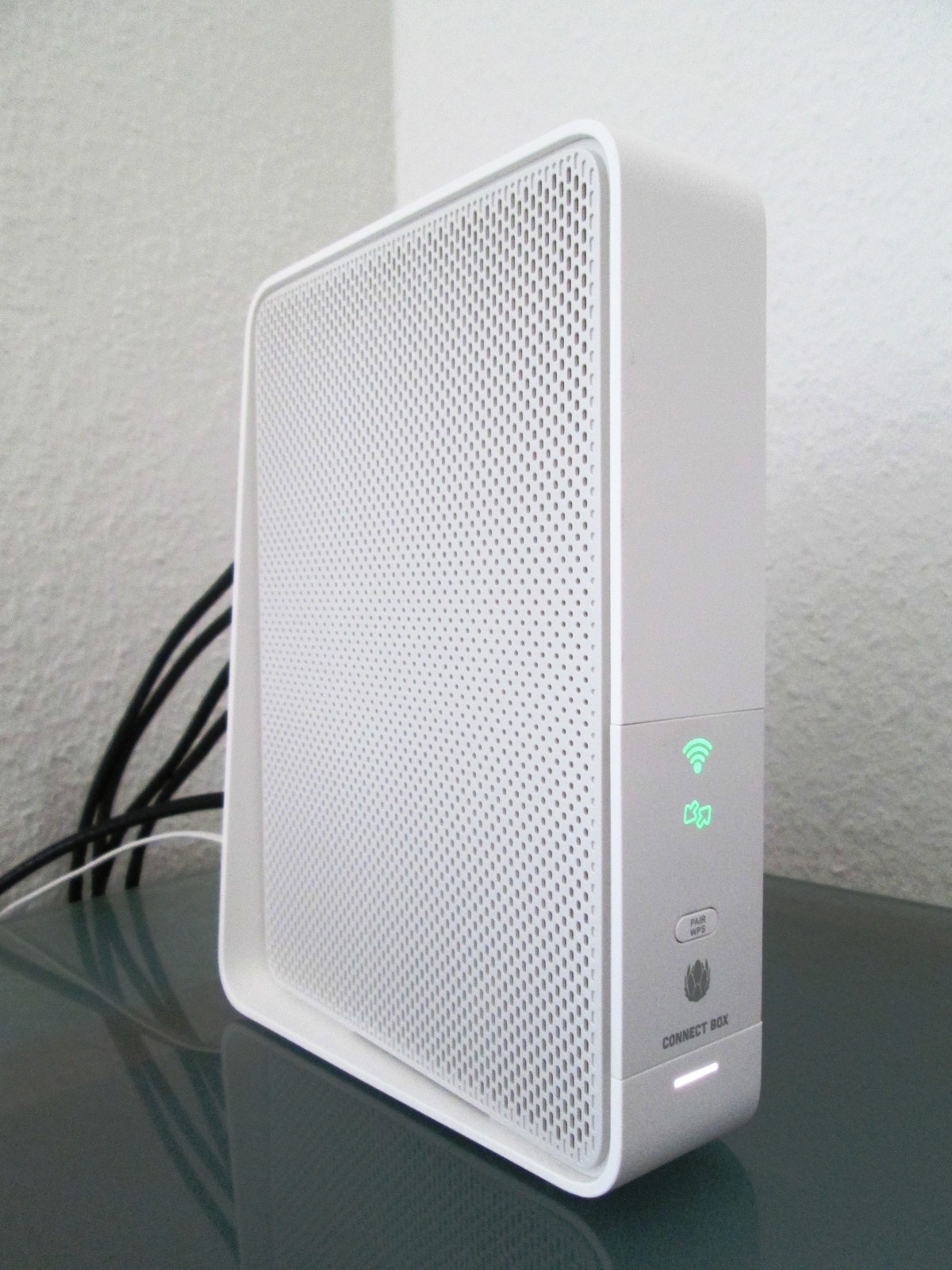
    The modem router and the computer is connected directly to it with a cable. This is a Compal router, as someone wrote above. I have now found a model on the forum that may be Compal CH7465LG-LC. In UPC it is called "Connect Box". The look is right. At the input there is a coax with a signal from them, at the output there are four ethernet ports and two telephone ports. It is possible that IPv6 is enabled. In the console after typing "ipconfig /all", if I remember correctly, there was also some address in this line. Modem settings are default, the ones I modified are described above. I found the user manual, which I put in the attachment, you can see the individual settings screens there.

    Remotely turning on the computer (wake on lan) does not work after changing loca Remotely turning on the computer (wake on lan) does not work after changing loca
    Attachments:
    • upc_instrukcja_obslugi_modemu_compal.pdf (17.43 MB) You must be logged in to download this attachment.
  • #14 17346436
    KOCUREK1970
    Network and Internet specialist
    Posts: 35138
    Help: 3786
    Rate: 5326
    Włodi wrote:
    It is possible that IPv6 is enabled. In the console after typing "ipconfig /all", if I remember correctly, there was also some address in this line.

    Call UPC what they would turn off if IPv6 is unnecessary.

    As such, the external IP is only there on the modem router and not on the specific client end device:
    - it is not possible to use WOL from the outside (from the Internet) - no possibility to redirect traffic from the WAN to the Broadcast address of the LAN
    - no access from the outside (from the Internet) to the router configuration page - although there is an option to enable it - a parental lock message pops up.

    Compal's bridge mode (but only IPv4) and your own router with WOL support may help here.

Topic summary

✨ The discussion revolves around issues with Wake on LAN (WoL) functionality after changing locations. The user configured their MSI Z77A-G45 motherboard's UEFI settings and attempted to wake their computer remotely while on vacation. They encountered problems with the router (UPC Connect Box) not sending signals to the network card when the computer was off. Solutions proposed include adding a static ARP entry in the router, ensuring proper port forwarding, and using a router that supports WoL packets. The importance of DHCP settings and the limitations of the Compal router in handling WoL were also highlighted. Users suggested switching the router to bridge mode and using a separate router with WoL support for better functionality.
Generated by the language model.

FAQ

TL;DR: Remote WoL works when your router injects the Magic Packet (102 bytes) onto your LAN—"a broadcast frame"—to your NIC’s MAC. [Magic packet]

Why it matters: This FAQ helps home users behind UPC Connect Box/Compal fix Internet Wake-on-LAN that stopped working after moving location.

  • WoL uses a Magic Packet (6×FF + 16×MAC), sent at Layer 2 as broadcast, not a TCP service. [Wake-on-LAN]
  • You can’t send LAN broadcast over the Internet; have the router emit the packet on the LAN for reliability. [Elektroda, tzok, post #17343749]
  • UPC Connect Box cannot forward WAN→LAN broadcast; bridge to IPv4 and use your own router for WoL. [Elektroda, KOCUREK1970, post #17346436]
  • If your public IP changes, set DDNS; router reboots also flush ARP, breaking unicast WoL. [Elektroda, makosuu, post #17343515]
  • Common WoL ports are UDP 7 or 9; they’re conventions for tools, not a protocol requirement. [Wake-on-LAN]

Quick Facts

  • WoL uses a Magic Packet (6×FF + 16×MAC), sent at Layer 2 as broadcast, not a TCP service. [Wake-on-LAN]
  • You can’t send LAN broadcast over the Internet; have the router emit the packet on the LAN for reliability. [Elektroda, tzok, post #17343749]
  • UPC Connect Box cannot forward WAN→LAN broadcast; bridge to IPv4 and use your own router for WoL. [Elektroda, KOCUREK1970, post #17346436]
  • If your public IP changes, set DDNS; router reboots also flush ARP, breaking unicast WoL. [Elektroda, makosuu, post #17343515]
  • Common WoL ports are UDP 7 or 9; they’re conventions for tools, not a protocol requirement. [Wake-on-LAN]

Why did Wake-on-LAN stop working after I changed location?

Nothing in your sender changed, but your home router likely lost ARP/switch table entries or rebooted. Port-forwarded unicast only works briefly while the router still knows the PC’s MAC. Set DDNS, and prefer router-side WoL or static ARP where possible. [Elektroda, makosuu, post #17343515]

Does port forwarding alone enable WoL from the Internet?

No. WoL is a Layer 2 broadcast, not a TCP/IP app. NAT forwards unicast, not LAN broadcast. “Wake on Lan is not a TCP/IP level application.” Use your router to send the packet on the LAN. [Elektroda, JacekCz, post #17343524]

How do I make WoL reliable behind a UPC Connect Box (Compal)?

Put the Connect Box in bridge mode (IPv4) and attach your own router. Use that router’s WoL feature to emit the broadcast on LAN. The Connect Box cannot forward WAN-to-broadcast, and remote config access is limited. [Elektroda, KOCUREK1970, post #17346436]

What’s the ARP issue that breaks remote WoL?

To send unicast, the router must know the PC’s MAC. A powered-off PC can’t answer ARP, so the router can’t build the frame. When ARP expires, unicast Magic Packets fail. Use router-originated broadcast or a static ARP entry. [Elektroda, tzok, post #17343920]

Can I send WoL over the Internet at all?

Yes, but your home router must generate the packet onto the LAN. “WoL packets can be sent over the internet and I checked that.” Many do this through OpenWrt/DD-WRT/AsusWrt features. [Elektroda, makosuu, post #17343975]

Which UDP port should I use for remote WoL?

Use UDP 9 or 7 by convention. The magic packet itself is transport-agnostic. Forwarding helps reach the router’s WoL service or listener, but the router must still broadcast onto LAN. [Wake-on-LAN]

How do I send the Magic Packet from my router (OpenWrt/DD‑WRT)?

  1. Log in to the router UI and open the Wake-on-LAN page.
  2. Add the target PC’s MAC and its LAN IP reservation.
  3. Click Wake/Send to broadcast the packet on LAN; test from mobile Internet. [Elektroda, tzok, post #17343920]

Do I need static IP or DDNS on UPC?

If you have a static public IP, you can use it directly. If not, set DDNS on the router. Router restarts change the public IP and flush ARP, which breaks ad‑hoc unicast attempts. [Elektroda, makosuu, post #17343515]

Does my phone’s CGNAT (e.g., Play) block sending WoL?

No. Your sending side can be behind CGNAT. Only the target network needs a reachable public IP or hostname. The sender just transmits the packet to that address. [Elektroda, makosuu, post #17343975]

Why did WoL work hours after shutdown but fail days later?

It worked while the router and switch still remembered the PC’s MAC. After ARP and switching tables aged out or the router rebooted, unicast delivery failed. Use router-side broadcast WoL or static ARP. [Elektroda, tzok, post #17343749]

Does Intel vPro/AMT change anything for WoL?

AMT is separate from WoL. It can keep management available and offer power control, but WoL doesn’t require AMT. “VPro is not Wake on lan.” Combining them improves manageability. [Elektroda, JacekCz, post #17343615]

Should I keep IPv6 enabled on the Connect Box for WoL?

No, if you don’t need it. Ask UPC to disable IPv6. The box limits WAN-to-LAN broadcast, and bridging to your router (IPv4) makes WoL feasible. [Elektroda, KOCUREK1970, post #17346436]

What should I enter in my WoL app (MAC, IP, subnet)?

Enter the target PC’s MAC and your home’s public IP or DDNS name. The subnet mask in an Internet WoL app is often irrelevant; the router must broadcast on LAN. 255.255.255.255 won’t help if the router blocks broadcast. [Wake-on-LAN]

Can the UPC Connect Box send WoL packets itself?

Compal Connect Box models typically lack static ARP and built‑in WoL broadcast tools. Switch it to bridge mode and use your own router to emit WoL reliably. [Elektroda, makosuu, post #17343975]
Generated by the language model.
ADVERTISEMENT