



logo elektroda
logo elektroda
X
logo elektroda

[Solved] Thelia Condens: constant temperature, weather curve, settings?

d3lta 28218 19
ADVERTISEMENT
Treść została przetłumaczona polish » english Zobacz oryginalną wersję tematu
  • #1 17440307
    d3lta
    Level 18  
    Hello.
    I have a Saunier Duval Thelia Condens AS 25 - A (H-PL) boiler with an Exacontrol E7 V. 2.11 controller and an outside temperature sensor.
    I would like to disable regulation based on outdoor temperature, indoor temperature and weather curve.
    I would like the boiler to maintain a constant temperature of water feeding the radiators, e.g. 40 degrees. How to set it up?
    Thanks in advance.
  • ADVERTISEMENT
  • Helpful post
    #2 17441066
    diodak_13
    Level 20  
    After disconnecting the external sensor and the regulator, you set the required temperature on the boiler. With a connected weather sensor and controller, you cannot. Only turn off the weather and leave the thermostat function (in the controller in service settings).
    What kind of installation do you have that, having the above, you do not want to use this benefit?
  • #3 17441264
    d3lta
    Level 18  
    Hello. Thank you for your interest.
    I have had a boiler for a few days, it only produces heat for central heating.
    I have not read in the manual how it is with a constant temperature, so I am asking out of curiosity.
    The house is 250 meters high, insulated walls, ceilings, roof ... The consumption of coal for heating was 5 tons per season. Mostly oversized cast iron radiators with thermostatic heads.
    Ultimately, I want to control only the weather curve, with the inside temperature sensor turned off, because each floor has different thermal conditions.
    Is it possible to do so that, for example, at -30 * C outside, have 40 * C on the radiators and at 0 * C outside 30 * C on the radiators?
  • ADVERTISEMENT
  • Helpful post
    #4 17442391
    diodak_13
    Level 20  
    Cast iron radiators and thermostats are the perfect solution for this boiler. a lot of water in the system guarantees better heat recovery from the flue gas
    in the boiler service settings:
    parameter d43 - the slope of the heating curve - you can freely set it
    parameter d45 - Value of the lower point of the heating curve - you change it if, after setting the curve, the room temperature is not intended
    In the controller, in the service settings, you switch off the thermostat function (influence of internal temperature), the device works according to the set heating curve.
    the graphs of the curve predict the range -20 to + 20 * C and the curve is selected for these values. In your case, I suggest 0.3

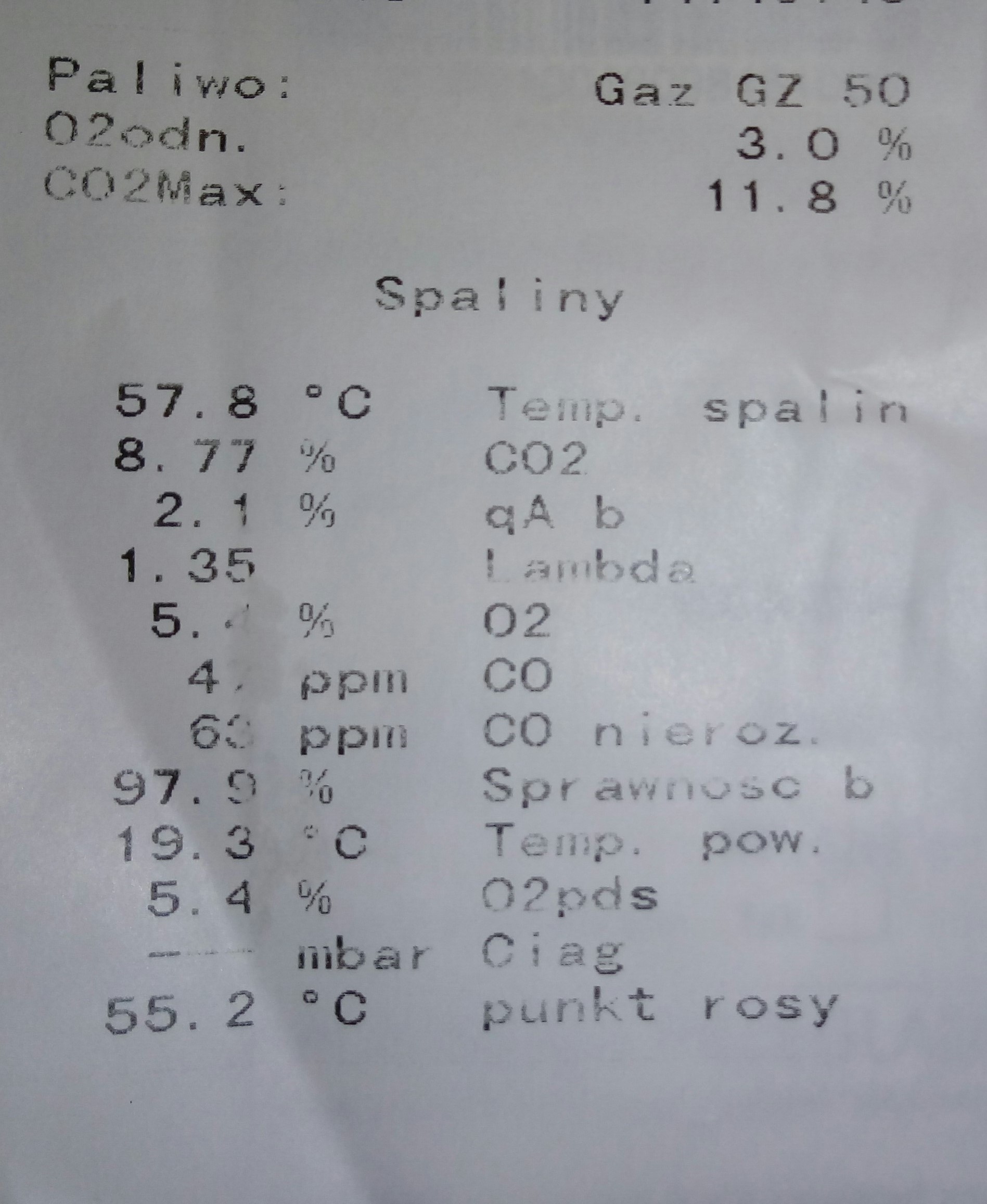
    Did you commission this boiler by the service - flue gas analysis? These settings belong to the service technician and he should set it up for you. It is free to run.
  • ADVERTISEMENT
  • #5 17442600
    d3lta
    Level 18  
    Thank you very much. The service technician was there, he measured, he adjusted the curve, but he didn't tell me anything about the curve adjustment, I didn't ask, so now I'm exploring the topic.
    Thelia Condens: constant temperature, weather curve, settings?
    I will check what I have set and I will probably ask again ;-)

    A service technician threatened me with sludge from cast iron radiators ... Is it really a problem? I rinsed the installation after disassembling the old boiler: once with water, then with detergent, and four times with water. A lot of black iron oxide was flowing, but I did not notice some "glutes" and sediment.
  • Helpful post
    #6 17442811
    diodak_13
    Level 20  
    if not a service technician, at least the installer should train and pre-arrange it, for that they take money, and it is not a lot of trouble.
    The analysis has a bit too little CO2, the manual says 9.2 + - 0.2% with the front panel removed and 9.2 + - 0.3% with the front panel on. It is important that the CO is not exceeded.
    Thelia exchangers are one of the best, over 10 years, proven. Large cross-sections inside and resistant to fouling.
    As for the sludge from the radiators - when you started the installations, you know what you have. When you rinsed it is ok, it is best to add some agent, turn on the pump on the old installation for a month and then change the boiler.
    You shouldn't have any problems. It is important that there is a magnetic filter in front of the wheel, because there is an electronic pump.
  • #7 17445843
    d3lta
    Level 18  
    Welcome back.
    I would like to ask about the parameters:
    d.43 Heating curve
    d.45 Value of the lower point of the heating curve

    What are they actually doing? I imagine the curve as some function, something from the outside temperature. But what? Supply temperatures? On the way back? What is d.43 doing with this graph of the function and what is this point d.45?
  • ADVERTISEMENT
  • #8 17446219
    diodak_13
    Level 20  
    Thelia Condens: constant temperature, weather curve, settings?
    the heating curve reflects the heat demand of your building. Perfectly matched, the boiler provides as much energy to the room as is needed to maintain the desired internal design temperature at a given moment. The more efficient the condensate is, the more heat it receives from the flue gas, therefore the curve is used and not, for example, 70 * C. It is always good to set it up with little margin for comfort or lowered for less gas consumption.
    d.43 - range 0.1-4. You choose the slope of the curve for your building. As you can see in the diagram, the heating (supply to radiators) temperature is a function of the outside temperature.
    When the (ebus) exacontrol e7 controller is connected, the possibility of adjusting the curve disappears (I do not remember if you turn off the thermostat or not - you have to check)
    d.45 - changes the starting point of the curve (x and y axis intersection). i.e. if it is ok at low temperatures, then with positive temperatures the curve may differ a bit, therefore you move the beginning of the curve with this parameter.
    Tehelia generally has a lot of room to set up
  • Helpful post
    #9 17449356
    Szczecin62
    Level 21  
    Hello,
    You do not need any regulator to work with the boiler ONLY with weather control. The system is in the boiler, you only need to connect a WIRED external sensor (or make it yourself for a few zlotys, i.e. housing + appropriate thermistor + 2 resistors matching the characteristics of the system to the characteristics of the original sensor). By seeing the charts of heating curves, you can in d43 and 45 make sure that it is not too hot in the transitional period, and too hot or too cold in severe frosts. And sell Exacontrol on OLX ;-) In general, the room regulator and weather automation are not interchangeable, but only complement each other. The continuous regulation causes the boiler to be smoothly modulated so that the set temperature in the room is achieved asymptotically and it tries to maintain this in a continuous manner. The problem arises when we do not have a representative room in the facility (school, hospital, etc.), which is also the case with you, where only the weather itself works, without being related to the actual temperature in the rooms.
  • #10 17451032
    d3lta
    Level 18  
    Thanks for the good idea.
    Should I switch off "automatic heat curve management"?
  • #11 17451087
    Szczecin62
    Level 21  
    You should completely disconnect the room regulator because it, and more precisely the room temperature with the regulator, will modulate the boiler's operation only for the needs of this one room and it will probably not be representative for other rooms.
    Greetings
  • #12 17451091
    d3lta
    Level 18  
    Szczecin62 wrote:
    You should completely disconnect the room regulator because it, and more precisely the room temperature with the regulator, will modulate the boiler's operation only for the needs of this one room and it will probably not be representative for other rooms.
    Greetings

    There is an option to disable the influence of internal temperature in the controller. I will not disassemble exacontrola until I have a warranty for the whole thing. So two more years without two weeks.
  • Helpful post
    #13 17452012
    Szczecin62
    Level 21  
    My friend,
    EXACONTROL is a ROOM ONLY controller, so it would be pointless to deactivate the temperature sensor in it and there is no such possibility! POORBAR is built into the boiler and cooperates with the regulator or can work without it.
    Either you get lost or you got it mixed up with Vaillant's weather controls. There, weather regulators (Vaillant boilers do not have a factory-built weather forecast and it is applied in the regulator) were only switched to the weather by default and had to be activated in the program to also be a room thermostat.
    Greetings
  • #14 17452182
    d3lta
    Level 18  
    Szczecin62 wrote:
    My friend,
    EXACONTROL is a ROOM ONLY controller, so it would be pointless to deactivate the temperature sensor in it and there is no such possibility! POORBAR is built into the boiler and cooperates with the regulator or can work without it.
    Either you get lost or you got it mixed up with Vaillant's weather controls. There, weather regulators (Vaillant boilers do not have a factory-built weather forecast and it is applied in the regulator) were only switched to the weather by default and had to be activated in the program to also be a room thermostat.
    Greetings


  • #15 17453124
    Szczecin62
    Level 21  
    Yes, I WAS MISTAKED, Only that you have not written what the regulator is about. I associated it with type B (and 99% of it does not have such an option). You show type C and in fact there is such an option on it (if I am not mistaken then only when we connect the external sensor to the boiler and it is practically unnecessary with such a regulator, because the regulator itself can greatly optimize the operation of the boiler only as a function of the internal temperature, and more precisely as it grows quickly and how quickly it descends) and I never paid attention to it because it seems to me that it is difficult to justify the option to turn off the room regulator when the weather system itself is in the boiler! Why this regulator then?
    Greetings
  • #16 17453253
    d3lta
    Level 18  
    I repeat the question:
    Should I turn off "automatic heat curve management" if I want to set myself to 20 and 0.3?
  • Helpful post
    #17 17454651
    kz61
    Level 27  
    Exa won't let you change the curve without turning off the automatics.
  • Helpful post
    #18 17455948
    Szczecin62
    Level 21  
    Sell Exa on OLX set the curve and offset on the boiler you have solved the problem.
    Remember that the curve and its offset should be set with an understanding of how both parameters influence each other and what they give together. You will not set them theoretically, but experience and intelligent observation after at least one season will give you a hint on how to set. After the second season, everything should be ok and you forget about the weather (make sure that no vermin get into the external sensor housing because their products can change the resistance. It is less of a problem for new boilers, because they have a thermistor of about 1 k (20 * C) and it is difficult to change such a resistance, but in older boilers the thermistor was 12.5 ka, for such a resistance, already wet cobwebs, etc., garbage was already flowing in.
    I'm silent on the subject
    Greetings
    for everyone
  • #19 17531240
    d3lta
    Level 18  
    Szczecin62 wrote:
    You should completely disconnect the room regulator because it, and more precisely the room temperature with the regulator, will modulate the boiler's operation only for the needs of this one room and it will probably not be representative for other rooms.
    Greetings

    You were right. Indeed, exa blocks the possibility of changing the d45 parameter. I unplugged it, set it up and it's fine.
    Thank you.
  • #20 17531249
    d3lta
    Level 18  
    Szczecin62 wrote:
    You should completely disconnect the room regulator because it, and more precisely the room temperature with the regulator, will modulate the boiler's operation only for the needs of this one room and it will probably not be representative for other rooms.
    Greetings

    You were right. Indeed, exa blocks the possibility of changing the d45 parameter. I unplugged it, set it up and it's fine.
    Thank you.

    Added after 3 [minutes]:

    1. Disconnecting the room regulator.
    2. Parameters:
    d43 - 0.3
    d45 - 21

Topic summary

✨ The discussion revolves around configuring the Saunier Duval Thelia Condens AS 25 - A (H-PL) boiler with an Exacontrol E7 V. 2.11 controller to maintain a constant water temperature for radiators, independent of outdoor and indoor temperature influences. Users seek to disable the weather curve regulation and set specific parameters (d43 and d45) for optimal heating. Key advice includes disconnecting the external temperature sensor and the room regulator to allow manual adjustments of the heating curve. The importance of proper parameter settings for maintaining desired radiator temperatures during varying outdoor conditions is emphasized, along with the recommendation to consult a service technician for initial setup and flue gas analysis. Concerns about sludge in cast iron radiators and the necessity of a magnetic filter are also discussed.

FAQ

TL;DR: Want constant radiator temps on a Thelia Condens? The heating curve spans −20 to +20°C, and “In your case, I suggest 0.3.” Disable room influence, set d.43/d.45, or unplug Exacontrol to adjust. [Elektroda, diodak_13, post #17442391]

Why it matters: This FAQ helps Thelia Condens owners decide between constant flow temperature and weather/room control, and shows exactly how to set each mode.

Quick Facts

How do I set a constant flow temperature (e.g., 40°C) on a Thelia Condens?

Disconnect the outdoor sensor and the Exacontrol. With both connected, the boiler won’t hold a fixed flow setpoint. Alternatively, disable weather mode and leave only thermostat control in the controller. Then set your desired CH flow temperature on the boiler front panel. How‑To: 1. Unplug outside sensor and room regulator. 2. Restart the boiler. 3. Set the CH flow temperature (e.g., 40°C). [Elektroda, diodak_13, post #17441066]

What do parameters d.43 and d.45 actually control?

d.43 sets the slope (0.1–4) of the heating curve, linking supply temperature to outdoor temperature. d.45 shifts the curve’s starting point to correct for over/under‑heating at milder conditions. With Exacontrol connected, curve adjustment may be disabled. “The heating (supply to radiators) temperature is a function of the outside temperature.” [Elektroda, diodak_13, post #17446219]

Can I run weather‑only control and ignore the room sensor?

Yes. In the controller’s service settings, switch off the thermostat function (room temperature influence). The boiler will then follow the heating curve only. Adjust d.43 for slope and use d.45 to fine‑tune comfort at mild temperatures. [Elektroda, diodak_13, post #17442391]

How do I change d.43/d.45 when Exacontrol E7 is connected?

Turn off Exacontrol’s automatic heat‑curve management first. Otherwise, the boiler locks curve edits. How‑To: 1. In Exa service menu, disable automatic heat‑curve management. 2. Set d.43 and d.45 in the boiler. 3. Save and verify. “Exa won’t let you change the curve without turning off the automatics.” [Elektroda, kz61, post #17454651]

What starting curve slope works well with cast‑iron radiators?

Start at d.43 = 0.3 and refine after observing room temperatures. Cast‑iron radiators with thermostatic heads pair very well with this boiler. “Cast iron radiators and thermostats are the perfect solution for this boiler.” The larger system water volume can improve condensing performance. [Elektroda, diodak_13, post #17442391]

What outside temperature range does the heating curve target?

The factory curve is designed around −20 to +20°C. Choose your slope and offset within this range. Tune lower for efficiency, higher for comfort. Adjust gradually and observe results over several days. [Elektroda, diodak_13, post #17442391]

I want 40°C at −30°C outside and 30°C at 0°C—can I set that?

The built‑in curve is defined for −20 to +20°C. Use d.43 (slope) and d.45 (offset) to approach your targets within that window. Outside this range, behavior can diverge from expectations, so plan for some deviation. [Elektroda, diodak_13, post #17442391]

What flue‑gas CO2 setting should the service tech aim for?

Target about 9.2% CO2, ±0.2% with the front panel removed and ±0.3% with it on. The key is not to exceed CO limits. A proper combustion analysis during commissioning is required. [Elektroda, diodak_13, post #17442811]

Do I need Exacontrol for weather‑based operation?

No. The Thelia Condens has weather logic in the boiler. Connect a wired outdoor sensor and tune d.43/d.45. A DIY sensor is possible with a suitable thermistor and two resistors. Room regulators and weather control complement each other but solve different problems. [Elektroda, Szczecin62, post #17449356]

How do I disable room influence but keep weather control active?

In Exacontrol’s service menu, switch off the thermostat function. The boiler then ignores indoor readings and follows the weather curve. Quick setup: 1. Disable room influence. 2. Set an initial slope (e.g., 0.3). 3. Use d.45 to correct mild‑weather comfort. [Elektroda, diodak_13, post #17442391]

Are cast‑iron radiators a sludge risk with this boiler?

If you flushed the system, you’re fine. The Thelia heat exchanger has large cross‑sections and resists fouling. Add a magnetic filter before the pump to protect the electronic pump. Consider periodic checks if the system was very dirty. [Elektroda, diodak_13, post #17442811]

What settings ended up working for the thread starter?

They disconnected Exacontrol to unlock curve edits, then set d.43 = 0.3 and d.45 = 21. This combination delivered the desired comfort. If results drift, re‑check after a few days and adjust slightly. [Elektroda, d3lta, post #17531249]

Any edge cases with the outdoor sensor I should watch for?

Keep insects and moisture out of the sensor housing. Contamination can alter resistance and skew readings. Newer boilers use ≈1 kΩ thermistors at 20°C; older ones used ≈12.5 kΩ, which are more sensitive to contamination. Clean or replace if readings seem off. [Elektroda, Szczecin62, post #17455948]

Why does more system water help condensing efficiency here?

Greater water volume smooths temperature swings and returns cooler water, improving flue‑gas heat recovery. As one expert noted, “a lot of water in the system guarantees better heat recovery from the flue gas.” This synergy suits cast‑iron radiators well. [Elektroda, diodak_13, post #17442391]
ADVERTISEMENT