logo elektroda
logo elektroda
X
logo elektroda

[Solved] Correct installation of the expansion vessel in the DHW installation

alienone 113925 31
Best answers

How should a domestic hot water expansion vessel be installed, and what precharge and size should it have?

Yes, it can be installed, but on the cold-water side with a check valve between the boiler inlet valve and the tee/safety group so hot water cannot flow back into the domestic installation [#17767530] With a pressure reducer set to 4 bar, set the vessel precharge about 0.2 bar lower, i.e. around 3.8 bar; DHW vessels are normally factory-filled around 3.5–4 bar, while 1.5 bar vessels are for heating and are not suitable here [#17768846] [#17768275] For an 80 l boiler at these pressures, an 8 l vessel is too small; a 12 l vessel is the closer suitable size [#17781033] [#17781229] If you use a non-flow vessel, the simplified diagram is correct, but it should be mounted vertically and on a quick-release connection so the precharge can be checked [#17781515] If you buy a flow-through vessel, use the proper DHW type (for example Refix DD / Airfix D) and do not install it in a way that isolates it from the boiler [#17781033] [#17781251]
Generated by the language model.
ADVERTISEMENT
Treść została przetłumaczona polish » english Zobacz oryginalną wersję tematu
  • #31 17782218
    DiGital_Butcher
    Level 11  
    alienone wrote:
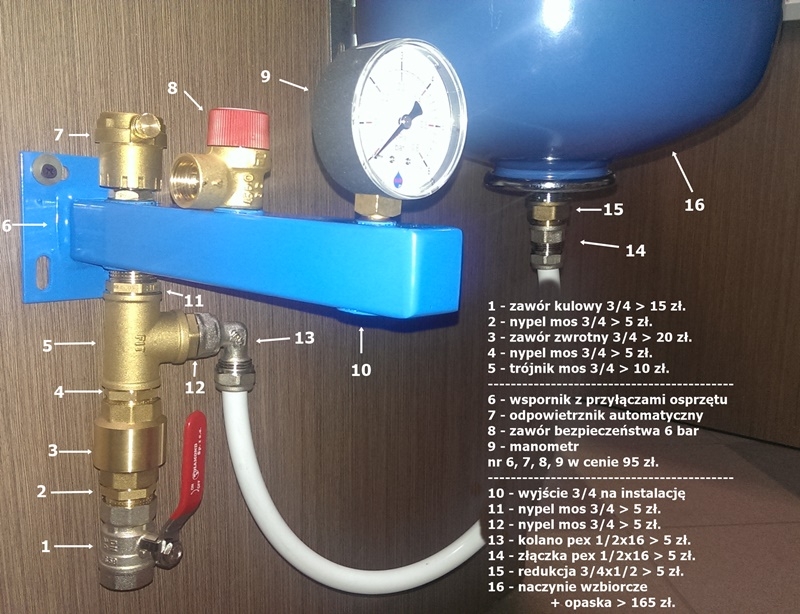
    I have 80 liters of Boljer. Tomorrow's assembling the chip. I was a bit surprised by the white Flamco expansion vessel, the manufacturer recommends installation with the valve facing down, so I have to change the safety group as in the photo with the appropriate diameter for the vessel. I think it will be correct.


    Correct installation of the expansion vessel in the DHW installation


    This bar in the picture is an example of how not to install an expansion vessel .... Check and shut-off valve in front of the vessel, how is this vessel supposed to work? Secondly, this beam is for central heating, not hot water, as my colleague noticed above, only rust will collect ...
  • ADVERTISEMENT
  • #32 17782246
    alienone
    Level 11  
    Topic to close with thanks to a fellow expat

Topic summary

✨ The discussion revolves around the correct installation of an expansion vessel in a domestic hot water (DHW) system. The user inquires about the accuracy of a provided diagram and the feasibility of installing an expansion vessel in their system, which includes a pressure reducer set at 4 bars. Responses emphasize the necessity of a check valve to prevent backflow and the importance of selecting the appropriate pre-charge pressure for the expansion vessel, which should be set lower than the downstream pressure. Recommendations include using a flow-through expansion vessel, specifically models from Flamco and Reflex, and ensuring proper installation to avoid issues such as water dripping from the safety valve. The correct pre-charge pressure for the vessel is discussed, with suggestions ranging from 1.5 to 4 bars depending on the system's pressure. The conversation concludes with the user planning to implement the suggested changes and confirming the installation details.
Generated by the language model.

FAQ

TL;DR: A 50 °C temperature rise expands water by ~2 %, which can push 4 bar mains up to 6 bar without a correctly-sized DHW expansion vessel. “Install the check valve before the tee” [Elektroda, stanislaw1954, post #17767530]

Why it matters: Correct placement and pressure settings stop nuisance valve dripping, save water and reduce Legionella risk.

Quick Facts

• Typical DHW safety valve setting: 6 bar (EN 1487:2007). • Expansion vessel pre-charge = mains pressure − 0.2 bar (e.g., 3.8 bar for 4 bar supply) [Elektroda, emigrant, post #17768846] • Sizing rule: 0.1 L vessel per 1 L boiler at 4 bar; 80 L boiler → ≥ 8 L vessel [REFLEX Datasheet]. • Minimum connection pipe: ½" (15 mm) [Elektroda, stanislaw1954, post #17767910] • Flow-through models (Refix DD, Airfix D/A) meet potable-water hygiene codes [Flamco Manual, 2023].

1. Why does pressure rise when my DHW cylinder heats up?

Water volume grows ~2 % from 10 °C to 60 °C. In a closed system the extra volume has nowhere to go, so pressure climbs—often from 4 bar cold to 6 bar hot—until a vessel absorbs it or the safety valve opens [Elektroda, stanislaw1954, post #17767530]

2. Where should I install the expansion vessel?

Install it on the cold-water feed, after the check valve/reducer and before the tee to the boiler. Keep the safety valve within 1 m of the boiler outlet for code compliance [Elektroda, emigrant, post #17781515]

3. Flow-through vs non-flow: which is safer?

Flow-through vessels (Refix DD, Airfix D/A) rinse with fresh water each draw-off, limiting stagnation. Non-flow units (Refix DE, Airfix R) hold static water and can harbour Legionella if rarely used [WHO, 2007]. "For homes, choose flow-through for sanitation" [Elektroda, emigrant, post #17781166]

4. How big should my vessel be for an 80 L cylinder at 4 bar?

Use the 0.1 L per 1 L rule. 80 L × 0.1 = 8 L gross volume. Manufacturers round up, so a 12 L vessel is recommended [Elektroda, emigrant, post #17781033]

5. What pre-charge pressure do I set?

Set nitrogen/air pre-charge 0.2 bar below downstream mains. With a 4 bar reducer, charge to 3.8 bar cold [Elektroda, emigrant, post #17768846] Too low and the vessel water-logs; too high and it cannot accept expansion.

6. Does mounting orientation matter?

Yes. Follow the label: some Flamco models require valve down to keep the membrane wet. Wrong orientation shortens membrane life and traps air pockets [Flamco Manual, 2023].

8. Do I still need a 6 bar safety valve?

Yes. The safety valve is an emergency device. If the vessel bladder ruptures or the thermostat sticks, it prevents catastrophic pressure—up to 12 bar—by venting [EN 1487:2007].

9. How do I recharge or check the vessel?

  1. Close the quick-release coupling and isolate the vessel.
  2. Drain vessel water via schrader until pressure reads zero.
  3. Pump to target pre-charge (e.g., 3.8 bar), reopen coupling. Check annually [Elektroda, emigrant, post #17781515]

10. Can I reuse a central-heating (blue) vessel for DHW?

Not recommended. CH vessels ship at 1.5 bar and lack potable-water certification. "Water can smell of EPDM rubber" in such units [Elektroda, emigrant, post #17781099]

11. What happens if the vessel is undersized or empty?

Safety valve will drip 3–5 L per week, wasting energy and scaling outlets—exactly what the thread starter reported [Elektroda, alienone, post #17781184] Long term, the valve seat pits and may fail completely.

12. Minimum components in a compliant set-up?

Reducer → check valve → tee → flow-through expansion vessel → boiler cold inlet; branch off tee to 6 bar safety valve + tundish. This meets EN 806 and keeps the vessel in circuit during draw-off [Elektroda, emigrant, post #17781515]
Generated by the language model.
ADVERTISEMENT