logo elektroda
logo elektroda
X
logo elektroda

[Solved] Unscrewing Anode Plug in GALMET SGW(S) Boiler: Accessing Hidden Nut without Damaging Insulation

axl2 31743 13
ADVERTISEMENT
Treść została przetłumaczona polish » english Zobacz oryginalną wersję tematu
  • #1 18051671
    axl2
    Level 14  
    Hello,

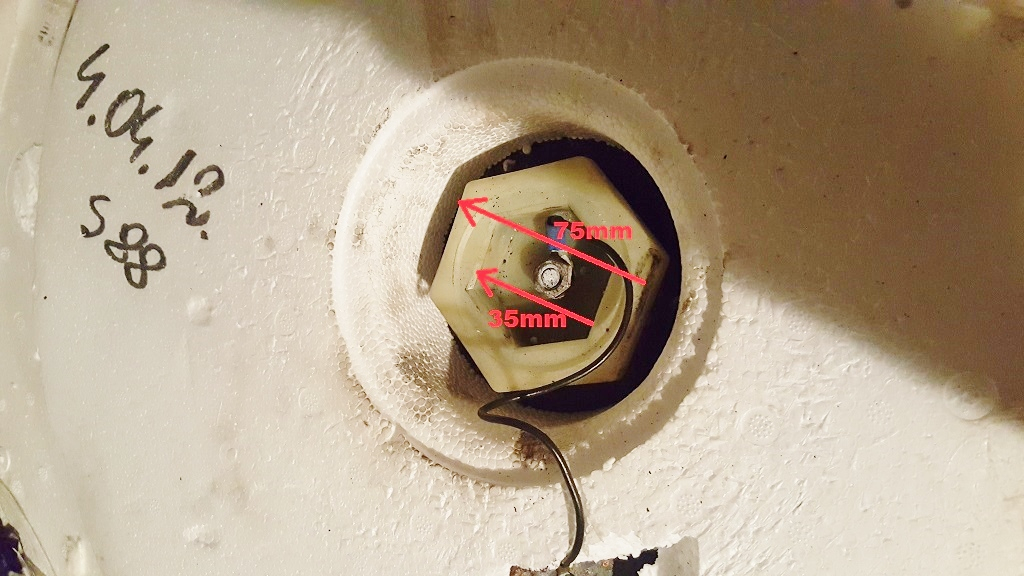
    Will anyone suggest a patent for unscrewing the anode fixing nut in the Galmet SGW(S) boiler at home? the nut is hidden in the insulation by about 2 cm, therefore it is impossible to reach the Swede unless I destroy the styrofoam and I would like to avoid that. In addition, the size of this plastic nut as in the picture is quite strange, quite different from the mounting of the anode or heater itself. The anode and heater are screwed with a 5/4 wrench, while the plastic plug on the outside of the wall is 75mm and 35mm inside. It's hard with such keys in the supermarket
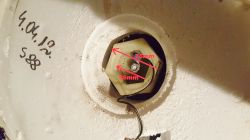
    Unscrewing Anode Plug in GALMET SGW(S) Boiler: Accessing Hidden Nut without Damaging Insulation
  • ADVERTISEMENT
  • #2 18051679
    bumble
    Level 40  
    tubular wrench. Is it exactly 75mm or 3”?
  • #3 18051788
    axl2
    Level 14  
    I measured yesterday evening quickly, but from what I remember it came out on a 75mm caliper, maybe a little more than 3 inches, it's probably still far away
  • ADVERTISEMENT
  • #4 18051804
    bumble
    Level 40  
    I know that larger wrenches are in inches and you can buy 3 of them.
  • #5 18051877
    Rafikusa
    Level 18  
    Some tubular could even fit inside. Some have a fairly well-pressed hexagon on the outside. Depending on the thickness of the wall, maybe a 30mm tubular one will fit there. This is easier to get.
  • #6 18051913
    axl2
    Level 14  
    I was just thinking about looking inside. Thanks for your help, I'll look for a tubular one today. If it's a little bigger, you can always tighten it ;) I'll let you know when I unscrew it
  • ADVERTISEMENT
  • #7 18052302
    Michelson
    Level 26  
    Maybe you can find an M24 screw somewhere, it has a hex size of 36 mm.
  • #9 18054685
    dobroslaw

    Level 22  
    Unscrew the cable and measure the current between the anode and the housing, because maybe you don't have to unscrew it, if the current is above 1 mA, it's ok, if 0.5-1, it's better to check if below 0.5, the anode needs to be replaced or has become scaled.
    Company Account:
    Term Klima serwis De Dietrich Białystok
    białystok słowackiego 7, Białystok, 15-229 | Tel.: 500XXXXXX (Show)
  • #10 18055264
    axl2
    Level 14  
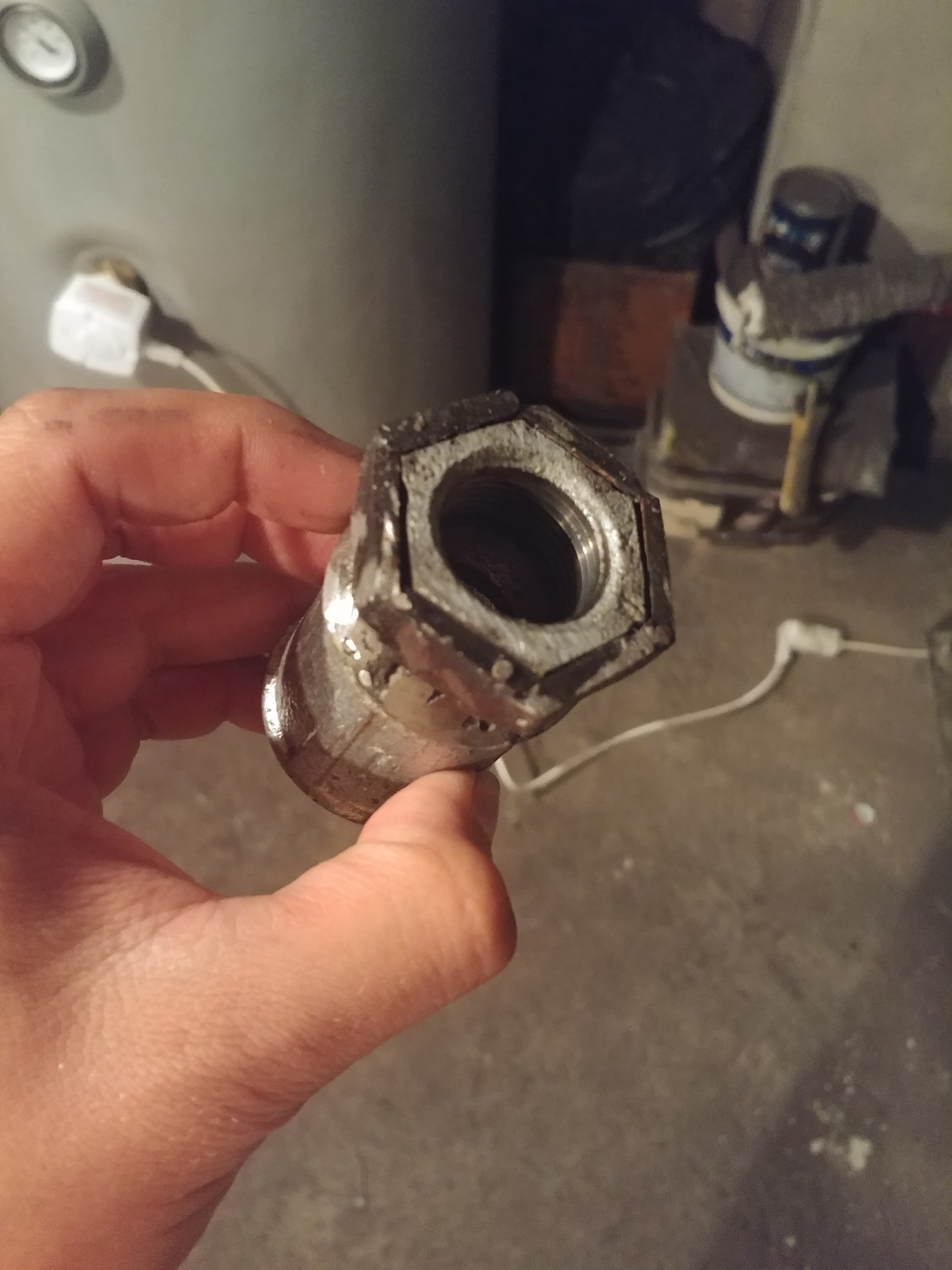
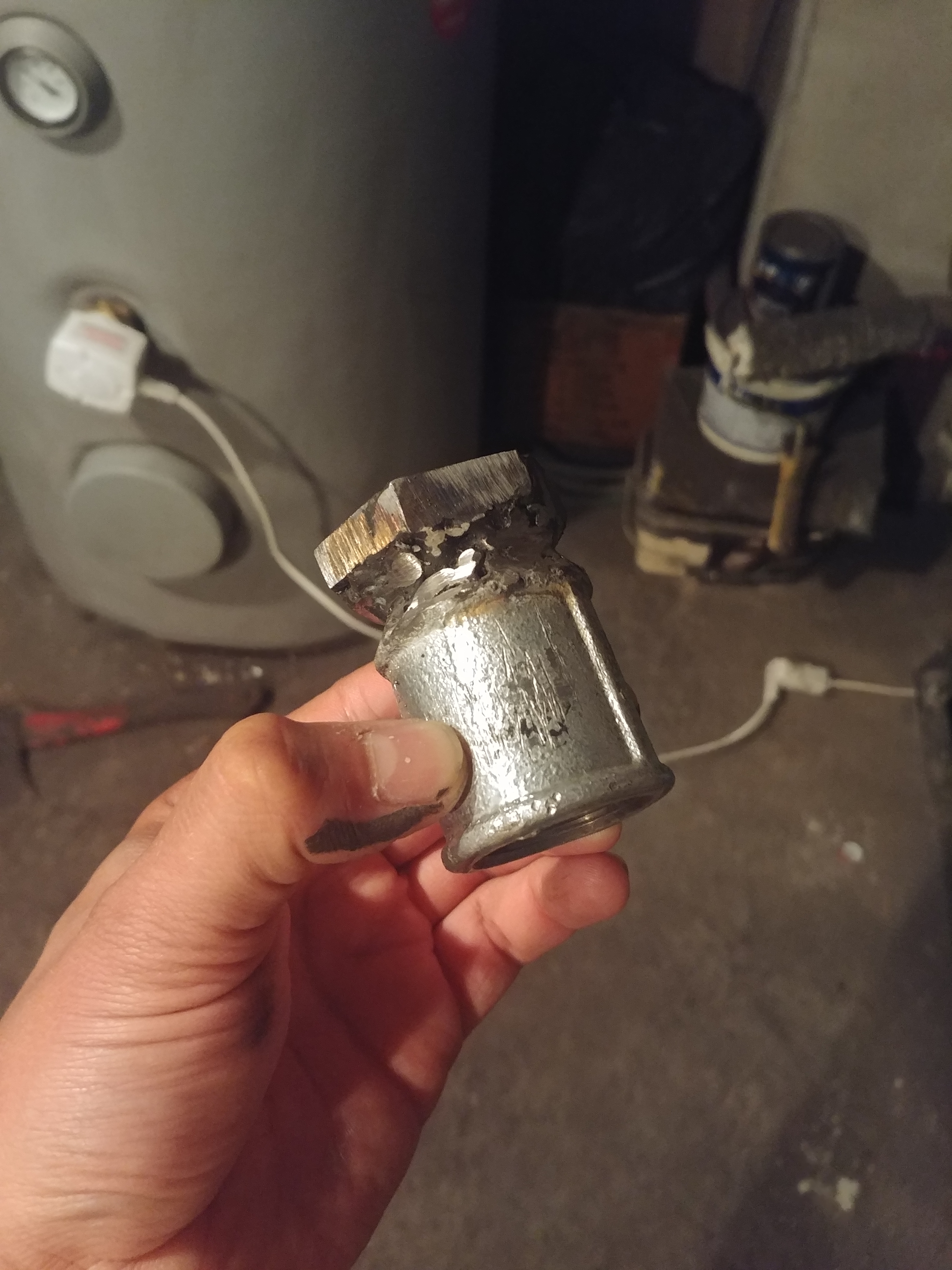
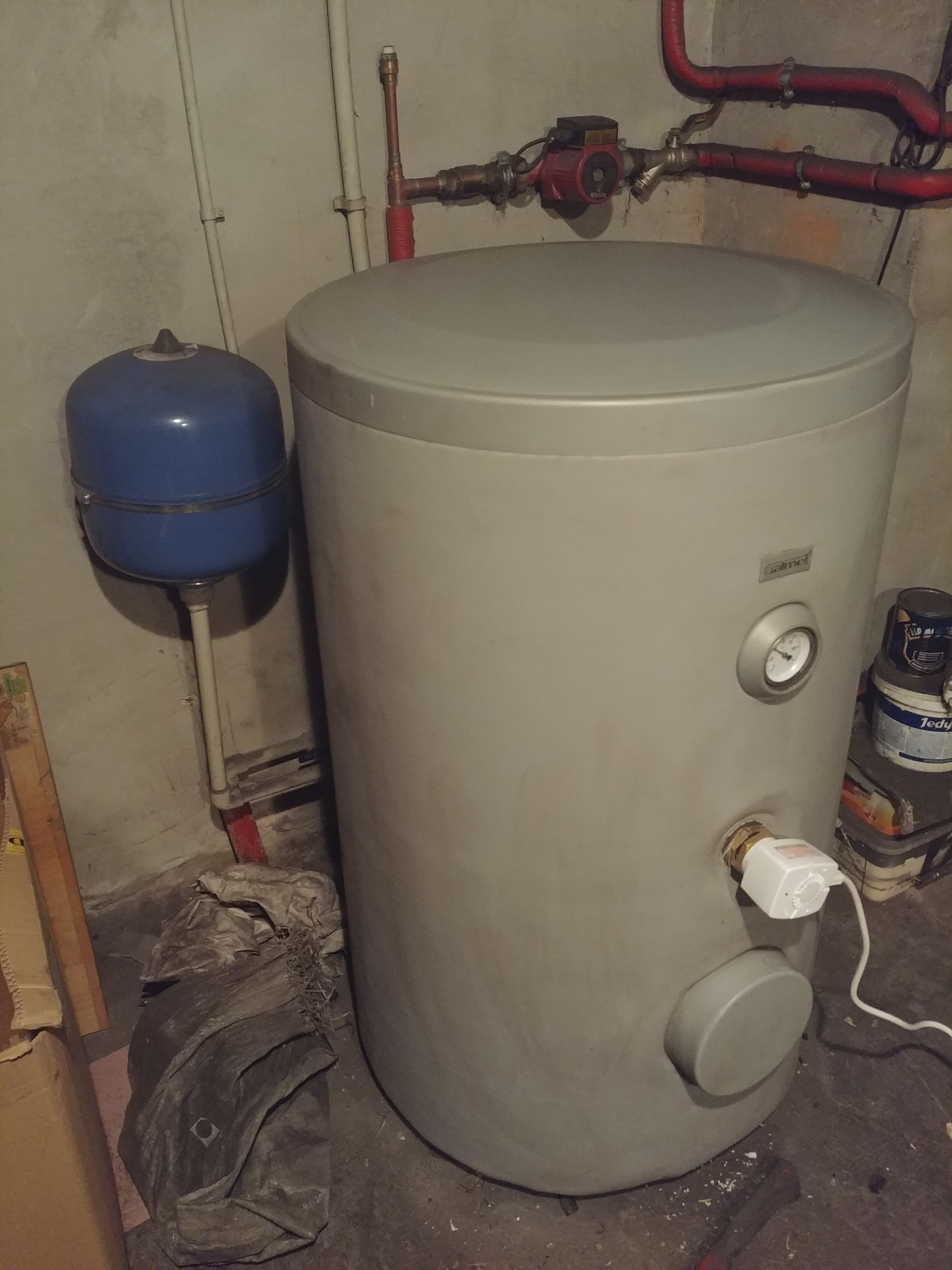
    Thanks for the info, but I had to unscrew the top plug anyway because I was still installing the heater and I wouldn't drain the water. I did not get the key, which was the reason for mobilization and making my own ;) Surprisingly, after 7-8 years, the anode is like new (wow) there is not much stone inside, it did not even cover the bottom. I have one more question because I'm not a plumber; p does an air cushion have to be left in the standing boiler? When I installed the heater, I flooded the boiler almost to the tap, leaving about 5-10 cm of slack, screwed the top cap and added water again, then the pressure was created and everything is OK, but I'm concerned if it's supposed to look like this? it turns out that the boiler is 100% filled with water

    Unscrewing Anode Plug in GALMET SGW(S) Boiler: Accessing Hidden Nut without Damaging Insulation Unscrewing Anode Plug in GALMET SGW(S) Boiler: Accessing Hidden Nut without Damaging Insulation
    Unscrewing Anode Plug in GALMET SGW(S) Boiler: Accessing Hidden Nut without Damaging Insulation
  • #11 18055280
    bumble
    Level 40  
    What about a pillow? It is a billiard and it is supposed to have and air will come out when using hot water and there should be an air vent on the heating, i.e. the coil.
  • ADVERTISEMENT
  • #12 18055311
    Michelson
    Level 26  
    There should be no air, because it is always an environment for corrosion. In such tanks, there will always be some air collected from the degassing of the water, or that somehow got into the installation.
    I still have a note about the installation of the heating module. For proper operation, the module should always be mounted with the cable downwards, due to the location of the thermocouple in relation to the heating element.
  • #13 18055430
    axl2
    Level 14  
    OK, I'll tighten it up tighter. Thank you for your help
  • #14 18055432
    axl2
    Level 14  
    OK, I'll tighten it up tighter. Thank you for your help

    Added after 1 [minutes]:

    Socket made of own design + Swedish wrench. Unfortunately, supermarkets do not have such large wrenches and the prices at auctions are such that it is not worth making a purchase several times.

Topic summary

✨ The discussion revolves around the challenge of unscrewing the anode fixing nut in a Galmet SGW(S) boiler, which is obscured by insulation. Users suggest using a tubular wrench, with measurements indicating the nut is approximately 75mm in size. Alternatives such as M24 screws with a hex size of 36mm are also mentioned. One user successfully created a custom socket to access the nut, avoiding damage to the insulation. Additionally, there are inquiries about the necessity of leaving an air cushion in the boiler, with advice given on proper installation and maintenance practices to prevent corrosion.
Generated by the language model.

FAQ

TL;DR: For Galmet SGW(S) service, first test anode current—“above 1 mA is OK”—before unscrewing. If it reads 0.5 mA or less, plan a replacement or descaling. [Elektroda, dobroslaw, post #18054685]

Why it matters: DIY homeowners can avoid damaging insulation and make smarter repair calls on SGW(S) anodes and heaters.

Quick Facts

What size are the SGW(S) anode/heater fittings and the outer plastic plug?

User measurements report a 75 mm outer plastic cap and a ~35 mm inner hex. The anode and heater take a 5/4" wrench. Always verify your unit before buying tools. [Elektroda, axl2, post #18051671]

Which tool works when the nut is recessed in insulation?

Use a tubular socket that fits into the cap and presents an external hex to turn. Approx. 30 mm often fits, depending on wall thickness and clearance. This lets you avoid cutting the foam. [Elektroda, Rafikusa, post #18051877]

Is a 3-inch wrench suitable for the outer cap?

Large cap wrenches are sold in inch sizes, and 3-inch options are available. Check the cap across-flats and confirm clearance before purchase. [Elektroda, bumble, post #18051804]

Can I build a DIY tool if I can’t source a huge socket?

Yes. One owner made a custom socket and drove it with a Swedish wrench to remove the cap. "Socket made of own design + Swedish wrench." This avoids destroying the insulation when large tools aren’t in stores. [Elektroda, axl2, post #18055432]

Can I use a bolt head as a makeshift inner-hex key?

An M24 bolt has a 36 mm hex head. You can use it as a 36 mm driver for the inner hex, if clearance allows. Check fit and avoid over-torquing plastic. [Elektroda, Michelson, post #18052302]

How do I measure if the magnesium anode still works without unscrewing?

Disconnect the anode’s cable and measure current between the anode and the tank body. >1 mA is OK; 0.5–1 mA warrants checking; <0.5 mA signals replacement or scale. "Above 1 mA is OK." This test saves unnecessary teardown. [Elektroda, dobroslaw, post #18054685]

My plug sits about 2 cm deep in foam—how do I plan tool reach?

Plan for a long tubular socket that reaches past 2 cm of insulation. An adjustable wrench will not reach without harming the foam, as reported by the owner. Measure recess depth before selecting the tool. [Elektroda, axl2, post #18051671]

How do I remove the recessed plastic plug without damaging insulation?

Use this 3-step approach:
  1. Select a tubular socket that fits the cap’s inner hex and clears the insulation.
  2. Insert it into the cap; engage fully to avoid rounding.
  3. Turn using the socket’s external hex, keeping the tool square to the cap. This preserves the foam shell. [Elektroda, Rafikusa, post #18051877]

Should I leave an air cushion in a standing SGW(S) after refilling?

No. Avoid deliberate air pockets because air accelerates corrosion. Some air will appear anyway from water degassing, but do not plan an air space. "There should be no air." Refill normally and bleed where designed. [Elektroda, Michelson, post #18055311]

Where should trapped air be vented in a coil-equipped SGW(S)?

Vent the heating coil via its air vent. Domestic hot water will purge air during use, but the coil needs a proper air vent in the heating circuit. [Elektroda, bumble, post #18055280]

How should I orient the electric heater module when reinstalling?

Install the heater with the cable pointing downward. This respects the thermostat/thermocouple position relative to the heating element for correct control. [Elektroda, Michelson, post #18055311]

Can an anode still look new after 7–8 years?

Yes. One SGW(S) owner reported his anode looked like new after 7–8 years. Water chemistry varies, so confirm with a current test to avoid premature replacement. [Elektroda, axl2, post #18055264]

Is there a video example of this plug/anode service?

A forum post links a video walkthrough relevant to this task. Use it for visual cues on tool engagement and handling. [Elektroda, VPS, post #18053250]
Generated by the language model.
ADVERTISEMENT