Should I choose a Rigol DS1054Z or a Rigol DS1202Z-E for an oscilloscope purchase, considering channels, bandwidth, and memory?
If two channels are enough and higher bandwidth matters, the thread leans toward the Siglent SDS1000X-E series rather than either Rigol; the Rigol DS1054Z is mainly attractive when you need four channels and can take advantage of the promotion/free options. [#18893989][#18894946][#18895348] The DS1054Z can be bought with extra options in promotion and reportedly unlocked to 100 MHz, but that means modifying the unit and losing warranty, so it is not suitable for company equipment. [#18894212][#18894871] Several replies say the DS1054Z is an older design, while the Siglent SDS1104X-E / SDS1202X-E is more modern and generally better or at least comparable on paper. [#18893989][#18895348] For the specific 2-channel, 100–200 MHz use case, the Siglent is the preferred choice; the Rigol only really wins when you want 4 channels and are satisfied with 50 MHz. [#18894946][#18895348] The memory difference was described as less decisive than the channel count and bandwidth, with Rigol promotions mentioning 24 Mpts and Siglent around 14 Mpts. [#18894171][#18894946]
AI summary based on the discussion. May contain errors.
Hello, I would like to buy an oscilloscope in the near future. After reading similar topics on the electrode, I chose the Rigol DS1054Z device, but a moment later I found (and at a slightly more attractive price) the Rigol DS1202Z-E. The second one has 2 channels, it's more than enough for me (although it's obvious that it's better to have 4), 200MHz instead of 50MHz in the first one (I don't know how real the difference is), and as far as I know, the acquisition memory is 24Mp instead of 12Mp with the possibility of expansion up to 24 Mpt. What do you think is better to choose?
This Rigol is already old and the parameters are also not knocking on your knees. Before you choose, take a look at the Siglent SDS1000X-E series (SDS1104X-E, SDS1202X-E).
DS1054Z can be purchased in a continuous promotion with options for free. No doubt better than hacking DS1202Z-E from what I see has 2 channels + external triggering, higher bandwidth and probably so many differences. Same memory, triggers, screen, and so on. Offsets at 0.5mV/Div are pretty dire, responsiveness is tolerable, no miracles, although the 3GHz LeCroy is just as irritating despite the price, touchscreen and zillion knobs on a panel that itself is 2x Rigol... Automatic measurements are ultra useful in my daily practice.
The Siglent SDS1202X-E has knobs for each channel - I personally prefer them. With 4 channels, the problem is the same as with Rigol. A little less memory, but a little faster processing. Protocol analysis has LIN and CAN but I don't know if useful. There is no craziness in Rigol, look at YouTube. I haven't used it, but it looks at least attractive.
DS 1054z can be bought in a promotion with options but "without band" - if someone needs and is not afraid, you can unlock it yourself. There is a big topic on EEVblog and there are links to use - I confirm that they still work!! and you can switch to 100Mhz. I changed mine 3 months ago and everything works perfectly. These are wonderful times for amateurs - never before has there been such a choice in equipment for a reasonable price
also look at the Siglent SDS1000X-E series (SDS1104X-E, SDS1202X-E)
I looked and they look better than rigole. The parameters are not very different. @CosteC
CosteC wrote:
Offsets at 0.5 mV/Div
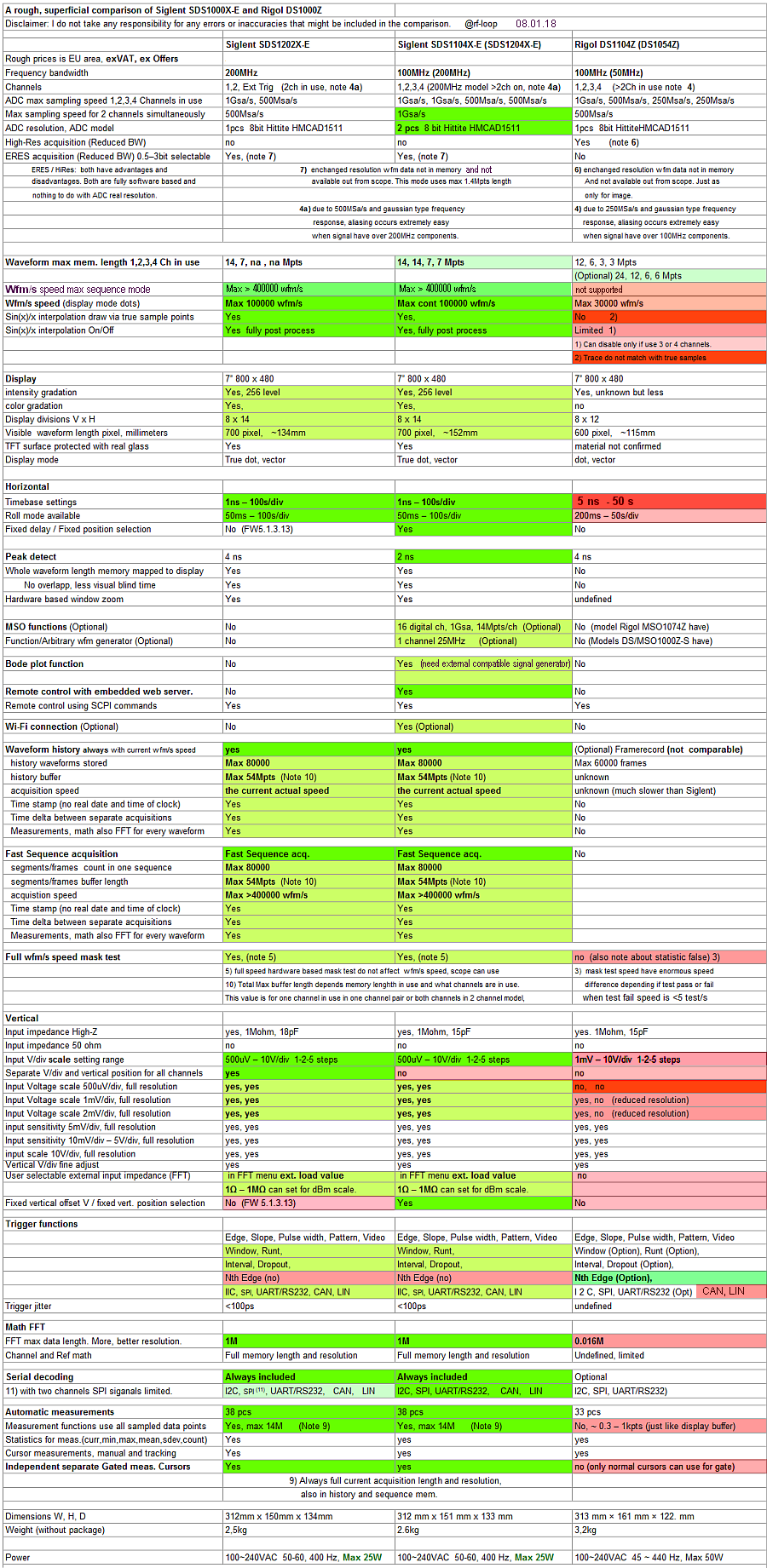
The table shows that the rigs have 1mV/Div. That's why the 0.5mV Siglent appeals to me, though it only has a 12M memory compared to the rigol's 24M. And here I don't know what will be more useful in practice.
eev#4 wrote:
...Rigol, unlocked to 100 MHz, is probably only good for a 15 MHz square wave. The Siglent is twice that. ...
plus for Siglent. @barti10
barti10 wrote:
you can unlock yourself
And lose the warranty . This will be company equipment, so I won't be modifying anything.
Thanks for your commitment to the topic. All in all, the Siglent 4 SDS1104X-E or SDS1202X-E appeals to me, and rather the 2-channel 200MHz one. I will continue the topic, if someone comes up with another oscilloscope, and maybe has some comments on the oscilloscopes mentioned in the subject or can tell about their advantages / disadvantages from experience, then go ahead, I will be grateful
Looking at the tables for 4 channels when 50 MHz Rigol wins for me. When 2 channels are enough and 100-200 MHz is needed then Siglent. If you read Rigol's papers, 0.5 mV is an option, which in NDN may be included in the price (I don't remember), there is definitely 24 MS of memory in the promotion. SIGLENTA 14 MS I don't know if it makes a difference, it probably depends on what you're doing. Certainly 2.5k of memory in files is grief and sadness and 1M is the past
@mechatron97 You didn't mention what the main purpose of this device is. With such knowledge, more could be written.
500uV in 1054Z doesn't work. Simply. (https://www.eevblog.com/forum/testgear/new-rigol-ds1054z-oscilloscope/1025/) "500uV is for another Rigol scope, the 1054z does not have that capability." "No, you enabled the software to use a hardware function the scope does not have. Not the same thing." And in Polish, info from NDN: https://www.elektroda.pl/rtvforum/topic3389900.html#16796053
Comparing the 1054Z and 1104X-E is a bit pointless, because they are separated by an era. There is virtually no category in which Rigol would offer more or be better - both in terms of parameters and offered functionalities. Maybe there are some specific cases where something might look different/better, but in most cases Siglent works better or the same. It's like still driving on the opinion that the Passat 1.9TDI once won - great thing, but that's in the past. The table mentioned above is tragically weak, and the claim "a bit better on paper" is definitely out of place, because if you were to list the functionalities from Siglent's point of view, then the 1054Z column would be unhappy. This one is more interesting (http://teslacoil.pl/luzne-rozmowy/first-podstawowy-oscyloskop-cyfrowy-dla-poczatkujacych-t645.html):
Additionally - there are more and more 1054Z appearing on the secondary market. People sell them as "practically new", "used a few times" for sick money (PLN 200-300 below the official retail price). Poles rarely sell something that is good and useful. Apparently, this is the last call to get rid of this equipment while still having a good reputation and add some change to buy something better. Of course, I have nothing to do 1054Z - it's a great piece of equipment and it's still useful for many, but at the prices that are demanded for it, it's currently a completely unprofitable purchase .
@spy I need an oscilloscope, mainly for working with microcontrollers, power testing, etc., no audio. The table is a bit exaggerated, because honestly who needs the option of buying a w-ifi dongle?? xD
@jasiu2604 Hantek, I think he would also be able to handle the vast majority of tasks for kt. I need an oscilloscope, but I want to have decent equipment for years, and which can be serviced, and this price/quality hantek is not necessarily better than the above-mentioned siglenta or rigola.
Then 4 channels is what you need. After some time, you may find that even this amount is too small.
mechatron97 wrote:
The table is a bit exaggerated
It's not overdone. She is reliable.
mechatron97 wrote:
because frankly, who needs the opportunity to buy a w-ifi dongle?? xD
Anyone who has ever had the opportunity to work with an oscilloscope connected to a large monitor screen. Both oscilloscopes (Rigol/Siglent) do not have a VGA output, but Siglent has a web interface where it is possible to view the oscilloscope screen in near real time. Of course, with the limitations that are natural for VNC, which is used here. (yes, you can also connect via ethernet cable, but now almost everything works on wi-fi, so why not?) You will appreciate in a dual-monitor setup, where you have the code you are working on on one screen, the preview of what is happening on the oscilloscope on the other, and all the test equipment can be lying somewhere nearby, where coffee/cola/water will not spill on it/ nothing or no one will touch the cable with their elbow. Then you don't have to shake your head like a chicken or a pigeon. You can even leave the whole thing at work and connect to an oscilloscope from home to check what's going on with the equipment. The knobs can also be "turned" remotely.
It was so marginal . I don't see the use of either wifi or VGA at home. In an oscilloscope of this class, I don't think it would be wise to invest $300 for this purpose.
I have an analyser, probably the cheapest possible and it is well above my expectations. So, the 2 channels will touch for now.
In an oscilloscope of this class, I don't think it would be wise to invest $300 for this purpose
xD
mechatron97 wrote:
I have an analyser, probably the cheapest possible and it is well above my expectations. So, the 2 channels will touch for now
Then maybe you don't need to spend ~ PLN 2k on an oscilloscope at all? A half-price Hantek or something similar could be enough for you. Or a USB oscilloscope adapter. Or even DSO138 would be OK.
This Hantek doesn't even have a DPO... it's a museum of some sort. Plus 2MS memory. It was competitive 10 years ago.
I would like ... according to this: http://hantek.com.cn/products/detail/96 it has 40kS of memory. Regret. Old Tektronix housing, better screen and poor memory. Even the 1:20 probe will not be connected 'normally' because it does not support such attenuation.
The discussion revolves around the selection between the Rigol DS1054Z and DS1202Z-E oscilloscopes, focusing on their specifications such as channel count, bandwidth, and memory. The DS1054Z offers 4 channels with a bandwidth of 50MHz and 12Mpts of memory, while the DS1202Z-E has 2 channels, a higher bandwidth of 200MHz, and 24Mpts of memory. Users express preferences for the Siglent SDS1000X-E series, noting its competitive features and better specifications. The importance of channel count, memory capacity, and specific use cases, such as working with microcontrollers, is emphasized. Some users also mention the potential for modifying the DS1054Z to unlock additional bandwidth, while others highlight the advantages of Siglent's user interface and functionality. Overall, the conversation reflects a thorough comparison of features and user experiences with these oscilloscopes. AI summary based on the discussion. May contain errors.
TL;DR: 200 MHz vs 50 MHz and 24 MS vs 14 MS memory drive scope usability; "When 2 channels are enough and 100–200 MHz is needed then Siglent." Pick 4 channels for flexibility or 2 channels for higher bandwidth value. [Elektroda, CosteC, post #18894946]
Why it matters: This FAQ helps engineers choose a first lab oscilloscope for MCU and power work without overpaying or missing key features.
For microcontrollers, 4 channels help a lot; Siglent’s web UI mirrors the screen over Wi‑Fi/Ethernet for big‑monitor use. [Elektroda, spy, post #18895718]
Avoid very cheap Hantek lines lacking DPO and offering only ~2 MS memory; they’re dated for modern debugging. [Elektroda, tzok, post #18897927]
Which should I pick for MCU work: DS1054Z, DS1202Z‑E, SDS1104X‑E, or SDS1202X‑E?
Prioritize channels. Four channels simplify timing across multiple MCU signals. At 50 MHz, DS1054Z is strong on value with four channels. If two channels suffice and you need 100–200 MHz bandwidth, the Siglent SDS1202X‑E fits better. Balance bandwidth, channels, and budget. [Elektroda, CosteC, post #18894946]
Does the DS1054Z really support 0.5 mV/div sensitivity?
No. “500uV in 1054Z doesn’t work. Simply.” That menu point reflects capabilities of other Rigol models, not the 1054Z hardware. Treat software toggles or hacks skeptically here. Use the valid ranges for accurate low‑level work. [Elektroda, spy, post #18895348]
Is unlocking a DS1054Z to 100 MHz still possible and stable?
Yes, users still report success using methods documented on EEVblog. One user noted, “I changed mine 3 months ago and everything works perfectly.” Prefer official promos if warranty or corporate policy matters. Consider long‑term support needs before modifying. [Elektroda, barti10, post #18894212]
How much does deep memory matter: 24 MS vs 14 MS?
Deeper memory preserves detail over longer captures and higher sample rates. DS1054Z promos often include 24 MS, while SDS1202X‑E is ~14 MS. For most lab tasks both beat shallow buffers. As one expert put it, “2.5k of memory… grief and sadness and 1M is the past.” [Elektroda, CosteC, post #18894946]
What really differs between DS1054Z and DS1202Z‑E?
DS1202Z‑E offers 2 channels plus external trigger and higher bandwidth. Memory depth, trigger set, and screen experience are essentially similar. Choose DS1202Z‑E for bandwidth with fewer channels, or DS1054Z for four channels at lower bandwidth. [Elektroda, CosteC, post #18894171]
Is the Siglent SDS1202X‑E more modern than the DS1054Z?
Yes. “Comparing the 1054Z and 1104X‑E is a bit pointless… separated by an era.” Siglent’s SDS1000X‑E line generally leads on features and responsiveness at similar price points. Check the exact bundle, but expect smoother operation. [Elektroda, spy, post #18895348]
Do I really need four channels for MCU and power debugging?
Usually yes. “Then 4 channels is what you need.” You’ll correlate clocks, data, interrupts, and power rails more easily. Two channels can feel limiting as projects grow. Plan ahead if you probe multiple buses or control loops. [Elektroda, spy, post #18895718]
How can I mirror a Siglent scope screen to my PC or big monitor?
Siglent SDS1000X‑E provides a browser‑based screen with VNC‑like control.
Connect the scope to your LAN via Ethernet or Wi‑Fi.
Open its web interface in your browser to view the live screen.
Do these scopes include protocol decode like CAN or LIN?
SDS1202X‑E includes protocol analysis for LIN and CAN. Whether it helps depends on your workload and bus usage. It complements logic analyzers by correlating analog signal integrity with decoded frames. Confirm firmware options in your bundle. [Elektroda, CosteC, post #18894171]
Is buying a used DS1054Z still good value?
Caution. Many used units list close to retail, making them poor value. Sellers tout “practically new,” yet pricing often doesn’t justify second‑hand risk. In today’s market, consider newer alternatives or wait for official promotions. [Elektroda, spy, post #18895348]
Is a cheap Hantek a smart alternative for hobby use?
Often no. Some models lack DPO and provide only about 2 MS memory. That limits capture length and waveform fidelity at speed. These designs felt competitive a decade ago. Today they lag on depth, UI, and analysis features. [Elektroda, tzok, post #18897927]
Any pitfalls with very cheap scopes and probes I should know?
Yes. Some budget units have extremely small buffers, e.g., ~40 kS, and even miss common probe attenuation options. One example lacked normal 1:20 probe support. Expect dated UI and hardware limitations as well. Verify memory and probe settings before buying. [Elektroda, CosteC, post #18898065]
Are Micsig tablet oscilloscopes worth considering?
They’re a viable portable option. Evaluate them against your needs for channels, bandwidth, decoding, and remote control. Confirm accessories and support. Tablet form factors can help in cramped benches or field work. [Elektroda, zdziwiony, post #18895141]
What about the GW Instek GDS‑1202B for this use case?
Apply the same criteria: for MCU work, favor four channels; remote screen access is very useful. “4 channels is what you need.” Compare Instek’s features, connectivity, and UI against SDS1104X‑E or DS1054Z before deciding. Match to your debugging workflow. [Elektroda, spy, post #18895718]
AI summary based on the discussion. May contain errors.








 . This will be company equipment, so I won't be modifying anything.