logo elektroda
logo elektroda
X
logo elektroda

Seeking Recommendations for Affordable Digital Oscilloscope - No Analog or Computer Adapter

mikospl 10626 22
Best answers

What affordable used digital oscilloscope should I buy for home measurements, without choosing an analog scope or a computer adapter?

If you can spend around PLN 1,500–2,000, a used Siglent SDS1104X-U or SDS1202X-E/CNL is the best recommendation; the thread says Siglent is generally better than the older Rigol DS1054Z, which is no longer worth its current asking price [#19122867][#19121955] One reply also suggested the Rigol DS1054Z as a valid buy if the price is acceptable, but another user said it was about PLN 1,500–1,876 at the time and still good after a year of use [#19120349][#19120364] For a lower budget, around PLN 800, the SDS1102 was mentioned as a workable option [#19120349] If you only want to spend about PLN 300, the Hantek 6022BE USB scope was suggested, but that is clearly the compromise tier [#19120349][#19123059] Overall, the advice was to prefer Rigol/Siglent and skip cheaper Owon/Hantek/Voltcraft models unless the budget forces it [#19122867][#19123059]
Generated by the language model.
ADVERTISEMENT
Treść została przetłumaczona polish » english Zobacz oryginalną wersję tematu
  • #1 19120323
    mikospl
    Level 11  
    Posts: 39
    Help: 4
    Rate: 15
    Hello,
    classic problem. I would like to get a digital oscilloscope, preferably as cheap as possible but so that it can be used to measure. In the laboratory I use both high-end and low-end equipment. For home, I'd aim for the latter. I'd like to buy a used one, but I don't really know which one to choose. I am happy to hear the opinions of people who have devices that may interest me, or at least have used them. I will add right away that I don't want an analog or a computer adapter.
  • ADVERTISEMENT
  • Helpful post
    #2 19120349
    ^ToM^
    Level 42  
    Posts: 9048
    Help: 495
    Rate: 2929
    The classic question: how much are you willing to spend on it?
    This is a necessary question in order to be able to advise you.

    If you have about PLN 1,800, a good choice may be the recommended Rigol DS-1054Z or the SDS 1102 from the competition for about PLN 800 on Allegro.
    If you have about PLN 300, it can be in the form of a USB interface known HANTEK 6022BE. All these solutions are known and tested, and they work.
  • Helpful post
    #3 19120364
    prosiak_wej
    Level 39  
    Posts: 5273
    Help: 501
    Rate: 1456
    A year ago I bought a Rigol DS1054, I found "bljek frajdiej" in NDN and gave about PLN 1500 for it, where the regular price was PLN 1720. After a year of use, I have no objections, in the meantime I only added a power supply separated from the mains. It currently costs PLN 1876, so if this price is within your budget, it would be a good buy.

    Oh, I had a UNI-T UTD2052 "oscilloscope" at work - the price is slightly lower than Rigol's, but compared to him it's more of a toy ;)
  • #4 19120404
    mikospl
    Level 11  
    Posts: 39
    Help: 4
    Rate: 15
    Thanks for the factual answers.
    As for the question:
    ^ToM^ wrote:
    The classic question: how much are you willing to spend on it?

    I don't have a set amount. My question would be to find out how much you need to spend to make it work as it should and collect opinions that will help me.
  • ADVERTISEMENT
  • #5 19121955
    ^ToM^
    Level 42  
    Posts: 9048
    Help: 495
    Rate: 2929
    mikospl wrote:

    I don't have a set amount. My question would be to find out how much you need to spend to make it work as it should and collect opinions that will help me.


    If you do not have specific requirements, buy either Rigol DS-1054Z or Siglent SDS1104X-U or SDS1202X-E, or SDS1202X-E, or SDS1202CNL - they are all at a similar price, they differ only in certain functionalities.
  • Helpful post
    #6 19122867
    spy
    Level 27  
    Posts: 770
    Help: 86
    Rate: 260
    The Rigol DS-1054Z is already a grandfather and it makes no sense to buy it at the price that is still being asked for it. SDS-11xx or 12xx are a much better choice, we wrote a bit about it here: https://www.elektroda.pl/rtvforum/topic3669081.html#18710457 Actually every parameter is better with Siglent.: https:/ /www.elektroda.pl/rtvforum/topic3724514.html#18895348 --> https://obrazki.elektroda.pl/5374748000_1598720804.png

    Added after 20 [minutes]:

    All in all, the DS1202Z-E also looks interesting, but if you look at the data sheet, we still have 1mV/div and 2ns/div. Budget-wise, Hantek, Owony and Voltcraft are lower, but here you have to be aware that you pay less, but you make compromises.
  • ADVERTISEMENT
  • #7 19123059
    CosteC
    Level 39  
    Posts: 5221
    Help: 395
    Rate: 1612
    The budget is, I think, the key question. Two are the requirements: channels and bandwidth. @spy he's right: the mentioned Rigols and Siglents are interesting options, if you can afford it I'd skip Owon, Hantek and Voltcraft (it will still be a re-brand + surcharge) But what to choose depends on your budget and requirements.

    e.g. OWON SDS1102 is supposedly cheap and fast, but 10 kPts of memory is a pity and sadness compared to Rigol DS1054Z or Silglent SDS1102X-E / SDS1104X-E
    Besides idiotic limitations like probe attenuation factor only 1x, 10x, 100x, 1000x. Well, it's cheap.
  • #8 19123220
    mikospl
    Level 11  
    Posts: 39
    Help: 4
    Rate: 15
    Thanks for the replies. Let me say this, I have an analog oscilloscope that I measure every day, but it's a very old model and I would like to get something digital. As for the budget, if you really want to know, I wouldn't want to spend as much as for a small car, but I can spend a thousand or two.
  • #9 19123382
    CosteC
    Level 39  
    Posts: 5221
    Help: 395
    Rate: 1612
    1000 and 2000 PLN is the difference between 2 classes of instruments. If not three. New. Dozens of models are on the market.
  • #10 19123576
    mikospl
    Level 11  
    Posts: 39
    Help: 4
    Rate: 15
    You're probably right, but that's basically what I got out of your very helpful discussion. There are models and opinions about them in the price ranges that suit me. If I decide to buy it, I will probably choose it from what has been proposed, taking into account all the reservations.
  • ADVERTISEMENT
  • #11 20437088
    tomaszwis1
    Level 4  
    Posts: 18
    Hello. I have a request for advice. I need an oscilloscope for measurements in audio equipment - mainly turntables, amplifiers. Will a Siglent 1052 with a minimum sensitivity of 2mV be a sufficient tool? From what voltages will this oscilloscope be useful in practice? Thanks in advance.

    Added after 9 [minutes]:

    Hello. What parameters to pay attention to when choosing an oscilloscope for measurements in audio equipment - mainly turntables, amplifiers. Thanks for the advice.
  • #12 20437246
    zdzisiek1979
    Level 39  
    Posts: 5408
    Help: 557
    Rate: 1241
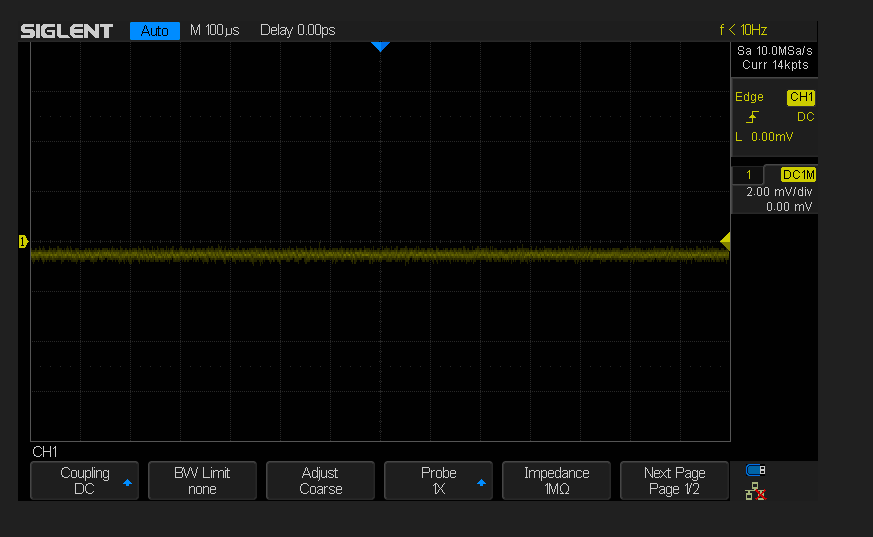
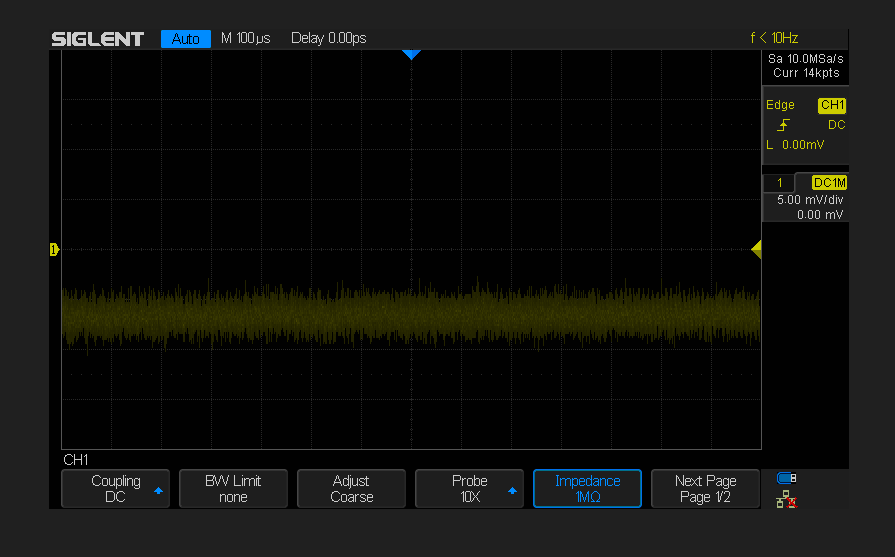
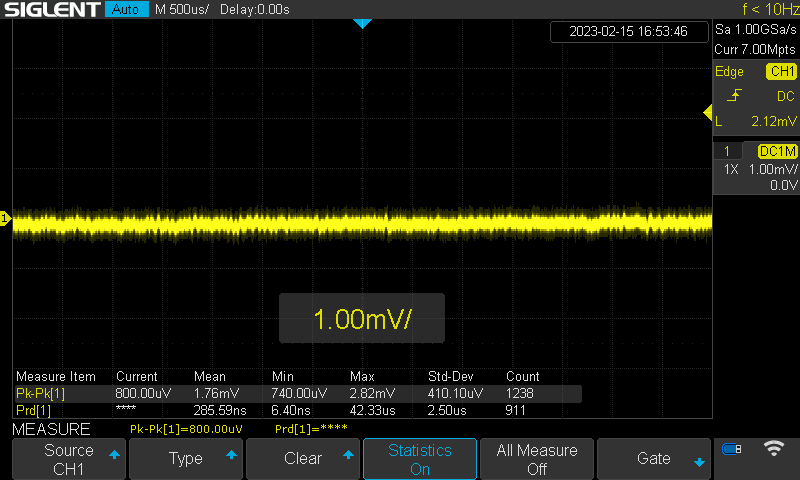
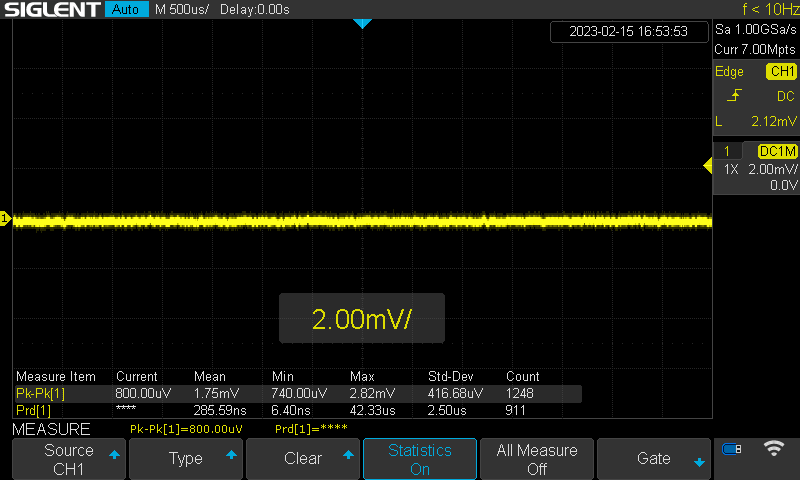
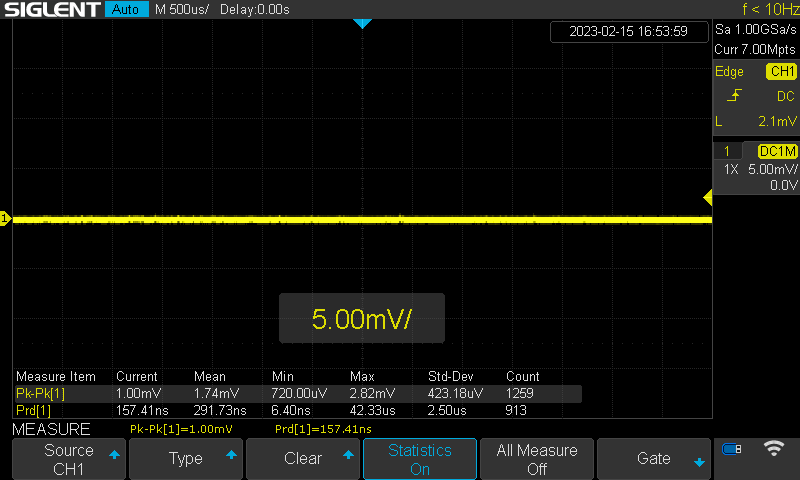
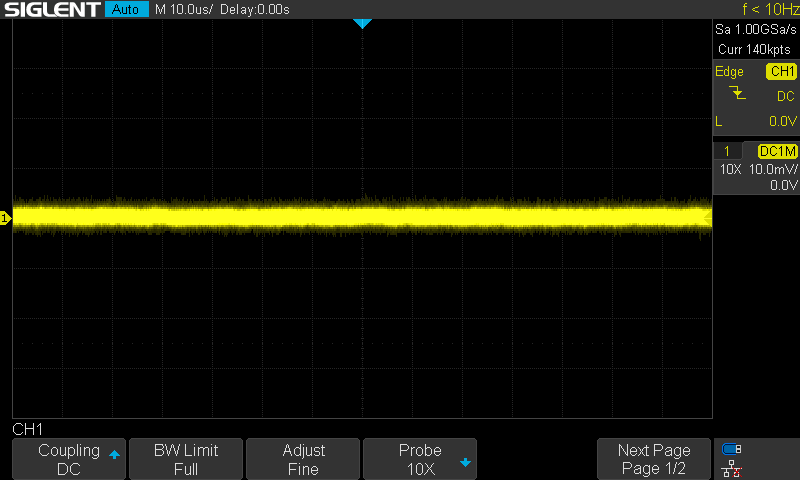
    You have a screen shot of siglent 1102x at 2mV if you are interested in this voltage per plot.
    so take a quick look at the settings and evaluate.
    Seeking Recommendations for Affordable Digital Oscilloscope - No Analog or Computer Adapter Seeking Recommendations for Affordable Digital Oscilloscope - No Analog or Computer Adapter
    Note that one measurement is with the x1 probe setting, the other x10 I did not connect the probes to the oscilloscope.

    Any oscilloscope will do, only the lowest mV ranges per plot, then noise creeps in.
  • #13 20437294
    rach_UMK
    Level 32  
    Posts: 1410
    Help: 208
    Rate: 395
    @tomaszwis1 you raise a completely different problem, so a new topic should probably be created.
    Do you want to directly examine the signal from the needle with an oscilloscope? forget it.
    @zdzisiek1979 with photos showed why. The oscilloscope is so sensitive that it collects a lot of garbage from the "air". LED lamp, inverter can already have an effect. Even though the oscilloscope is isolated, it also has its own noise.
    Of course you can do myk if you find it necessary to buy a fixed gain amplifier. And the other way around, i.e. when testing a phono preamp, make a silencer (like the Noise Reducer).
  • #14 20440128
    CosteC
    Level 39  
    Posts: 5221
    Help: 395
    Rate: 1612
    rach_UMK wrote:
    @zdzisiek1979 with photos showed why. The oscilloscope is so sensitive that it collects a lot of garbage from the "air". LED lamp, inverter can already have an effect. Even though the oscilloscope is isolated, it also has its own noise.

    @zdzisiek1979's screenshots from post #12 show two things: the self-noise of the oscilloscope and a large offset of 0.5 mV/Div - a classic for cheap oscilloscopes. Partially removable by switching to AC coupling and calibration after burn-in, but only partially. The hacked Rigol DS1054Z has very similar symptoms. Unfortunately, for PLN 2000-2500 it will not be better. On a different note, analog oscilloscopes usually hummed more, but it was less noticeable.
  • #15 20440360
    zdzisiek1979
    Level 39  
    Posts: 5408
    Help: 557
    Rate: 1241
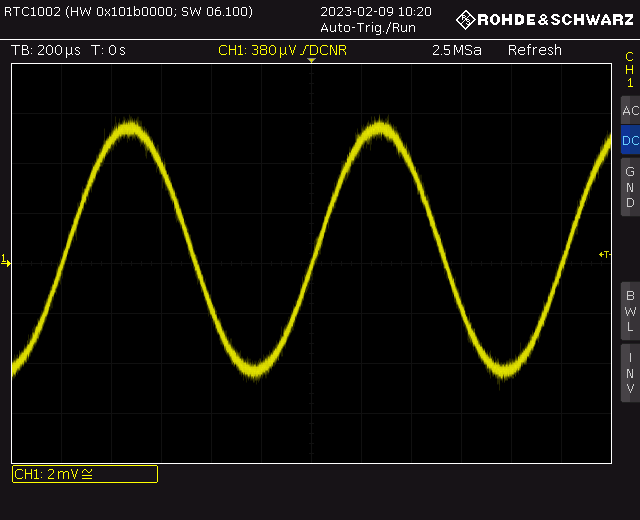
    I'm afraid that calibration won't help much and it takes a long time. These types do. Taking into account the zero line and its thickness, these ranges are probably not a happy choice for measurements or rather observations. I did the calibration after it warmed up, you can feel it on the BNC sockets because they are warmer but ... I think it's more of a marketing ploy, these uV
    Here the signal and voltage per division 2mV
    Seeking Recommendations for Affordable Digital Oscilloscope - No Analog or Computer Adapter and already confused. and an oscilloscope for 8k PLN
  • #16 20440485
    spy
    Level 27  
    Posts: 770
    Help: 86
    Rate: 260
    Something will definitely help. 1104X-E:
    Seeking Recommendations for Affordable Digital Oscilloscope - No Analog or Computer Adapter Seeking Recommendations for Affordable Digital Oscilloscope - No Analog or Computer Adapter Seeking Recommendations for Affordable Digital Oscilloscope - No Analog or Computer Adapter Seeking Recommendations for Affordable Digital Oscilloscope - No Analog or Computer Adapter
  • #17 20440733
    rach_UMK
    Level 32  
    Posts: 1410
    Help: 208
    Rate: 395
    @spy I have the same model. Turn on other channels and e.g. mix (1 and add 3 or 4). You may see strange phenomena.... ;)
    I don't know why, but for me channel 2 deviated the most (offset), but by combining channels (on, off) the offsets of individual channels changed slightly.
    The hotter it is, the closer it is to "0", except for channel "2".
    I don't remember, but let's assume channel 1 is like you in the picture, but by turning on, for example, channel 3, the signal on the screen with channel 1, for example, will lower it a bit.

    Just out of curiosity, @zdzisiek1979, what about the offset in Rohde (cold, warm) in relation to post #12?
  • #18 20440873
    ^ToM^
    Level 42  
    Posts: 9048
    Help: 495
    Rate: 2929
    zdzisiek1979 wrote:
    ....and also confused already. and an oscilloscope for 8k PLN


    Because it is a condition of today's constructions and it does not depend on the amount you spend. Even the more expensive ones have this problem.
  • #19 20441034
    CosteC
    Level 39  
    Posts: 5221
    Help: 395
    Rate: 1612
    ^ToM^ wrote:
    zdzisiek1979 wrote:
    .... and also confused already. and an oscilloscope for 8k PLN


    Because it is a condition of today's constructions and it does not depend on the amount you spend. Even the more expensive ones have this problem.

    And what oscilloscope with similar sampling (1 GSps, 8 bit) and bandwidth (50-100 MHz) has significantly less noise?
  • #20 20441182
    tzok
    VIP Meritorious for electroda.pl
    Posts: 38662
    Help: 3162
    Rate: 6407
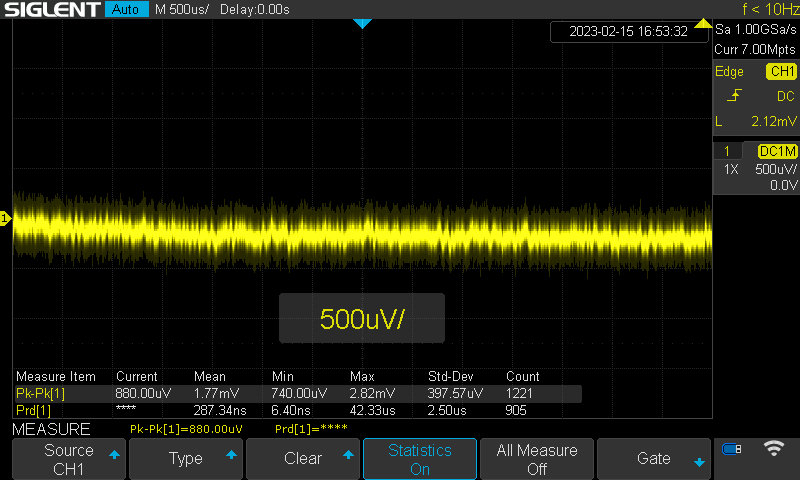
    This is what the offset and self-noise of the budget SDS1104X-U looks like:
    Seeking Recommendations for Affordable Digital Oscilloscope - No Analog or Computer Adapter
  • #21 20443145
    spy
    Level 27  
    Posts: 770
    Help: 86
    Rate: 260
    rach_UMK wrote:
    I don't remember, but let's assume channel 1 is like you in the picture, but by turning on, for example, channel 3, the signal on the screen with channel 1, for example, will lower it a bit.


    And you don't even need to switch between channels, just change the sensitivity and base. After a while, returning to the initial settings will show a larger offset :) Well, but it's such a problem with such sensitivities - probably a matter of compensation of the VGA amplifier. I read something about it once and the topic is not trivial.
  • #22 20443706
    CosteC
    Level 39  
    Posts: 5221
    Help: 395
    Rate: 1612
    spy wrote:
    Well, but it's such a problem with such sensitivities - probably a matter of compensation of the VGA amplifier

    I don't know about SIGLENT, but the Rigol DS1054Z has an input stage on discrete transistors. At 0.5 mV/div, which is the 4 mV range, it floats thermally first of all. VGA is then, and rather, as an integrated circuit will float less. Such an input stage is cheap and with readily available components - which is important nowadays.

    Someone dismantled the siglent input stage maybe?

Topic summary

✨ The discussion revolves around recommendations for affordable digital oscilloscopes, specifically excluding analog models and computer adapters. Users suggest various models based on budget and functionality, highlighting the Rigol DS-1054Z and Siglent SDS series as popular choices. The Rigol DS-1054Z is noted for its reliability, while the Siglent SDS1102X-E and SDS1202X-E are recommended for their superior specifications. Users emphasize the importance of budget, with suggestions ranging from PLN 300 for USB oscilloscopes to PLN 2000 for higher-end models. Concerns about noise and calibration issues in budget oscilloscopes are also discussed, along with the need for specific features depending on the intended use, such as audio equipment measurements.
Generated by the language model.

FAQ

TL;DR: PLN 1 876 secures a 4-channel Rigol DS-1054Z[Elektroda, prosiak_wej, post #19120364]; “buy either Rigol DS-1054Z or Siglent SDS1104X-U”[Elektroda, ^ToM^, post #19121955] Both meet hobby needs at ≤100 MHz. Why it matters: matching bandwidth, memory and noise floor saves hours of troubleshooting.

Quick Facts

• Entry-level USB scope: Hantek 6022BE ≈ PLN 300, 20 MHz, 2 CH[Elektroda,^ToM^,#19120349] • Best-value bench scope: Siglent SDS1104X-U, 100 MHz, 4 CH, 14 Mpts, ≈ PLN 2 000 (datasheet) • Legacy favourite: Rigol DS-1054Z, 50 MHz, 4 CH, 24 Mpts, PLN 1 800–1 900[Elektroda,prosiak_wej,#19120364] • Typical self-noise at 0.5 mV/div: ±0.5 div[Elektroda,CosteC,#20440128] • Memory depth below 10 kpts hampers single-shot captures at >1 µs/div[Elektroda,CosteC,#19123059]

What bandwidth do I really need for hobby and audio work?

For logic-level hobby projects, 50–100 MHz covers 5–10 ns edges. Audio analysis needs only 100 kHz, so any 20 MHz+ scope suffices. Choosing 100 MHz keeps headroom without big cost jump[Elektroda,^ToM^,#19120349].

Is the Siglent SDS1052 (50 MHz, 2 mV/div) sensitive enough for phono cartridge signals?

Bare phono outputs are ≈5 mV rms. At 2 mV/div the SDS1052 shows <2 div signal, buried in ±0.5 div noise[Elektroda,zdzisiek1979,#20437246]. Add a low-noise 40 dB preamp or use a sound card for sub-10 mV sources.

How much should I budget for a capable first digital oscilloscope?

Expect PLN 1 800–2 100 for a new 4-channel, 100 MHz model such as SDS1104X-U, or PLN 800–1 000 for a used 2-channel 70 MHz unit. Spending <PLN 500 limits you to USB adapters with smaller memory and higher noise[Elektroda,^ToM^,#19120349].

Why avoid very cheap brands like Owon or Voltcraft?

They often ship with 10 kpts memory, rigid probe attenuation settings, and higher offset drift[Elektroda,CosteC,#19123059]. These constraints hinder deep captures and accurate low-level work.

Rigol DS-1054Z vs. Siglent SDS1104X-U—what’s better today?

SDS1104X-U offers 100 MHz bandwidth, 14 Mpts memory and lower FFT noise versus the 50 MHz, 24 Mpts Rigol. Price difference is now ≈ PLN 200, so most users pick Siglent for longer relevance[Elektroda,spy,#19122867].

Do modern DSO’s all suffer from offset drift?

Yes. Budget scopes show up to 0.5 mV/div drift after warm-up[Elektroda,CosteC,#20440128]. High-end 8-bit, 1 GS/s models still exhibit visible baseline shifts[Elektroda,^ToM^,#20440873].

Can calibration remove the low-range noise?

Self-calibration trims DC offset by ~30 %, but cannot overcome front-end thermal noise[Elektroda,zdzisiek1979,#20440360]. “These ranges are not a happy choice for measurements” notes user zdzisiek1979.

Which parameters matter most for amplifier repair?

  1. Bandwidth ≥20 × highest audio harmonic (≈400 kHz).
  2. Vertical resolution ≥8-bits; 1 mV/div range helps noise checks.
  3. Memory ≥1 Mpts for low-speed sweeps.
  4. Low FFT noise floor (–90 dBFS typical on 100 MHz scopes).

How do I reduce airborne interference at 2 mV/div?

  1. Switch to AC coupling.
  2. Twist ground lead with probe.
  3. Turn off LED lamps and SMPS nearby. This cuts 50 Hz and RF pickup by >60 %. [How-To]

Is a USB oscilloscope a good idea?

USB units like Hantek 6022BE cost <PLN 300 but sample at 48 MS/s and lack hardware triggers[Elektroda,^ToM^,#19120349]. They suit slow microcontroller signals, yet fail on sub-200 ns edges and are unusable when the PC ground floats.

Edge case: what fails when memory depth is only 10 kpts?

At 1 µs/div, a 10 kpts buffer stores 1 ms. You lose zoomed-in detail of a 2 ms glitch; long data packets appear aliased[Elektroda,CosteC,#19123059].

Any quick steps to calibrate offset drift?

  1. Warm the scope 20 min.
  2. Disconnect all probes, select Utility > Self-Cal.
  3. Repeat if baseline shifts over 0.5 div at 0.5 mV/div afterwards. Each run takes about 90 s (Siglent menu).
Generated by the language model.
ADVERTISEMENT