logo elektroda
logo elektroda
X
logo elektroda

Check Network Card Speed: Steps for Wi-Fi Maximum Internet Speed Evaluation

rostov84 28764 27
Best answers

How can I check the maximum Wi‑Fi internet speed my network card supports?

You can check it in the adapter’s specifications or by identifying the NIC in Device Manager; the speed shown in Windows Wi‑Fi connection properties is the negotiated theoretical link speed, not the real internet throughput [#19379573] [#19379726] [#19379986] For the Qualcomm Atheros QCA9565 mentioned in the thread, the card supports about 72.2 Mbps on 20 MHz and 150 Mbps on 40 MHz, with real transfers roughly 30–50 Mbps and 70–100 Mbps respectively [#19379850] To get closer to 300 Mbps over Wi‑Fi, you need a newer dual-band 2.4/5 GHz card and a matching router; 2.4 GHz 802.11n 2x2 tops out around 220–230 Mbps, while 5 GHz 802.11ac can do much more in theory [#19379986] [#19380287] The thread also notes that laptop replacement cards may be limited by Dell BIOS/whitelist rules, so compatibility should be checked before buying [#19379814] [#19379997]
Generated by the language model.
ADVERTISEMENT
Treść została przetłumaczona polish » english Zobacz oryginalną wersję tematu
  • #1 19379541
    rostov84
    Level 12  
    Posts: 924
    Rate: 213
    How can I check what the highest internet speed I can get on my network card when connected to wi-fi?
  • ADVERTISEMENT
  • #2 19379573
    jimasek
    VIP Meritorious for electroda.pl
    Posts: 35287
    Help: 3783
    Rate: 2671
    In the specification of the network card.
  • #3 19379589
    rostov84
    Level 12  
    Posts: 924
    Rate: 213
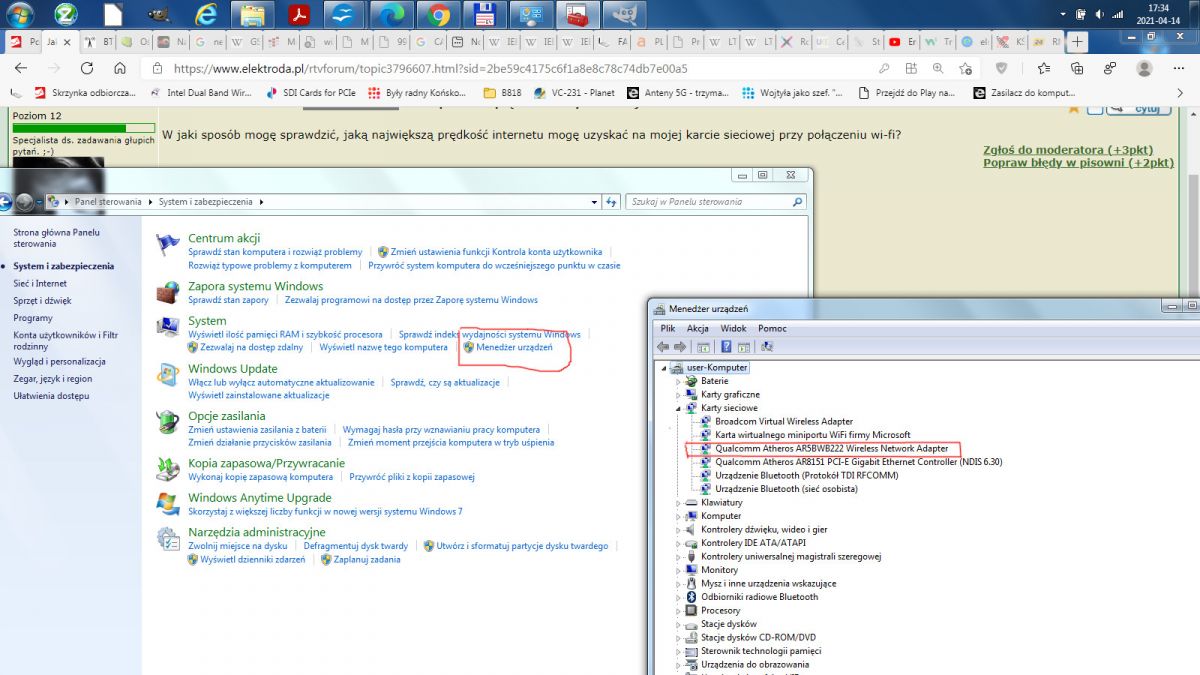
    I don't have documents for the laptop. Can I check it somehow in the system? I have Windows 7 Home Premium (x64).
  • ADVERTISEMENT
  • #4 19379591
    jimasek
    VIP Meritorious for electroda.pl
    Posts: 35287
    Help: 3783
    Rate: 2671
    Post your NIC ID and that should tell you something
  • #5 19379689
    rostov84
    Level 12  
    Posts: 924
    Rate: 213
    @jimasek , I admit I don't know where to look for such an identifier.
    Maybe it helps if I write that my laptop is a Dell Inspiron 15 N5050.
  • #6 19379726
    Anonymous
    Level 1  
  • ADVERTISEMENT
  • #7 19379795
    rostov84
    Level 12  
    Posts: 924
    Rate: 213
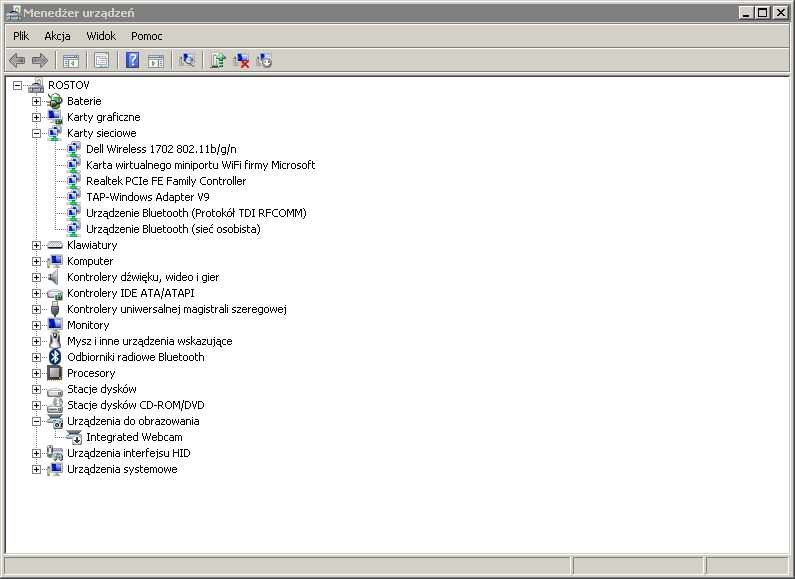
    @_cheetah_ , in device manager I don't know which device to choose:

    Check Network Card Speed: Steps for Wi-Fi Maximum Internet Speed Evaluation

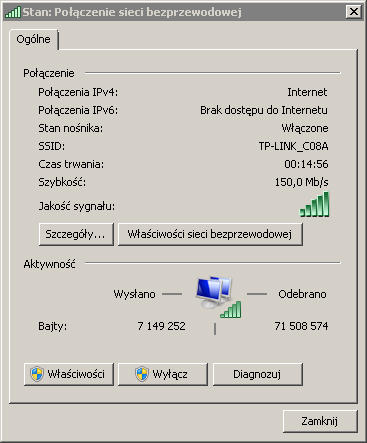
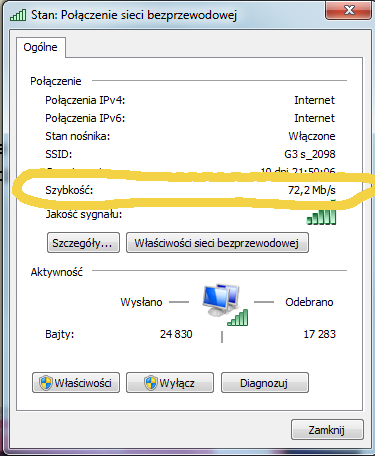
    In the connection properties (when connected via Wi-Fi) it shows me a speed of 65.0 Mb / s - so this is the maximum speed I can achieve without a cable?

    I am asking this because in the near future I am going to switch from neostrada to 300 Mb/s optical fiber and I would like to achieve the highest possible speed by connecting via Wi-Fi.
    Should I buy a different/newer card to get the maximum speed?
  • #8 19379814
    KOCUREK1970
    Network and Internet specialist
    Posts: 35130
    Help: 3786
    Rate: 5326
    rostov84 wrote:
    Should I buy a different/newer card to get the maximum speed?

    You will never get the maximum speed, because it is due to many reasons.
    To have a real wifi speed of 250 Mb / s, you need a wifi 802.11ac 2x2 MU-MIMO transmitter with a bandwidth of 867 Mbps.
    For MU-MIMO to work fully, your end devices must support MU-MIMO, i.e. 802.11ac Wave2.
    Not to mention how many other wifi networks there are, what signal strength, what obstacles in the premises, furniture, what is in the walls, reinforcement, etc.
    All in all, it can be said that the maximum you will achieve will be how much you receive and it will not be a constant value - wifi is radio.

    In addition, DELL seems to have locks for replacing wifi cards - you need to modify the BIOS.
    Look for the Dell whitelist on the net - and read what is related to this topic.
  • #9 19379850
    jimasek
    VIP Meritorious for electroda.pl
    Posts: 35287
    Help: 3783
    Rate: 2671
    Speeds for the Qualcomm Atheros QCA9565 processor
    72.2 Mbps for 20 MHz ~ 30 - 50Mpbs channel width
    150Mbps for 40MHz ~ 70 -100Mbps channel width

    ~real transfers on this card
  • #10 19379972
    rostov84
    Level 12  
    Posts: 924
    Rate: 213
    It seems that this model does not seem to have such limitations:

    https://www.dell.com/community/Laptops-Genera...Inspiron-15-replace-wifi-adapter/td-p/4434316

    If not, what better network card, which of course would be supported by this quite old laptop, should I buy to achieve at least slightly better results (both via cable and via wifi) than on the current network?
    The laptop is almost 10 years old now, so I bet there are already cards out there that support much newer technology than mine.
  • #11 19379986
    Anonymous
    Level 1  
  • #13 19380077
    rostov84
    Level 12  
    Posts: 924
    Rate: 213
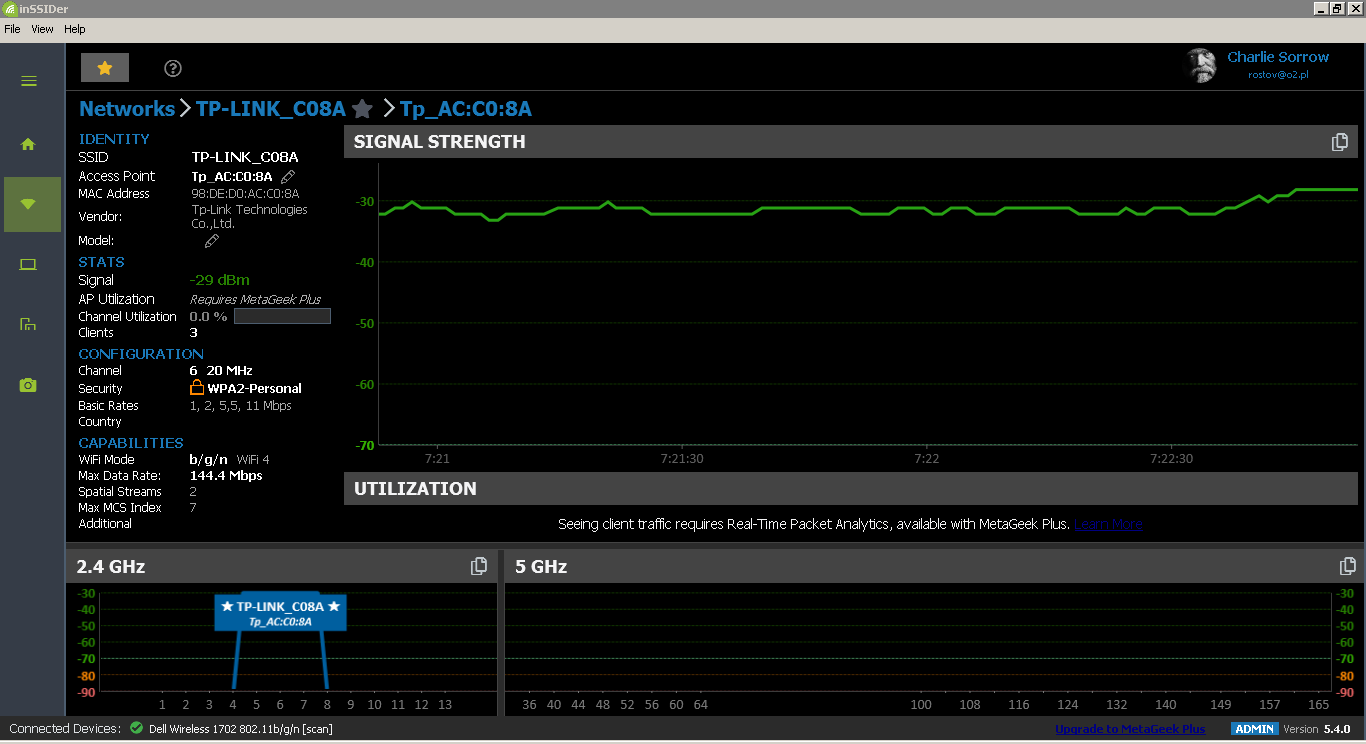
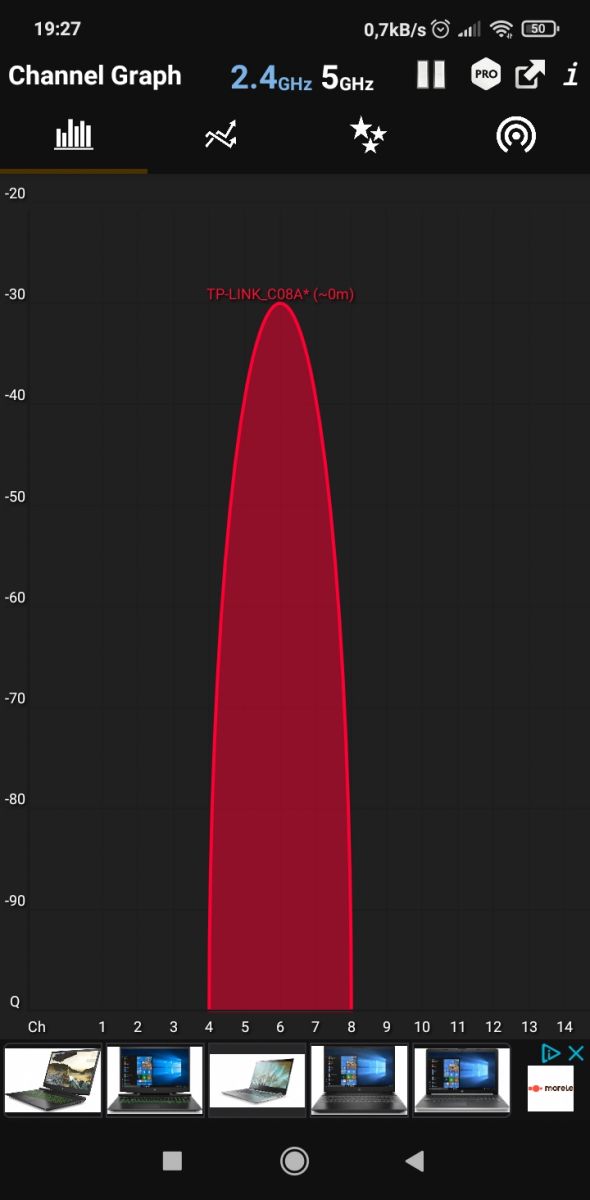
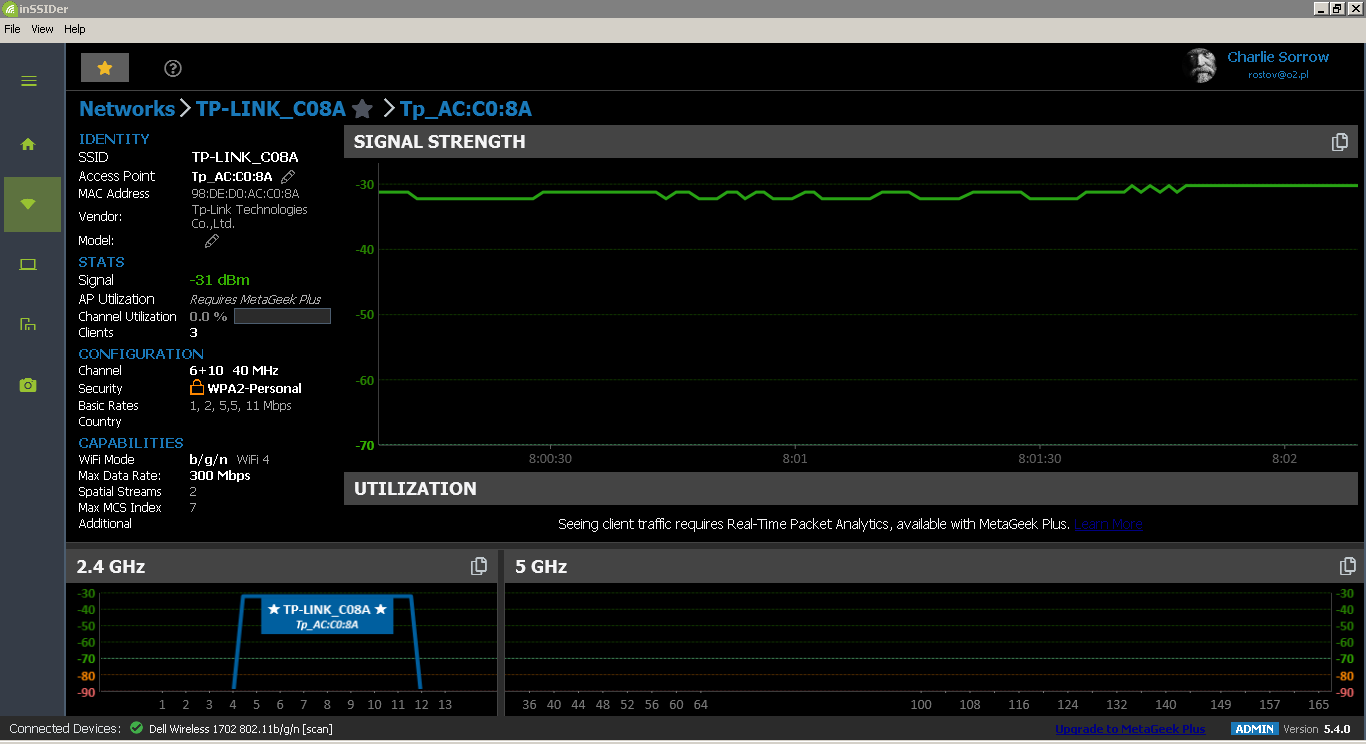
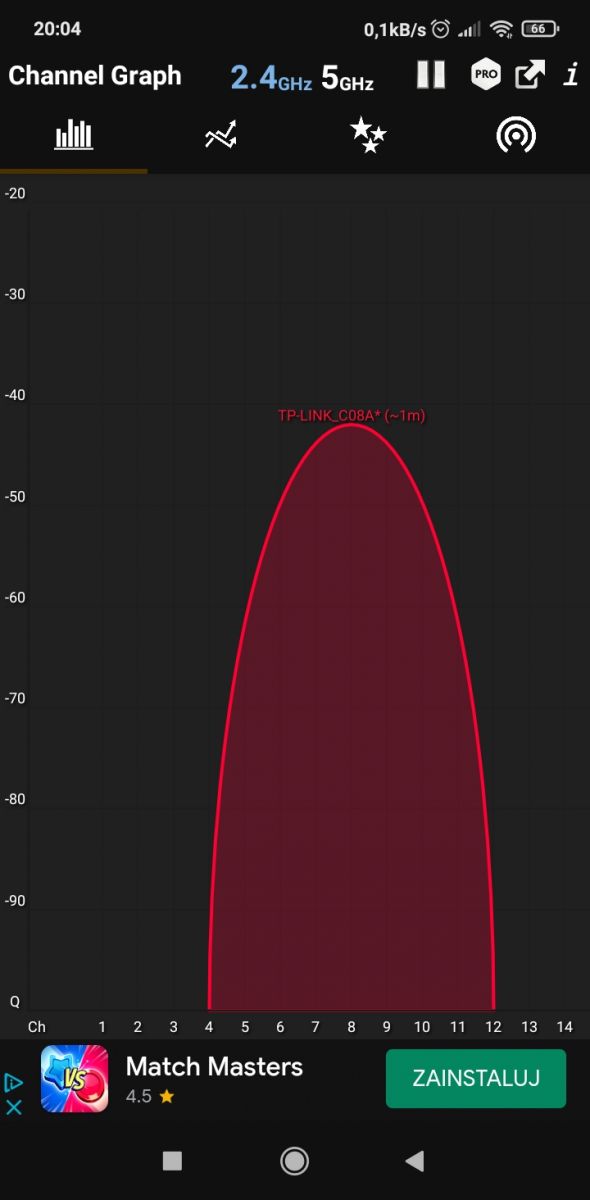
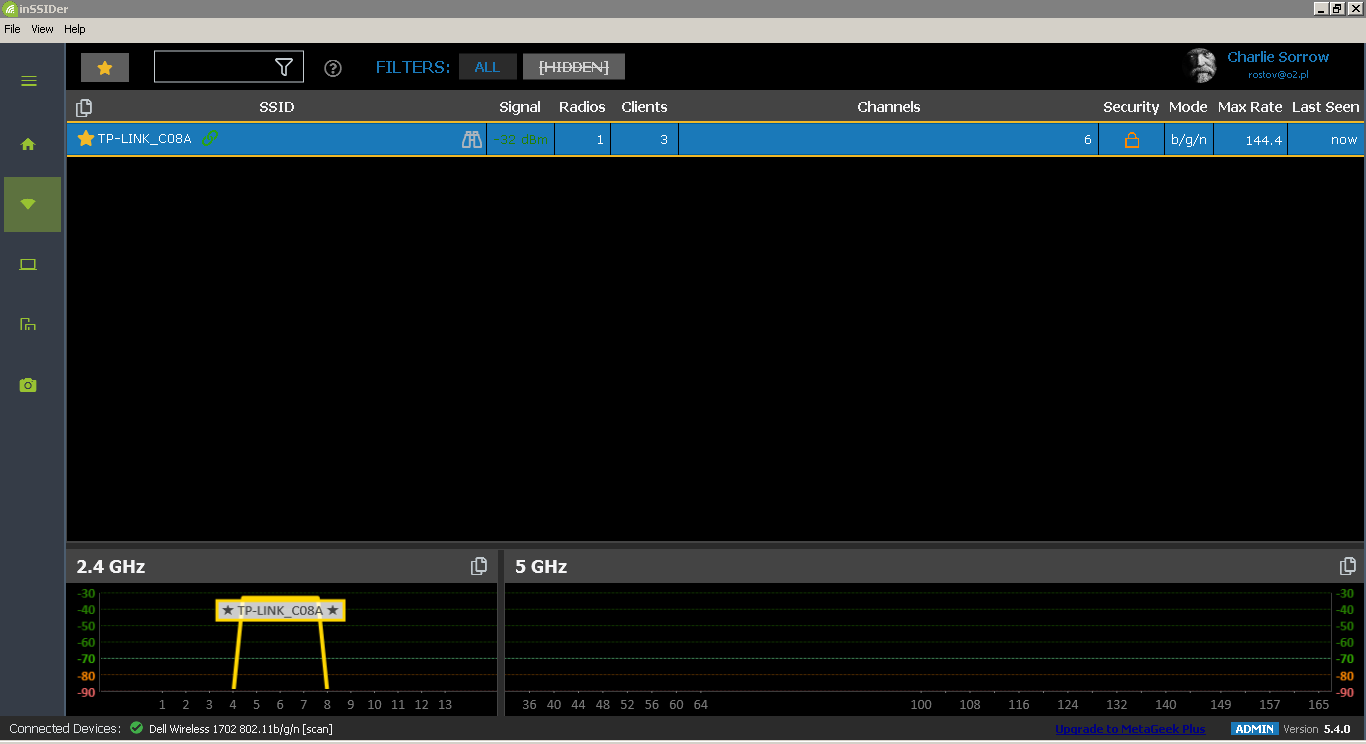
    @_cheetah_ , my version of InSSIDer looks a bit different, so I'm posting 2 screenshots. I hope that's about it.
    In my case, one location is the most important - the laptop on the desk, the router is about 0.5 m from it.

    Check Network Card Speed: Steps for Wi-Fi Maximum Internet Speed Evaluation Check Network Card Speed: Steps for Wi-Fi Maximum Internet Speed Evaluation Check Network Card Speed: Steps for Wi-Fi Maximum Internet Speed Evaluation
  • #14 19380112
    Anonymous
    Level 1  
  • #15 19380174
    rostov84
    Level 12  
    Posts: 924
    Rate: 213
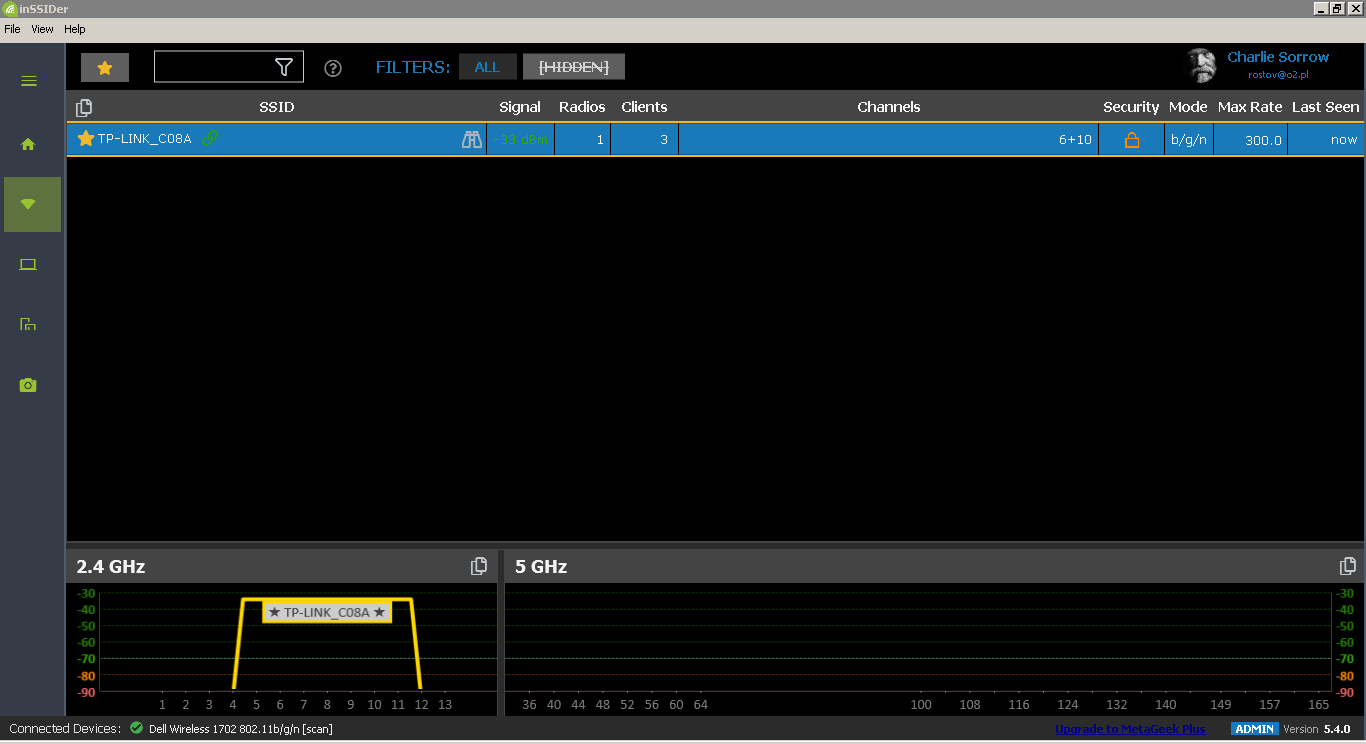
    @_cheetah_ , in the network card settings, in the '802.11n Bandwith' property, I set the value '20MHz/40Hz Auto' (I don't have the 40MHz value).
    However, in the router's wireless network settings, I set the channel width to '20/40MHz' (there is also no 40 MHz value here).
    Now the situation looks like this:

    Check Network Card Speed: Steps for Wi-Fi Maximum Internet Speed Evaluation Check Network Card Speed: Steps for Wi-Fi Maximum Internet Speed Evaluation Check Network Card Speed: Steps for Wi-Fi Maximum Internet Speed Evaluation Check Network Card Speed: Steps for Wi-Fi Maximum Internet Speed Evaluation
  • #16 19380215
    Anonymous
    Level 1  
  • #17 19380231
    rostov84
    Level 12  
    Posts: 924
    Rate: 213
    @_cheetah_ from what I can see, the 300 Mb / s option includes FunBox 3.0, i.e. 2.4 GHz 802.11n 2 * 2 and 5 GHz 802.11ac 4 * 4 and four antennas working in MU-MIMO mode
  • #18 19380266
    KOCUREK1970
    Network and Internet specialist
    Posts: 35130
    Help: 3786
    Rate: 5326
    rostov84 wrote:
    FunBox 3.0 is included in the price for the 300 Mb/s option

    Everything is beautiful, only he doesn't have any external antennas, so don't expect a torpedo here either, and in addition, people also complain about his wifi.
  • #19 19380282
    rostov84
    Level 12  
    Posts: 924
    Rate: 213
    Privately, I have a TP-LINK TD-W8960N, but it only works on 2.4 GHz, so it seems that in addition to a new network cable, you will also need to look for a new router ...
  • #20 19380287
    Anonymous
    Level 1  
  • ADVERTISEMENT
  • #21 19380416
    rostov84
    Level 12  
    Posts: 924
    Rate: 213
    For financial reasons, I do not foresee an option higher than 300 Mbps.
    By the way, my current card is what type? Fast Ethernet or Gigabit Ethernet?
  • #22 19380438
    Anonymous
    Level 1  
  • #23 19380444
    KOCUREK1970
    Network and Internet specialist
    Posts: 35130
    Help: 3786
    Rate: 5326
    rostov84 wrote:
    By the way, my current card is what type? Fast Ethernet or Gigabit Ethernet?

    Fast Ethernet only.
    So it won't be faster than 100Mb over LAN anyway.
  • #24 19380489
    rostov84
    Level 12  
    Posts: 924
    Rate: 213
    So why this 150 Mbps speed in the properties of the Wi-Fi connection?
    Forgive me for these lame questions, but I'm very lost in this network stuff.
  • #25 19380566
    KOCUREK1970
    Network and Internet specialist
    Posts: 35130
    Help: 3786
    Rate: 5326
    rostov84 wrote:
    So why this 150 Mbps speed in the properties of the Wi-Fi connection?

    Wifi has nothing to do with LAN, it's 2 different, mutually independent cards.
  • #26 19380680
    rostov84
    Level 12  
    Posts: 924
    Rate: 213
    @KOCUREK1970 , are they 2 separate, PHYSICAL devices?
  • #27 19380698
    KOCUREK1970
    Network and Internet specialist
    Posts: 35130
    Help: 3786
    Rate: 5326
    rostov84 wrote:
    are they 2 separate, PHYSICAL devices?

    Of course.
    You remove the wifi card from your computer and the LAN card still works.
  • #28 19380993
    rostov84
    Level 12  
    Posts: 924
    Rate: 213
    So what dual-band Wi-Fi card that would be compatible with my laptop should I purchase?

Topic summary

✨ To evaluate the maximum internet speed of a Wi-Fi network card, users can check the specifications of the network card, typically found in the Control Panel under Device Manager in Windows 7. The Dell Inspiron 15 N5050 was discussed, with users noting that the current Wi-Fi speed was limited to 65 Mbps, which may not be sufficient for future upgrades to 300 Mbps optical fiber. Recommendations included using diagnostic tools like InSSIDer to assess Wi-Fi performance and considering a new network card that supports 802.11ac with MIMO technology for better speeds. Users also highlighted the importance of router capabilities and potential limitations due to the laptop's age. The distinction between Wi-Fi and LAN cards was clarified, emphasizing that they are separate physical devices.
Generated by the language model.

FAQ

TL;DR: Your Dell Inspiron 15 N5050’s QCA9565 Wi-Fi tops out at 150 Mbps link rate (≈70-100 Mbps real)[Elektroda, jimasek, post #19379850]; “FE means 100 Mb/s over cable”[Elektroda, Anonymous, post #19380438] Upgrade to a dual-band 802.11ac USB or internal card plus Gigabit router to approach 300 Mb/s fiber.

Why it matters: Knowing each ceiling lets you fix the right bottleneck instead of buying speed you can’t use.

Quick Facts

• QCA9565 link rates: 72 Mbps @20 MHz, 150 Mbps @40 MHz [Elektroda, jimasek, post #19379850] • Fast-Ethernet port maxes at 100 Mbps [Elektroda, Anonymous, post #19380438] • 802.11ac 80 MHz single-stream gives ~320 Mbps real throughput [Cisco, 2018] • FunBox 3.0: 2.4 GHz 2×2 n, 5 GHz 4×4 ac MU-MIMO [Elektroda, rostov84, post #19380231] • Dell N5050 may enforce a Wi-Fi card whitelist; BIOS mod often required [Elektroda, KOCUREK1970, post #19379814]
How do I check my current Wi-Fi link speed in Windows 7?

  1. Open Control Panel ➜ Network & Sharing Center. 2. Click your wireless connection name. 3. Read the “Speed” field in the Status window; it updates live. This method showed 65 Mbps for the thread starter [Elektroda, rostov84, post #19379795]

Where can I find my network card identifier (NIC ID)?

Open Device Manager ➜ Network adapters ➜ right-click your Wi-Fi card ➜ Properties ➜ Details ➜ Hardware IDs. Posting that string online reveals exact chipset and limits [Elektroda, jimasek, post #19379591]

What is the maximum realistic throughput of the Qualcomm Atheros QCA9565?

The chipset links at 150 Mbps over a 40 MHz channel but usually moves 70–100 Mbps of real data under ideal conditions [Elektroda, jimasek, post #19379850]

Why does Windows show 150 Mbps but downloads stay below 100 Mbps?

The figure is a raw link rate before protocol overhead, interference, and TCP/IP loss. Expect roughly 50–70 % of the link value as usable throughput [Cisco, 2018].

Is my laptop’s Ethernet port Fast Ethernet or Gigabit?

Device Manager lists “Realtek PCIe FE Family Controller,” so it’s Fast-Ethernet—limited to 100 Mbps [Elektroda, Anonymous, post #19380438]

What bottlenecks arise when switching to 300 Mb/s fiber?

Your Fast-Ethernet port caps wired speed at 100 Mbps, and the QCA9565 Wi-Fi caps wireless around 100 Mbps. Both must upgrade to enjoy full fiber bandwidth [Elektroda, KOCUREK1970, post #19380444]

Can I replace the internal Wi-Fi card in a Dell Inspiron 15 N5050?

Yes, but Dell often whitelists specific cards; many users must flash a modified BIOS first [Elektroda, KOCUREK1970, post #19379814]

Which dual-band adapter hits 300 Mb/s on FunBox 3.0?

Any 802.11ac USB-AC1200 stick (2×2 MIMO, 867 Mbps link) reaches 300 Mb/s on the router’s 5 GHz band with headroom [Elektroda, Anonymous, post #19380287]

Will a USB 802.11ac adapter perform like an internal card?

In laptops lacking spare antennas, a quality USB-AC adapter with its own antennas often equals or beats an internal half-mini PCIe card [SmallNetBuilder, 2019].

How do channel width and MIMO streams affect speed?

Doubling channel width from 20 MHz to 40 MHz about doubles link rate; each extra MIMO stream adds another equal slice. Example: 802.11ac 80 MHz 2×2 links at ~866 Mbps versus 433 Mbps for 1×1 [Elektroda, Anonymous, post #19380287]

How can I enable wider channels on my current setup?

3-Step How-To:
  1. Log into router ➜ Wireless ➜ set bandwidth to 20/40 MHz or 40 MHz. 2. In Device Manager ➜ Wi-Fi card ➜ Advanced ➜ ‘802.11n Bandwidth’ ➜ 20/40 Auto. 3. Reconnect and verify link rate in Status window [Elektroda, rostov84, post #19380174]

What boost will 5 GHz bring compared with 2.4 GHz?

5 GHz suffers less interference and supports 80 MHz channels; a single-stream 802.11ac link can deliver ~320 Mbps real throughput, almost triple 2.4 GHz n 40 MHz [Cisco, 2018].

Do I need new cables for Gigabit Ethernet?

Cat 5e or better supports 1 Gbps up to 100 m. If your existing patch cable says Cat 5e, you’re ready; otherwise replace it [Fluke Networks, 2020].
Generated by the language model.
ADVERTISEMENT