logo elektroda
logo elektroda
X
logo elektroda

Seat Leon III - After replacing the battery in the key, the car reports a low battery in the

patryko_88 27921 20
Best answers

Why does my Seat Leon key report a low battery even though the CR2025 measures around 3.0 V?

The most likely cause is the battery itself, not the key: a CR2025 can show about 3.0 V on a multimeter and still be rejected if its internal resistance is too high or it cannot hold voltage under the key’s pulsed load [#19626275][#19616645] In this thread, swapping the questionable Energizer battery into the spare key made the warning follow the battery, while the Panasonic battery worked normally in the main key, which strongly points to a bad or unsuitable battery batch rather than a fault in the electronics [#19626246] The key’s battery check is therefore not based only on open-circuit voltage, so a fresh-looking battery can still trigger the “replace battery” message [#19626275] If a battery swap does not help, also inspect/clean the contacts and buttons for unwanted current draw [#19615093][#19615156], and one reply mentioned a possible BCM software update for this warning [#19628897]
Generated by the language model.
ADVERTISEMENT
This content has been translated flag-pl » flag-en View the original version here
  • #1 19615043
    patryko_88
    Level 8  
    Posts: 12
    Hi.

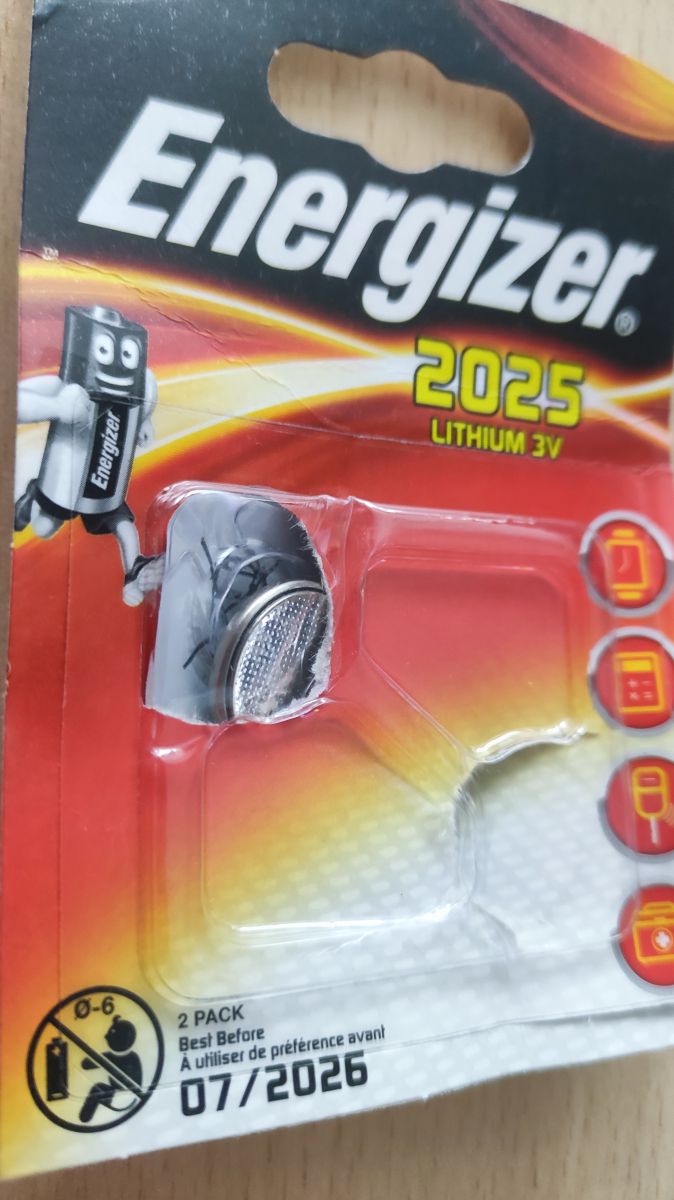
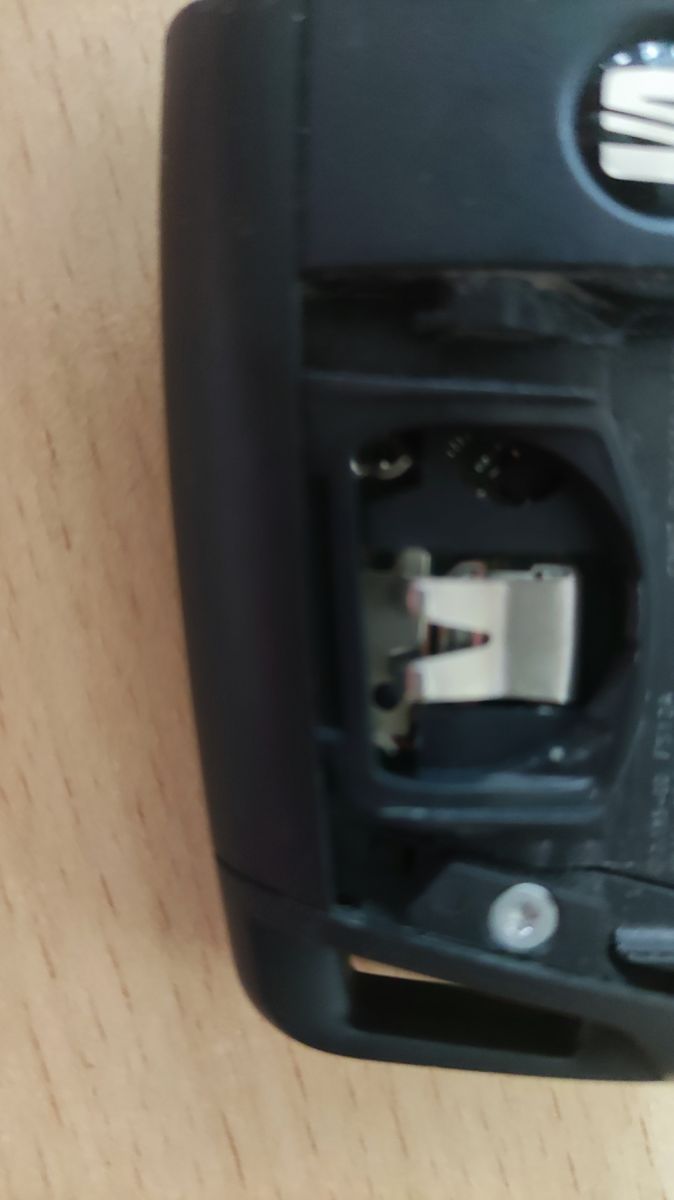
    I would like to ask for help with an unusual problem. I have recently replaced the CR2025 battery in my key (Seat Leon III 2016) with a new Energizer battery:
    Seat Leon III - After replacing the battery in the key, the car reports a low battery in the .

    Battery marked "fit for purpose" until 2026 so looks like a fresh supply. The problem is that 3 weeks after replacement, when starting the car on the computer a message pops up to replace the battery....

    I measured the voltages and yes, there is a Panasonic battery in the other remote (spare). The voltage measured with a meter on the battery is 3.01 volts.
    The battery in the key fob (Energizer) is 3.05 volts, I checked after pressing the button for example - 3.02 - 3.03 - a marginal drop.
    I checked the 2nd battery from the blister (when I bought it there were two for replacement). A new unused battery has a voltage of 3.23 V.

    Now to the question:
    What could be the cause of the battery being identified as used despite the correct voltage? Could the fact that the new battery was 3.24 volts have messed up the electronics in the key, or switched something and now anything below 3.2 volts is reported as too low a voltage? As I mentioned the spare key has a weaker voltage and it is not identified as a battery to be replaced. Please help to unravel this conundrum.
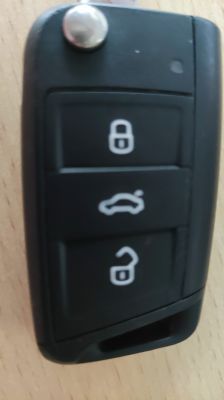
    Seat Leon III - After replacing the battery in the key, the car reports a low battery in the Seat Leon III - After replacing the battery in the key, the car reports a low battery in the
  • ADVERTISEMENT
  • #2 19615093
    gimak
    Level 41  
    Posts: 6203
    Help: 614
    Rate: 1661
    Check the contacts in the key (cleanliness) through which the battery connects to the rest of the electronics, as a voltage drop can be deposited on them, which can cause the battery to be treated as worn out.
  • #3 19615122
    patryko_88
    Level 8  
    Posts: 12
    Hi, I have tried this unfortunately nothing has worked. The contacts look perfectly clean. I also did the trick of taking the battery out of the key for 5h. After putting it back in, the key reported no battery problem for 2-3 days then the problem returned.
  • #4 19615151
    Aleksander_01
    Level 43  
    Posts: 12645
    Help: 1151
    Rate: 3361
    Maybe something is wrong with the antenna in the key. Do a test from what distance it stops "catching".
  • #5 19615156
    gimak
    Level 41  
    Posts: 6203
    Help: 614
    Rate: 1661
    To me, this 'number' would indicate that current is escaping from the battery as it is in the key minimum and this is causing the voltage on it to sit and not have time to rest - when it was removed it had time to regenerate. If you can see nothing on the board itself, then the problem could be in any of the buttons that it is not giving 100% break.
  • #6 19615300
    patryko_88
    Level 8  
    Posts: 12
    As for the range of the remote - I think everything is fine - I am able to unlock the car from 20m away through a closed door in a building.
    I'm going to do one more test - I'm going to reposition the battery from the spare key and see how things look. The original battery was a Panasonic CR2025.
  • ADVERTISEMENT
  • #7 19615523
    gimak
    Level 41  
    Posts: 6203
    Help: 614
    Rate: 1661
    It's not about the range of the remote control. I don't know, but I presume that the information that the battery is too weak is due to the fact that maybe the amplitude of the key signal is low, as a consequence of low battery voltage when the button is pressed. That the battery is under load not only when the button is pressed would be confirmed by an experiment with its 5 hour rest, after it was removed from the key. During this time, the unloaded one had time to regenerate and then run for three days.
    I don't know if this is feasible, but I would try to check (measure) by how much the voltage on the battery drops when the button of each key is pressed in both keys.
  • ADVERTISEMENT
  • #8 19615594
    Aleksander_01
    Level 43  
    Posts: 12645
    Help: 1151
    Rate: 3361
    gimak wrote:
    .
    I don't know if it's feasible, but I would try to check (measure) how much the battery voltage drops when each button is pressed on both keys.

    But it is feasible to check with an ammeter the current consumption of the remote control, it should be 0 mA, the consumption only when the button is pressed.
  • #9 19616625
    patryko_88
    Level 8  
    Posts: 12
    I checked the current consumption of the remote control with an ammeter and it is 0 mA. The consumption when pressing the button jumps to 1 mA.
    Now a curiosity:
    I swapped batteries: from the auxiliary key I put a Panasonic with 3.01 V into the key I use every day, and into the auxiliary remote control an Energiser which has 3.03 V according to the meter.
    The car for both cases now reports no need to change the battery. I have also done the manoeuvre of taking the battery out of the primary remote - putting it back into the remote and yet the car still reports the need to change the battery.

    I'll drive around in this configuration for a few days and let you know what came up, I haven't had such a case in any previous car yet. Perhaps I unnecessarily purchased a different brand of battery to the one that was in the remote control and this is the cause of the problems....
  • #10 19616645
    Anonymous
    Level 1  
  • #11 19626246
    patryko_88
    Level 8  
    Posts: 12
    Part, a brief update after a few days of testing. It turns out that there is something wrong with the batteries I purchased after all. I mentioned earlier that I changed the batteries in the keys:
    I put the battery from the spare key into the primary key, and put the one I bought new into the spare key.
    I use the keys alternately and the result is as follows:
    The primary key (with the repositioned Panasonic battery from the primary key) reports no errors.
    The secondary key (with the new Energizer battery) reports a low battery error.

    In my opinion, this clearly proves that the problem is with the battery and not the key electronics. I guess I was out of luck buying these batteries. Maybe it was some kind of stock lying around? Hard to say. On the other hand, it's better that it's a problem with the battery than with the key :) .
  • #12 19626275
    Macosmail
    Level 35  
    Posts: 2840
    Help: 227
    Rate: 848
    To me the batteries (two) in my Audi key lasted 10 years. Could be a fake Energizer or that's the quality of batteries they make now. In addition to the voltage, the internal resistance is important. The remote control draws current in, short pulses and then the voltage can squat (impossible to pick up with a normal multimeter). The circuit in the remote control monitors the power supply and, if it is too low, sends an appropriate message to the car about the low battery.
  • #13 19626456
    jacek074
    Level 30  
    Posts: 878
    Help: 186
    Rate: 719
    From my own experience, I know that replacing it with a battery from aso (made in china) helped. After removing the battery, press any button on the remote control before inserting the new one.
  • ADVERTISEMENT
  • #14 19626487
    balonika3
    Level 43  
    Posts: 10933
    Help: 1299
    Rate: 3653
    jacek074 wrote:
    After removing the battery, press any button on the remote control -before inserting a new one.
    And why is that?
  • #15 19626495
    Aleksander_01
    Level 43  
    Posts: 12645
    Help: 1151
    Rate: 3361
    balonika3 wrote:
    jacek074 wrote:
    After removing the battery, press any button on the remote - before inserting a new one.
    And why is that?
    .
    Because if you listen to your brother-in-law's cousin whose friend read somewhere that it helps, that's the way to do it.
  • #16 19628897
    specjalistasamochody
    Level 21  
    Posts: 326
    Help: 44
    Rate: 221
    I am not saying that the battery is ok. But for the appearance of this message there is a software update in bcm
  • #17 20898244
    bladykm61
    Level 1  
    Posts: 1
    In my case, I ignored the message on the display about the low battery in the key until finally the battery went completely dead. The voltage of the discharged battery was 3.01V. I had a Duracell DL2025 battery (same as CR2025) bought much earlier with a "best use before 2025" date. When I inserted it into the key there was no response to pressing the button, the red LED did not flash at all. The battery was showing a voltage of around 3.31V. I read up on various forums (English language) about this problem and mainly the problem of a weak battery came up. I also had a slightly thicker Energizer CR2032 battery, some people force it into the remote, I put it in just for a test and surprisingly the remote worked, voltage the same as the Duracell battery. Then I reinserted the Duracell DL2025 battery and it is already working without a problem, no coding was needed. I think that sometimes the electronics can get blocked in the remote control and such flowers happen. It is best to have 2-3 CR2025 batteries from different manufacturers in reserve.
  • #18 20898297
    gimak
    Level 41  
    Posts: 6203
    Help: 614
    Rate: 1661
    bladykm61 wrote:
    I also had a slightly thicker Energizer CR2032 battery, some people force it into the remote, I put it in just for a test and surprisingly the remote worked, voltage the same as the Duracel battery.
    Then I reinserted the Duracel DL2025 battery and it is already working without a problem, no coding was needed. I think that sometimes the electronics can get blocked in the remote control and such flowers happen. It's best to have 2-3 CR2025 batteries from different manufacturers in reserve.

    I had a similar situation recently with a remote control for a corolla. The battery removed from the remote from the non-functioning remote had a voltage of 3.02V, I figured it could still go. After putting it back in, the remote came to life, but for a very short time. So I removed the battery insert and moved the battery without removing it and the remote came alive again, so I thought the cause was poor contact between the battery and the remote's contacts. So I bent the contact plates and the remote came alive again for two days. I got tired of playing with it and replaced the battery with a new one and so far the remote is working, I wonder how long it will last. It seems that in remote controls at this battery voltage level the remote stops working.
  • #19 21303031
    leszelka
    Level 16  
    Posts: 463
    Help: 1
    Rate: 72
    patryko_88 wrote:
    Partly, a brief update after a few days of testing. Turns out there is something wrong with the batteries I purchased though. I mentioned earlier that I changed the batteries in the keys:
    I put the battery from the spare key into the primary key, and put the one I bought new into the spare key.
    I use the keys alternately and the result is as follows:
    The primary key (with the repositioned Panasonic battery from the primary key) reports no errors.
    The secondary key (with the new Energizer battery) reports a low battery error.

    In my opinion, this clearly proves that the problem is with the battery and not the key electronics. I guess I was out of luck buying these batteries. Maybe it was some kind of stock lying around? Hard to say. On the other hand, it's better that it's a battery problem than a key problem :)
    .

    And how is the issue today? I have a similar problem, except that the LED has even stopped flashing in the remote control.
  • #20 21567086
    George54351
    Level 7  
    Posts: 7
    Rate: 2
    In many cases even brand new batteries coming directly out of the package which measure 3v and more with multimeter can not work in practice.Try to replace it using a different battery brand.
  • #21 21567224
    Wawrzyniec
    Level 38  
    Posts: 3985
    Help: 390
    Rate: 1067
    Batteries from different manufacturers, despite identical appearance and size, have different capacities and thus different maximum discharge currents. It would be a good idea to look in catalogues and choose a battery with better parameters than the one from Energizer.

Topic summary

✨ A Seat Leon III (2016) key fob battery replacement with a new Energizer CR2025 resulted in a persistent low battery warning despite correct voltage readings (3.02–3.05 V). Testing revealed the original Panasonic CR2025 battery from the spare key performed better, with no error messages when swapped. Voltage alone was insufficient to determine battery health; internal resistance and current delivery under load are critical, as the remote control draws short current pulses causing voltage drops not detectable by standard multimeters. Potential causes include poor contact cleanliness, faulty key electronics (buttons or antenna), or excessive current draw. Current consumption tests showed 0 mA at rest and 1 mA when pressing buttons, indicating normal operation. Software updates in the vehicle's BCM may also influence battery status messages. Some users reported that batteries from different manufacturers, despite identical size and voltage, vary in capacity and discharge characteristics, affecting remote functionality. Recommendations include testing with batteries from authorized sources, checking and cleaning contacts, measuring voltage drop under load, and considering battery internal resistance. Cases of remotes becoming unresponsive despite new batteries suggest contact issues or electronic faults. Using batteries with higher discharge capacity than standard Energizer CR2025 may improve reliability.
Generated by the language model.

FAQ

TL;DR: Seat Leon Mk3 keys can warn "low battery" even when cells read 3.01–3.31 V; "there was no response to pressing the button." Try reseating, test another brand, or briefly test with CR2032, then refit CR2025. [Elektroda, bladykm61, post #20898244]

Why it matters: This FAQ helps Seat Leon III and VAG key owners stop persistent "Replace key battery" warnings and avoid unnecessary key replacement.

Quick Facts

Why does my Seat Leon say "Replace key battery" right after I fit a new CR2025?

The car monitors key voltage under pulse load, not just open-circuit voltage. A cell with high internal resistance sags during transmission. That sag can drop below the threshold and trigger the warning. "Internal resistance is important." Try a different brand or batch to compare behavior. [Elektroda, Macosmail, post #19626275]

Can a 3.23–3.31 V reading still be considered low by the car?

Yes. One owner measured 3.01 V on a dead cell and 3.31 V on a fresh one. The fresh Duracell initially produced no LED flash or response. A quick CR2032 test woke the remote, and the CR2025 then worked. Voltage alone is not decisive. [Elektroda, bladykm61, post #20898244]

How do I isolate whether the battery or the key is at fault?

Do a swap test so the fault follows the battery, not the key.
  1. Swap the coin cells between keys.
  2. Remove and refit the cell to power-cycle each key.
  3. Use each key for a day and note which shows the warning. If the fault follows the cell, the battery is bad. [Elektroda, patryko_88, post #19626246]

What current should I see if I measure the key fob?

A working Leon III key measured 0 mA at rest and about 1 mA when a button was pressed. Use these values as a quick check for leakage or stuck buttons. If idle current is above zero, inspect contacts and switches. [Elektroda, patryko_88, post #19616625]

Can dirty contacts or a sticky button cause the low-battery warning?

Yes. Residual current can leak through contamination or a button that does not fully open. That parasitic load prevents the cell from recovering between presses. Clean the contacts and check every switch for a crisp break. Replace the keypad if a button binds. [Elektroda, gimak, post #19615156]

My remote still works from ~20 m. Does that mean the battery is fine?

Not necessarily. Under load, a weak cell can drop voltage and reduce RF amplitude. The car may still receive commands yet flag low battery. "It's not about the range of the remote control." Measure voltage drop during a press to be sure. [Elektroda, gimak, post #19615523]

Should I try a different battery brand or batch?

Yes. Identical-size coin cells vary in capacity and maximum discharge current. A brand with better pulse performance can meet the remote’s demand. Check datasheets when possible and pick higher pulse capability. Source quality matters for reliability. [Elektroda, Wawrzyniec, post #21567224]

Is there a software update that fixes persistent low-battery messages?

Yes. A Body Control Module software update addresses this message. Ask a VAG dealer to check update availability for your VIN. Apply it if your car qualifies. This can reduce false alerts without hardware changes. [Elektroda, specjalistasamochody, post #19628897]

Does removing the key battery for a few hours help?

It can temporarily clear the warning. One owner removed the cell for five hours. After refitting, the message vanished for two to three days, then returned. That pattern indicates a borderline cell under load. Replace the battery. [Elektroda, patryko_88, post #19615122]

Is pressing a button with the battery removed a useful reset trick?

Some owners press a key button once with the battery out before installing a new cell. This discharges residual charge in the circuit. It is quick and harmless, and has helped in a few cases. Try it during replacement. [Elektroda, jacek074, post #19626456]

Can I use a CR2032 instead of a CR2025 in a pinch?

As a test only. One user briefly fitted a thicker CR2032 and the remote worked. After that, the correct CR2025 also worked. The thicker cell can stress contacts or the case. Use this only as a diagnostic step, not a fix. [Elektroda, bladykm61, post #20898244]

How should I clean or refresh the key safely?

Disassemble the housing and clean the board and keypad, then dry thoroughly. Do not reassemble until all moisture evaporates. This removes conductive debris and reduces leakage paths. Refit a known-good cell and retest functionality. [Elektroda, Anonymous, post #19616645]

Does a zero idle current mean my key is healthy?

Zero idle current suggests no leakage, which is good. Press a button and verify a momentary draw only during transmission. "It should be 0 mA, the consumption only when the button is pressed." If idle draw exists, find the cause. [Elektroda, Aleksander_01, post #19615594]

How do I measure voltage sag during a button press?

Attach a multimeter across the cell. Press each button and watch how much the voltage dips. Compare both keys under the same conditions. A larger dip indicates higher internal resistance. Replace the cell that sags most under load. [Elektroda, gimak, post #19615523]
Generated by the language model.
ADVERTISEMENT