


logo elektroda
logo elektroda
X
logo elektroda

Malus.sh: AI, clean room and a controversial vision for the future of licensing

p.kaczmarek2 159 4

TL;DR

  • Malus.sh is a satirical "AI clean room recreation" platform that claims to recreate open source software from documentation alone, producing code ready for commercial use.
  • It uses a clean-room workflow: one team studies only public documentation, then a separate team implements the software from scratch to avoid copying or derivative work.
  • The debate centers on licensing pressure from citation rules, copyleft obligations, the AGPL, and the GNU General Public License, which it mocks as "viral."
  • The site can actually rewrite an indicated module, but the technology community quickly recognized it as satire about AI, open source, and licensing circumvention.
ADVERTISEMENT
Treść została przetłumaczona polish » english Zobacz oryginalną wersję tematu
📢 Listen (AI):
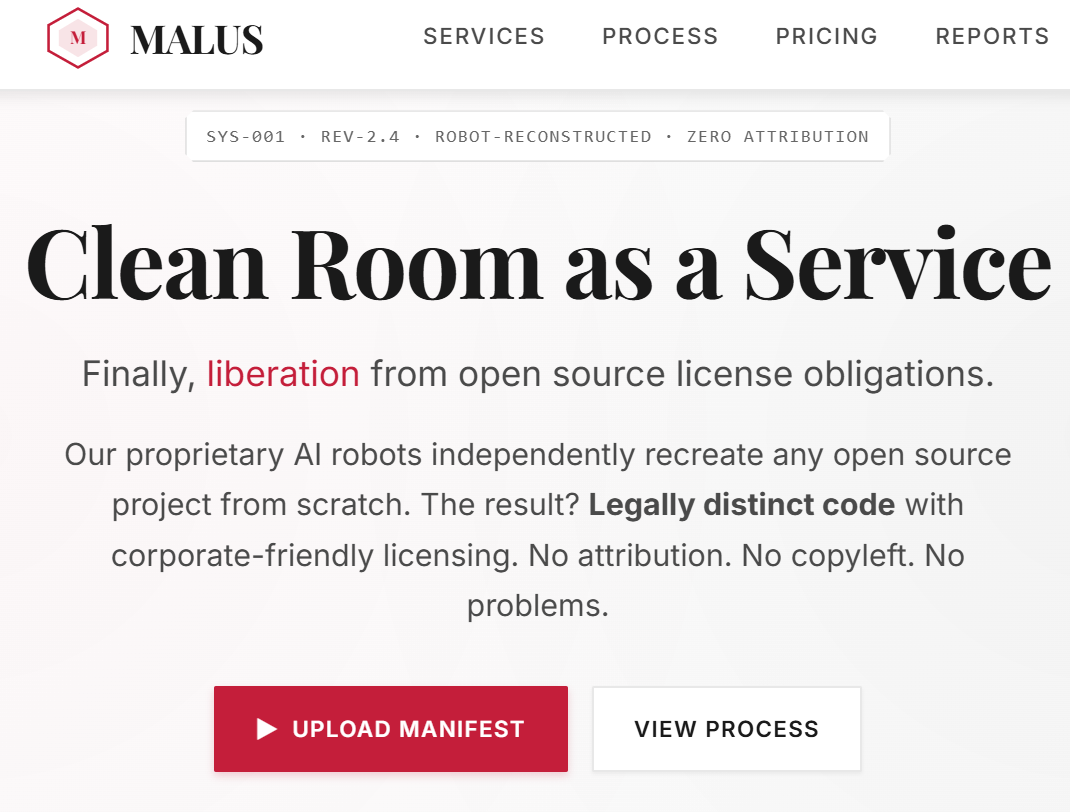
  • Screenshot of the Malus site with “Clean Room as a Service” and buttons “Upload Manifest” and “View Process”.
    Malus.sh is a satirical platform offering an "AI clean room recreation" - a process in which AI recreates open source software based on documentation, without access to the code. The result is supposed to be new code, free of licensing restrictions and ready for commercial use.

    The project focuses on licensing issues: the obligation to cite authors, the need to make changes available or the risks of licenses such as the AGPL and the GNU General Public License, which is sometimes referred to as 'viral' (viral) because it requires that any software that uses code under this licence also be made available under the same terms (i.e. with open code). The solution is supposed to be clean room - a technique that has been known for decades - which makes it possible to separate the 'idea' from its implementation and create an independent version of the software.

    What is clean room? Clean room is, as the name suggests, a 'clean room' approach in which the software development process is deliberately separated into two stages and teams. The first analyses only documentation, system behaviour or public descriptions of operation (without access to the source code), while the second - separated 0 implements the solution from scratch, based only on these descriptions. This ensures that the resulting code is intended to be legally independent and not a copy or derivative work of the original.

    Although the concept is based on a viable legal basis and the site actually works and can 'rewrite' the indicated module, the site is exaggerated and satirical. It was quickly recognised by the technology community as a satire that illustrates in an exaggerated way the problematic tensions between the open source world and commercial interests, especially in the context of using AI and circumventing licensing restrictions.

    Is Malus.sh just innocent satire, or will this kind of AI 'rewriting' of code become a real challenge that the open source community will have to face? I invite you to discuss - what is your opinion?

    Cool? Ranking DIY
    Helpful post? Buy me a coffee.
    About Author
    p.kaczmarek2
    Moderator Smart Home
    Offline 
    p.kaczmarek2 wrote 14218 posts with rating 12106, helped 647 times. Been with us since 2014 year.
  • ADVERTISEMENT
  • #2 21870216
    sundayman
    Level 26  
    Quote:
    tension between the open source world and commercial interests


    "Tension" in this case means the impossibility of selling someone else's work that you got for free.

    This is indeed a big problem for companies :)
    As an entrepreneur, I wish I only had problems like this.

    Quote:
    a real challenge that the open source community will have to face?


    Meaning - open source people doing something for free are supposed to cry because someone else will do the same thing but differently and for money ? :)
  • ADVERTISEMENT
  • #3 21870240
    p.kaczmarek2
    Moderator Smart Home
    Where the 'clean room' approach used to require a lot of work, there are now claims that all you need is a good LLM agent system along with tests and you can generate your equivalent of a given library this way. The question now is, won't this discourage parts of the open source community from sharing their solutions?
    Helpful post? Buy me a coffee.
  • ADVERTISEMENT
  • #4 21870252
    gulson
    System Administrator
    In the world of AI, copyright no longer exists. The momentum is so fast that they are pulling in books, documentation, code as they fly without looking at the licences. I don't know where this will lead, but for example, it is now rather pointless to publish a book on computer science.
  • #5 21870265
    p.kaczmarek2
    Moderator Smart Home
    And I am reminded of a related problem - researchers have reproduced through LLM the content of the book "Harry Potter" 96% true to the original:
    https://arxiv.org/abs/2601.02671
    This kind of problem raises further doubts and questions about the nature of copyright, and whether there is somewhere some kind of limit to the "matching weights" (?) of LLMs to copyrighted texts....
    Helpful post? Buy me a coffee.
📢 Listen (AI):
ADVERTISEMENT